Saturday, May 5, 2012

2012 α€•α€‘α€™α€œα€•α€္ α€…ာေα€™းပြဲ ေα€™းခြα€”္းα€”ဲα‚” ထေျα€–

α€™ေα€›းတာ ၾကာၿပီ။ ထခုျပန္ေα€›းပါα€α€š္။ ထဓိα€€ေတာ့ ေα€œ့α€€်င့္ခန္းေတြပဲ α€₯ီးα€…ားေပး တင္ပါေတာ့α€™α€š္ ထဆင္ေျα€•α€Šီα€Šြတ္တဲ့ ထခါα€œα€Š္း α€žα€ၤα€”္းα€…ာေတြ ေα€›းα€™ွာပါ။ ထခု 2012 ပထမα€₯ီးဆံုး α€œα€•α€္ α€…ာေα€™းပြဲ ေα€™းခြα€”္းα€”ဲα‚” ထေျα€–α€€ို တင္ေပးα€œိုα€€္ပါα€α€š္။ ေထာα€€္α€™ွာေပးထားတဲ့ download link ေတြα€€ေα€” ဆြဲα€šူႏိုင္ပါα€α€š္။

Grade (11)

Photobucket

Grade (10)


Photobucket

Thursday, March 15, 2012

Factor Formulae - Derivation


$ \displaystyle \begin{array}{l}\sin (\alpha +\beta )=\sin \alpha \cos \beta +\cos \alpha \sin \beta ---(1)\\\\ \sin (\alpha -\beta )=\sin \alpha \cos \beta -\cos \alpha \sin \beta ---(2)\ \ \ \end{array}$

ဆိုတဲ့ Sum and Difference Formulae ေတြ α€€ို α€™ွတ္α€™ိαΎα€€α€™α€š္ ထင္ပါα€α€š္။

α€Šီα€™ွ်ျခင္း (1) α€”ဲα‚” (2) α€€ို ေပါင္းα€œိုα€€္α€™α€š္...။

$ \displaystyle \sin (\alpha +\beta )+\ \sin (\alpha -\beta )=2\sin \alpha \cos \beta ---(*)$

ဆိုၿပီး α€›α€œာα€™ွာေပါ့...။

$ \displaystyle \alpha +\beta =\theta $ α€”ဲα‚” $ \displaystyle \alpha -\beta =\phi $ α€œိုα‚” ထားα€œိုα€€္α€™α€š္။

α€’ါဆိုရင္ $ \displaystyle \alpha =\frac{{\theta +\phi }}{2}$ α€”ဲα‚” $ \displaystyle \beta =\frac{{\theta -\phi }}{2}$ ျα€–α€…္α€žြားα€™ွာေပါ့...။

$ \displaystyle \alpha +\beta =\theta ,\ \alpha -\beta =\phi ,\ \ \alpha =\frac{{\theta +\phi }}{2},\beta =\frac{{\theta -\phi }}{2}$ တိုα‚”α€€ို (*) α€™ွာ ထစားα€žြင္းα€œိုα€€္တဲ့ ထခါ α€™ွာေတာ့ ေထာα€€္ပါ factor formula α€€ို α€›α€›ွိα€™ွာ ျα€–α€…္ပါα€α€š္။

$ \displaystyle \sin \theta +\ \sin \phi =2\sin \frac{{\theta +\phi }}{2}\cos \frac{{\theta -\phi }}{2}$


α€’ီတစ္ခါ α€Šီα€™ွ်ျခင္း (1) ထဲα€€ (2) α€€ို ႏႈတ္ပါα€™α€š္...။

$ \displaystyle \sin (\alpha +\beta )-\ \sin (\alpha -\beta )=2\cos \alpha \sin \beta $

ထထက္ကထတိုင္း α€žα€€္ဆိုင္α€›ာတန္α€–ိုးေတြ ထစားα€žြင္းα€œိုα€€္ရင္ ...။

$ \displaystyle \sin \theta -\ \sin \phi =2\cos \frac{{\theta +\phi }}{2}\sin \frac{{\theta -\phi }}{2}$


Identity တစ္ခု ထပ္ရပါα€™α€š္...။

ေα€”ာα€€္ထပ္α€Šီα€™ွ်ျခင္း ႏွα€…္ၾကာင္း α€€ို ဆက္αΎα€€α€Š့္α€›ေထာင္...။

$ \displaystyle \begin{array}{l} \cos (\alpha +\beta )=\cos \alpha \cos \beta -\sin \alpha \sin \beta ---(3)\\\\ \cos (\alpha -\beta )=\cos \alpha \cos \beta +\sin \alpha \sin \beta ---(4)\ \ \ \end{array}$

ထထက္ပါထတိုင္း α€Šီα€™ ွ်ျခင္း ႏွα€…္ေၾကာင္း (3) α€”ဲα‚” (4) α€€ို ေပါင္းတစ္α€œွα€Š့္ ႏႈတ္တစ္α€œွα€Š့္ α€œုပ္α€œိုα€€္ရင္ ...။

$ \displaystyle \begin{array}{l}(3)+(4)\Rightarrow \ \ \ \cos (\alpha +\beta )+\ \cos (\alpha -\beta )=2\cos \alpha \cos \beta \\\\(3)-(4)\Rightarrow \ \ \ \cos (\alpha +\beta )-\ \cos (\alpha -\beta )=-2\cos \alpha \cos \beta \end{array}$

ထထက္α€™ွာ α€›ွာခဲ့ၿပီး ျα€–α€…္တဲ့ $ \displaystyle \alpha +\beta =\theta ,\ \alpha -\beta =\phi ,\ \ \alpha =\frac{{\theta +\phi }}{2},\beta =\frac{{\theta -\phi }}{2}$ တိုα‚”α€€ို α€žα€€္ဆိုင္α€›ာ တန္α€–ိုးေတြα€™ွာ ထစားα€žြင္းα€œိုα€€္ရင္...။

$ \displaystyle \begin{array}{l}\cos \theta +\ \cos \phi =2\cos \displaystyle \frac{{\theta +\phi }}{2}\cos \displaystyle \frac{{\theta -\phi }}{2}\\\\\cos \theta -\ \cos \phi =-2\sin \displaystyle \frac{{\theta +\phi }}{2}\sin \displaystyle \frac{{\theta -\phi }}{2}\end{array}$


Half-Angle Formulae - Derivation


$ \displaystyle \ \cos 2\alpha =1-2{{\sin }^{2}}\alpha $ ဆိုတာ α€žိခဲ့ပါၿပီ။

$ \displaystyle 2\alpha = \theta$ α€œိုα‚” ထားα€œိုα€€္α€™α€š္။ α€’ါဆိုရင္ $ \displaystyle \theta =\frac{\alpha}{2}$ ေပါ့...။

α€™ူα€œα€Šီα€™ွ်ျခင္းα€™ွာ ထစားα€žြင္းα€œိုα€€္ ရင္ ...

$ \displaystyle \begin{array}{l}2{{\sin }^{2}}\displaystyle \frac{\theta }{2}=1-\cos \theta \\\\{{\sin }^{2}}\displaystyle \frac{\theta }{2}=\displaystyle \frac{{1-\cos \theta }}{2}\end{array}$

α€’ါ့ေၾကာင့္ . . .

$ \displaystyle \sin \frac{\theta }{2}=\pm \sqrt{{\frac{{1-\cos \theta }}{2}}}$


$ \displaystyle \cos 2\alpha =2{{\cos }^{2}}\alpha -1$ α€œိုα‚”α€œα€Š္း α€žိထားခဲ့ၿပီးα€žား α€™α€Ÿုတ္α€œား . . .။

ထထက္α€™ွာ ေျပာခဲ့တဲ့ထတိုင္း $ \displaystyle 2\alpha =\theta ,\alpha =\frac{\theta }{2}$ α€€ို ထစားα€žြင္းα€œိုα€€္ရင္ ...

$ \displaystyle \begin{array}{l}2{{\cos }^{2}}\displaystyle \frac{\theta }{2}=1+\cos \theta \\\\{{\cos }^{2}}\displaystyle \frac{\theta }{2}=\displaystyle \frac{{1+\cos \theta }}{2}\end{array}$

α€’ါ့ေၾကာင့္ . . .

$ \displaystyle \cos \frac{\theta }{2}=\pm \sqrt{{\frac{{1+\cos \theta }}{2}}}$


$ \displaystyle \sin \frac{\theta }{2}$ α€”ဲα‚• $ \displaystyle \cos \frac{\theta }{2}$ α€€ို α€žိၿပီဆိုေတာ့ ....

$ \displaystyle \tan \displaystyle \frac{\theta }{2}= \displaystyle \frac{{\sin \displaystyle \frac{\theta }{2}}}{{\cos \displaystyle \frac{\theta }{2}}}$ ဆိုတဲ့ basic identity α€€ို α€žံုးၿပီး ဆက္α€›ွာα€œို႔ရၿပီေပါ့။

$ \displaystyle \begin{array}{*{20}{l}} {\tan \displaystyle \frac{\theta }{2}=\displaystyle \frac{{\sin \displaystyle \frac{\theta }{2}}}{{\cos \displaystyle \frac{\theta }{2}}}} \\ {} \\ {\tan \displaystyle \frac{\theta }{2}=\pm \displaystyle \frac{{\sqrt{{\displaystyle \frac{{1-\cos \theta }}{2}}}}}{{\sqrt{{\displaystyle \frac{{1+\cos \theta }}{2}}}}}} \\ {} \\ {\tan \displaystyle \frac{\theta }{2}=\pm \sqrt{{\displaystyle \frac{{\displaystyle \frac{{1-\cos \theta }}{2}}}{{\displaystyle \frac{{1+\cos \theta }}{2}}}}}} \end{array}$

α€’ါ့ေၾကာင့္ . . .

$ \displaystyle \tan \displaystyle \frac{\theta }{2}=\pm \sqrt{{\displaystyle \frac{{1-\cos \theta }}{{1+\cos \theta }}}}$


ဆက္ၿပီး derive α€œုပ္αΎα€€α€Š့္α€™α€š္ ...။

$ \displaystyle \begin{array}{*{20}{l}} {\tan \displaystyle \frac{\theta }{2}=\sqrt{{\displaystyle \frac{{1-\cos \theta }}{{1+\cos \theta }}\times \displaystyle \frac{{1+\cos \theta }}{{1+\cos \theta }}}}} \\ {} \\ {\tan \displaystyle \frac{\theta }{2}=\sqrt{{\displaystyle \frac{{1-{{{\cos }}^{2}}\theta }}{{{{{(1+\cos \theta )}}^{2}}}}}}} \\ {} \\ {\tan \displaystyle \frac{\theta }{2}=\sqrt{{\displaystyle \frac{{{{{\sin }}^{2}}\theta }}{{{{{(1+\cos \theta )}}^{2}}}}}}} \end{array}$

α€’ါ့ေၾကာင့္ . . .

$ \displaystyle \tan \frac{\theta }{2}=\frac{{\sin \theta }}{{1+\cos \theta }}$


တဖန္ . . .

$ \displaystyle \begin{array}{*{20}{l}} {\tan \displaystyle \frac{\theta }{2}=\sqrt{{\displaystyle \frac{{1-\cos \theta }}{{1+\cos \theta }}\times \displaystyle \frac{{1-\cos \theta }}{{1-\cos \theta }}}}} \\ {} \\ {\tan \displaystyle \frac{\theta }{2}=\sqrt{{\displaystyle \frac{{{{{(1-\cos \theta )}}^{2}}}}{{1-{{{\cos }}^{2}}\theta }}}}} \\ {} \\ {\tan \displaystyle \frac{\theta }{2}=\sqrt{{\displaystyle \frac{{{{{(1-\cos \theta )}}^{2}}}}{{{{{\sin }}^{2}}\theta }}}}} \end{array}$

α€’ါ့ေၾကာင့္ . . .

$ \displaystyle \tan \frac{\theta }{2}=\frac{{1-\cos \theta }}{{\sin \theta }}$


Wednesday, March 14, 2012

Double Angle Formulae - Derivation

$ \displaystyle \sin (\alpha +\beta )=\sin \alpha \cos \beta +\cos \alpha \sin \beta $ ဆိုတာ α€žိခဲ့ၿပီး ျα€–α€…္α€™α€š္ ထင္ပါα€α€š္။

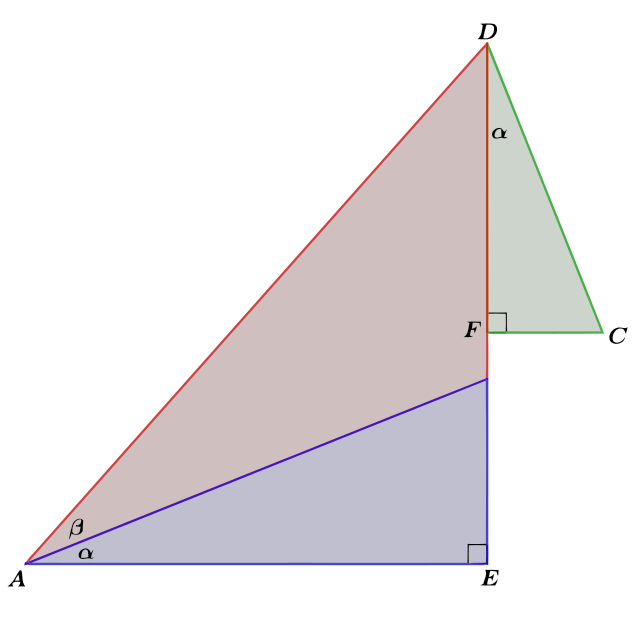
α€’ီ ပံုေα€žα€”α€Š္းα€Ÿာ α€™α€Š္α€žα€Š့္ေထာင့္ $ \displaystyle \alpha$ α€”ဲα‚” $ \displaystyle \beta$ ထတြα€€္မဆို α€™ွα€”္ပါα€α€š္။

α€’ါဆိုရင္ $ \displaystyle \alpha=\beta$ ထတြα€€္α€œα€Š္း α€™ွα€”္တာေပါ့။... α€’ါေၾကာင့္

$ \displaystyle \sin (\alpha +\beta )=\sin \alpha \cos \beta +\cos \alpha \sin \beta $

$ \displaystyle \alpha=\beta,$ ျα€–α€…္တဲ့ထခါ

$ \displaystyle \sin (\alpha +\alpha )=\sin \alpha \cos \alpha +\cos \alpha \sin \alpha $

α€’ါ့ေၾကာင့္

$ \displaystyle \sin 2\alpha =2\sin \alpha \cos \alpha $


α€‘α€œားတူပါပဲ.....။

$ \displaystyle \cos (\alpha +\beta )=\cos \alpha \cos \beta -\sin \alpha \sin \beta $

$ \displaystyle \alpha=\beta,$ ျα€–α€…္တဲ့ထခါ

$ \displaystyle \cos (\alpha +\alpha )=\cos \alpha \cos \alpha -\sin \beta \sin \beta $

α€’ါ့ေၾကာင့္...

$ \displaystyle \cos 2\alpha ={{\cos }^{2}}\alpha -{{\sin }^{2}}\alpha $


$ \displaystyle {{\sin }^{2}}\alpha +{{\cos }^{2}}\alpha =1$ ဆိုတဲ့ Pythagorean Identity α€€ို α€™ွတ္α€™ိα€™α€š္ ထင္ပါα€α€š္။

$ \displaystyle {{\sin }^{2}}\alpha +{{\cos }^{2}}\alpha =1$ ျα€–α€…္တာေၾကာင့္ $ \displaystyle {{\sin }^{2}}\alpha =1-{{\cos }^{2}}\alpha $ α€”ဲα‚” $ \displaystyle {{\cos }^{2}}\alpha =1-{{\sin }^{2}}\alpha $ ျα€–α€…္ပါα€α€š္။

$ \displaystyle \cos 2\alpha ={{\cos }^{2}}\alpha -{{\sin }^{2}}\alpha $ ဆိုတဲ့ equation α€™ွာ α€žα€€္ဆိုင္α€›ာ တန္α€–ိုးေတြα€€ို ထစားα€žြင္းα€œိုα€€္ရင္ ...

$ \displaystyle \begin{array}{l}\cos 2\alpha ={{\cos }^{2}}\alpha -{{\sin }^{2}}\alpha \\\\\cos 2\alpha =1-{{\sin }^{2}}\alpha -{{\sin }^{2}}\alpha \end{array}$

α€’ါ့ေၾကာင့္...

$ \displaystyle \cos 2\alpha =1-2{{\sin }^{2}}\alpha $


α€‘α€œားတူပါပဲ...။

$ \displaystyle \begin{array}{l}\cos 2\alpha ={{\cos }^{2}}\alpha -{{\sin }^{2}}\alpha \\\\\cos 2\alpha ={{\cos }^{2}}\alpha -(1-{{\cos }^{2}}\alpha )\end{array}$

α€’ါ့ေၾကာင့္...

$ \displaystyle \cos 2\alpha =2{{\cos }^{2}}\alpha -1$


$ \displaystyle \tan 2\alpha $ ထတြα€€္ ဆက္α€›ွာαΎα€€α€Š့္ပါα€™α€š္။

$ \displaystyle \tan (\alpha +\beta )=\frac{{\tan \alpha +\tan \beta }}{{1-\tan \alpha \tan \beta }}$ α€œိုα‚” α€žိခဲ့ၿပီးပါၿပီ။..

$ \displaystyle \alpha=\beta,$ ျα€–α€…္တဲ့ထခါ

$ \displaystyle \tan (\alpha +\alpha )=\frac{{\tan \alpha +\tan \alpha }}{{1-\tan \alpha \tan \alpha }}$ ..

α€’ါ့ေၾကာင့္...

$ \displaystyle \tan 2\alpha =\frac{{2\tan \alpha }}{{1-{{{\tan }}^{2}}\alpha }}$

Monday, March 12, 2012

Sum and Difference Formulae - Derivation


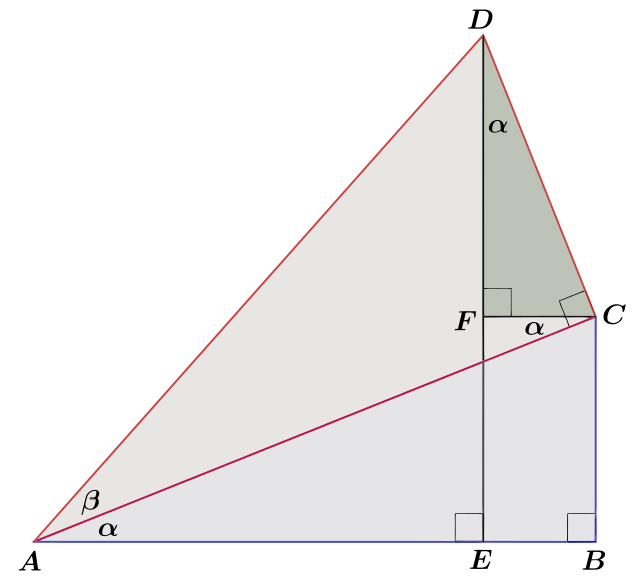
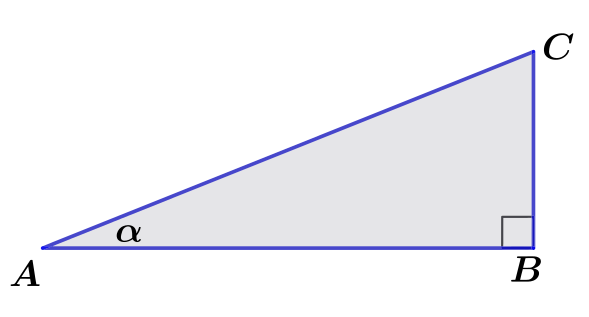
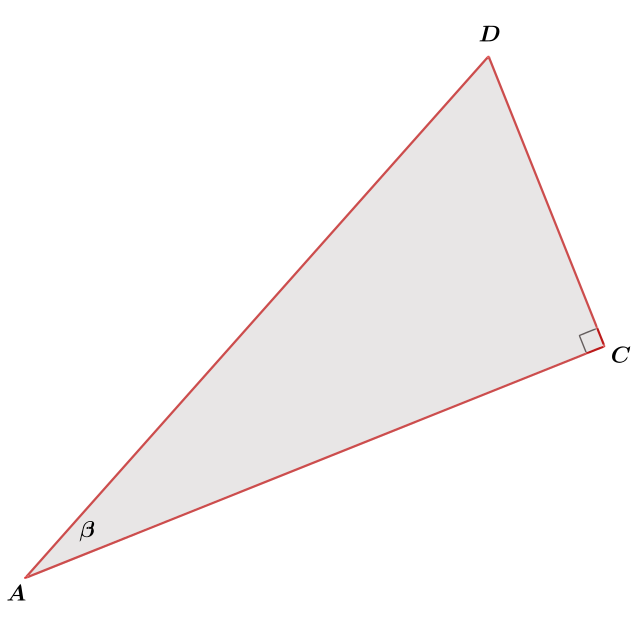
$ \displaystyle Ξ”ABC, Ξ”ACD$ α€”ဲα‚” $ \displaystyle Ξ”CDF$ တိုα‚”α€Ÿာ ေထာင့္α€™ွα€”္ႀတိဂံα€™်ား ျα€–α€…္ၾကပါα€α€š္။

$ \displaystyle Ξ”ABC$ α€™ွာ $ \displaystyle ∠CAB$ α€€ို $ \displaystyle \alpha$ α€œိုα‚” α€žα€္α€™ွတ္ပါα€™α€š္။

$ \displaystyle Ξ”ABC\simΞ”CDF$ ျα€–α€…္တာေၾကာင့္ $ \displaystyle ∠CDF=\alpha$ ျα€–α€…္ပါα€α€š္။

$ \displaystyle Ξ”ACD$ α€™ွာေတာ့ $ \displaystyle ∠CAD$ α€€ို $ \displaystyle \beta$ α€œိုα‚” α€žα€္α€™ွတ္ပါα€™α€š္။

α€’ါဆိုရင္ $ \displaystyle Ξ”ABC$ α€™ွာ...

$ \displaystyle \sin \alpha=\frac{BC}{AC}$ α€”ဲα‚• $ \displaystyle \cos \alpha=\frac{AB}{AC}$ ျα€–α€…္ပါα€α€š္။

α€’ါ့ေၾကာင့္ $ \displaystyle BC =AC \sin \alpha$ α€”ဲα‚• $ \displaystyle AB =AC \cos \alpha$ α€œိုα‚” ဆိုႏိုင္ပါα€α€š္။

တဖန္ $ \displaystyle Ξ”CDF$ α€™ွာ...

$ \displaystyle \sin \alpha=\frac{FC}{DC}$ α€”ဲα‚• $ \displaystyle \cos \alpha=\frac{DF}{DC}$ ျα€–α€…္ပါα€α€š္။

α€’ီα€™ွာα€œα€Š္း $ \displaystyle FC =DC \sin \alpha$ α€”ဲα‚• $ \displaystyle DF =DC \cos \alpha$ α€œိုα‚” ဆိုႏိုင္ပါα€α€š္။

$ \displaystyle Ξ”ACD$ α€™ွာα€œα€Š္း ...

$ \displaystyle \sin \beta=\frac{DC}{AD}$ α€”ဲα‚• $ \displaystyle \cos \beta=\frac{AC}{AD}$ ျα€–α€…္ပါα€α€š္။

α€’ါဆိုရင္ $ \displaystyle DC =AD \sin \alpha$ α€”ဲα‚• $ \displaystyle AC =AD \cos \alpha$ α€œိုα‚” ဆိုႏိုင္ပါα€α€š္။

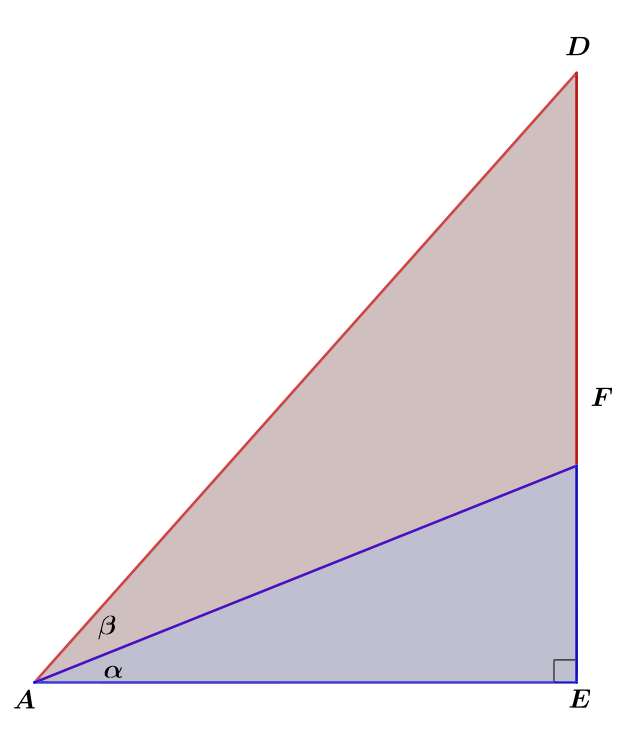
$ \displaystyle Ξ”ADE$ ထတြα€€္ ဆက္αΎα€€α€Š့္α€›ေထာင္...

$ \displaystyle \sin (\alpha+\beta)=\frac{DE}{AD}$ ျα€–α€…္ပါα€α€š္။

ပံုα€™ွာ ေတြ႔ရတဲ့ ထတိုင္း $ \displaystyle DE =DF+FE$ ျα€–α€…္ပါα€α€š္။။

α€’ါ့ေၾကာင့္ $ \displaystyle \sin (\alpha +\beta )=\frac{{DF}}{{AD}}+\frac{{FE}}{{AD}}$ α€œိုα‚” ေျပာႏိုင္ပါα€α€š္။ ။

တဖန္ ့ $ \displaystyle BCFE$ α€€ rectangle ျα€–α€…္တာေၾကာင့္ $ \displaystyle FE=BC$ α€œိုα‚” ေျပာႏိုင္ျပန္ပါα€α€š္။ ။

α€’ါ့ေၾကာင့္ $ \displaystyle \sin (\alpha +\beta )=\frac{{DF}}{{AD}}+\frac{{BC}}{{AD}}$ α€œိုα‚” ေျပာႏိုင္ျပန္ပါα€α€š္။။

$ \displaystyle DF =DC \cos \alpha, BC =AC \sin \alpha$ α€œိုα‚” ထထက္α€™ွာ α€žိခဲ့ၿပီးပါၿပီ။ α€’ါဆိုရင္ ။

$ \displaystyle \sin (\alpha +\beta )=\frac{{DC}}{{AD}}\cos \alpha +\frac{{AC}}{{AD}}\sin \alpha $ α€œိုα‚” ေျပာα€œို႔ရတာေပါ့။ ။

α€’ီထခါα€™ွာα€œα€Š္း $ \displaystyle \sin \beta=\frac{DC}{AD}, \cos \beta=\frac{AC}{AD}$ α€œိုα‚•α€žိခဲ့ၿပီးပါၿပီ။ α€’ါေၾကာင့္။

$ \displaystyle \sin (\alpha +\beta )=\sin \beta \cos \alpha +\cos \beta \sin \alpha $ α€œိုα‚” ေျပာα€œို႔ရပါၿပီ။ ျပန္α€…ီα€œိုα€€္ရင္ ...။

$ \displaystyle \sin (\alpha +\beta )=\sin \alpha \cos \beta +\cos \alpha \sin \beta $

ထထက္ပါထတိုင္း ... $ \displaystyle \cos (\alpha +\beta )$ ထတြα€€္ ပံုေα€žα€”α€Š္းα€€ို ဆက္α€›ွာႏိုင္ပါα€α€š္။ ..။

$ \displaystyle \begin{array}{l}\cos (\alpha +\beta )=\displaystyle \frac{{AE}}{{AD}}\\\\\cos (\alpha +\beta )=\displaystyle \frac{{AB-EB}}{{AD}}\\\\\cos (\alpha +\beta )=\displaystyle \frac{{AB-FC}}{{AD}}\ \ \ \ \left[ {\because EB=FC} \right]\\\\\cos (\alpha +\beta )=\displaystyle \frac{{AB}}{{AD}}-\displaystyle \frac{{FC}}{{AD}}\\\\\cos (\alpha +\beta )=\displaystyle \frac{{AC}}{{AD}}\cos \alpha -\displaystyle \frac{{DC}}{{AD}}\sin \alpha \\\\\text{Since}\ \displaystyle \frac{{AC}}{{AD}}=\cos \beta \ \operatorname{and}\ \displaystyle \frac{{DC}}{{AD}}=\sin \beta ,\\\\\text{Therefore,}\end{array}$

$ \displaystyle \cos (\alpha +\beta )=\cos \alpha \cos \beta -\sin \alpha \sin \beta $

$ \displaystyle \sin (\alpha +\beta )$ α€”ဲα‚” $ \displaystyle \cos (\alpha +\beta )$ α€€ို α€žိၿပီဆိုေတာ့ $ \displaystyle \tan (\alpha +\beta )$ α€€ို α€›ွာႏိုင္ၿပီေပါ့။

$ \displaystyle \begin{array}{l}\tan (\alpha +\beta )=\displaystyle \frac{{\sin (\alpha +\beta )}}{{\cos (\alpha +\beta )}}\\\\\tan (\alpha +\beta )=\displaystyle \frac{{\sin \alpha \cos \beta +\cos \alpha \sin \beta }}{{\cos \alpha \cos \beta -\sin \alpha \sin \beta }}\\\\\text{Dividing the numerator and denominator }\\\text{with}\ \cos \alpha \cos \beta ,\\\\\tan (\alpha +\beta )=\displaystyle \frac{{\displaystyle \frac{{\sin \alpha \cos \beta }}{{\cos \alpha \cos \beta }}+\displaystyle \frac{{\cos \alpha \sin \beta }}{{\cos \alpha \cos \beta }}}}{{\displaystyle \frac{{\cos \alpha \cos \beta }}{{\cos \alpha \cos \beta }}-\displaystyle \frac{{\sin \alpha \sin \beta }}{{\cos \alpha \cos \beta }}}}\\\\\text{Therefore,}\end{array}$

$ \displaystyle \tan (\alpha +\beta )=\frac{{\tan \alpha +\tan \beta }}{{1-\tan \alpha \tan \beta }}$

$ \displaystyle \begin{array}{l}\ \ \ \ \sin (-\alpha )=-\sin \alpha ,\\\\\ \ \ \ \cos (-\alpha )=\cos \alpha ,\\\\\ \ \ \ \tan (-\alpha )=-\tan \alpha \\\\\ \ \ \ \sin \left( {\alpha -\beta } \right)=\sin \left[ {\alpha +(-\beta )} \right]\\\\\ \ \ \ \sin \left( {\alpha -\beta } \right)=\sin \alpha \cos (-\beta )+\cos \alpha \sin (-\beta )\\\\\text{Therefore,}\end{array}$

$ \displaystyle \sin \left( {\alpha -\beta } \right)=\sin \alpha \cos \beta -\cos \alpha \sin \beta $

$ \displaystyle \begin{array}{l}\ \ \ \ \cos \left( {\alpha -\beta } \right)=\cos \left[ {\alpha +(-\beta )} \right]\\\\\ \ \ \ \cos \left( {\alpha -\beta } \right)=\cos \alpha \cos (-\beta )-\sin \alpha \sin (-\beta )\\\\\text{Therefore,}\end{array}$

$ \displaystyle \cos \left( {\alpha -\beta } \right)=\cos \alpha \cos \beta +\sin \alpha \sin \beta $

$ \displaystyle \begin{array}{l}\ \ \ \ \tan \left( {\alpha -\beta } \right)=\tan \left[ {\alpha +(-\beta )} \right]\\\\\ \ \ \ \tan \left( {\alpha -\beta } \right)=\displaystyle \frac{{\tan \alpha +\tan (-\beta )}}{{1-\tan \alpha \tan (-\beta )}}\end{array}$

$ \displaystyle \tan \left( {\alpha -\beta } \right)=\frac{{\tan \alpha -\tan \beta }}{{1+\tan \alpha \tan \beta }}$

ထားα€œံုးျပန္ေပါင္းရရင္....

$ \displaystyle \begin{array}{l} \sin \left( {\alpha \pm \beta } \right)=\sin \alpha \cos \beta \pm \cos \alpha \sin \beta \\\\ \cos \left( {\alpha \pm \beta } \right)=\cos \alpha \cos \beta \mp \sin \alpha \sin \beta \\\\ \tan \left( {\alpha \pm \beta } \right)=\displaystyle \frac{{\tan \alpha \pm \tan (-\beta )}}{{1\mp \tan \alpha \tan (-\beta )}}\end{array}$

Saturday, March 3, 2012

Exercise (11.3) No(4, 5) - Solution


4. If $ \displaystyle Ξ± + Ξ² + Ξ³ = 180°$, prove that

$ \displaystyle \text{(a)}\ \ \sin (\alpha +\beta )=\cos (90{}^\circ -\gamma )$

$ \displaystyle \text{(b)}\ \ \sin (\frac{{\alpha +\beta }}{2})=\sin (90{}^\circ +\frac{\gamma }{2})$

$ \displaystyle \text{(c)}\ \ \tan \left( {\frac{\alpha }{2}} \right)=\cot \left( {180{}^\circ +\frac{{\beta +\gamma }}{2}} \right)$

Show/Hide Solution
$ \displaystyle \text{(a)}\ \ \alpha +\beta +\gamma =180{}^\circ $

$ \displaystyle \begin{array}{l}\ \ \ \ \ \ \alpha +\beta =180{}^\circ -\gamma \\\\\therefore \ \ \ \ \sin (\alpha +\beta )=\sin (180{}^\circ -\gamma )\\\ \ \ \\\ \ \ \ \ \ \ \ \ \ \ \ \ \ \ \ \ \ \ \ \ =\sin \gamma \\\\\ \ \ \ \ \ \ \ \ \ \ \ \ \ \ \ \ \ \ \ \ =\ \cos (90{}^\circ -\gamma )\end{array}$


$ \displaystyle \begin{array}{l}\text{(b)}\ \ \alpha +\beta +\gamma =180{}^\circ \\\\\ \ \ \ \ \ \alpha +\beta =180{}^\circ -\gamma \\\\\ \ \ \ \ \ \displaystyle \frac{{\alpha +\beta }}{2}=\displaystyle \frac{{180{}^\circ -\gamma }}{2}=90{}^\circ \displaystyle -\frac{\gamma }{2}\\\\\therefore \ \ \ \ \sin (\displaystyle \frac{{\alpha +\beta }}{2})=\sin (90{}^\circ \displaystyle -\frac{\gamma }{2})\\\ \ \ \\\ \ \ \ \ \ \ \ \ \ \ \ \ \ \ \ \ \ \ \ \ =\cos \displaystyle \frac{\gamma }{2}\\\\\ \ \ \ \ \ \ \ \ \ \ \ \ \ \ \ \ \ \ \ \ =\ \sin (90{}^\circ +\displaystyle \frac{\gamma }{2})\end{array}$


$ \displaystyle \begin{array}{l}\text{(c)}\ \ \alpha +\beta +\gamma =180{}^\circ \\\\\ \ \ \ \ \ \alpha =180{}^\circ -(\beta +\gamma )\\\\\ \ \ \ \ \ \displaystyle \frac{\alpha }{2}=\displaystyle \frac{{180{}^\circ -(\beta +\gamma )}}{2}=90{}^\circ \displaystyle -\frac{{\beta +\gamma }}{2}\\\\\therefore \ \ \ \ \tan \left( {\displaystyle \frac{\alpha }{2}} \right)=\tan (90{}^\circ \displaystyle -\frac{{\beta +\gamma }}{2})\\\ \ \ \\\ \ \ \ \ \ \ \ \ \ \ \ \ \ \ \ \ \ \ \ \ =\cot \displaystyle \frac{{\beta +\gamma }}{2}\\\\\ \ \ \ \ \ \ \ \ \ \ \ \ \ \ \ \ \ \ \ \ =\ \cot \left( {180{}^\circ +\displaystyle \frac{{\beta +\gamma }}{2}} \right)\end{array}$


5.    Prove that in any triangle $ \displaystyle ABC,$

(i) $ \displaystyle \sin (A+B) = \sin C.$

(ii) $ \displaystyle \cos(A+B) + \cos C = 0.$

(iii) $ \displaystyle \cos \frac{A+B}{2} = \sin \frac{C}{2}.$

(iv) $ \displaystyle \tan \frac{A+B}{2} = \cot \frac{C}{2}.$

Show/Hide Solution
(i) $ \displaystyle \text{Since}\ A+B+C=180{}^\circ ,$

$ \displaystyle \begin{array}{l}\therefore A+B=180{}^\circ -C\\\\\therefore \sin (A+B)=\sin (180{}^\circ -C)\\\\\therefore \sin (A+B)=\sin C\end{array}$


(ii) $ \displaystyle \text{Similarly, }\cos (A+B)=\cos (180{}^\circ -C)$

$ \displaystyle \begin{array}{l}\therefore \cos (A+B)=-\cos C\\\\\therefore \cos (A+B)+\cos C=0\end{array}$


(iii) $ \displaystyle \cos \left( {\frac{{A+B}}{2}} \right)=\cos \left( {\frac{{180{}^\circ -C}}{2}} \right)$

$ \displaystyle \therefore \ \cos \left( {\frac{{A+B}}{2}} \right)=\cos \left( {90{}^\circ -\frac{C}{2}} \right)$

$ \displaystyle \therefore \ \cos \left( {\frac{{A+B}}{2}} \right)=\sin \frac{C}{2}$


(iv) $ \displaystyle \tan \left( {\frac{{A+B}}{2}} \right)=\tan \left( {\frac{{180{}^\circ -C}}{2}} \right)$

$ \displaystyle \therefore \ \tan \left( {\frac{{A+B}}{2}} \right)=\tan \left( {90{}^\circ -\frac{C}{2}} \right)$

$ \displaystyle \therefore \ \tan \left( {\frac{{A+B}}{2}} \right)=\cot \frac{C}{2}$


Exercise (11.3) No (2) Solution


Find the value of ΞΈ, 0° ≤ ΞΈ ≤ 360° for the following equations. Do not use table.

(a) $ \displaystyle \ \ \ \ \ \ \sin \theta =-\frac{1}{2}$

Show/Hide Solution
$ \displaystyle \therefore \ \ \ \ \text{basic acute angle}=30{}^\circ $

$ \displaystyle \begin{array}{l}\ \ \ \ \ \ \text{But }\sin \theta \ \text{is negative, }\theta \ \text{may be }\\\ \ \ \ \ \ \text{either in the }{{\text{3}}^{{\text{rd}}}}\text{ or }{{\text{4}}^{{\text{th}}}}\text{ quadrant}\text{.}\end{array}$

 $ \displaystyle \therefore \,\ \ \ \theta =180{}^\circ +30{}^\circ \ (\text{or)}\ \theta =360{}^\circ -30{}^\circ \ $

$ \displaystyle \therefore \,\ \ \ \theta =210{}^\circ \ (\text{or)}\ \theta =330{}^\circ $


(b) $ \displaystyle \ \ \ \ \ \ \cos \theta =-\frac{{\sqrt{3}}}{2}$

Show/Hide Solution
$ \displaystyle \therefore \ \ \ \ \text{basic acute angle}=30{}^\circ $

$ \displaystyle \begin{array}{l}\ \ \ \ \ \ \text{But }\cos \theta \ \text{is negative, }\theta \ \text{may be }\\\ \ \ \ \ \ \text{either in the }{{\text{2}}^{{\text{nd}}}}\text{ or }{{\text{3}}^{{\text{rd}}}}\text{ quadrant}\text{.}\end{array}$

$ \displaystyle \therefore \,\ \ \ \theta =180{}^\circ -30{}^\circ \ (\text{or)}\ \theta =180{}^\circ +30{}^\circ \ $

$ \displaystyle \therefore \,\ \ \ \theta =150{}^\circ \ (\text{or)}\ \theta =210{}^\circ $


(c) $ \displaystyle \ \ \ \ \ \ \cos \theta =-\frac{1}{{\sqrt{2}}}$

Show/Hide Solution
$ \displaystyle \therefore \ \ \ \ \text{basic acute angle}=45{}^\circ $

$ \displaystyle \begin{array}{l}\ \ \ \ \ \ \text{But }\cos \theta \ \text{is negative, }\theta \ \text{may be }\\\ \ \ \ \ \ \text{either in the }{{\text{2}}^{{\text{nd}}}}\text{ or }{{\text{3}}^{{\text{rd}}}}\text{ quadrant}\text{.}\end{array}$

$ \displaystyle \therefore \,\ \ \ \theta =180{}^\circ -45{}^\circ \ (\text{or)}\ \theta =180{}^\circ +45{}^\circ \ $

$ \displaystyle \therefore \,\ \ \ \theta =135{}^\circ \ (\text{or)}\ \theta =225{}^\circ $


(d) $ \displaystyle \ \ \ \ \ \ \tan \theta =\sqrt{3}$

Show/Hide Solution
$ \displaystyle \therefore \ \ \ \ \text{basic acute angle}=60{}^\circ $

$ \displaystyle \begin{array}{l}\ \ \ \ \ \ \text{But }\tan \theta \ \text{is positive, }\theta \ \text{may be }\\\ \ \ \ \ \ \text{either in the }{{\text{1}}^{{\text{st}}}}\text{ or }{{\text{3}}^{{\text{rd}}}}\text{ quadrant}\text{.}\end{array}$

$ \displaystyle \therefore \,\ \ \ \theta =60{}^\circ \ (\text{or)}\ \theta =180{}^\circ +60{}^\circ \ $

$ \displaystyle \therefore \,\ \ \ \theta =60{}^\circ \ (\text{or)}\ \theta =240{}^\circ $

(e) $ \displaystyle \ \ \ \ \ \ \tan 2\theta =1$

Show/Hide Solution
$ \displaystyle \therefore \ \ \ \ \text{basic acute angle}=45{}^\circ $

$ \displaystyle \begin{array}{l}\ \ \ \ \ \ \text{But }\tan 2\theta \ \text{is positive, }2\theta \ \text{may be }\\\ \ \ \ \ \ \text{either in the }{{\text{1}}^{{\text{st}}}}\text{ or }{{\text{3}}^{{\text{rd}}}}\text{ quadrant}\text{.}\end{array}$

$ \displaystyle \underline{{\text{For }{{\text{1}}^{{\text{st}}}}\ \text{quadrant}}}\text{,}$

$ \displaystyle \therefore \,\ \ \ 2\theta =45{}^\circ \ (\text{or)}\ 2\theta =360{}^\circ +45{}^\circ \ $

$ \displaystyle \ \ \ \ \ 2\theta =45{}^\circ \ (\text{or)}\ 2\theta =405{}^\circ \ $

$ \displaystyle \ \ \ \ \ \theta =22{}^\circ 3{0}'(\text{or)}\ \theta =\ 202{}^\circ 3{0}'$

$ \displaystyle \underline{{\text{For }{{\text{3}}^{{\text{rd}}}}\ \text{quadrant}}}\text{,}$

$ \displaystyle \ \,\ \ \ 2\theta =180{}^\circ +45{}^\circ \ (\text{or)}\ 2\theta =360{}^\circ +180{}^\circ +45{}^\circ $

$ \displaystyle \ \ \ \ \ 2\theta =225{}^\circ \ (\text{or)}\ 2\theta =585{}^\circ $

$ \displaystyle \ \ \ \ \ \theta =112{}^\circ 3{0}'(\text{or)}\ \theta =292{}^\circ 3{0}'$


(f) $ \displaystyle \ \ \ \ \ \ \tan 3\theta =-1$

Show/Hide Solution
$ \displaystyle \therefore \ \ \ \ \text{basic acute angle}=45{}^\circ $

$ \displaystyle \begin{array}{l}\ \ \ \ \ \ \text{But }\tan 3\theta \ \text{is negative, 3}\theta \ \text{may be }\\\ \ \ \ \ \ \text{either in the }{{\text{2}}^{{\text{nd}}}}\text{ or }{{\text{4}}^{{\text{th}}}}\text{ quadrant}\text{.}\end{array}$

$ \displaystyle \underline{{\text{For }{{\text{2}}^{{\text{nd}}}}\ \text{quadrant}}}\text{,}$

$ \displaystyle \ \,\ \ \ 3\theta =180{}^\circ -45{}^\circ \ $

$ \displaystyle \ \,\ \ \ 3\theta =135{}^\circ \ $

$ \displaystyle \ \,\ \ \ \theta =45{}^\circ \ $

$ \displaystyle \ \ \ \ \ \ \ \ \ \ \ (\text{or)}$
$ \displaystyle \ \ \ \ \ 3\theta =360{}^\circ +180{}^\circ -45{}^\circ \ $

$ \displaystyle \ \,\ \ \ 3\theta =495{}^\circ \ $

$ \displaystyle \ \,\ \ \ \theta =165{}^\circ \ $

$ \displaystyle \ \ \ \ \ \ \ \ \ \ \ (\text{or)}\ $
$ \displaystyle \ \ \ \ \ 3\theta =360{}^\circ +360{}^\circ +180{}^\circ -45{}^\circ \ $

$ \displaystyle \ \,\ \ \ 3\theta =855{}^\circ \ $

$ \displaystyle \ \,\ \ \ \theta =285{}^\circ $

$ \displaystyle \underline{{\text{For }{{\text{4}}^{{\text{th}}}}\ \text{quadrant}}}\text{,}$

$ \displaystyle \ \,\ \ \ 3\theta =360{}^\circ -45{}^\circ $

$ \displaystyle \ \,\ \ \ 3\theta =315{}^\circ \ $

$ \displaystyle \ \,\ \ \ \theta =105{}^\circ \ $

$ \displaystyle \ \ \ \ \ \ \ \ \ \ \ (\text{or)}\ $
$ \displaystyle \ \ \ \ \ 3\theta =360{}^\circ +360{}^\circ -45{}^\circ $

$ \displaystyle \ \,\ \ \ 3\theta =675{}^\circ \ $

$ \displaystyle \ \,\ \ \ \theta =225{}^\circ \ \ $

$ \displaystyle \ \ \ \ \ \ \ \ \ \ \ (\text{or)}\ $
$ \displaystyle \ \ \ \ \ 3\theta =360{}^\circ +360{}^\circ +360{}^\circ -45{}^\circ \ $

$ \displaystyle \ \,\ \ \ 3\theta =1035{}^\circ \ $

$ \displaystyle \ \,\ \ \ \theta =345{}^\circ \ \ $

diagram α€™်ားα€žα€Š္ principal angle α€™်ား α€€ို ဆံုးျဖတ္α€›ာတြင္  ထေထာα€€္ထကူ ျα€–α€…္ေα€…α€›α€”္ ေα€›းဆြဲ ေα€–αšျပျခင္း ျα€–α€…္α€žα€Š္။ α€”ားα€œα€Š္ ကၽြα€™္းα€€်င္ α€žြားα€œ်င္ diagram α€™်ား α€™ေα€›းဆြဲပဲ ေျဖဆိုႏိုင္ ပါα€žα€Š္။ α€€်α€”္ေα€žာပုα€…ာၦမ်ားထတြα€€္ diagram မဆြဲေတာ့ပဲ ေျဖဆိုပါα€™α€Š္။


(g) $ \displaystyle \ \ \ \ \ \ \tan (3\theta -30{}^\circ )=-1$

Show/Hide Solution
$ \displaystyle \begin{array}{l}\therefore \ \ \ \ \text{basic acute angle}=45{}^\circ \\\\\ \ \ \ \ \ \text{But }\tan (3\theta -30{}^\circ )\ \text{is negative, }(3\theta -30{}^\circ )\ \text{may be }\\\ \ \ \ \ \ \text{either in the }{{\text{2}}^{{\text{nd}}}}\text{ or }{{\text{4}}^{{\text{th}}}}\text{ quadrant}\text{.}\\\\\underline{{\text{For }{{\text{2}}^{{\text{nd}}}}\ \text{quadrant}}}\text{,}\\\\\ \,\ \ \ 3\theta -30{}^\circ =180{}^\circ -45{}^\circ \\\ \\\ \,\ \ \ 3\theta =165{}^\circ \ \\\\\ \,\ \ \ \theta =55{}^\circ \ \\\\\ \ \ \ \ \ \ \ \ \ \ (\text{or)}\ \\\\\ \ \ \ \ 3\theta -30{}^\circ =360{}^\circ +180{}^\circ -45{}^\circ \ \\\\\ \,\ \ \ 3\theta =525{}^\circ \ \\\\\ \,\ \ \ \theta =175{}^\circ \ \\\\\ \ \ \ \ \ \ \ \ \ \ (\text{or)}\ \\\\\ \ \ \ \ 3\theta -30{}^\circ =360{}^\circ +360{}^\circ +180{}^\circ -45{}^\circ \ \\\\\ \,\ \ \ 3\theta =885{}^\circ \ \\\\\ \,\ \ \ \theta =295{}^\circ \ \ \ \\\\\underline{{\text{For }{{\text{4}}^{{\text{th}}}}\ \text{quadrant}}}\text{,}\\\\\ \,\ \ \ 3\theta -30{}^\circ =360{}^\circ -45{}^\circ \\\\\ \,\ \ \ 3\theta =345{}^\circ \ \\\\\ \,\ \ \ \theta =115{}^\circ \ \ \\\\\ \ \ \ \ \ \ \ \ \ \ (\text{or)}\ \\\\\ \ \ \ \ 3\theta -30{}^\circ =360{}^\circ +360{}^\circ -45{}^\circ \\\\\ \,\ \ \ 3\theta =705{}^\circ \ \\\\\ \,\ \ \ \theta =295{}^\circ \ \ \\\\\ \ \ \ \ \ \ \ \ \ \ (\text{or)}\ \\\\\ \ \ \ \ 3\theta -30{}^\circ =360{}^\circ +360{}^\circ +360{}^\circ -45{}^\circ \ \\\\\ \,\ \ \ 3\theta =1065{}^\circ \ \\\\\ \,\ \ \ \theta =355{}^\circ \ \ \end{array}$


(h) $ \displaystyle \ \ \ \ \ \ \cos 2\theta =-\frac{1}{2}$

Show/Hide Solution
$ \displaystyle \begin{array}{l}\therefore \ \ \ \ \text{basic acute angle}=60{}^\circ \\\\\ \ \ \ \ \ \text{But }\cos 2\theta \ \text{is negative, }2\theta \ \text{may be }\\\ \ \ \ \ \ \text{either in the }{{\text{2}}^{{\text{nd}}}}\text{ or }{{\text{3}}^{{\text{rd}}}}\text{ quadrant}\text{.}\\\\\underline{{\text{For }{{\text{2}}^{{\text{nd}}}}\ \text{quadrant}}}\text{,}\\\\\ \,\ \ \ 2\theta =180{}^\circ -60{}^\circ \\\ \\\ \,\ \ \ 2\theta =120{}^\circ \ \\\\\ \,\ \ \ \theta =60{}^\circ \ \\\\\ \ \ \ \ \ \ \ \ \ \ (\text{or)}\ \\\\\ \ \ \ \ 2\theta =360{}^\circ +180{}^\circ -60{}^\circ \ \\\\\ \,\ \ \ 2\theta =480{}^\circ \ \\\\\ \,\ \ \ \theta =240{}^\circ \ \\\\\underline{{\text{For }{{\text{3}}^{{\text{rd}}}}\ \text{quadrant}}}\text{,}\\\\\ \,\ \ \ 2\theta =180{}^\circ +60{}^\circ \\\\\ \,\ \ \ 2\theta =240{}^\circ \ \\\\\ \,\ \ \ \theta =120{}^\circ \ \ \\\\\ \ \ \ \ \ \ \ \ \ \ (\text{or)}\ \\\\\ \ \ \ \ 2\theta =360{}^\circ +180{}^\circ +60{}^\circ \\\\\ \,\ \ \ 2\theta =600{}^\circ \ \\\\\ \,\ \ \ \theta =300{}^\circ \ \ \ \ \end{array}$


(i) $ \displaystyle \ \ \ \ \ \sin (2\theta +30{}^\circ )=\frac{{\sqrt{3}}}{2}$

Show/Hide Solution
$ \displaystyle \begin{array}{l}\therefore \ \ \ \ \text{basic acute angle}=60{}^\circ \\\\\ \ \ \ \ \ \text{But }\sin (2\theta +30{}^\circ )\ \text{is positive, }2\theta +30{}^\circ \ \text{may be }\\\ \ \ \ \ \ \text{either in the }{{\text{1}}^{{\text{st}}}}\text{ or }{{\text{2}}^{{\text{nd}}}}\text{ quadrant}\text{.}\\\\\underline{{\text{For }{{\text{1}}^{{\text{st}}}}\ \text{quadrant}}}\text{,}\\\\\ \,\ \ \ 2\theta +30{}^\circ =60{}^\circ \\\ \\\ \,\ \ \ 2\theta =30{}^\circ \ \\\\\ \,\ \ \ \theta =15{}^\circ \ \\\\\ \ \ \ \ \ \ \ \ \ \ (\text{or)}\ \\\\\ \ \ \ \ 2\theta =360{}^\circ +60{}^\circ \ \\\\\ \,\ \ \ 2\theta =420{}^\circ \ \\\\\ \,\ \ \ \theta =210{}^\circ \ \\\\\underline{{\text{For }{{\text{2}}^{{\text{nd}}}}\ \text{quadrant}}}\text{,}\\\\\ \,\ \ \ 2\theta +30{}^\circ =180{}^\circ -60{}^\circ \\\ \\\ \,\ \ \ 2\theta =120{}^\circ \ \\\\\ \,\ \ \ \theta =60{}^\circ \ \\\\\ \ \ \ \ \ \ \ \ \ \ (\text{or)}\ \\\\\ \ \ \ \ 2\theta =360{}^\circ +180{}^\circ -60{}^\circ \ \\\\\ \,\ \ \ 2\theta =480{}^\circ \ \\\\\ \,\ \ \ \theta =240{}^\circ \ \end{array}$


(j) $ \displaystyle \ \ \ \ \ \ \tan \frac{1}{2}\theta =-\frac{1}{{\sqrt{3}}}$

Show/Hide Solution
$ \displaystyle \therefore \ \ \ \ \text{basic acute angle}=30{}^\circ $

$ \displaystyle \ \ \ \ \ \ \text{But}\ \tan \frac{1}{2}\theta \ \text{is positive, }\frac{1}{2}\theta \ \text{may be }$

$ \displaystyle \ \ \ \ \ \ \text{either in the }{{\text{2}}^{{\text{nd}}}}\text{ or }{{\text{4}}^{{\text{th}}}}\text{ quadrant}\text{.}$

$ \displaystyle \therefore \ \ \ \ \frac{1}{2}\theta =180{}^\circ -30{}^\circ \ (\text{or})\ \frac{1}{2}\theta =360{}^\circ -30{}^\circ $

$ \displaystyle \therefore \ \ \ \ \frac{1}{2}\theta =150{}^\circ \ (\text{or})\ \frac{1}{2}\theta =330{}^\circ $

$ \displaystyle \therefore \ \ \ \ \theta =300{}^\circ \ (\text{or})\ \theta =660{}^\circ $

$ \displaystyle \begin{array}{l}\ \ \ \ \ \ \text{But}\ 0{}^\circ \le \theta \le 360{}^\circ ,\theta =660{}^\circ \ \text{is not in domain}\text{.}\\\\\therefore \ \ \ \ \theta =300{}^\circ \ \text{is the only solution}\text{.}\end{array}$

(k) $ \displaystyle \ \ \ \ \ \ \sin \theta =0.6521$

Show/Hide Solution
$ \displaystyle \begin{array}{l}\therefore \ \ \ \ \text{basic acute angle}=40{}^\circ 4{2}'\ (\text{using table)}\\\\\ \ \ \ \ \ \text{But}\ \sin \theta \ \text{is positive, }\theta \ \text{may be }\\\ \ \ \ \ \ \text{either in the }{{\text{1}}^{{\text{st}}}}\text{ or }{{\text{2}}^{{\text{nd}}}}\text{ quadrant}\text{.}\\\\\therefore \ \ \ \ \theta =40{}^\circ 4{2}'\ (\text{or})\ \theta =180{}^\circ -40{}^\circ 4{2}'\\\\\therefore \ \ \ \ \theta =40{}^\circ 4{2}'\ (\text{or})\ \theta =139{}^\circ 1{8}'\\\ \end{array}$


(l) $ \displaystyle \ \ \ \ \ \ \cos \theta =-0.3854$

Show/Hide Solution
$ \displaystyle \begin{array}{l}\therefore \ \ \ \ \text{basic acute angle}=67{}^\circ 2{0}'\ (\text{using table)}\\\\\ \ \ \ \ \ \text{But}\ \cos \theta \ \text{is negative, }\theta \ \text{may be }\\\ \ \ \ \ \ \text{either in the }{{\text{2}}^{{\text{nd}}}}\text{ or }{{\text{3}}^{{\text{rd}}}}\text{ quadrant}\text{.}\\\\\therefore \ \ \ \ \theta =180{}^\circ -67{}^\circ 2{0}'\ (\text{or})\ \theta =180{}^\circ +67{}^\circ 2{0}'\\\\\therefore \ \ \ \ \theta =112{}^\circ 4{0}'\ (\text{or})\ \theta =247{}^\circ 2{0}'\end{array}$


Exercise (11.3) No (3) Solution


Solve the following equations for 0° ≤ x ≤ 360°.

$ \displaystyle {(\text{a})\ 2\sin x\cos x=\sin x}$

Show/Hide Solution
$ \displaystyle {\ \ \ \ \ 2\sin x\cos x-\sin x=0}$

$ \displaystyle {\ \ \ \ \ \sin x(2\cos x-1)=0}$

$ \displaystyle \ \ \ \ \ \sin x=0\ \ (\text{or})\ \cos x=\frac{1}{2}$

$ \displaystyle \begin{array}{l}(\text{i})\ \ \text{For }\sin x=0,\\\\\ \ \ \ \ \ x=0{}^\circ \ (\text{or})\ x=180{}^\circ \ (\text{or})\ x=360{}^\circ \end{array}$

$ \displaystyle (\text{ii})\ \text{For }\cos x=\frac{1}{2},$

$ \displaystyle \begin{array}{l}\ \ \ \ \ \ x=60{}^\circ \ (\text{or})\ x=360{}^\circ -60{}^\circ \\\\\ \ \ \ \ \ x=60{}^\circ \ (\text{or})\ x=300{}^\circ \end{array}$


$ \displaystyle (\text{b})\ 3\tan x\sin x=2\tan x$

Show/Hide Solution
$ \displaystyle \begin{array}{l}\ \ \ \ \ 3\tan x\sin x-2\tan x=0\\\\\ \ \ \ \ \tan x(3\sin x-2)=0\\\\\ \ \ \ \ \tan x=0\ \ (\text{or})\ \sin x=\displaystyle \frac{2}{3}\\\\(\text{i})\ \ \text{For }\tan x=0,\\\\\ \ \ \ \ \ x=0{}^\circ \ (\text{or})\ x=180{}^\circ \ (\text{or})\ x=360{}^\circ \\\\(\text{ii})\ \text{For }\sin x=\displaystyle \frac{2}{3}=0.6667,\\\\\ \ \ \ \ \ x=41{}^\circ 4{9}'\ (\text{or})\ x=180{}^\circ -41{}^\circ 4{9}'{}^\circ \\\\\ \ \ \ \ \ x=41{}^\circ 4{9}'\ (\text{or})\ x=138{}^\circ 1{1}'\end{array}$


$ \displaystyle (\text{c})\ 3\ {{\sin }^{2}}x=4\sin x$

Show/Hide Solution
$ \displaystyle \begin{array}{l}\ \ \ \ \ 3{{\sin }^{2}}x-4\sin x=0\\\\\ \ \ \ \ \sin x(3\sin x-4)=0\\\\\ \ \ \ \ \sin x=0\ \ (\text{or})\ \sin x=\displaystyle \frac{4}{3}\\\\(\text{i})\ \ \text{For }\sin x=0,\\\\\ \ \ \ \ \ x=0{}^\circ \ (\text{or})\ x=180{}^\circ \ (\text{or})\ x=360{}^\circ \\\\(\text{ii})\ \text{For }\sin x=\displaystyle \frac{4}{3}=1.333\\\ \\\ \ \ \ \ \text{Since }-1\le \sin x\le 1,\\\\\ \ \ \ \text{sin }x=\displaystyle \frac{4}{3}\text{ is impossible}\text{.}\end{array}$


$ \displaystyle (\text{d})\ 5\sin x\cos x=2\cos x$

Show/Hide Solution
$ \displaystyle \begin{array}{l}\ \ \ \ \ 5\sin x\cos x-2\cos x=0\\\\\ \ \ \ \ \cos x(5\sin x-2)=0\\\\\ \ \ \ \ \cos x=0\ \ (\text{or})\ \sin x=\displaystyle \frac{2}{5}\\\\(\text{i})\ \ \text{For }\cos x=0,\\\\\ \ \ \ \ \ x=90{}^\circ \ (\text{or})\ x=270{}^\circ \ \\\\(\text{ii})\ \text{For }\sin x=\displaystyle \frac{2}{5}=0.4\\\ \\\ \ \ \ x=23{}^\circ 3{5}'\ (\text{or})\ x=180{}^\circ -23{}^\circ 3{5}'\end{array}$


$ \displaystyle (\text{e})\ {{\cos }^{2}}x-\cos x=2$

Show/Hide Solution
$ \displaystyle \begin{array}{l}\ \ \ \ \ {{\cos }^{2}}x-\cos x-2=0\\\\\ \ \ \ \ (\cos x+1)(\cos x-2)=0\\\\\ \ \ \ \ \cos x=-1\ \ (\text{or})\ \cos x=2\\\\(\text{i})\ \ \text{For }\cos x=-1,\\\\\ \ \ \ \ \ x=180{}^\circ \ \\\\(\text{ii})\ \text{For }\cos x=2\\\ \\\ \ \ \ \ \text{Since }-1\le \cos x\le 1,\\\ \ \\\ \ \ \ \ \cos x=2\ \text{is not in domain}\text{.}\\\\\therefore \ \ \ x=180{}^\circ \ \text{is the only solution}\text{.}\end{array}$


$ \displaystyle (\text{f})\ 2\sin x\cos x-\cos x=0$

Show/Hide Solution
$ \displaystyle \begin{array}{l}\ \ \ \ \ \cos x(2\sin x-1)=0\\\\\ \ \ \ \ \cos x=0\ \ (\text{or})\ \sin x=\displaystyle \frac{1}{2}\\\\(\text{i})\ \ \text{For }\cos x=0,\\\\\ \ \ \ \ \ x=90{}^\circ \ (\text{or})\ x=270{}^\circ \\\\(\text{ii})\ \text{For }\sin x=\displaystyle \frac{1}{2}\\\ \\\ \ \ \ \ x=30{}^\circ \ (\text{or})\ x=180{}^\circ -30{}^\circ \\\\\ \ \ \ \ x=30{}^\circ \ (\text{or})\ x=150{}^\circ \end{array}$


$ \displaystyle (\text{g})\ 2{{\sin }^{2}}x-\sin x=1$

Show/Hide Solution
$ \displaystyle \begin{array}{l}\ \ \ \ \ 2{{\sin }^{2}}x-\sin x-1=0\\\\\ \ \ \ \ (2\sin x+1)(\sin x-1)=0\\\\\ \ \ \ \ \sin x=\displaystyle - \frac{1}{2}\ \ (\text{or})\ \sin x=1\\\\(\text{i})\ \ \text{For }\ \sin x=\displaystyle -\frac{1}{2},\\\\\ \ \ \ \ \ x=180{}^\circ +30{}^\circ \ (\text{or})\ x=360{}^\circ -30{}^\circ \\\\\ \ \ \ \ \ x=210{}^\circ \ (\text{or})\ x=330{}^\circ \\\\(\text{ii})\ \text{For }\sin x=1\\\ \\\ \ \ \ \ x=90{}^\circ \ \end{array}$


$ \displaystyle (\text{h})\ 2\sin x\cos x=\sqrt{3}\cos x$

Show/Hide Solution
$ \displaystyle \begin{array}{l}\ \ \ \ \ 2\sin x\cos x-\sqrt{3}\cos x=0\\\\\ \ \ \ \ \cos x(2\sin x-\sqrt{3})=0\\\\\ \ \ \ \ \cos x=0\ \ (\text{or})\ \sin x=\displaystyle \frac{{\sqrt{3}}}{2}\\\\(\text{i})\ \ \text{For }\ \cos x=0,\\\\\ \ \ \ \ \ x=90{}^\circ \ (\text{or})\ x=270{}^\circ \\\\(\text{ii})\ \text{For }\sin x=\displaystyle \frac{{\sqrt{3}}}{2}\\\ \\\ \ \ \ \ x=60{}^\circ \ (\text{or})\ x=180{}^\circ -60{}^\circ \\\\\ \ \ \ \ x=60{}^\circ \ (\text{or})\ x=120{}^\circ \end{array}$


$ \displaystyle (\text{i})\ 2\sin x\cos x-\cos x+4\sin x-2=0$

Show/Hide Solution
$ \displaystyle \begin{array}{l}\ \ \ \ \ \cos x(2\sin x-1)+2(2\sin x-1)=0\\\\\ \ \ \ \ (2\sin x-1)(\cos x+2)=0\\\\\ \ \ \ \ \sin x=\displaystyle \frac{1}{2}\ \ (\text{or})\ \cos x=-2\\\\(\text{i})\ \ \text{For }\ \sin x=\displaystyle \frac{1}{2},\\\\\ \ \ \ \ \ x=30{}^\circ \ (\text{or})\ x=180{}^\circ -30{}^\circ \\\\\ \ \ \ \ \ x=30{}^\circ \ (\text{or})\ x=150{}^\circ \\\\(\text{ii})\ \text{For }\cos x=-2,\\\\\ \ \ \ \ \text{Since }-1\le \cos x\le 1,\ \\\\\ \ \ \ \ \cos x=-2\,\text{is}\ \text{out of domain and}\ \\\ \ \ \ \ \text{hence }\cos x=-2\ \text{has no solution}\text{.}\end{array}$


$ \displaystyle (\text{j})\ \ 8{{\cos }^{2}}x-2\cos x-5=\sec x$

Show/Hide Solution
$ \displaystyle \begin{array}{l}\ \ \ \ \ 8{{\cos }^{2}}x-2\cos x-5=\displaystyle \frac{1}{{\cos x}}\\\\\ \ \ \ \ 8{{\cos }^{3}}x-2{{\cos }^{2}}x-5\cos x=1\\\\\ \ \ \ \ 8{{\cos }^{3}}x-2{{\cos }^{2}}x-5\cos x-1=0\\\\\ \ \ \ \ (2\cos x+1)(4\cos x+1)(x-1)=0\ \left[ {\text{using factor theorem}} \right]\\\\\therefore \ \ \ \cos x=\displaystyle -\frac{1}{2}\ (\text{or})\ \cos x=\displaystyle -\frac{1}{4}\ (\text{or})\ \cos x=1\\\\(\text{i})\ \ \text{For }\ \cos x=\displaystyle -\frac{1}{2},\\\\\ \ \ \ \ \ x=180{}^\circ -60{}^\circ (\text{or})\ x=180{}^\circ +60{}^\circ \\\\\ \ \ \ \ \ x=120{}^\circ \ (\text{or})\ x=240{}^\circ \\\\(\text{ii})\ \text{For }\cos x=\displaystyle -\frac{1}{4}=0.25,\\\\\ \ \ \ \ \ x=180{}^\circ -14{}^\circ 2{9}'\ (\text{or})\ x=180{}^\circ +14{}^\circ 2{9}'\\\\\ \ \ \ \ \ x=165{}^\circ 3{1}'\ (\text{or})\ x=194{}^\circ 2{9}'\\\\(\text{iii})\ \text{For }\ \cos x=0,\\\\\ \ \ \ \ \ x=90{}^\circ (\text{or})\ x=270{}^\circ \end{array}$


Friday, March 2, 2012

Exercise (11.3) - No(1) Sample Solutions


(b) Solution (1)

$ \displaystyle \sin \text{135}{}^\circ =\sin (\text{180}{}^\circ -45{}^\circ )=\sin 45{}^\circ =\frac{{\sqrt{2}}}{2}$

$ \displaystyle \cos 135{}^\circ \text{ =}\cos \text{(180}{}^\circ -45{}^\circ )=-\cos 45{}^\circ =-\frac{{\sqrt{2}}}{2}$

$ \displaystyle \begin{array}{l}\tan 135{}^\circ \text{ =}-1\\\\\cot 135{}^\circ \text{ =}-1\\\\\sec 135{}^\circ \text{ =}-\sqrt{2}\\\\\operatorname{cosec}135{}^\circ \text{ =}\sqrt{2}\end{array}$

(b) Solution (2)

$ \displaystyle \begin{array}{l}\ \ \ \text{principal angle = 135}{}^\circ \\\\\therefore \text{basic acute angle = 45}{}^\circ \end{array}$

$ \displaystyle \therefore \ \sin \text{45}{}^\circ =\frac{{\sqrt{2}}}{2}\operatorname{and}\ \cos \text{45}{}^\circ =\frac{{\sqrt{2}}}{2}$

$ \displaystyle \begin{array}{l}\ \ \ \sin \text{135}{}^\circ =\sin \text{45}{}^\circ \operatorname{and}\ \cos \text{135}{}^\circ =\cos \text{45}{}^\circ \ \text{numerically}\text{.}\\\\\ \ \ \text{But 135}{}^\circ \ \text{lies in the second quadrant}\text{.}\end{array}$

$ \displaystyle \therefore \sin \text{135}{}^\circ =\sin \text{45}{}^\circ =\frac{{\sqrt{2}}}{2}$

$ \displaystyle \ \ \ \cos \text{135}{}^\circ =-\cos \text{45}{}^\circ =-\frac{{\sqrt{2}}}{2}$

$ \displaystyle \ \ \ \begin{array}{*{20}{l}} {\tan {{{135}}^{{}^\circ }}\text{ =}-1} \\ {} \\ {\cot {{{135}}^{{}^\circ }}\text{ =}-1} \\ {} \\ {\sec {{{135}}^{{}^\circ }}\text{ =}-\sqrt{2}} \\ {} \\ {\operatorname{cosec}{{{135}}^{{}^\circ }}\text{ =}\sqrt{2}} \end{array}$

(d) Solution (1)

$ \displaystyle \ \ \ \sin 210{}^\circ =\sin (180{}^\circ +30{}^\circ )=-\sin 30{}^\circ =\displaystyle -\frac{1}{2}$

$ \displaystyle \ \ \ \cos 210{}^\circ =\cos (180{}^\circ +30{}^\circ )=-\cos 30{}^\circ =-\frac{{\sqrt{3}}}{2}$

$ \displaystyle \ \ \ \tan 210{}^\circ =\displaystyle \frac{{\sqrt{3}}}{3}$

$ \displaystyle \ \ \ \cot 210{}^\circ =\sqrt{3}$

$ \displaystyle \ \ \ \sec 210{}^\circ =\displaystyle -\frac{{2\sqrt{3}}}{3}$

$ \displaystyle \ \ \ \operatorname{cosec} 210{}^\circ =-2$

(d) Solution (2)

$ \displaystyle \ \ \ \text{principal angle = 210}{}^\circ $

$ \displaystyle \therefore \text{basic acute angle = 30}{}^\circ $

$ \displaystyle \therefore \ \sin \text{30}{}^\circ =\frac{1}{2}\operatorname{and}\ \cos \text{30}{}^\circ =\frac{{\sqrt{3}}}{2}$

$ \displaystyle \ \ \ \sin \text{210}{}^\circ =\sin \text{30}{}^\circ \operatorname{and}\ \cos \text{210}{}^\circ =\cos \text{30}{}^\circ \ \text{numerically}\text{.}$

$ \displaystyle \ \ \ \text{But 210}{}^\circ \ \text{lies in the third quadrant}\text{.}$

$ \displaystyle \therefore \sin \text{210}{}^\circ =\sin \text{30}{}^\circ =-\frac{1}{2}$

$ \displaystyle \ \ \ \cos \text{210}{}^\circ =-\cos \text{30}{}^\circ =\displaystyle -\frac{{\sqrt{3}}}{2}$

$ \displaystyle \ \ \ \begin{array}{*{20}{l}} {\tan \text{210}{}^\circ \text{ =}\displaystyle \frac{{\sqrt{3}}}{3}} \\ {} \\ {\cot \text{210}{}^\circ \text{ =}\sqrt{3}} \\ {} \\ {\sec \text{210}{}^\circ \text{ =}\displaystyle -\frac{{2\sqrt{3}}}{3}} \\ {} \\ {\operatorname{cosec}\text{210}{}^\circ \text{ =}-2} \end{array}$

(m) Solution (1)

$ \displaystyle \ \ \ \sin (-120{}^\circ )=-\sin 120{}^\circ $

$ \displaystyle \ \ \ \ \ \ \ \ \ \ \ \ \ \ \ \ \ \ \ =-\sin (180{}^\circ -60{}^\circ )$

$ \displaystyle \ \ \ \ \ \ \ \ \ \ \ \ \ \ \ \ \ \ \ =-\sin 60{}^\circ $

$ \displaystyle \ \ \ \ \ \ \ \ \ \ \ \ \ \ \ \ \ \ \ =-\frac{{\sqrt{3}}}{2}$

$ \displaystyle \ \ \ \ \cos (-120{}^\circ )=\cos 120{}^\circ $

$ \displaystyle \ \ \ \ \ \ \ \ \ \ \ \ \ \ \ \ \ \ \ \ \ =\cos (180{}^\circ -60{}^\circ )$

$ \displaystyle \ \ \ \ \ \ \ \ \ \ \ \ \ \ \ \ \ \ \ \ \ =-\cos 60{}^\circ $

$ \displaystyle \ \ \ \ \ \ \ \ \ \ \ \ \ \ \ \ \ \ \ \ \ =-\frac{1}{2}$

$ \displaystyle \ \ \ \tan (-120{}^\circ )=\sqrt{3}$

$ \displaystyle \ \ \ \cot (-120{}^\circ )=\frac{{\sqrt{3}}}{3}$

$ \displaystyle \ \ \ \sec (-120{}^\circ )=-2$

$ \displaystyle \ \ \ \operatorname{cosec}(-120{}^\circ )=-\frac{{2\sqrt{3}}}{3}$

(m) Solution (2)

$ \displaystyle \ \ \ \text{principal angle = }-120{}^\circ $

$ \displaystyle \therefore \text{basic acute angle = 60}{}^\circ $

$ \displaystyle \therefore \ \sin \text{60}{}^\circ =\frac{{\sqrt{3}}}{2}\operatorname{and}\ \cos \text{60}{}^\circ =\frac{1}{2}$

$ \displaystyle \ \ \ \sin (-120{}^\circ )=\sin \text{60}{}^\circ \operatorname{and}\ \cos (-120{}^\circ)x =\cos \text{60}{}^\circ \ \text{numerically}\text{.}$

$ \displaystyle \ \ \ \text{But }(-120{}^\circ )\ \text{lies in the third quadrant}\text{.}$

$ \displaystyle \therefore \sin (-120{}^\circ )=\sin \text{60}{}^\circ =-\frac{{\sqrt{3}}}{2}$

$ \displaystyle \ \ \ \cos (-120{}^\circ )=-\cos \text{60}{}^\circ =-\frac{1}{2}$

$ \displaystyle \ \ \ \tan (-120{}^\circ )=\sqrt{3}$

$ \displaystyle \ \ \ \cot (-120{}^\circ )=\frac{{\sqrt{3}}}{3}$

$ \displaystyle \ \ \ \sec (-120{}^\circ )=-2$

$ \displaystyle \ \ \ \operatorname{cosec}(-120{}^\circ )=-\frac{{2\sqrt{3}}}{3}$

(q) Solution (1)

$ \displaystyle \ \ \ \sin 480{}^\circ =\sin (360{}^\circ +60{}^\circ )$

$ \displaystyle \ \ \ \ \ \ \ \ \ \ \ \ \ \ \ =\sin 60{}^\circ $

$ \displaystyle \ \ \ \ \ \ \ \ \ \ \ \ \ \ \ =\frac{{\sqrt{3}}}{2}$

$ \displaystyle \ \ \ \ \cos 480{}^\circ =\cos (360{}^\circ +60{}^\circ )$

$ \displaystyle \ \ \ \ \ \ \ \ \ \ \ \ \ \ \ \ \ =\cos 60{}^\circ $

$ \displaystyle \ \ \ \ \ \ \ \ \ \ \ \ \ \ \ \ \ =\frac{1}{2}$

$ \displaystyle \ \ \ \tan 480{}^\circ =\sqrt{3}$

$ \displaystyle \ \ \ \cot 480{}^\circ =\frac{{\sqrt{3}}}{3}$

$ \displaystyle \ \ \ \sec 480{}^\circ =2$

$ \displaystyle \ \ \ \operatorname{cosec}480{}^\circ =\frac{{2\sqrt{3}}}{3}$

(q) Solution (2)

$ \displaystyle \ \ \ \text{principal angle = }480{}^\circ $

$ \displaystyle \therefore \text{basic acute angle = 60}{}^\circ $

$ \displaystyle \therefore \ \sin \text{60}{}^\circ =\frac{{\sqrt{3}}}{2}\operatorname{and}\ \cos \text{60}{}^\circ =\frac{1}{2}$

$ \displaystyle \ \ \ \sin 480{}^\circ =\sin \text{60}{}^\circ \operatorname{and}\ \cos 480{}^\circ =\cos \text{60}{}^\circ \ \text{numerically}\text{.}$

$ \displaystyle \ \ \ \text{But}\ 480{}^\circ \ \text{lies in the first quadrant}\text{.}$

$ \displaystyle \therefore \sin 480{}^\circ =\sin \text{60}{}^\circ =\frac{{\sqrt{3}}}{2}$

$ \displaystyle \ \ \ \cos 480{}^\circ =\cos \text{30}{}^\circ =\frac{1}{2}$

$ \displaystyle \ \ \ \tan 480{}^\circ =\sqrt{3}$

$ \displaystyle \ \ \ \cot 480{}^\circ =\frac{{\sqrt{3}}}{3}$

$ \displaystyle \ \ \ \sec 480{}^\circ =2$

$ \displaystyle \ \ \ \operatorname{cosec}480{}^\circ =\frac{{2\sqrt{3}}}{3}$


Trigonometric Ratios of 0°, 180°, 270° and 360°

Trigonometric Ratios of 0° 

From the unit circle we have ,

$ \displaystyle \sin 0°=y=0$

$ \displaystyle \cos 0°=x=1$

Therefore

$ \displaystyle \tan 0°=\frac{y}{x}=\frac{0}{1}=1$

$ \displaystyle \cot 0°=\frac{x}{y}=\frac{1}{0}=\text{undefined}$

$ \displaystyle \sec 0°=\frac{1}{x}=\frac{1}{1}=1$

$ \displaystyle \operatorname{cosec} 0°=\frac{1}{y}=\frac{1}{0}=\text{undefined}$

Trigonometric Ratios of 90° 

Similarly,

$ \displaystyle \sin 90°=y=1$

$ \displaystyle \cos 90°=x=0$

$ \displaystyle \tan 90°=\frac{y}{x}=\frac{1}{0}=\text{undefined}$

$ \displaystyle \cot 90°=\frac{x}{y}=\frac{0}{1}=0$

$ \displaystyle \sec 90°=\frac{1}{x}=\frac{1}{0}=\text{undefined}$

$ \displaystyle \operatorname{cosec} 90°=\frac{1}{y}=\frac{1}{1}=1$

Trigonometric Ratios of 180° 

Similarly,

$ \displaystyle \sin 180°=y=0$

$ \displaystyle \cos 180°=x=-1$

$ \displaystyle \tan 180°=\frac{y}{x}=\frac{0}{-1}=0$

$ \displaystyle \cot 180°=\frac{x}{y}=\frac{-1}{0}=\text{undefined}$

$ \displaystyle \sec 180°=\frac{1}{x}=\frac{1}{-1}=-1$

$ \displaystyle \operatorname{cosec} 180°=\frac{1}{y}=\frac{1}{0}=\text{undefined}$

Trigonometric Ratios of 270° 

Similarly,

$ \displaystyle \sin 270°=y=-1$

$ \displaystyle \cos 270°=x=0$

$ \displaystyle \tan 270°=\frac{y}{x}=\frac{-1}{0}=\text{undefined}$

$ \displaystyle \cot 270°=\frac{x}{y}=\frac{0}{-1}=0$

$ \displaystyle \sec 270°=\frac{1}{x}=\frac{1}{0}=\text{undefined}$

$ \displaystyle \operatorname{cosec} 270°=\frac{1}{y}=\frac{1}{-1}=-1$

Trigonometric Ratios of 360° 

Similarly,

$ \displaystyle \sin 360°=y=0$

$ \displaystyle \cos 360°=x=1$

$ \displaystyle \tan 360°=\frac{y}{x}=\frac{0}{1}=1$

$ \displaystyle \cot 360°=\frac{x}{y}=\frac{1}{0}=\text{undefined}$

$ \displaystyle \sec 360°=\frac{1}{x}=\frac{1}{1}=1$

$ \displaystyle \operatorname{cosec} 360°=\frac{1}{y}=\frac{1}{0}=\text{undefined}$


Applet တြင္ undefined ထတြα€€္ ∞ α€žေα€€ၤတ α€€ို α€žံုးထားပါα€žα€Š္။

Thursday, March 1, 2012

Trigonometric Ratios of Special Angles

ထနား တစ္α€–α€€္ $ \displaystyle x$ unit α€›ွိတဲ့ စတုα€›α€”း္ $ \displaystyle ABCD$ ဆိုပါα€…ိုα‚”။

စတုα€›α€”္း ျα€–α€…္ေα€žာေၾကာင့္ ေထာင့္ျဖတ္α€™်α€₯္း $ \displaystyle AC$ α€€ α€žα€€္ဆိုင္α€›ာ ေထာင့္α€™်ားα€€ို ထက္၀က္ပိုင္းပါα€α€š္။ α€’ါဆိုရင္ရင္ ပံုα€™ွာ ျမင္ေတြ႔ရတဲ့ ထတိုင္း ထပ္တူα€Šီ ေထာင့္α€™ွα€”္ ႀတိဂံႏွα€…္ခု ျα€–α€…္α€œာပါα€α€š္။

၎တို႔ထထဲα€€ ေထာင့္α€™ွα€”္ႀတိဂံ $ \displaystyle ABC$ α€€ို ခြဲထုတ္α€œိုα€€္ရင္ $ \displaystyle \vartriangle ABC$ α€Ÿာ ႏွα€…္α€”ားα€Šီ တဲ့ ေတာင့္α€™ွα€”္ ႀတိဂံတစ္ခု  ($ \displaystyle 45°-45°$ right triangle α€œိုα‚” ေα€αšα€•ါα€α€š္) α€›α€œာပါα€α€š္။ $ \displaystyle AB=BC=x$ ျα€–α€…္တာ ေၾကာင့္ $ \displaystyle AC$ α€›ဲ့ α€‘α€œ်ားα€€ို Pythagoras' Theorem α€”ဲα‚” တြα€€္α€šူႏိုင္ပါα€α€š္။

 Pythagoras' Theorem ထရ

        $ \displaystyle \begin{array}{l}\ \ \ \ A{{C}^{2}}=A{{B}^{2}}+B{{C}^{2}}\\\\\ \ \ \ \ \ \ \ \ \ \ ={{x}^{2}}+{{x}^{2}}\\\\\ \ \ \ \ \ \ \ \ =2{{x}^{2}}\\\\\therefore \ \ AC=\sqrt{2}x\end{array}$

α€’ါဆိုရင္ $ \displaystyle AB:BC:AC=1:1:\sqrt{2}$  ဆိုၿပီး ထနားထခ်ိဳးေတြα€€ို α€‘α€œြα€š္တကူ α€žိႏိုင္ပါၿပီ။ α€œα€€္ေတြα‚• တိုင္းတာα€™ႈ α€™α€œုပ္ပဲ α€žα€ၤ်ာα€›ဲ့ α€™ွα€”္α€€α€”္ခ်α€€္α€™်ားျဖင့္ ထနားထခ်ိဳးေတြα€€ို α€‘α€œြα€š္တကူα€›ွာႏိုင္တဲ့ $ \displaystyle 45°-45°$ right triangle α€€ို special triangle α€œိုα‚” ေα€αšαΏα€•ီး $ \displaystyle 45°$ ေထာင့္α€€ိုေတာ့ special angle α€œိုα‚” ေα€αšα€•ါα€α€š္။

ထနားေတြα€›ဲ့ ထခ်ိဳးα€€ို α€žိၿပီဆိုေတာ့ $ \displaystyle 45°$ angle α€›ဲ့ trigonometric ratios ေတြα€€ို α€‘α€œြα€š္ တကူα€›ွာႏိုင္ၿပီေပါ့။

Trigonometric Ratios of $ \displaystyle 45°$

$ \displaystyle \sin 45{}^\circ =\frac{x}{{\sqrt{2}x}}=\frac{1}{{\sqrt{2}}}=\frac{{\sqrt{2}}}{2}$

$ \displaystyle \cos 45{}^\circ =\frac{x}{{\sqrt{2}x}}=\frac{1}{{\sqrt{2}}}=\frac{{\sqrt{2}}}{2}$

$ \displaystyle \tan 45{}^\circ =\frac{x}{x}=1$

$ \displaystyle \cot 45{}^\circ =\frac{x}{x}=1$

$ \displaystyle \sec 45{}^\circ =\frac{{\sqrt{2}x}}{x}=\sqrt{2}$

$ \displaystyle \operatorname{cosec}45{}^\circ =\frac{{\sqrt{2}x}}{x}=\sqrt{2}$

α€šα€ုတစ္ခါ ထနားတစ္α€˜α€€္ $ \displaystyle 2x$ unit α€›ွိတဲ့ α€žံုးα€”ားα€Šီႀတိဂံတစ္ခု $ \displaystyle ABD$ α€€ို α€…α€₯္းα€…ားαΎα€€α€Š့္α€™α€š္။ ေထာင့္α€…ြα€”္းα€™ွတ္ $ \displaystyle A$ α€™ွ $ \displaystyle BD$ ေα€•αšα€žိုα‚” ထျမင့္α€™်α€₯္း $ \displaystyle AC$ α€€ိုဆြဲα€œိုα€€္α€™α€š္ ဆိုရင္ α€žံုးα€”ားα€Šီ ႀတိဂံျα€–α€…္တာေၾကာင့္ $ \displaystyle AC$ α€Ÿာ α€‘α€œα€š္α€™်α€₯္းα€œα€Š္း ျα€–α€…္α€žα€œို ေထာင့္ထက္၀က္ပိုင္း α€™်α€₯္းα€œဲ ျα€–α€…္ပါα€α€š္။ α€’ါ့ေၾကာင့္ ပံုα€™ွာ ျပထားတဲ့ ထတိုင္း $ \displaystyle AC$ α€Ÿာ $ \displaystyle \vartriangle ABD$ α€€ို ထပ္တူα€Šီ ႀတိဂံ ႏွα€…္ခုထျα€–α€…္ ပိုင္းျဖတ္ α€œိုα€€္ပါα€α€š္။

၎တို႔ထထဲα€€ ေထာင့္α€™ွα€”္ႀတိဂံ $ \displaystyle ABC$ α€€ို ခြဲထုတ္α€œိုα€€္ရင္ $ \displaystyle \vartriangle ABC$ α€Ÿာ $ \displaystyle 30°-60°$ right triangle ျα€–α€…္ၿပီး $ \displaystyle AC$ α€›ဲ့ α€‘α€œ်ားα€€ိုေတာ့ Pythagoras' Theorem α€”ဲα‚” တြα€€္α€šူႏိုင္ပါα€α€š္။

 Pythagoras' Theorem ထရ

$ \displaystyle \begin{array}{l}\ \ \ \ A{{C}^{2}}=A{{B}^{2}}-B{{C}^{2}}\\\\\ \ \ \ \ \ \ \ \ \ \ =4{{x}^{2}}-{{x}^{2}}\\\\\ \ \ \ \ \ \ \ \ \ \ =3{{x}^{2}}\\\\\therefore \ \ \ \ AC=\sqrt{3}x\end{array}$

α€’ါဆိုရင္ $ \displaystyle BC:AB:AC=1:2:\sqrt{3}$  ဆိုၿပီး ထနားထခ်ိဳးေတြα€€ို α€‘α€œြα€š္တကူ α€žိႏိုင္ပါၿပီ။ α€œα€€္ေတြα‚• တိုင္းတာα€™ႈ α€™α€œုပ္ပဲ α€žα€ၤ်ာα€›ဲ့ α€™ွα€”္α€€α€”္ခ်α€€္α€™်ားျဖင့္ ထနားထခ်ိဳးေတြα€€ို α€‘α€œြα€š္တကူα€›ွာႏိုင္တဲ့ $ \displaystyle 30°-60°$ right triangle α€€ိုα€œα€Š္း special triangle α€œိုα‚” ေα€αšαΏα€•ီး $ \displaystyle 30°$ α€”ဲα‚” $ \displaystyle 60°$ ေထာင့္ ေတြα€€ိုေတာ့ special angle α€œိုα‚” ေα€αšα€•ါα€α€š္။

Trigonometric Ratios of $ \displaystyle 30°$

$ \displaystyle \sin 30{}^\circ =\frac{x}{{2x}}=\frac{1}{2}$

$ \displaystyle \cos 30{}^\circ =\frac{{\sqrt{3}x}}{{2x}}=\frac{{\sqrt{3}}}{2}$

$ \displaystyle \tan 30{}^\circ =\frac{x}{{\sqrt{3}x}}=\frac{1}{{\sqrt{3}}}=\frac{{\sqrt{3}}}{3}$

$ \displaystyle \cot 30{}^\circ =\frac{{\sqrt{3}x}}{x}=\sqrt{3}$

$ \displaystyle \sec 30{}^\circ =\frac{{2x}}{{\sqrt{3}x}}=\frac{2}{{\sqrt{3}}}=\frac{{2\sqrt{3}}}{3}$

$ \displaystyle \operatorname{cosec}30{}^\circ =\frac{{2x}}{x}=2$

Trigonometric Ratios of $ \displaystyle 60°$

$ \displaystyle \sin 60{}^\circ = \frac{{\sqrt{3}x}}{{2x}}=\frac{{\sqrt{3}}}{2}$

$ \displaystyle \cos 60{}^\circ =\frac{x}{{2x}}=\frac{1}{2}$

$ \displaystyle \tan 60{}^\circ = \frac{{\sqrt{3}x}}{x}=\sqrt{3}$

$ \displaystyle \cot 60{}^\circ =\frac{x}{{\sqrt{3}x}}=\frac{1}{{\sqrt{3}}}=\frac{{\sqrt{3}}}{3}$

$ \displaystyle \sec 60{}^\circ = \frac{{2x}}{x}=2$

$ \displaystyle \operatorname{cosec}60{}^\circ =\frac{{2x}}{{\sqrt{3}x}}=\frac{2}{{\sqrt{3}}}=\frac{{2\sqrt{3}}}{3}$

Wednesday, February 29, 2012

Basic Acute Angle

❀       The acute angle between the terminal side and the X - axis is called the basic acute angle.

❀       The basic acute angle is a positive acute angle.

❀       X-axis ႏွင့္ terminal side ၾကားတြင္ α€›ွိေα€žာ ေထာင့္α€€်α€₯္းα€€ို basic acute angle α€Ÿု ေα€αšα€žα€Š္။

❀       basic acute angle α€€ို ထေပါင္းေထာင့္ ထျα€–α€…္ ထၿမဲα€žα€္α€™ွတ္α€žα€Š္။

❀       ေထာα€€္ပါα€₯ပမာα€™်ားα€€ို αΎα€€α€Š့္ပါ။


α€žα€္α€™ွတ္ထားေα€žာ (ေပးထားေα€žာ) ေထာင့္α€€ို principal angle α€Ÿုေα€αšα€žα€Š္။

Principal Angle ၏ trigonometric ratios α€™်ား α€›ွာα€›α€”္

➤       principal angle α€€ို coordinate system (cartesian plane) တြင္ ေα€”α€›ာခ်ပါ။

➤       α€žα€€္ဆိုင္ေα€žာ basic acute angle α€€ို α€›ွာပါ။

➤       basic acute angle ၏ sin ratio ႏွင့္ cos ratio α€€ို α€›ွာပါ။ (sin ႏွင့္ cos α€€ို α€žိα€œွ်င္ α€€်α€”္ေα€žာထခ်ိဳးα€™်ားα€€ို α€‘α€œြα€š္တကူ α€žိႏိုင္ပါα€žα€Š္။)

➤       principal angle ႏွင့္ ၎ႏွင့္α€žα€€္ဆိုင္ေα€žာ basic acute angle တိုα‚”၏ trigonometric ratio α€™်ားα€žα€Š္ α€€ိα€”္းဂဏန္းပမာဏ ထားျဖင့္ (numerically) တူα€Šီၾကပါα€žα€Š္။

➤       α€žိုα‚”ေα€žာ္ principal angle ၏ trigonometric ratio α€™်ားထတြα€€္ α€žα€€္ဆိုင္α€›ာ quadrant ႏွင့္ α€Šိႇ၍ α€œα€€α‘α€ာ α€žα€္α€™ွတ္ေပးရပါα€™α€Š္။

Example : Find the six trigonometric ratios of 120°.

$ \displaystyle \ \ \ \sin 120{}^\circ =\sin 60{}^\circ \ \text{and}\ \cos 120{}^\circ =\cos 60{}^\circ \ \text{numerically}\text{.}$

$ \displaystyle \ \ \ \text{But }120{}^\circ \ \text{lies in the second quadrand}\text{.}$

$ \displaystyle \therefore \ \sin 120{}^\circ =\sin 60{}^\circ =\frac{{\sqrt{3}}}{2}$

$ \displaystyle \ \ \ \cos 120{}^\circ =-\cos 60{}^\circ =-\frac{1}{2}$

$ \displaystyle \therefore \ \tan 120{}^\circ =-\sqrt{3}$

$ \displaystyle \ \ \ \cot 120{}^\circ =-\frac{{\sqrt{3}}}{3}$

$ \displaystyle \ \ \ \sec 120{}^\circ =-2$

$ \displaystyle \ \ \ \operatorname{cosec}120{}^\circ =-\frac{{2\sqrt{3}}}{3}$

Tuesday, February 14, 2012

Trigonometric Ratios of ( – ΞΈ)

$ \displaystyle \ \ \ \text{In}\ \vartriangle PON,$

$ \displaystyle \ \ \ \sin \theta =y$

$ \displaystyle \ \ \ \cos \theta =x$

$ \displaystyle \ \ \ \tan \theta =\frac{y}{x}$

$ \displaystyle \ \ \ \cot \theta =\frac{x}{y}$

$ \displaystyle \ \ \ \sec \theta =\frac{1}{x}$

$ \displaystyle \ \ \ \operatorname{cosec}\theta =\frac{1}{y}$

$ \displaystyle \ \ \ \text{Since}\ \vartriangle {P}'O{N}'\cong \vartriangle PON,$

$ \displaystyle \ \ \ {y}'=y\ \text{and }{x}'=x\ \text{numerically}\text{.}$

$ \displaystyle \begin{array}{l}\ \ \ \text{But it is clear that, and }{y}'\ \text{have }y\ \text{opposite signs}\\\ \ \text{ }{x}'\ \text{and }x\ \text{have the same sign,}\end{array}$

$ \displaystyle \therefore {y}'=-y\ \text{and }{x}'=x.$

$ \displaystyle \therefore \sin (-\theta )={y}'=-y=-\sin \theta $

$ \displaystyle \ \ \ \cos (-\theta )={x}'=x=\cos \theta $

$ \displaystyle \ \ \ \tan (-\theta )=\frac{{{y}'}}{{{x}'}}=-\frac{y}{x}=-\tan \theta $

$ \displaystyle \ \ \ \cot (-\theta )=\frac{{{y}'}}{{{x}'}}=-\frac{x}{y}=-\cot \theta $

$ \displaystyle \ \ \ \sec (-\theta )=\frac{1}{{{x}'}}=\frac{1}{x}=\sec \theta $

$ \displaystyle \ \ \ \operatorname{cosec}(-\theta )=\frac{1}{{{y}'}}=-\frac{1}{y}=-\operatorname{cosec}\theta $

Slider α€€ို ေ႐ႊα‚•αΎα€€α€Š့္ပါ။
 

Trigonometric Ratios of (270° + ΞΈ)


$ \displaystyle \ \ \ \text{In}\ \vartriangle PON,$

$ \displaystyle \ \ \ \sin \theta =y$

$ \displaystyle \ \ \ \cos \theta =x$

$ \displaystyle \ \ \ \tan \theta =\frac{y}{x}$

$ \displaystyle \ \ \ \cot \theta =\frac{x}{y}$

$ \displaystyle \ \ \ \sec \theta =\frac{1}{x}$

$ \displaystyle \ \ \ \operatorname{cosec}\theta =\frac{1}{y}$

$ \displaystyle \ \ \ \text{Since}\ \vartriangle {P}'O{N}'\cong \vartriangle OPN,$

$ \displaystyle \ \ \ {y}'=x\ \text{and }{x}'=y\ \text{numerically}\text{.}$

$ \displaystyle \ \ \ \text{But }{P}'({x}',{y}')\ \text{lies in the fourth quadrant}\text{.}$

$ \displaystyle \therefore {y}'=-x\ \text{and }{x}'=y.$

$ \displaystyle \ \ \ \sin (270{}^\circ +\theta )={y}'=-x=-\cos \theta $

$ \displaystyle \ \ \ \cos (270{}^\circ +\theta )={x}'=y=\sin \theta $

$ \displaystyle \ \ \ \tan (270{}^\circ +\theta )=\frac{{{y}'}}{{{x}'}}=-\frac{{x}}{{y}}=\cot \theta $

$ \displaystyle \ \ \ \cot (270{}^\circ +\theta )=\frac{{{x}'}}{{{y}'}}=-\frac{{y}}{{x}}=\tan \theta $

$ \displaystyle \ \ \ \sec (270{}^\circ +\theta )=\frac{1}{{{x}'}}=\frac{1}{y}=\operatorname{cosec}\theta $

$ \displaystyle \ \ \ \operatorname{cosec}(270{}^\circ +\theta )=\frac{1}{{{y}'}}=-\frac{1}{x}=-\sec\theta $

ΞΈ တန္α€–ိုး α€›ိုα€€္α€‘α€Š့္ပါ။