Showing posts with label trigonometric ratios. Show all posts

Thursday, July 15, 2021

Exercise (10.4) - Trigonometric Ratios of Special Angles

Trigonometric Ratios of $30^{\circ}, 45^{\circ}$ and $60^{\circ}$


$\begin{array}{|c|c|c|c|c|c|c|} \hline \theta & \sin \theta & \cos \theta & \tan \theta & \cot \theta & \sec \theta & \csc \theta \\ \hline 30^{\circ}\left(\displaystyle\frac{\pi}{6}\right) & \displaystyle\frac{1}{2} & \displaystyle\frac{\sqrt{3}}{2} & \displaystyle\frac{\sqrt{3}}{3} & \sqrt{3} & \displaystyle\frac{2 \sqrt{3}}{3} & 2 \\ \hline 45^{\circ}\left(\displaystyle\frac{\pi}{4}\right) & \displaystyle\frac{\sqrt{2}}{2} & \displaystyle\frac{\sqrt{2}}{2} & 1 & 1 & \sqrt{2} & \sqrt{2} \\ \hline 60^{\circ}\left(\displaystyle\frac{\pi}{3}\right) & \displaystyle\frac{\sqrt{3}}{2} & \displaystyle\frac{1}{2} & \sqrt{3} & \displaystyle\frac{\sqrt{3}}{3} & 2 & \displaystyle\frac{2 \sqrt{3}}{3} \\ \hline \end{array}$

Exercise (10.4)
  1. Draw a right triangle and find $\angle A$.

    (a) $\sin A=\displaystyle\frac{1}{2}$


    $ \begin{array}{l} \quad \quad \sin A=\displaystyle\frac{1}{2}\\\\ \quad \quad \displaystyle\frac{{\text{length of opposite side}}}{{\text{ length of hypotenuse side}}}=\displaystyle\frac{1}{2}\\\\ \therefore \quad \text{the triangle is a}\ 30^{\circ} -60^{\circ} \ \text{right triangle}\text{.}\\\\ \therefore \quad \angle A=\text{30}^{\circ} \end{array}$

    (b) $\cos A=\displaystyle\frac{\sqrt{3}}{2}$


    $\begin{array}{l} \quad \quad\cos A=\displaystyle\frac{{\sqrt{3}}}{2}\\\\ \quad\quad \displaystyle\frac{{\text{length of adjacent side}}}{{\text{length of}\ \text{hypotenuse side}}}=\displaystyle\frac{{\sqrt{3}}}{2}\\\\ \therefore \quad \text{the triangle is a}\ 30^{\circ} -60^{\circ} \ \text{right triangle}\text{.}\\\\ \therefore \quad \angle A=30^{\circ} \end{array}$

    (c) $\tan A=\sqrt{3}$


    $\begin{array}{l} \quad \quad\tan A=\sqrt{3}\\\\ \quad\quad \displaystyle\frac{\text{length of opposite side}}{\text{length of adjacent side}}=\sqrt{3}\\\\ \therefore \quad \text{the triangle is a}\ 30^{\circ} -60^{\circ} \ \text{right triangle.}\\\\ \therefore \quad \angle A=60^{\circ} \end{array}$

    (d) $\cot A=1$


    $\begin{array}{l} \quad \quad\cot A=1\\\\ \quad\quad \displaystyle\frac{\text{length of adjacent side}}{\text{length of opposite side}}=1\\\\ \therefore \quad \text{the triangle is a}\ 45^{\circ} -45^{\circ} \ \text{right triangle.}\\\\ \therefore \quad \angle A=45^{\circ} \end{array}$

    (e) $\sec A=\sqrt{2}$


    $\begin{array}{l} \quad \quad\sec A=\sqrt{2}\\\\ \quad\quad \displaystyle\frac{\text{length of hypotenuse side}}{\text{length of adjacent side}}=\sqrt{2}\\\\ \therefore \quad \text{the triangle is a}\ 45^{\circ} -45^{\circ} \ \text{right triangle.}\\\\ \therefore \quad \angle A=45^{\circ} \end{array}$

    (f) $\csc A=2$


  2. $\begin{array}{l} \quad \quad\csc A=2\\\\ \quad\quad \displaystyle\frac{\text{length of hypotenuse side}}{\text{length of opposite side}}=2\\\\ \therefore \quad \text{the triangle is a}\ 30^{\circ} -60^{\circ} \ \text{right triangle.}\\\\ \therefore \quad \angle A=30^{\circ} \end{array}$

    For each of the right triangles $A B C$, find the indicated sides.

  3. $\angle A=30^{\circ}, \quad c=30$, find $a$.


  4. $\begin{array}{l} \quad\quad \displaystyle \frac{a}{c}=\sin A\\\\ \quad\quad \displaystyle \frac{a}{{30}}=\sin 30^{\circ} \\\\\ \quad\quad \displaystyle \frac{a}{{30}}=\displaystyle \frac{1}{2}\\\\ \quad\quad a=\displaystyle \frac{1}{2}\times 30=15 \end{array}$

  5. $\angle A=60^{\circ}, \quad a=15$, find $b$.


  6. $\begin{array}{l} \quad\quad \displaystyle \frac{b}{a}=\cot A\\\\ \quad\quad \displaystyle \frac{b}{15}=\cot 60^{\circ} \\\\\ \quad\quad \displaystyle \frac{b}{15}=\displaystyle \frac{1}{\sqrt{3}}\\\\ \quad\quad b=\displaystyle \frac{15}{\sqrt{3}}=5\sqrt{3} \end{array}$

  7. $\angle B=45^{\circ}, \quad a=16$, find $c$.


  8. $\begin{array}{l} \quad\quad \displaystyle \frac{c}{a}=\csc A\\\\ \quad\quad \displaystyle \frac{c}{16}=\csc 45^{\circ} \\\\\ \quad\quad \displaystyle \frac{c}{16}=\sqrt{2}\\\\ \quad\quad b=16\sqrt{2} \end{array}$

  9. $\angle B=30^{\circ}, \quad b=8$, find $c$.


  10. $\begin{array}{l} \quad\quad \displaystyle \frac{c}{b}=\csc B\\\\ \quad\quad \displaystyle \frac{c}{8}=\csc 30^{\circ} \\\\ \quad\quad \displaystyle \frac{c}{8}=2\\\\ \quad\quad c=16 \end{array}$

  11. A ladder is placed along a wall such that it upper end is touching the top of the wall. The foot of the ladder is $5\ \text{ft}$ away from the wall and the ladder is making an angle of $60^{\circ}$ with the level of the ground. Find the height of the wall.


  12. $\begin{array}{l}\ \ AC=5\ \text{ft}\\\\\ \ \angle A=60{}^\circ ,\ \angle C=90{}^\circ \\\\\ \ BC=?\\\\\ \ \ \text{In right }\triangle ABC,\\\\\ \ \displaystyle\frac{{BC}}{{AC}}=\tan A\\\\\ \ \displaystyle\frac{{BC}}{5}=\tan 60{}^\circ \\\\\ \ \displaystyle\frac{{BC}}{5}=\sqrt{3}\\\\\ \ BC=5\sqrt{3}\ \text{ft}\end{array}$

    Find the numerical value of:

  13. $\cot ^{3} 45^{\circ}+4 \sin ^{3} 30^{\circ}$.


  14. $\begin{array}{l}\ \ \ {{\cot }^{3}}45{}^\circ +4{{\sin }^{3}}30{}^\circ \\={{(1)}^{3}}+4{{\left( {\displaystyle\frac{1}{2}} \right)}^{3}}\\={{(1)}^{3}}+4\left( {\displaystyle\frac{1}{8}} \right)\\=1+\displaystyle\frac{1}{2}\\=\displaystyle\frac{3}{2}\end{array}$

  15. $\tan 60^{\circ} \cot 30^{\circ}+4 \sec ^{2} 30^{\circ}$


  16. $\begin{array}{l}\ \ \ \tan {60}^{\circ }\cot {30}^{\circ }+4\sec^{2}30^{\circ }\\\\=\sqrt{3}\left( {\sqrt{3}} \right)+4{{\left( 2 \right)}^{2}}\\\\=3+16\\\\=19\end{array}$

  17. $\tan ^{2} 45^{\circ}+\sin 30^{\circ}-\cos ^{2} 30^{\circ}+2 \tan ^{2} 60^{\circ}$.


  18. $\begin{array}{l} \ \ \ \tan^{2} 45^{\circ} +\sin 30^{\circ} -\cos^2 30^{\circ} +2\tan^2 {60}^{\circ} \\\\ ={1}^{2}+\displaystyle\frac{1}{2}-\left(\displaystyle\frac{\sqrt{3}}{2} \right)^{2}+2\left(\sqrt{3}\right)\\\\ =1+\displaystyle\frac{1}{2}-\displaystyle\frac{3}{4}+2\sqrt{3}\\\\ =\displaystyle\frac{3+8\sqrt{3}}{4} \end{array}$

  19. $\displaystyle\frac{1}{2} \sec ^{2} 30^{\circ}+\csc ^{2} 45^{\circ}-2 \tan ^{2} 30^{\circ}$.


  20. $\begin{array}{l} \ \ \ \displaystyle \frac{1}{2}\sec^{2} 30^{\circ} +\csc^{2} 45^{\circ} -2\tan^{2} 30^{\circ} \\\\ =\displaystyle \frac{1}{2}{{\left( \displaystyle \frac{2\sqrt{3}}{3} \right)}^{2}}+{{\left( \sqrt{2} \right)}^{2}}-2\left( \displaystyle \frac{\sqrt{3}}{3} \right)^{2}\\\\ =\displaystyle \frac{1}{2}\left( \displaystyle \frac{4}{3} \right)+\left( 2 \right)-2\left( \displaystyle \frac{1}{3} \right)\\\\=\displaystyle \frac{2}{3}+2-\displaystyle \frac{2}{3}\\\\ =2 \end{array}$


Monday, April 1, 2019

Unit Circle and Trigonometric Ratios of any Angle


(၁)

Cartesian Coordinate System အကြောငင်း ရှင်းပြတယ်။ Axis ဆိုတာ...။ Origin ဆိုတာ ...။ Coordinate ဆိုတာ...။ Quadrant ဆိုတာ ...။ Quadrant အလိုက် ပြောင်းလဲသွားတဲ့.. လက္ခဏာတွေ အကြောင်း...။ ဆယ်တန်းအဆင့် ကျောင်းသား ဒါတွေသိပြီးသားပဲ လိုလို့လား ဆိုရင်တော့ လိုအပ်ပါတယ်။ ပြန်လည်ပြောပြလိုက်မှ ရှေ့ဆက်ဖို့ လွယ်ကူပါတယ်။


(၂)

အဲဒီနောက်မှာတော့ right triangle, six trigonometric ratios (functions) နဲ့ basic trigonometric identity တွေအကြောင်း ပြန်ပြောပြပါတယ်။ (၉) တန်းမှာ သင်ပြီးသားဆိုပေမယ့် ဒါလဲ ပြန်ပြောပြဖို့ လိုပါတယ်။ derivation တွေကိုတော့ ဒီ post မှာ ရှင်းပြီးသား ဖြစ်လို့ ဒီနေရာမှာ ပြန်မပြောတော့ပါဘူး။


$ \displaystyle \begin{array}{l}\ \ \ \ \ \ \ \underline{{\text{Six Trigonometric Ratios}}}\\\\\sin \theta \ \ \ \ =\displaystyle \frac{{\text{opposite side of}\ \theta }}{{\text{hypotenuse side of}\ \theta }}\ =\displaystyle \frac{y}{h}\\\\\cos \theta \ \ \ \ =\displaystyle \frac{{\text{adjacent side of}\ \theta }}{{\text{hypotenuse side of}\ \theta }}=\displaystyle \frac{x}{h}\\\\\tan \theta \ \ \ \ =\displaystyle \frac{{\text{opposite side of}\ \theta }}{{\text{adjacent side of}\ \theta }}\ \ \ \ \ =\displaystyle \frac{y}{x}\\\\\cot \theta \ \ \ \ =\displaystyle \frac{{\text{adjacent side of}\ \theta }}{{\text{ opposite}\ \text{side of}\ \theta }}\ \ \ \ =\displaystyle \frac{x}{y}\\\\\sec \theta \ \ \ \ =\displaystyle \frac{{\text{hypotenuse side of}\ \theta }}{{\text{adjacent side of}\ \theta }}=\displaystyle \frac{h}{x}\\\\\operatorname{cosec}\theta =\displaystyle \frac{{\text{hypotenuse side of}\ \theta }}{{\text{opposite side of}\ \theta }}=\displaystyle \frac{h}{x}\\\\\ \ \ \ \ \ \underline{{\text{Basic Identities}}}\\\\\tan \theta \ \ \ \ =\displaystyle \frac{{\sin \theta \ }}{{\cos \theta }}\\\\\cot \theta \ \ \ \ =\displaystyle \frac{{\cos \theta \ }}{{\sin \theta }}=\displaystyle \frac{1}{{\tan \theta }}\\\\\sec \theta \ \ \ \ =\displaystyle \frac{1}{{\cos \theta }}\\\\\operatorname{cosec}\theta =\displaystyle \frac{1}{{\sin \theta }}\\\\\ \ \ \ \ \ \underline{{\text{Pythagorean Identities}}}\\\\{{\sin }^{2}}\theta +{{\cos }^{2}}\theta =1\\\\{{\tan }^{2}}\theta +1={{\sec }^{2}}\theta \\\\1+{{\cot }^{2}}\theta ={{\sec }^{2}}\theta \end{array}$

(၃)

Trigonometry မှာ angle တွေကို Cartesian plane မှာ ဖေါ်ပြပုံ သတ်မှတ်ချက် အကြောင်း၊ Positive angle, Negative angle အဓိပ္ပာယ် သတ်မှတ်ချက်တွေကို ရှင်းပြပါတယ်။


Crtesinplane ပေါ်မှာ ထောင့် တစ်ခုရဲ့ trigonometric ratios တွေဟာ အဲဒီထောင့်ရဲ့ terminal side ရဲ့ coordinate တွေနဲ့ ဆက်စပ်ပုံကို ရှင်းပြဖြစ်ပါတယ်။ x - coordinate, y - coordinate တွေနဲ့ ထောင့်ရဲ့ trigonometric ratios တွေ ဆက်စပ်နေပုံကို ရှင်းပြပါတယ်။


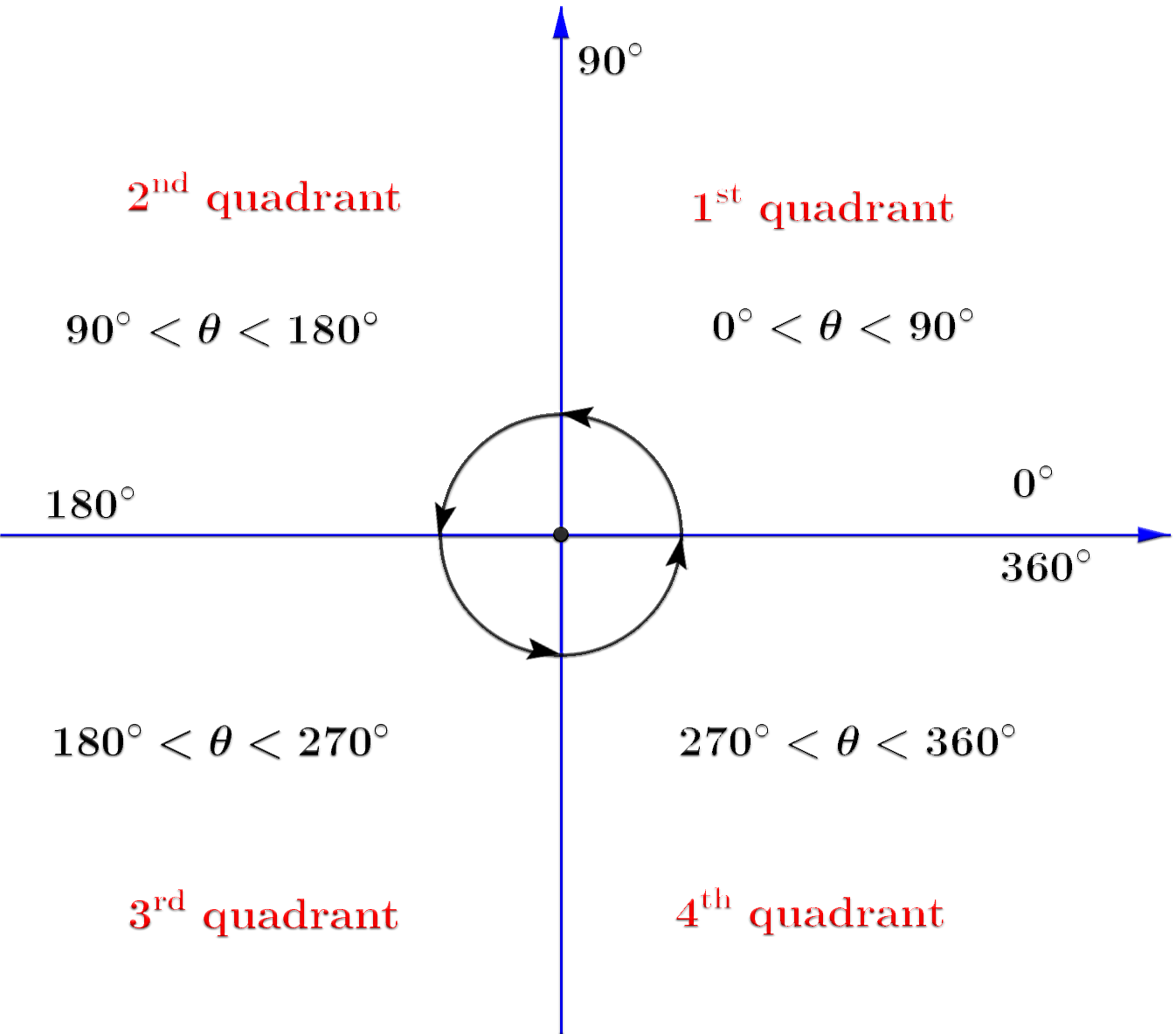
ထောင့်တန်ဖိုး ကို ကြည့်ပြီး ထောင့်လက်တံ (terminal side) ဟာ ဘယ် quadrant မှာ ရှိနေမလဲ ဆိုတဲ့ quadrant အလိုက် angle range ကို ရှင်းပြပါတယ်။


(၄)

40° ရှိတဲ့ ထောင့်ကို Cartesian Plane မှာနေရာချခိုင်းပါတယ်။ စက်ဝိုင်းခြမ်း (protractor) နဲ့ အတိအကျ တိုင်းခိုင်းတာပါ။ ထောင့်လက်တံရဲ့အလျား 1 decimetre (10 cm) ဖြတ်ခိုင်းပါတယ်။ ဖြတ်လို့ရတဲ့ နေရာ ကနေ x-axis ပေါ် ထောင့်မတ်ကျမျဉ်း ဆွဲခိုင်းပါတယ်။


ON ရဲ့ အလျားတန်ဖိုး (x-coordinate)၊ PN ရဲ့ အလျားတန်ဖိုး (y-coordinate) တို့ကိုတိုင်းခိုင်းပါတယ်။ centimetre နဲ့ တိုင်းကြတာပေါ့။ ရတဲ့ အဖြေတွေ ချရေးခိုင်းထားတာပေါ့။ ΔPON ရဲ့ အနားသုံးနား အလျားသိပြီ။ 40° ရဲ့ trigonometric ratios တွေ ရှာခိုင်ပါတယ်။ sin 40° နဲ့ 40° ပဲရှာခိုင်းတာပါ။ ကျန်တာတွေက decimal value တွေဖြစ်နေတာ့ အချိန်အလွန် ကုန်သွားမှာ စိုးလို့ပါ။

$ \displaystyle \sin 40{}^\circ =\frac{{6.4}}{{10}}=0.64$ နဲ့ $ \displaystyle \cos 40{}^\circ =\frac{{7.6}}{{10}}=0.76$ ဆိုပြီးရတာပေါ့။ trigonometric tables က natural sine နဲ့40°=0.7660 ဖြစ်တာကို သူတို့ တွေ့ရမယ်။ 10 cm (1 dm) မှာ ဒသမ နှစ်နေရာ အထိပဲရှာနိုင်တယ်။ ဒသမ လေးနေရာ အထိရှာချင်ရင် ဘယ်လောက် အလျား ထားရမလဲ သူတို့ကို ပြန်မေးကြည့်တယ်။ တစ်ချို့တလေ ပဲ ဖြေနိုင်ပါတယ်။ 10 ဆိုနှစ်လုံး ဆိုတော့ 100 ဆို 3 လုံး၊ 1000 ဆို လေးလုံး... ပါ။ ဒသမ လေးလုံးအထိ အတိအကျ လိုချင်ရင် terminal side (hypotenuse) အလျားကို 1000 cm အထိ ထားရပါမယ် ဆရာ...။ တစ်ယောက်တလေ ဖြေနိုင်ကြပါတယ်။ အေး 1000 cm ဆိုရင် metre နဲ့ ဘယ်လောက်ဖြစ်မလဲ...။ ဆက်သွယ် ချက်တွေ ပြန်ရွတ်ရင်း 10 m ပါဆရာ...။>အေး ... 10 m ဆိုတာ 33 ပေ လောက် ရှိတယ်။ (နယ်ချဲ့ အင်္ဂလိပ်တွေရဲ့ လွှမ်းမိုးမှုကို မလွန်ဆန်နိုင် သေးတော့ metre ဆိုရင် မခန့်မှန်းတတ်ကြပါဘူး၊ ကျွန်တော်လဲ မမြင်ဘူးဗျ။ 😁😁😁) အဲဒီလောက် အလျားကို စာရွက်ပေါ်မှာ ဘယ်လိုဆွဲမလဲ မဖြစ်နိုင်တော့ဘူး။ ဒါ့ကြောင့် မင်းတို့တွေ တွက်ရလွယ်အောင် တိုင်းစရာမလိုပဲ အချိန်ကုန် သက်သာအောင် tables တွေ ထုတ်ပေးထားတာပဲ။ ... စသဖြင့် ရှင်းပြ လိုက်ပါတယ်။


(၅)

အဲဒီနောက်မှာတော့  စိတ်ကူးထဲ ပေါ်ရာပေါ့...။ 130° အတွက် ရှာခိုင်းပြန်တယ်။ second quadrant ထဲ ရောက်သွားပြီလေ...။ တစ်ချို့ကတော့ ရှေ့ မှာလုပ်ခဲ့တဲ့ အတိုင်း သွက်သွက် လက်လက်နဲ့ အဖြေရပြီဆိုပြီး အော်ကြတယ်။ နဲနဲ စေ့စပ်တဲ့သူက ဆရာ လက္ခဏာတွေ ကောထည့်ရမှာလား ဆိုပြီမေးကြတယ်...။ x, y ဆိုတာ coordinate တွေ ဖြစ်တယ်။ coordinate တွေဆိုတာ သက်ဆိုင်ရာ quadrant အလိုက် လက္ခဏာတွေ ပြောင်းလဲနေတော့ ထည့်ရမှာလား မထည့်ရမှာလား ...၊ ထည့်ရမှာပါဆရာ....။ စောစောက အဖြေရပြီဆိုတဲ့ ကျောင်းသားတွေလဲ မသိမသာ ပြင်ကြတာပေါ့။ 230°, 325° စသည်ဖြင့် quadrant စုံအောင် ရှာခိုင်းလိုက်တယ်။.... 


အဲဒီနောက်မှာတော့ တစ်ခါ 40°, 140°, 220° ထောင့်သုံးထောင့်ကို တစ်ပုံထဲ ဆွဲခိုင်းတယ်။ အတန်းထဲမှာ ရှိတဲ့ လူ အရေအတွက်အတိုင်း (A3) တွေ ဆောင်းသွားရတာပေါ့။ ပါးနပ်တဲ့ တစ်ယောက် နှစ်ယောက်ကတော့ compass နဲ့ 10 cm အချင်းဝက်နဲ့ စက်ဝိုင်းဆွဲနေပါပြီ...။ (ရှားပါတယ် ... ရှိခဲ့ရင်တော့ ရှေ့ဆက်ဖို့ ပိုလွယ်တာပေါ့။ မရှိရင်လဲ ဆွဲလာအောင် လမ်းခင်းပေးရတာပေါ့...။)

အလျားတွေ အားလုံးဟာ 40° တြိဂံနဲ့ တူကြောင်း quadrant အလိုက် လက္ခဏာတွေ ပြောင်းပေး ရကြောင်း ပြောလာနိုင်ကြပါတယ်။ နောက်ထပ် (55°, 125°, 235°, 305°) တွေအတွက် ထပ်ရှာခိုင်းပါတယ်..။ အထက်ပါအတိုင်း အြဖေတွေ တူပြီး လက္ခဏာတွေ ပြောင်းသွားကြောင်း ဖြေကြ တာပေါ့။


(၆)


အခု တိုင်းခဲ့တဲ့ အဖြေတွေကို ဘာလို့ 10 နဲ့ စားရတာလဲကွ ... hypotenuse က 10 cm ဖြစ်နေလို့ပါ...။

ဒါဆိုရင်....ဆိုရင် မစားရပဲ အဖြေတန်းရရင် မကောင်းဘူးလား...။ ကောင်းတာပေါ့...ဆရာ...။

ဒါဆို ရင် မစားရအောင် hypotenuse တန်ဘိုး ဘယ်လောက်ထားရင် ကောင်းမလဲကွာ....။

အတော်အတန် စဉ်းစားကြပြီးမှ 1 ထားရင် ကောင်းပါတယ်... ဆရာ...။


အေး အခုလဲ 1 decimetre ထားခဲ့တာပဲလေ...။ မင်းတို့က centimetre ရှုထောင့်က တိုင်းပြီးပြောလို့ 10 နဲ့ စားရတာ။ decimetre ရှုထောင့်က ကြည့်ရင်... 7.6 ဆိုတာ 0.76 dm ပဲ...။ ဒါ့ကြောင့် နောင်မှာ မင်းတို့ ဆွဲလိုက်တဲ့ စက်ဝိုင်းရဲ့ အချင်းဝက်ကို 1 လို့ပဲ ထားမယ်...။ မင်းတို့ တိုင်းလို့ရတဲ့ x နဲ့ y တန်ဖိုးတွေက  အများဆုံး 1 ပဲ ဖြစ်မယ်... 1 မဟုတ်ခဲ့ရင် 1 အောက် အမြဲငယ်တယ်လို့ မှတ်ထားရမယ်..။ အဲဒီလို အချင်းဝက် တစ်ယူနစ်ထားဆွဲတဲ့ စက်ဝိုင်းကို unit circle ကို ခေါ်တယ်ကွ ..။ ဒီလိုမှတ်ထားပါ...။


(၇)

ကဲ ခုဏက ရခဲ့တာတွေ ပြန်ဆက်ရအောင်...။

125° --> ဘယ် quadrant ထဲမှာလဲဟေ့ ...။ Second Quadrant မှာပါ။

ဘယ်လာက် degree ကို မကျော်သေးဘူးလဲ ဟေ့ ...။ 180° ကို မကျော်သေးပါဘူး။

ဘယ်လောက်လိုသေးလဲဟေ့ ...။  55° လိုပါတယ်...။

ဒါဆိုရင် 125°=(180° - 55°) လို့ မပြောနိုင်ဘူးလား ဟေ့ ။ ပြောနိုင်ပါတယ်။

235° --> ဘယ် quadrant ထဲမှာလဲဟေ့ ...။ Third Quadrant မှာပါ။

ဘယ်လာက် degree ကို ကျော်သွားပြီလဲ ဟေ့ ...။ 180° ကို ကျော်သွားပါပြီ...။

ဘယ်လောက်  ကျော်သွားပြီလဲ ဟေ့...။ 55° ကျော်သွားပါပြီ...။

ဒါဆိုရင် 235°=(180° + 55°) လို့ မပြောနိုင်ဘူးလား ဟေ့ ။ ပြောနိုင်ပါတယ်။

305° --> ဘယ် quadrant ထဲမှာလဲဟေ့ ...။ Fourth Quadrant မှာပါ။

ဘယ်လာက် degree ကို မကျော်သေးဘူးလဲ ဟေ့ ...။ 360° ကို မကျော်သေးပါဘူး။

ဘယ်လောက်လိုသေးလဲဟေ့ ...။  55° လိုပါတယ်...။

ဒါဆိုရင် 305°=(360° - 55°) လို့ မပြောနိုင်ဘူးလား ဟေ့ ။ ပြောနိုင်ပါတယ်။

ဒါဆိုရင် အခုပြာခဲ့တဲ့ ထောင့်တန်ဖိုးတွေ အားလုံးဟာ လက္ခဏာတွေသာ မပါရင် ဘယ်သူ့ရဲ့ တန်ဖိုးနဲ့ တူမှာလဲဟေ့...။

55° နဲ့ တူမှာပါ။

လက္ခဏာတွေ မပါလို့ရလားဟေ့....။ မရပါဘူး...။

ဘာဖြစ်လို့လဲ ဟေ့...။   Quadrant ပေါ်မူတည်လို့ပါ။

OK....

ဒါဆိုရင် ထောင့်ကျဉ်း θ နဲ့ လက္ခဏာမပါရင် တူတဲ့ ထောင့်တန်ဖိုးတွေက ဘာတွေ ဖြစ်မလဲ ဟေ့...။

(180° - θ) , (180° + θ), (360° - θ) တို့ပါ....။

ဘယ် quadrant မှာ ဘယ်ဟာ သုံးသင့်လဲ ဟေ့...။

2nd ဆိုရင်  (180° - θ)

3rd ဆိုရင်  (180° + θ)

4th ဆိုရင်  (360° - θ) သုံးရပါမယ်...။

လက္ခဏာတွေ မပါလို့ ရလား ဟေ့....။

မရပါဘူး....။

မရရင် ဘယ်လိုထည့်မလဲ ဟေ....။

Quadrant ရဲ့ x နဲ့ y ရဲ့ လက္ခဏာကို ကြည့်ပြီး ထည့်ပါမယ်...။

fisrst quadrant မှာ လက္ခဏာ သတ်မှတ်ချက် ထည့်ပေးရမလား ...ဟေ့။

အနှုတ်မရှိလို့ .....မလိုပါဘူး....။

ကျန်တဲ့ quadrant တွေမှာကော....။

အပေါင်းနှစ်ခု ....၊ အနှုတ်လေးခုပါ...။

အပေါင်း နှစ်ခု မှတ်ရင် ကျန်တဲ့လေးခု အနှုတ်၊ အနှုတ် လေးခု မှတ်ရင် ကျန်တဲ့နှစ်ခု အပေါင်း... အကုန် မှတ်ထားဖို့ လိုလားဟေ့...။

မလိုပါဘူး.....။

ဒါဆိုရင် ဘာကို မှတ်ထားကြရင် ကောင်းမလဲဟေ့...။

အပေါင်းနှစ်ခုကို  မှတ်ပါမယ်....။

ဘာလို့လဲ ဟေ့....။

နဲလို့ပါ...။

ဒါဆိုရင် .....

1st quadrent မှာ  ----> (+, +) အချိုးတွေ အကုန်လုံး အပေါင်း ဖြစ်မယ်...။

2nd quadrent မှာ  ----> (-, +) sin, cosec အပေါင်း ဖြစ်မယ်...။

3rd quadrent မှာ  ----> (-, -) tan, cot အပေါင်း ဖြစ်မယ်...။

4th quadrent မှာ  ----> (+, -) cos, sec အပေါင်း ဖြစ်မယ်...။


လိုက်ပြောကြဟေ့... လက္ခဏာတွေ အပေါင်း ဖြစ်တာ...

1, 2, 3, 4, ... 1, 2, 3, 4,

all, sin, tan, cos .... all, sin, tan, cos

ဘယ်နှစ်ချိန်လောက် သင်ရင် လောက်မလဲ ခင်ဗျ...။

Saturday, March 3, 2012

Exercise (11.3) No (2) Solution


Find the value of θ, 0° ≤ θ ≤ 360° for the following equations. Do not use table.

(a) $ \displaystyle \ \ \ \ \ \ \sin \theta =-\frac{1}{2}$

Show/Hide Solution
$ \displaystyle \therefore \ \ \ \ \text{basic acute angle}=30{}^\circ $

$ \displaystyle \begin{array}{l}\ \ \ \ \ \ \text{But }\sin \theta \ \text{is negative, }\theta \ \text{may be }\\\ \ \ \ \ \ \text{either in the }{{\text{3}}^{{\text{rd}}}}\text{ or }{{\text{4}}^{{\text{th}}}}\text{ quadrant}\text{.}\end{array}$

 $ \displaystyle \therefore \,\ \ \ \theta =180{}^\circ +30{}^\circ \ (\text{or)}\ \theta =360{}^\circ -30{}^\circ \ $

$ \displaystyle \therefore \,\ \ \ \theta =210{}^\circ \ (\text{or)}\ \theta =330{}^\circ $


(b) $ \displaystyle \ \ \ \ \ \ \cos \theta =-\frac{{\sqrt{3}}}{2}$

Show/Hide Solution
$ \displaystyle \therefore \ \ \ \ \text{basic acute angle}=30{}^\circ $

$ \displaystyle \begin{array}{l}\ \ \ \ \ \ \text{But }\cos \theta \ \text{is negative, }\theta \ \text{may be }\\\ \ \ \ \ \ \text{either in the }{{\text{2}}^{{\text{nd}}}}\text{ or }{{\text{3}}^{{\text{rd}}}}\text{ quadrant}\text{.}\end{array}$

$ \displaystyle \therefore \,\ \ \ \theta =180{}^\circ -30{}^\circ \ (\text{or)}\ \theta =180{}^\circ +30{}^\circ \ $

$ \displaystyle \therefore \,\ \ \ \theta =150{}^\circ \ (\text{or)}\ \theta =210{}^\circ $


(c) $ \displaystyle \ \ \ \ \ \ \cos \theta =-\frac{1}{{\sqrt{2}}}$

Show/Hide Solution
$ \displaystyle \therefore \ \ \ \ \text{basic acute angle}=45{}^\circ $

$ \displaystyle \begin{array}{l}\ \ \ \ \ \ \text{But }\cos \theta \ \text{is negative, }\theta \ \text{may be }\\\ \ \ \ \ \ \text{either in the }{{\text{2}}^{{\text{nd}}}}\text{ or }{{\text{3}}^{{\text{rd}}}}\text{ quadrant}\text{.}\end{array}$

$ \displaystyle \therefore \,\ \ \ \theta =180{}^\circ -45{}^\circ \ (\text{or)}\ \theta =180{}^\circ +45{}^\circ \ $

$ \displaystyle \therefore \,\ \ \ \theta =135{}^\circ \ (\text{or)}\ \theta =225{}^\circ $


(d) $ \displaystyle \ \ \ \ \ \ \tan \theta =\sqrt{3}$

Show/Hide Solution
$ \displaystyle \therefore \ \ \ \ \text{basic acute angle}=60{}^\circ $

$ \displaystyle \begin{array}{l}\ \ \ \ \ \ \text{But }\tan \theta \ \text{is positive, }\theta \ \text{may be }\\\ \ \ \ \ \ \text{either in the }{{\text{1}}^{{\text{st}}}}\text{ or }{{\text{3}}^{{\text{rd}}}}\text{ quadrant}\text{.}\end{array}$

$ \displaystyle \therefore \,\ \ \ \theta =60{}^\circ \ (\text{or)}\ \theta =180{}^\circ +60{}^\circ \ $

$ \displaystyle \therefore \,\ \ \ \theta =60{}^\circ \ (\text{or)}\ \theta =240{}^\circ $

(e) $ \displaystyle \ \ \ \ \ \ \tan 2\theta =1$

Show/Hide Solution
$ \displaystyle \therefore \ \ \ \ \text{basic acute angle}=45{}^\circ $

$ \displaystyle \begin{array}{l}\ \ \ \ \ \ \text{But }\tan 2\theta \ \text{is positive, }2\theta \ \text{may be }\\\ \ \ \ \ \ \text{either in the }{{\text{1}}^{{\text{st}}}}\text{ or }{{\text{3}}^{{\text{rd}}}}\text{ quadrant}\text{.}\end{array}$

$ \displaystyle \underline{{\text{For }{{\text{1}}^{{\text{st}}}}\ \text{quadrant}}}\text{,}$

$ \displaystyle \therefore \,\ \ \ 2\theta =45{}^\circ \ (\text{or)}\ 2\theta =360{}^\circ +45{}^\circ \ $

$ \displaystyle \ \ \ \ \ 2\theta =45{}^\circ \ (\text{or)}\ 2\theta =405{}^\circ \ $

$ \displaystyle \ \ \ \ \ \theta =22{}^\circ 3{0}'(\text{or)}\ \theta =\ 202{}^\circ 3{0}'$

$ \displaystyle \underline{{\text{For }{{\text{3}}^{{\text{rd}}}}\ \text{quadrant}}}\text{,}$

$ \displaystyle \ \,\ \ \ 2\theta =180{}^\circ +45{}^\circ \ (\text{or)}\ 2\theta =360{}^\circ +180{}^\circ +45{}^\circ $

$ \displaystyle \ \ \ \ \ 2\theta =225{}^\circ \ (\text{or)}\ 2\theta =585{}^\circ $

$ \displaystyle \ \ \ \ \ \theta =112{}^\circ 3{0}'(\text{or)}\ \theta =292{}^\circ 3{0}'$


(f) $ \displaystyle \ \ \ \ \ \ \tan 3\theta =-1$

Show/Hide Solution
$ \displaystyle \therefore \ \ \ \ \text{basic acute angle}=45{}^\circ $

$ \displaystyle \begin{array}{l}\ \ \ \ \ \ \text{But }\tan 3\theta \ \text{is negative, 3}\theta \ \text{may be }\\\ \ \ \ \ \ \text{either in the }{{\text{2}}^{{\text{nd}}}}\text{ or }{{\text{4}}^{{\text{th}}}}\text{ quadrant}\text{.}\end{array}$

$ \displaystyle \underline{{\text{For }{{\text{2}}^{{\text{nd}}}}\ \text{quadrant}}}\text{,}$

$ \displaystyle \ \,\ \ \ 3\theta =180{}^\circ -45{}^\circ \ $

$ \displaystyle \ \,\ \ \ 3\theta =135{}^\circ \ $

$ \displaystyle \ \,\ \ \ \theta =45{}^\circ \ $

$ \displaystyle \ \ \ \ \ \ \ \ \ \ \ (\text{or)}$
$ \displaystyle \ \ \ \ \ 3\theta =360{}^\circ +180{}^\circ -45{}^\circ \ $

$ \displaystyle \ \,\ \ \ 3\theta =495{}^\circ \ $

$ \displaystyle \ \,\ \ \ \theta =165{}^\circ \ $

$ \displaystyle \ \ \ \ \ \ \ \ \ \ \ (\text{or)}\ $
$ \displaystyle \ \ \ \ \ 3\theta =360{}^\circ +360{}^\circ +180{}^\circ -45{}^\circ \ $

$ \displaystyle \ \,\ \ \ 3\theta =855{}^\circ \ $

$ \displaystyle \ \,\ \ \ \theta =285{}^\circ $

$ \displaystyle \underline{{\text{For }{{\text{4}}^{{\text{th}}}}\ \text{quadrant}}}\text{,}$

$ \displaystyle \ \,\ \ \ 3\theta =360{}^\circ -45{}^\circ $

$ \displaystyle \ \,\ \ \ 3\theta =315{}^\circ \ $

$ \displaystyle \ \,\ \ \ \theta =105{}^\circ \ $

$ \displaystyle \ \ \ \ \ \ \ \ \ \ \ (\text{or)}\ $
$ \displaystyle \ \ \ \ \ 3\theta =360{}^\circ +360{}^\circ -45{}^\circ $

$ \displaystyle \ \,\ \ \ 3\theta =675{}^\circ \ $

$ \displaystyle \ \,\ \ \ \theta =225{}^\circ \ \ $

$ \displaystyle \ \ \ \ \ \ \ \ \ \ \ (\text{or)}\ $
$ \displaystyle \ \ \ \ \ 3\theta =360{}^\circ +360{}^\circ +360{}^\circ -45{}^\circ \ $

$ \displaystyle \ \,\ \ \ 3\theta =1035{}^\circ \ $

$ \displaystyle \ \,\ \ \ \theta =345{}^\circ \ \ $

diagram မ်ားသည္ principal angle မ်ား ကို ဆံုးျဖတ္ရာတြင္  အေထာက္အကူ ျဖစ္ေစရန္ ေရးဆြဲ ေဖၚျပျခင္း ျဖစ္သည္။ နားလည္ ကၽြမ္းက်င္ သြားလ်င္ diagram မ်ား မေရးဆြဲပဲ ေျဖဆိုႏိုင္ ပါသည္။ က်န္ေသာပုစာၦမ်ားအတြက္ diagram မဆြဲေတာ့ပဲ ေျဖဆိုပါမည္။


(g) $ \displaystyle \ \ \ \ \ \ \tan (3\theta -30{}^\circ )=-1$

Show/Hide Solution
$ \displaystyle \begin{array}{l}\therefore \ \ \ \ \text{basic acute angle}=45{}^\circ \\\\\ \ \ \ \ \ \text{But }\tan (3\theta -30{}^\circ )\ \text{is negative, }(3\theta -30{}^\circ )\ \text{may be }\\\ \ \ \ \ \ \text{either in the }{{\text{2}}^{{\text{nd}}}}\text{ or }{{\text{4}}^{{\text{th}}}}\text{ quadrant}\text{.}\\\\\underline{{\text{For }{{\text{2}}^{{\text{nd}}}}\ \text{quadrant}}}\text{,}\\\\\ \,\ \ \ 3\theta -30{}^\circ =180{}^\circ -45{}^\circ \\\ \\\ \,\ \ \ 3\theta =165{}^\circ \ \\\\\ \,\ \ \ \theta =55{}^\circ \ \\\\\ \ \ \ \ \ \ \ \ \ \ (\text{or)}\ \\\\\ \ \ \ \ 3\theta -30{}^\circ =360{}^\circ +180{}^\circ -45{}^\circ \ \\\\\ \,\ \ \ 3\theta =525{}^\circ \ \\\\\ \,\ \ \ \theta =175{}^\circ \ \\\\\ \ \ \ \ \ \ \ \ \ \ (\text{or)}\ \\\\\ \ \ \ \ 3\theta -30{}^\circ =360{}^\circ +360{}^\circ +180{}^\circ -45{}^\circ \ \\\\\ \,\ \ \ 3\theta =885{}^\circ \ \\\\\ \,\ \ \ \theta =295{}^\circ \ \ \ \\\\\underline{{\text{For }{{\text{4}}^{{\text{th}}}}\ \text{quadrant}}}\text{,}\\\\\ \,\ \ \ 3\theta -30{}^\circ =360{}^\circ -45{}^\circ \\\\\ \,\ \ \ 3\theta =345{}^\circ \ \\\\\ \,\ \ \ \theta =115{}^\circ \ \ \\\\\ \ \ \ \ \ \ \ \ \ \ (\text{or)}\ \\\\\ \ \ \ \ 3\theta -30{}^\circ =360{}^\circ +360{}^\circ -45{}^\circ \\\\\ \,\ \ \ 3\theta =705{}^\circ \ \\\\\ \,\ \ \ \theta =295{}^\circ \ \ \\\\\ \ \ \ \ \ \ \ \ \ \ (\text{or)}\ \\\\\ \ \ \ \ 3\theta -30{}^\circ =360{}^\circ +360{}^\circ +360{}^\circ -45{}^\circ \ \\\\\ \,\ \ \ 3\theta =1065{}^\circ \ \\\\\ \,\ \ \ \theta =355{}^\circ \ \ \end{array}$


(h) $ \displaystyle \ \ \ \ \ \ \cos 2\theta =-\frac{1}{2}$

Show/Hide Solution
$ \displaystyle \begin{array}{l}\therefore \ \ \ \ \text{basic acute angle}=60{}^\circ \\\\\ \ \ \ \ \ \text{But }\cos 2\theta \ \text{is negative, }2\theta \ \text{may be }\\\ \ \ \ \ \ \text{either in the }{{\text{2}}^{{\text{nd}}}}\text{ or }{{\text{3}}^{{\text{rd}}}}\text{ quadrant}\text{.}\\\\\underline{{\text{For }{{\text{2}}^{{\text{nd}}}}\ \text{quadrant}}}\text{,}\\\\\ \,\ \ \ 2\theta =180{}^\circ -60{}^\circ \\\ \\\ \,\ \ \ 2\theta =120{}^\circ \ \\\\\ \,\ \ \ \theta =60{}^\circ \ \\\\\ \ \ \ \ \ \ \ \ \ \ (\text{or)}\ \\\\\ \ \ \ \ 2\theta =360{}^\circ +180{}^\circ -60{}^\circ \ \\\\\ \,\ \ \ 2\theta =480{}^\circ \ \\\\\ \,\ \ \ \theta =240{}^\circ \ \\\\\underline{{\text{For }{{\text{3}}^{{\text{rd}}}}\ \text{quadrant}}}\text{,}\\\\\ \,\ \ \ 2\theta =180{}^\circ +60{}^\circ \\\\\ \,\ \ \ 2\theta =240{}^\circ \ \\\\\ \,\ \ \ \theta =120{}^\circ \ \ \\\\\ \ \ \ \ \ \ \ \ \ \ (\text{or)}\ \\\\\ \ \ \ \ 2\theta =360{}^\circ +180{}^\circ +60{}^\circ \\\\\ \,\ \ \ 2\theta =600{}^\circ \ \\\\\ \,\ \ \ \theta =300{}^\circ \ \ \ \ \end{array}$


(i) $ \displaystyle \ \ \ \ \ \sin (2\theta +30{}^\circ )=\frac{{\sqrt{3}}}{2}$

Show/Hide Solution
$ \displaystyle \begin{array}{l}\therefore \ \ \ \ \text{basic acute angle}=60{}^\circ \\\\\ \ \ \ \ \ \text{But }\sin (2\theta +30{}^\circ )\ \text{is positive, }2\theta +30{}^\circ \ \text{may be }\\\ \ \ \ \ \ \text{either in the }{{\text{1}}^{{\text{st}}}}\text{ or }{{\text{2}}^{{\text{nd}}}}\text{ quadrant}\text{.}\\\\\underline{{\text{For }{{\text{1}}^{{\text{st}}}}\ \text{quadrant}}}\text{,}\\\\\ \,\ \ \ 2\theta +30{}^\circ =60{}^\circ \\\ \\\ \,\ \ \ 2\theta =30{}^\circ \ \\\\\ \,\ \ \ \theta =15{}^\circ \ \\\\\ \ \ \ \ \ \ \ \ \ \ (\text{or)}\ \\\\\ \ \ \ \ 2\theta =360{}^\circ +60{}^\circ \ \\\\\ \,\ \ \ 2\theta =420{}^\circ \ \\\\\ \,\ \ \ \theta =210{}^\circ \ \\\\\underline{{\text{For }{{\text{2}}^{{\text{nd}}}}\ \text{quadrant}}}\text{,}\\\\\ \,\ \ \ 2\theta +30{}^\circ =180{}^\circ -60{}^\circ \\\ \\\ \,\ \ \ 2\theta =120{}^\circ \ \\\\\ \,\ \ \ \theta =60{}^\circ \ \\\\\ \ \ \ \ \ \ \ \ \ \ (\text{or)}\ \\\\\ \ \ \ \ 2\theta =360{}^\circ +180{}^\circ -60{}^\circ \ \\\\\ \,\ \ \ 2\theta =480{}^\circ \ \\\\\ \,\ \ \ \theta =240{}^\circ \ \end{array}$


(j) $ \displaystyle \ \ \ \ \ \ \tan \frac{1}{2}\theta =-\frac{1}{{\sqrt{3}}}$

Show/Hide Solution
$ \displaystyle \therefore \ \ \ \ \text{basic acute angle}=30{}^\circ $

$ \displaystyle \ \ \ \ \ \ \text{But}\ \tan \frac{1}{2}\theta \ \text{is positive, }\frac{1}{2}\theta \ \text{may be }$

$ \displaystyle \ \ \ \ \ \ \text{either in the }{{\text{2}}^{{\text{nd}}}}\text{ or }{{\text{4}}^{{\text{th}}}}\text{ quadrant}\text{.}$

$ \displaystyle \therefore \ \ \ \ \frac{1}{2}\theta =180{}^\circ -30{}^\circ \ (\text{or})\ \frac{1}{2}\theta =360{}^\circ -30{}^\circ $

$ \displaystyle \therefore \ \ \ \ \frac{1}{2}\theta =150{}^\circ \ (\text{or})\ \frac{1}{2}\theta =330{}^\circ $

$ \displaystyle \therefore \ \ \ \ \theta =300{}^\circ \ (\text{or})\ \theta =660{}^\circ $

$ \displaystyle \begin{array}{l}\ \ \ \ \ \ \text{But}\ 0{}^\circ \le \theta \le 360{}^\circ ,\theta =660{}^\circ \ \text{is not in domain}\text{.}\\\\\therefore \ \ \ \ \theta =300{}^\circ \ \text{is the only solution}\text{.}\end{array}$

(k) $ \displaystyle \ \ \ \ \ \ \sin \theta =0.6521$

Show/Hide Solution
$ \displaystyle \begin{array}{l}\therefore \ \ \ \ \text{basic acute angle}=40{}^\circ 4{2}'\ (\text{using table)}\\\\\ \ \ \ \ \ \text{But}\ \sin \theta \ \text{is positive, }\theta \ \text{may be }\\\ \ \ \ \ \ \text{either in the }{{\text{1}}^{{\text{st}}}}\text{ or }{{\text{2}}^{{\text{nd}}}}\text{ quadrant}\text{.}\\\\\therefore \ \ \ \ \theta =40{}^\circ 4{2}'\ (\text{or})\ \theta =180{}^\circ -40{}^\circ 4{2}'\\\\\therefore \ \ \ \ \theta =40{}^\circ 4{2}'\ (\text{or})\ \theta =139{}^\circ 1{8}'\\\ \end{array}$


(l) $ \displaystyle \ \ \ \ \ \ \cos \theta =-0.3854$

Show/Hide Solution
$ \displaystyle \begin{array}{l}\therefore \ \ \ \ \text{basic acute angle}=67{}^\circ 2{0}'\ (\text{using table)}\\\\\ \ \ \ \ \ \text{But}\ \cos \theta \ \text{is negative, }\theta \ \text{may be }\\\ \ \ \ \ \ \text{either in the }{{\text{2}}^{{\text{nd}}}}\text{ or }{{\text{3}}^{{\text{rd}}}}\text{ quadrant}\text{.}\\\\\therefore \ \ \ \ \theta =180{}^\circ -67{}^\circ 2{0}'\ (\text{or})\ \theta =180{}^\circ +67{}^\circ 2{0}'\\\\\therefore \ \ \ \ \theta =112{}^\circ 4{0}'\ (\text{or})\ \theta =247{}^\circ 2{0}'\end{array}$