Showing posts with label Polynomial. Show all posts

Saturday, October 2, 2021

MCQ Questions : The Remainder Theorem and The Factor Theorem

မှန်သော အဖြေကို ရွေးပေးရန် ဖြစ်ပါသည်။

  1. 1. The degree of a polynomial is the _____
    Explanation

    ကိန်းရှင် $x$ ပါဝင်သော polynomial တစ်ခုတွင် $x$ ၏ အကြီးဆုံးထပ်ညွှန်းကို ၎င်း polynomial ၏ degree (သို့) order ဟု ခေါ်သည်။
  2. When $9 x^{2}-6 x+2$ is divided by $x-3$, the remainder will be
    Explanation

    Let $f(x)=9 x^{2}-6 x+2$.

    When $f(x)$ is divided by $x-3$,

    The remainder = $f(3)=9 (3)^{2}-6 (3)+2=65$
  3. If a polynomial $f(x)$ is divided by a linear divisor $(x-a)$, then the remainder is
    Explanation

    Remainder Theorem ကို မေးထားခြင်း ဖြစ်ပါသည်။
  4. For what value of $k, x+4$ is a factor of the polynomial $x^{2}-x-(2 k-2) ?$
    Explanation

    $x+4$ is a factor of the polynomial $x^{2}-x-(2 k-2)$.

    By factor theorem,

    $(-4)^{2}-(-4)-(2 k-2)=0$

    $16+4-2(k-1)=0$

    $2(k-1)=20$

    $k=11$
  5. If the two roots of the equation $x^{3}-x^{2}-5 x+5=0$ are $\sqrt{5}$ and $-\sqrt{5}$, then the third root is
    Explanation

    The two roots of the equation $x^{3}-x^{2}-5 x+5=0$ are $\sqrt{5}$ and $-\sqrt{5}$.

    Let the third root be $k$.

    $\therefore \quad x^{3}-x^{2}-5 x+5=\left(x-\sqrt{5}\right)\left(x+\sqrt{5}\right)\left(x-k\right)$.

    $\therefore\quad \sqrt{5}\times \left(-\sqrt{5} \right)\times (-k)=5$

    $\quad\quad 5k=5$

    $\quad\quad k=1$
  6. What should be subtracted to the polynomial $x^{2}-16 x+30$, so that $x-15$ is the factor of the resulting polynomial?
    Explanation

    Let $f(x) = x^{2}-16 x+30$.

    When $f(x)$ is divided by $x-15$,

    The remainder = $f(15) = (15)^{2}-16 (15)+30 = 15(15 - 16 + 2) = 15$

    Hence, $15$ should be subtracted.
  7. The quadratic polynomial $a x^{2}+b x+c=0$ where $c=\dfrac{b^{2}}{4 a}$ has _____real roots.
    Explanation

    $a x^{2}+b x+c=0$ where $c=\dfrac{b^{2}}{4 a}$

    $\therefore\quad 4ac = b^2$

    $\therefore\quad b^2-4ac = 0$

    $\therefore\quad a x^{2}+b x+c=0$ has only one root.
  8. The remainder when $x^{4}-3 x^{2}+4 x+1$ is divided by $x^{2}-x-1$ is
    Explanation

  9. If the sum and the product of the roots of $x^{2}+b x+c=0$ are $3$ and $2$ , then
    Explanation

    The sum and the product of the roots of $x^{2}+b x+c=0$ are $3$ and $2$.

    Let the roots be $p$ and $q$.

    $\therefore\quad p+q = 3, \ pq=2$

    $\therefore\quad x^{2}+b x+c=(x-p)(x-q)$

    $\therefore\quad x^{2}+b x+c=x^{2}-(p+q) x+pq$

    $\therefore\quad x^{2}+b x+c=x^{2}-3x+2$

    $\therefore\quad b = -3, \ c = 2$
  10. Given that $f(x)=x^{4}+x^{2}+3 x-1$ and $g(x)=x^{2}-1$. If $f(x)=q(x) g(x)+r(x)$, which of the following is true?

    $\mathbf{I.}\ q(x)=x^2+2 \quad$ $\mathbf{II.}\ r(x)=3 x+1 \quad$ $\mathbf{III.}\ g(x)$ is a factor of $f(x)$
    Explanation


    $f(x)=x^{4}+x^{2}+3 x-1$ and $g(x)=x^{2}-1$

    $\quad\quad f(x)=q(x) g(x)+r(x)$ (given)

    $\therefore\quad f(x)=(x^2+2)(x^2-1)+3x+1$

    $\therefore\quad q(x)=x^2+2, \ r(x) = 3x+1$

  11. If $x-3$ is a factor of $x^{3}-(2+k) x^{2}+7 k$, then $k=$
    Explanation

    $x-3$ is a factor of $x^{3}-(2+k) x^{2}+7 k$.

    $\therefore\quad 3^{3}-(2+k) (3)^{2}+7 k=0$

    $\therefore\quad 27-9\left(2+k\right)+7k=0$

    $\therefore\quad k=\dfrac{9}{2} = 4.5$

  12. If $f(x)=6 x^{3}+13 x^{2}+p x+q$ is exactly divisible $2 x^{2}+7 x-4$, then
    Explanation

    $f(x)=6 x^{3}+13 x^{2}+p x+q$ is exactly divisible $2 x^{2}+7 x-4$

    $2 x^{2}+7 x-4=(2x-1)(x+4)$

    $\therefore\quad 6 \left(\dfrac{1}{2}\right)^{3}+13 \left(\dfrac{1}{2}\right)^{2}+p \left(\dfrac{1}{2}\right)+q=0 \ldots(1)$

    $\quad\quad 6 \left(-4\right)^{3}+13 \left(-4\right)^{2}+p \left(-4\right)+q=0\ldots(2)$

    $\therefore\quad p=-40,\ q=16$

    $\therefore\quad f(x)=6 x^{3}+13 x^{2}-40x+16$

    $\therefore\quad f \left(\dfrac{4}{3}\right)=6 \left(\dfrac{4}{3}\right)^{3}+13 \left(\dfrac{4}{3}\right)^{2}-40\left(\dfrac{4}{3}\right)+16$

    $\hspace{2.7cm} =\dfrac{128}{9}+\dfrac{208}{9}-\dfrac{160}{3}+16$

    $\hspace{2.7cm} =0$

    $\therefore\quad 3 x-4$ is a factor of $f(x)$.
  13. If $x^{2}+2 x-3$ is a factor of $f(x)=x^{4}+2 x^{3}-7 x^{2}+a x+b$, then
    Explanation

    $x^{2}+2 x-3$ is a factor of $f(x)=x^{4}+2 x^{3}-7 x^{2}+a x+b$

    Let $f(x) = g(x)(x^{2}+2 x-3)$

    $\therefore x^{4}+2 x^{3}-7 x^{2}+a x+b = g(x)(x+3)(x-1)$

    When $x=-3,\ (-3)^{4}+2 (-3)^{3}-7 (-3)^{2}+a (-3)+b = 0$

    When $x=1,\ (1)^{4}+2 (1)^{3}-7 (1)^{2}+a (1)+b = 0$

    $\therefore\quad 3a - b =-36 \ \ldots(1)$

    $\quad\quad a + b = 4 \ \ \quad\ldots(2)$

    $\therefore\quad a= -8, b=12$
  14. If $x^{2}+a x+b$ is divided by $x+c$, then remainder is
    Explanation

    $x^{2}+a x+b$ is divided by $x+c$, then

    the remainder $= (-c)^{2}+a (-c) +b = c^2-ac+b$
  15. If $x^{3}+9 x+5$ is divided by $x$, then the remainder is
    Explanation

    $x^{3}+9 x+5$ is divided by $x$, then

    the remainder $= (0)^{3}+9 (0)+5 = 5$
  16. If $(x-1)$ is a factor of $a x-a$, then the value of $a$ is
    Explanation

    Let $f(x) = ax - a$

    $f(1) = a - a = 0$

    $\therefore\quad x-1$ is a factor of $f(x)$ for all value of $a\in \mathbb{R}$.
  17. What is the remainder when $f(x)=x^{3}+3 x^{2}+k x+k$ is divided by $p x$ ?
    Explanation

    When $f(x)=x^{3}+3 x^{2}+k x+k$ is divided by $p x$,

    The remainder = $f(0) = k$
  18. If $x^{2}-3 x+2$ is a factor of the polynomial $f(x)$, then $f(2)=$
    Explanation

    $x^{2}-3 x+2$ is a factor of the polynomial $f(x)$.

    $x^{2}-3 x+2 = (x-1)(x-2)$

    $\therefore\quad (x-1)$ and (x-2) are factors $f(x)$.

    $\therefore\quad f(2)=0$
  19. Given that $f(x)=q(x)\left(x^{2}-4\right)+3$. What is the remainder when $f(x)$ is divided by $x-2$ ?
    Explanation

    $f(x)=q(x)\left(x^{2}-4\right)+3$.

    When $f(x)$ is divided by $x-2$,

    The remainder $f(2)=q(2)\left(2^{2}-4\right)+3 =3$
  20. If $n$ is a positive integer, what is the remainder when $5 x^{2 n+1}+10 x^{2 n}-3 x^{2 n-1}+5$ is divided by $x+1$.
    Explanation

    Let $f(x)=5 x^{2 n+1}+10 x^{2 n}-3 x^{2 n-1}+5$ where $n$ is a positive integer.

    When $f(x)$ is divided $x + 1$,

    The remainder $= f(-1)$.

    $\hspace{2.5cm} =5 (-1)^{2 n+1}+10 (-1)^{2 n}-3 (-1)^{2 n-1}+5$

    $\hspace{2.5cm} =5 (-1)^{\text{odd integer}}+10 (-1)^{\text{even integer}}-3 (-1)^{\text{odd integer}}+5$ where $n\in \mathbb{J^+}$

    $\hspace{2.5cm} =5 (-1)+10 (1)-3 (-1) + 5$

    $\hspace{2.5cm} =13$
  21. Your Score:

Monday, July 12, 2021

Polynomials and The Remainder Theorem

Polynomial


အောက်ဖော်ပြပါ ဇယားရှိ polynomial နှင့် non-polynomial ယှဉ်တွဲဖော်ပြချက်ကို လေ့လာကြည့်ပါမည်။


Polynomial Non Polynomial
$x^{2}-4 x+3$ $2 x^{2}-7 x+x^{-1}$
$2 x^{5}+7 x^{4}$ $-x^{\frac{1}{2}}+x^{-3}$
$5 x^{3}+6-\displaystyle\frac{5}{7} x$ $x^{2}-\sqrt{x}$
$8$ $\displaystyle\frac{1}{x}-\displaystyle\frac{2}{x^{4}}-\sqrt[3]{x}$

polynomial ဆိုသည်မှာ ကိန်းရှင်တစ်ခု၏ အနုတ်မဟုတ်သော ထပ်ကိန်းများသာပါသော ကိန်းတန်းတစ်ခု ဖြစ်ကြောင်းတွေ့ရပါမည်။

အောက်ဖော်ပြပါ polynomial ကို ဆက်လက်လေ့လာကြည့်ကြမည်။

$x^3-2x^2+3x-4$
  • အပေါင်းနှင့် အနုတ်လက္ခဏာများကြားရှိ ကိန်းလုံးများကို terms ဟုခေါ်သည်။
  • ကိန်းတန်းတွင်ပါဝင်သော $x$ ကို variable ဟုခေါ်သည်။
  • $x$ ၏ အကြီးဆုံးထပ်ကိန်းကို polynomial ၏ order (သို့) degree ဟုခေါ်သည်။
  • ကိန်းရှင် $x$ ပါဝင်သော polynomial ကိန်းတန်းတစ်ခုကို $f(x), g(x), P(x)$ စသဖြင့် သတ်မှတ်နိုင်ပါသည်။

Definition:  Polynomial Expression
A polynomial in $x$ is an algebraic expression consisting of terms with non-negative powers of $x$ only

$$ a_{n} x^{n}+a_{n-1} x^{n-1}+a_{n-2} x^{n-2}+\ldots+a_{2} x^{2}+a_{1} x+a_{0},$$

where $n$ is a non-negative integer, the coefficients $a_n$, $a_{n-1}$,$a_{n-2}$, ..., $a_2$, $a_1$, $a_0$ are constants and $x$ is a variable.

Note
  • A polynomial cannot have negative values of exponents.

    Polynomial များတွင် အနုတ်ထပ်ညွှန်းမရှိရပါ။

    E.g. $4x^{-2}$ can not be a polynomial term.

  • A polynomial term can not have the variable in the denominator.

    Polynomial ကိန်းတစ်ခုသည် အပိုင်းကိန်းတစ်ခု၏ ပိုင်းခြေမဖြစ်ရပါ။

    E.g. $\displaystyle\frac{4}{x}$ is not a polynomial term.

  • A polynomial term cannot have a variable inside the radical sign.

    Polynomial ကိန်းတစ်ခုသည် radical sign မပါရှိရပါ။

    E.g. $3x\sqrt{x}$ is therefore not a polynomial term.

  • A polynomial term can have more than one variable.

    Polynomial ကိန်းတန်းတစ်ခုတွင် ကိန်းရှင်တစ်ခုထက် ပိုနိုင်ပါသည်။

    E.g. $3x^3y + 2x^2y^2 - 4xy^3 + 2$ is a polynomial.

  • The highest power of the variable that occurs in the polynomial is called the degree (or order) of a polynomial. Polynomial တစ်ခုတွင်ပါဝင်သော ကိန်းရှင်၏ အကြီးဆုံးထပ်ကိန်းကို ၎င်း polnomial ၏ degree (သို့) order ဟုခေါ်သည်။

    $\begin{array}{lll} \text{E.g.} & x^{4}-2 x^{2}+5 x-6 & \text{degree = 4}\\ & & \text{quartic polynomial }\\\\ & a x^{3}+b x^{2}+c x+d & \text{degree = 3}\\ & & \text{cubic polynomial }\\\\ & 3 x^{2}-5 x+2 & \text{ degree = 2}\\ & & \text{quadratic polynomial }\\\\ & 5 x-1 & \text{degree = 1}\\ & & \text{linear polynomial } \end{array}$

  • The leading term is the term with the highest power, and its coefficient is called the leading coefficient.

    Polynomial တစ်ခုတွင် ကိန်းရှင်၏ အကြီးဆုံးထပ်ကိန်း ပါသောကိန်းလုံးကို leading term ဟုခေါ်ပြီး အဆိုပါကိန်းရှင်၏ မြှောက်ဖေါ်ကိန်းကို leading coefficient ဟုခေါ်သည်။

    E.g. The leading term of $3x^3 + 2x^2 - 4x + 2$ is $3x^3$ and the leading coefficient is $3$.

  • A polynomial where the highest power of its single variable has a coefficient of 1, it is called a monic polynomial.

    ကိန်းရှင်တစ်ခုထဲဖြင့် ဖွဲ့စည်းထားသော polynomial ၏ အကြီးဆုံးထပ်ကိန်း ပါသော ကိန်းလုံး (leading term) ၏ မြှောက်ဖော်ကိန်းသည် $1$ ဖြစ်လျှင် ၎င်း polynomial ကို monic polynomial ဟုခေါ်သည်။

    E.g. $x^5 + 2x^2 - 4x + 2$, $x^3-2x^2+3x-1$ are monic polynomials.

Division of Polynomials


ကိန်းဂဏန်းများနည်းတူ Polynomial အချင်းချင်း ပေါင်း၊ နုတ်၊ မြှောက်၊ စားဆိုသော အခြေခံလုပ်ဆောင် ချက်များကို ဆောင်ရွက်နိုင်ပါသည်။ ပေါင်းခြင်း၊ နုတ်ခြင်း၊ မြှောက်ခြင်း၊ တို့ကို ဖြတ်သန်းခဲ့ပြီးသော အတန်း များတွင် သင်ကြား ခဲ့ပြီး ဖြစ်ရာ ယခုသင်ခန်းစာတွင် polynomial အချင်းချင်းစားခြင်းကိုသာ ဆက်လက် တင်ပြသွားပါမည်။


Polynomial Long Division

Polynomial တစ်ခုကို ၎င်းအောက် degree ငယ်သော polynomial တစ်ခုဖြင့် စားလျှင် ငယ်စဉ်အတန်း များတွင် ကိန်းဂဏန်းများ စာအိမ်ဖွဲ့၍ စားသကဲ့သို့ စားနိုင်သည်။ ထိုကဲ့သို့ စာအိမ်ဖွဲ့၍ စားခြင်းကို polynomial long division ဟုခေါ်သည်။ polynomial ချင်း မစားမှီ ကိန်းဂဏန်းများ စားအိမ်ဖွဲ့စားခြင်းကို ပြန်လည်တင်ပြ ပါမည်။ စားခြင်းဆိုင်ရာ ဝေါဟာရများကို သိရှိထားရပါမည်။ တည်ကိန်း (dividend)၊ စား ကိန်း (divisor)၊ စားလဒ် (quotient)၊ အကြွင်း (remainder) တို့ ဖြစ်ကြသည်။


ဆက်လက်ပြီး polynomial long division ကို တင်ပြပါမည်။ ဥပမာ $x^3 + 2x- 7$ ကို $x-2$ ဖြင့်စားသည်ဆို ပါစို့။ အကြွင်းမည်မျှ ရမည်ကို အောက်ပါအတိုင်း စားအိမ်ဖွဲ့စားခြင်းဖြင့် ရှာယူနိုင်ပါသည်။


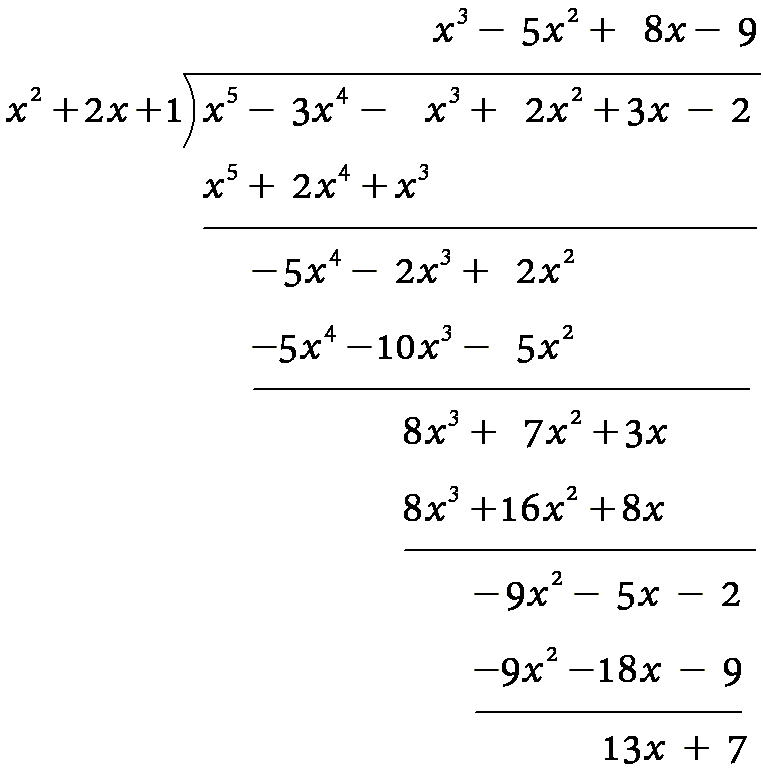
ပေးထားသော polynomial တွင် $x^2$ term ပါဝင်မှုမရှိသဖြင့် စားအိမ်ဖွဲ့ စားသည့်အခါ $x^2$ term အတွက် နေရာလွတ်ချန်၍ သော်လည်းကောင်း၊ မြှောက်ဖော်ကိန်း 0 ထား၍သော်လည်းကောင်း ဖြေရှင်းနိုင်ပါသည်။ ဆက်လက်၍ $x^5-3x^4-x^3+2x^2+3x-2$ ကို $x^2+2x+1$ ဖြင့်စားကြည့်ပါမည်။


Note
ကိန်းဂဏန်းများစားခြင်းတွင် အကြွင်းသည် စားလဒ်အောက် အမြဲငယ်ပြီး polynomial များ စားခြင်းတွင် အကြွင်း၏ (degree) သည် စားကိန်း (degree) အောက် အမြဲငယ်သည်ကို တွေ့ရပါမည်။

Division Algorithm

မည်သည့်စာခြင်းမဆို အောက်ပါညီမျှခြင်းကို အမြဲပြေလည်စေသည်။


Dividend (တည်ကိန်း) = Quotient (စားလဒ်) $\times$ Divisor (စားကိန်း) + Remainder (အကြွင်း)

ထို့ကြောင့် အထက်တွင်ဖေါ်ပြခဲ့သော ဥပမာများကို အောက်ပါအတိုင်း ညီမျှခြင်းဖြင့် ပြန်လည်ဖော်ပြနိုင် ပါသည်။

  • $7=3\times2+1$

  • $x^3+2x-7=(x^2+2x+3)(x-2)+5$

  • $x^5-3x^4-x^3+2x^2+3x-2=(x^3-5x^2+8x-9)(x^2+2x+1)+13x+7$

$a$ သည် တည်ကိန်းဖြစ်ပြီး ၎င်းကို $b$ ဖြင့်စားသည့်အခါ စားလဒ်မှာ $q$ ဖြစ်ပြီး အကြွင်းမှာ $r$ ဖြစ်သည် ဆို ပါစို့။ ထိုအခါ $a, b, q$ နှင့် $r$ ဆက်သွယ်ချက်ကို အောက်ပါအတိုင်း ဖော်ပြနိုင်ပါသည်။


$a=bq+r$ or $\displaystyle\frac{a}{b}=q+\displaystyle\frac{r}{b}$

ထိုနည်းတူစွာ plynomial $f(x)$ ကို $D(x)$ ဖြင့်စားသည့်အခါ စားလဒ်မှာ $Q(x)$ ဖြစ်ပြီး အကြွင်းမှာ $R(x)$ ဖြစ်သည် ဆိုပါစို့။ အဆိုပါ function လေးခု၏ ဆက်သွယ်ချက်ကို အောက်ပါအတိုင်း ဖေါ်ပြနိုင်သည်။


$f(x)=Q(x)*D(x)+R(x)$


The Remainder Theorem


အထက်ဖော်ပြပါ ဆက်သွယ်ချက် ညီမျှခြင်းများကို Division Algorithm ဟုခေါ်သည်။

အကယ်၍ $D(x)=x-k$ ဖြစ်လျှင်

$f(x)=Q(x)(x-k)+ R$ ဖြစ်မည်။ remainder $R$ သည် divisor အောက် degree ငယ်သောကြောင့် ကိန်းရှင် $x$ ပေါ်တွင် မှီခိုခြင်းမရှိတော့ပါ။ ထို့ကြောင့် ကိန်းသေ $R$ ဖြင့် သတ်မှတ်ပါမည်။ $x=k$ ဖြစ်သည့်အခါ

$\begin{aligned} f(k)&=Q(k)(k-k)+R\\\\ &=Q(k)\centerdot0+R\\\\ &=R\\\\ &=\text{remainder} \end{aligned}$

ထို့ကြောင့် polynomial $f(x)$ ကို $x-k$ ဖြင့်စားသည့်အခါ အကြွင်းကို $f(k)$ ဟုသတ်မှတ်နိုင်သည်။


The Remainder Theorem
If a polynomial $f (x)$ is divided by $x-k$, the remainder is $f (k)$.


Extension of the Remainder Theorem


$f(x)$ ကို $x-k$ ဖြင့်စားလျှင် remainder မှာ f(k) ဖြစ်ကြောင်းသိရှိခဲ့ပြီး ဖြစ်သည်။ $f(x)$ ကို $x+k$ ဖြင့်စားလျှင် remainder မည်သို့ရမည်ကို ဆက်လက်လေ့လာကြည့်ကြမည်။

$f(x)\div (x-k)\Rightarrow \text{remainder}=f(k)$

$f(x)\div (x+k)\Rightarrow f(x)\div (x-(-k))\Rightarrow \text{remainder}=f(-k)$

ဆက်လက်၍ $f(x)$ ကို $ax-b$ ဖြစ်စားလျှင် remainder မည်သို့ရမည်ကို လေ့လာကြည့်ကြမည်။ စားလဒ်သည် $Q(x)$ ဖြစ်ပြီး အကြွင်းမှာ $R$ ဖြစ်သည် ဆိုပါစို့။ ထိုအခါ

$f(x)=Q(x)(ax-b)+R$

ဖြစ်မည်။ တစ်နည်းဆိုရသော်

$f(x)=Q(x)a\left(x-\displaystyle\frac{b}{a}\right)+R$

ဖြစ်သည်။ $x=\displaystyle\frac{b}{a}$ ဖြစ်သောအခါ

$\begin{aligned} f\left( \displaystyle\frac{b}{a} \right)&=Q(x)a\left(x-\frac{b}{a}\right)+R \\\\ &=Q\left(\displaystyle\frac{b}{a} \right)\centerdot 0 + R \\\\ &=R\\\\ &=\text{ remainder} \end{aligned}$

$f(x)\div (ax-b)\Rightarrow \text{ remainder}=f\left( \displaystyle\frac{b}{a} \right)$

$f(x)\div (ax+b)\Rightarrow f(x)\div (ax-(-b))\Rightarrow \text{remainder}=f\left( -\displaystyle\frac{b}{a} \right)$

ဆက်လက်၍ $f(x)$ ကို $ax$ ဖြစ်စားလျှင် remainder မည်သို့ရမည်ကို လေ့လာကြည့်ပါဦးမည်။ စားလဒ်သည် $Q(x)$ ဖြစ်ပြီး အကြွင်းမှာ $R$ ဟုထားမည်။ ထို့ကြောင့် $$f(x)=Q(x)(ax)+R$$ ဖြစ်မည်။ $x=0$ ဖြစ်သည့်အခါ

$\begin{aligned} f(k)&=Q(0)(a\times0)+R\\\\ &=Q(0)\centerdot0+R\\\\ &=R\\\\ &=\text{ remainder} \end{aligned}$

Corollary


  • If a polynomial $f (x)$ is divided by $x + k$, the remainder is $f (-k)$.

  • If a polynomial $f (x)$ is divided by $ax - b$, the remainder is $f\left(\displaystyle \frac{b}{a} \right)$.

  • If a polynomial $f (x)$ is divided by $ax + b$, the remainder is $f\left( -\displaystyle\frac{b}{a} \right)$.

  • If a polynomial $f (x)$ is divided by $ax$, the remainder is $f(0)$.

Example (1)


Using the remainder theorem, find the remainder when $x^3 + 4x^2 + 6x + 5$ is divided by $x - 2$.

Solution Let $f(x)=x^3 + 4x^2 + 6x + 5$.

When $f(x)$ is divided by $x+2$,

$\begin{aligned} \text{the remainder}&= f(2)\\\\ &=2^2+4(2)^2+6(2)+5\\\\ &=4+16+12+5\\\\ &=37 \end{aligned}$

Example (2)


If the polynomial $x^3 - 3x^2 + kx+7$ is divided by $x+3$, the remainder is $1$, find the value of $k$.

Solution Let $f(x)=x^3 - 3x^2 + kx+7$.

When $f(x)$ is divided by $x+3$, the remainder = f(-3).

By the problem,

$\begin{aligned} f(-3)&= 1\\\\ (-3)^3 - 3(-3)^2 + k(-3)+7&=1\\\\ -27-27-3k+7 &= 1\\\\ -47-3k &=1\\\\ 3k &= 48\\\\ \therefore \ \ \ k &= 16 \end{aligned}$

Example (3)


Given that $2x^4 + ax^3 - 4x^2 + bx + 7$ leaves a remainder $2x + 5$ when it is divided by $x^2 - 3x + 2$. Find the values of $a$ and $b$.

Solution
Let $Q(x)$ be the quotient when $2x^4 + ax^3 - 4x^2 + bx + 7$ is divided by $x^2 - 3x + 2$.

By division algorithm, we have

$2 x^{4}+a x^{3}-4 x^{2}+b x+7=Q(x)\left(x^{2}-3 x+2\right)+2 x+5$

$2 x^{4}+a x^{3}-4 x^{2}+b x+7=Q(x)(x-1)(x-2)+2 x+5$

When $x=1$,

$2+a-4+b+7=Q(1)(1-1)(1-2)+2(1)+5$

$a+b+5=0+2+5$

$a+b=2-----(1)$

When $x=2$,

$2(2)^{4}+a(2)^{3}-4(2)^{2}+b(2)+7=Q(2)(2-1)(2-2)+2(2)+5$

$32+8 a-16+2 b+7=0+4+5$

$8 a+2 b+23=9$

$4 a+b=-7-----(2)$

Subtracting equation $(1)$ from equation $(2)$,

$3 b=-9$

$b=-3$

Substituting $b=-3$ in equation $(1)$

$a-3=2$

$a=5$

Exercise


  1. Using the remainder theorem, find the remainder when:
    (a) $2x^2 - 13x + 10$ is divided by $x - 3$.
    (b) $x^3 - 3x^2 + 5x - 9$ is divided by $x - 2$.
    (c) $x^3 + 4x^2 + 6x + 5$ is divided by $x + 2$.
    (d) $x^6 - x3 - 1$ is divided by $x + 2$.
    (e) $9x^2 + 6x - 10$ is divided by $3x + 1$.
    (f) $3x^3 + 3x^2 - 11x + 8$ is divided by $3x - 1$.
    (g) $6x^3 + x^2 + 1$ is divided by $2x - 3$.
    (h) $3 (x + 4)^2 - (1 - x)^3$ is divided by $x$.
    (i) $(2x - 1)^3 + 6 (3 + 4x)^2 - 10$ is divided by $2x + 1$.
  2. Find the value of $k$ if $5 x^{5}+2 k x^{3}-6 k x^{2}+9$ has a remainder of 22 when divided by $x-1$.

  3. The polynomial $x^{3}+a x^{2}+b x-3$ leaves a remainder of 27 when divided by $x-2$ and a remainder of 3 when divided by $x+1$. Calculate the remainder when the polynomial is divided by $x-1$.

  4. The expression $6 x^{2}-2 x+3$ leaves the remainder of 3 when divided by $x-p$. Determine the values of $p$.

  5. Given that the expression $x^{3}-a x^{2}+b x+c$ leaves the same remainder when divided by $x+1$ or $x-2$, find $a$ in terms of $b$.

  6. The expressions $x^{3}-7 x+6$ and $x^{3}-x^{2}-4 x+24$ have the same remainder when divided by $x+p .$ Find the possible values of $p .$

  7. If the polynomial $x^{3}-3 x^{2}+a x-b$ is divided by $(x-2)$ and $(x+2)$, the remainders are 21 and 1 respectively. Find the values of $a$ and $b$.

  8. Given that the remainder when $x^{3}-x^{2}+a x$ is divided by $x+a$ where $a>0$, is twice the remainder when it is divided by $x-2 a$, find the value of $a$.

  9. The remainder when $a x^{3}+b x^{2}+2 x+3$ is divided by $x-1$ is twice when it is divided by $x+1$, show that $b=3 a+3$.

  10. The remainder when $x^{4}+3 x^{2}-2 x+2$ is divided by $x+a$ is the square of the remainder when $x^{2}-3$ is divided by $x+a$. Calculate the possible values of $a$.

  11. The expression $a x^{3}-x^{2}+b x-1$ leaves the remainders of $-33$ and 77 when divided by $x+2$ and $x-3$ respectively. Find the value of $a$ and $b$ and find the remainder when the expression is divided by $x-2$.

  12. When the polynomial $x^{3}-3 x^{2}+k x+7$ is divided by $x+3$, the remainder is $1$ . Find the value of $k$.

  13. When $x^{3}+a x^{2}+b x-1$ is divided by $x-1$ the remainder is 3 and when divided by $x+2$ the remainder is $-27$. Find $a$ and $b$.

  14. Find the value of $\mathrm{n}$ for which the division of $x^{2 n}-7 x^{n}+5$ by $x-2$ gives the remainder of 13.

  15. The remainder when $a(a-b)(a+b)$ is divided by $a-2 b$ is $\displaystyle\frac{3}{4}$. Find the numerical value of $b$.

  16. The remainder when $p x^{3}+q x^{2}+2 x+1$ is divided by $x+1$ is twice the remainder when it is divided by $x-1$, find the relation between $p$ and $q$.

  17. If $f(x)=a x^{2}+b x+c$ leaves the remainders $1,25,1$ on division by $x-1$, $x+1, x-2$ respectively, show that $f(x)$ is a perfect square.

  18. Given that the expression $x^{2}-10 x+14$ leaves the same remainder when divided $x+2 b$ or $x+2 c$, where $b \neq c$, show that $b+c+5=0$.

  19. The expression $5 x^{2}-10 x+4$ has the same remainder when divided by $x-2 p$ or $x+q$ where $2 p \neq-q$. Find the value of $2 p-q$.

  20. When the expression $a x^{3}+5 x^{2}+b x+4$ and $b x^{3}+9 x^{2}+a x-6$ are divided by $x+3$, the remainders are $-14$ and $-12$ respectively. Find the value $a$ and $b$.

  21. Given that $f(x)=k x^{3}+(3 k-2) x^{2}-4$, where $k$ is a constant. If $f(x)$ is divisible by $x+2$, find the value of $k$. With this value $k$, find the remainder when $f(x)$ is divided by $(2 x-1)$.

  22. The expression $x^{3}+8 x^{2}+p x-25$ leaves a remainder of $R$ when divided by $x-1$ and a remainder of $-R$ when divided by $x+2$. Find the value of $p$. Hence find the remainder when the expression is divided by $x+3$.

  23. The polynomial $a x^{2}+b x+c$ leaves remainder 1,2, and 9 when divided by $x$, $x-1$ and $x-2$ respectively. What are the values of $a, b$ and $c$?

  24. If the polynomial $x^{4}-6 x^{3}+16 x^{2}-25 x+10$ is divided by another polynomial $x^{2}-2 x+k$, the remainder comes out to be $x+a$, find $k$ and $a$.

Thursday, June 16, 2016

Problem Study (Polynomial Division)

1.   If is a factor of , Find the values of and
Solution 
Let  .
Since is a factor of , the remainder when is divided by is 0.
By polynomial long division we can find the remainder.  


Hence we have
 
and .
Similarly, we can say , 
When , and
When , .
-------------------------------------------------------------------------
 2.   If is divisible by , prove that .
Solution 
 Since is divisible by , The remainder when is divided by = is zero.
By polynomial long division,


and .
.

Monday, May 16, 2016

Problem Study (Polynomial)

    When a polynomial f(x) is divided by (x - 1) and (x + 5),
    the remainders are -6 and 6 respectively. Let r(x be the
    remainder when f(x) is divided by x2 + 4x - 5. Find the  
    value of r(-2).   

Solution 

    By the problem,
    f(x) = p(x) (x - 1) - 6 ............(1)
    f(x) = q(x) (x + 5) + 6 ............(2)
    f(x) = Q(x) (x2 + 4x - 5) + r(x) ............(3) 
    (1) × (x + 5) ⇒ (x + 5) f(x) = p(x) (x - 1) (x + 5) - 6x - 30   
    (2) × (x - 1)  ⇒  (x - 1) f(x) = q(x) (x - 1) (x + 5) + 6x - 6 
    Subtracting the two equations,
    6 f(x) = [p(x) - q(x)] (x - 1) (x + 5) - 12x - 24
    Hence ,
    f(x) =  p ( x ) - q ( x ) 6 (x - 1) (x + 5) - 2x - 4 -------(4)
    Comparing equations (3) and (4), we have
    r(x) = - 2x - 4
    Therefore, r (-2) = -2 (-2) - 4 = 0.

    Credit : Sayar U Pyi Kyaw