

Polynomial
အောက်ဖော်ပြပါ ဇယားရှိ polynomial နှင့် non-polynomial ယှဉ်တွဲဖော်ပြချက်ကို လေ့လာကြည့်ပါမည်။
| Polynomial | Non Polynomial |
|---|---|
| $x^{2}-4 x+3$ | $2 x^{2}-7 x+x^{-1}$ |
| $2 x^{5}+7 x^{4}$ | $-x^{\frac{1}{2}}+x^{-3}$ |
| $5 x^{3}+6-\displaystyle\frac{5}{7} x$ | $x^{2}-\sqrt{x}$ |
| $8$ | $\displaystyle\frac{1}{x}-\displaystyle\frac{2}{x^{4}}-\sqrt[3]{x}$ |
polynomial ဆိုသည်မှာ ကိန်းရှင်တစ်ခု၏ အနုတ်မဟုတ်သော ထပ်ကိန်းများသာပါသော ကိန်းတန်းတစ်ခု ဖြစ်ကြောင်းတွေ့ရပါမည်။
အောက်ဖော်ပြပါ polynomial ကို ဆက်လက်လေ့လာကြည့်ကြမည်။
$x^3-2x^2+3x-4$- အပေါင်းနှင့် အနုတ်လက္ခဏာများကြားရှိ ကိန်းလုံးများကို terms ဟုခေါ်သည်။
- ကိန်းတန်းတွင်ပါဝင်သော $x$ ကို variable ဟုခေါ်သည်။
- $x$ ၏ အကြီးဆုံးထပ်ကိန်းကို polynomial ၏ order (သို့) degree ဟုခေါ်သည်။
- ကိန်းရှင် $x$ ပါဝင်သော polynomial ကိန်းတန်းတစ်ခုကို $f(x), g(x), P(x)$ စသဖြင့် သတ်မှတ်နိုင်ပါသည်။
| Definition: Polynomial Expression |
|---|
| A polynomial in $x$ is an algebraic expression consisting of terms with non-negative powers of $x$ only $$ a_{n} x^{n}+a_{n-1} x^{n-1}+a_{n-2} x^{n-2}+\ldots+a_{2} x^{2}+a_{1} x+a_{0},$$ where $n$ is a non-negative integer, the coefficients $a_n$, $a_{n-1}$,$a_{n-2}$, ..., $a_2$, $a_1$, $a_0$ are constants and $x$ is a variable. |
| Note |
|---|
|
Division of Polynomials
ကိန်းဂဏန်းများနည်းတူ Polynomial အချင်းချင်း ပေါင်း၊ နုတ်၊ မြှောက်၊ စားဆိုသော အခြေခံလုပ်ဆောင် ချက်များကို ဆောင်ရွက်နိုင်ပါသည်။ ပေါင်းခြင်း၊ နုတ်ခြင်း၊ မြှောက်ခြင်း၊ တို့ကို ဖြတ်သန်းခဲ့ပြီးသော အတန်း များတွင် သင်ကြား ခဲ့ပြီး ဖြစ်ရာ ယခုသင်ခန်းစာတွင် polynomial အချင်းချင်းစားခြင်းကိုသာ ဆက်လက် တင်ပြသွားပါမည်။
Polynomial Long Division
Polynomial တစ်ခုကို ၎င်းအောက် degree ငယ်သော polynomial တစ်ခုဖြင့် စားလျှင် ငယ်စဉ်အတန်း များတွင် ကိန်းဂဏန်းများ စာအိမ်ဖွဲ့၍ စားသကဲ့သို့ စားနိုင်သည်။ ထိုကဲ့သို့ စာအိမ်ဖွဲ့၍ စားခြင်းကို polynomial long division ဟုခေါ်သည်။ polynomial ချင်း မစားမှီ ကိန်းဂဏန်းများ စားအိမ်ဖွဲ့စားခြင်းကို ပြန်လည်တင်ပြ ပါမည်။ စားခြင်းဆိုင်ရာ ဝေါဟာရများကို သိရှိထားရပါမည်။ တည်ကိန်း (dividend)၊ စား ကိန်း (divisor)၊ စားလဒ် (quotient)၊ အကြွင်း (remainder) တို့ ဖြစ်ကြသည်။
 |
|---|
ဆက်လက်ပြီး polynomial long division ကို တင်ပြပါမည်။ ဥပမာ $x^3 + 2x- 7$ ကို $x-2$ ဖြင့်စားသည်ဆို ပါစို့။ အကြွင်းမည်မျှ ရမည်ကို အောက်ပါအတိုင်း စားအိမ်ဖွဲ့စားခြင်းဖြင့် ရှာယူနိုင်ပါသည်။
 |
|---|
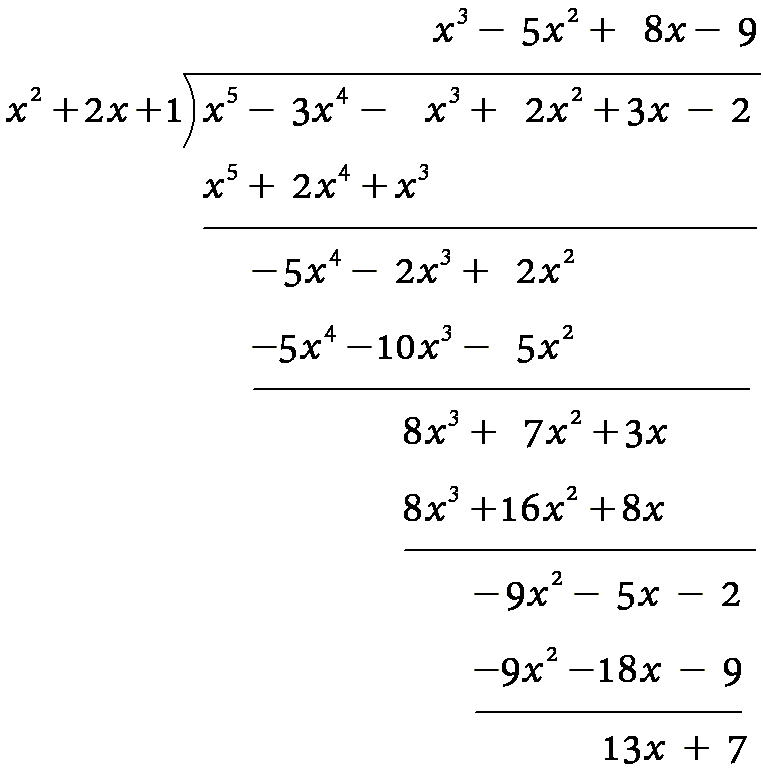
ပေးထားသော polynomial တွင် $x^2$ term ပါဝင်မှုမရှိသဖြင့် စားအိမ်ဖွဲ့ စားသည့်အခါ $x^2$ term အတွက် နေရာလွတ်ချန်၍ သော်လည်းကောင်း၊ မြှောက်ဖော်ကိန်း 0 ထား၍သော်လည်းကောင်း ဖြေရှင်းနိုင်ပါသည်။ ဆက်လက်၍ $x^5-3x^4-x^3+2x^2+3x-2$ ကို $x^2+2x+1$ ဖြင့်စားကြည့်ပါမည်။
 |
|---|
| Note |
|---|
| ကိန်းဂဏန်းများစားခြင်းတွင် အကြွင်းသည် စားလဒ်အောက် အမြဲငယ်ပြီး polynomial များ စားခြင်းတွင် အကြွင်း၏ (degree) သည် စားကိန်း (degree) အောက် အမြဲငယ်သည်ကို တွေ့ရပါမည်။ |
Division Algorithm
မည်သည့်စာခြင်းမဆို အောက်ပါညီမျှခြင်းကို အမြဲပြေလည်စေသည်။
ထို့ကြောင့် အထက်တွင်ဖေါ်ပြခဲ့သော ဥပမာများကို အောက်ပါအတိုင်း ညီမျှခြင်းဖြင့် ပြန်လည်ဖော်ပြနိုင် ပါသည်။
|
|---|
$a$ သည် တည်ကိန်းဖြစ်ပြီး ၎င်းကို $b$ ဖြင့်စားသည့်အခါ စားလဒ်မှာ $q$ ဖြစ်ပြီး အကြွင်းမှာ $r$ ဖြစ်သည် ဆို ပါစို့။ ထိုအခါ $a, b, q$ နှင့် $r$ ဆက်သွယ်ချက်ကို အောက်ပါအတိုင်း ဖော်ပြနိုင်ပါသည်။
ထိုနည်းတူစွာ plynomial $f(x)$ ကို $D(x)$ ဖြင့်စားသည့်အခါ စားလဒ်မှာ $Q(x)$ ဖြစ်ပြီး အကြွင်းမှာ $R(x)$ ဖြစ်သည် ဆိုပါစို့။ အဆိုပါ function လေးခု၏ ဆက်သွယ်ချက်ကို အောက်ပါအတိုင်း ဖေါ်ပြနိုင်သည်။
The Remainder Theorem
အထက်ဖော်ပြပါ ဆက်သွယ်ချက် ညီမျှခြင်းများကို Division Algorithm ဟုခေါ်သည်။
အကယ်၍ $D(x)=x-k$ ဖြစ်လျှင်
$f(x)=Q(x)(x-k)+ R$ ဖြစ်မည်။ remainder $R$ သည် divisor အောက် degree ငယ်သောကြောင့် ကိန်းရှင် $x$ ပေါ်တွင် မှီခိုခြင်းမရှိတော့ပါ။ ထို့ကြောင့် ကိန်းသေ $R$ ဖြင့် သတ်မှတ်ပါမည်။ $x=k$ ဖြစ်သည့်အခါ
ထို့ကြောင့် polynomial $f(x)$ ကို $x-k$ ဖြင့်စားသည့်အခါ အကြွင်းကို $f(k)$ ဟုသတ်မှတ်နိုင်သည်။
| The Remainder Theorem |
|---|
| If a polynomial $f (x)$ is divided by $x-k$, the remainder is $f (k)$. |
Extension of the Remainder Theorem
$f(x)$ ကို $x-k$ ဖြင့်စားလျှင် remainder မှာ f(k) ဖြစ်ကြောင်းသိရှိခဲ့ပြီး ဖြစ်သည်။ $f(x)$ ကို $x+k$ ဖြင့်စားလျှင် remainder မည်သို့ရမည်ကို ဆက်လက်လေ့လာကြည့်ကြမည်။
| $f(x)\div (x-k)\Rightarrow \text{remainder}=f(k)$ $f(x)\div (x+k)\Rightarrow f(x)\div (x-(-k))\Rightarrow \text{remainder}=f(-k)$ |
|---|
ဆက်လက်၍ $f(x)$ ကို $ax-b$ ဖြစ်စားလျှင် remainder မည်သို့ရမည်ကို လေ့လာကြည့်ကြမည်။ စားလဒ်သည် $Q(x)$ ဖြစ်ပြီး အကြွင်းမှာ $R$ ဖြစ်သည် ဆိုပါစို့။ ထိုအခါ
ဖြစ်မည်။ တစ်နည်းဆိုရသော်
ဖြစ်သည်။ $x=\displaystyle\frac{b}{a}$ ဖြစ်သောအခါ
| $f(x)\div (ax-b)\Rightarrow \text{ remainder}=f\left( \displaystyle\frac{b}{a} \right)$ $f(x)\div (ax+b)\Rightarrow f(x)\div (ax-(-b))\Rightarrow \text{remainder}=f\left( -\displaystyle\frac{b}{a} \right)$ |
|---|
ဆက်လက်၍ $f(x)$ ကို $ax$ ဖြစ်စားလျှင် remainder မည်သို့ရမည်ကို လေ့လာကြည့်ပါဦးမည်။ စားလဒ်သည် $Q(x)$ ဖြစ်ပြီး အကြွင်းမှာ $R$ ဟုထားမည်။ ထို့ကြောင့် $$f(x)=Q(x)(ax)+R$$ ဖြစ်မည်။ $x=0$ ဖြစ်သည့်အခါ
Corollary
- If a polynomial $f (x)$ is divided by $x + k$, the remainder is $f (-k)$.
- If a polynomial $f (x)$ is divided by $ax - b$, the remainder is $f\left(\displaystyle \frac{b}{a} \right)$.
- If a polynomial $f (x)$ is divided by $ax + b$, the remainder is $f\left( -\displaystyle\frac{b}{a} \right)$.
- If a polynomial $f (x)$ is divided by $ax$, the remainder is $f(0)$.
Example (1)
Using the remainder theorem, find the remainder when $x^3 + 4x^2 + 6x + 5$ is divided by $x - 2$.
Solution Let $f(x)=x^3 + 4x^2 + 6x + 5$.
When $f(x)$ is divided by $x+2$,
$\begin{aligned} \text{the remainder}&= f(2)\\\\ &=2^2+4(2)^2+6(2)+5\\\\ &=4+16+12+5\\\\ &=37 \end{aligned}$
Example (2)
If the polynomial $x^3 - 3x^2 + kx+7$ is divided by $x+3$, the remainder is $1$, find the value of $k$.
Solution Let $f(x)=x^3 - 3x^2 + kx+7$.
When $f(x)$ is divided by $x+3$, the remainder = f(-3).
By the problem,
$\begin{aligned} f(-3)&= 1\\\\ (-3)^3 - 3(-3)^2 + k(-3)+7&=1\\\\ -27-27-3k+7 &= 1\\\\ -47-3k &=1\\\\ 3k &= 48\\\\ \therefore \ \ \ k &= 16 \end{aligned}$
Example (3)
Given that $2x^4 + ax^3 - 4x^2 + bx + 7$ leaves a remainder $2x + 5$ when it is divided by $x^2 - 3x + 2$. Find the values of $a$ and $b$.
Solution
| Let $Q(x)$ be the quotient when $2x^4 + ax^3 - 4x^2 + bx + 7$ is divided by $x^2 - 3x + 2$. By division algorithm, we have $2 x^{4}+a x^{3}-4 x^{2}+b x+7=Q(x)\left(x^{2}-3 x+2\right)+2 x+5$ $2 x^{4}+a x^{3}-4 x^{2}+b x+7=Q(x)(x-1)(x-2)+2 x+5$ When $x=1$, $2+a-4+b+7=Q(1)(1-1)(1-2)+2(1)+5$ $a+b+5=0+2+5$ $a+b=2-----(1)$ When $x=2$, $2(2)^{4}+a(2)^{3}-4(2)^{2}+b(2)+7=Q(2)(2-1)(2-2)+2(2)+5$ $32+8 a-16+2 b+7=0+4+5$ $8 a+2 b+23=9$ $4 a+b=-7-----(2)$ Subtracting equation $(1)$ from equation $(2)$, $3 b=-9$ $b=-3$ Substituting $b=-3$ in equation $(1)$ $a-3=2$ $a=5$ |
|---|
Exercise
- Using the remainder theorem, find the remainder when:
(a) $2x^2 - 13x + 10$ is divided by $x - 3$. (b) $x^3 - 3x^2 + 5x - 9$ is divided by $x - 2$. (c) $x^3 + 4x^2 + 6x + 5$ is divided by $x + 2$. (d) $x^6 - x3 - 1$ is divided by $x + 2$. (e) $9x^2 + 6x - 10$ is divided by $3x + 1$. (f) $3x^3 + 3x^2 - 11x + 8$ is divided by $3x - 1$. (g) $6x^3 + x^2 + 1$ is divided by $2x - 3$. (h) $3 (x + 4)^2 - (1 - x)^3$ is divided by $x$. (i) $(2x - 1)^3 + 6 (3 + 4x)^2 - 10$ is divided by $2x + 1$. - Find the value of $k$ if $5 x^{5}+2 k x^{3}-6 k x^{2}+9$ has a remainder of 22 when divided by $x-1$.
- The polynomial $x^{3}+a x^{2}+b x-3$ leaves a remainder of 27 when divided by $x-2$ and a remainder of 3 when divided by $x+1$. Calculate the remainder when the polynomial is divided by $x-1$.
- The expression $6 x^{2}-2 x+3$ leaves the remainder of 3 when divided by $x-p$. Determine the values of $p$.
- Given that the expression $x^{3}-a x^{2}+b x+c$ leaves the same remainder when divided by $x+1$ or $x-2$, find $a$ in terms of $b$.
- The expressions $x^{3}-7 x+6$ and $x^{3}-x^{2}-4 x+24$ have the same remainder when divided by $x+p .$ Find the possible values of $p .$
- If the polynomial $x^{3}-3 x^{2}+a x-b$ is divided by $(x-2)$ and $(x+2)$, the remainders are 21 and 1 respectively. Find the values of $a$ and $b$.
- Given that the remainder when $x^{3}-x^{2}+a x$ is divided by $x+a$ where $a>0$, is twice the remainder when it is divided by $x-2 a$, find the value of $a$.
- The remainder when $a x^{3}+b x^{2}+2 x+3$ is divided by $x-1$ is twice when it is divided by $x+1$, show that $b=3 a+3$.
- The remainder when $x^{4}+3 x^{2}-2 x+2$ is divided by $x+a$ is the square of the remainder when $x^{2}-3$ is divided by $x+a$. Calculate the possible values of $a$.
- The expression $a x^{3}-x^{2}+b x-1$ leaves the remainders of $-33$ and 77 when divided by $x+2$ and $x-3$ respectively. Find the value of $a$ and $b$ and find the remainder when the expression is divided by $x-2$.
- When the polynomial $x^{3}-3 x^{2}+k x+7$ is divided by $x+3$, the remainder is $1$ . Find the value of $k$.
- When $x^{3}+a x^{2}+b x-1$ is divided by $x-1$ the remainder is 3 and when divided by $x+2$ the remainder is $-27$. Find $a$ and $b$.
- Find the value of $\mathrm{n}$ for which the division of $x^{2 n}-7 x^{n}+5$ by $x-2$ gives the remainder of 13.
- The remainder when $a(a-b)(a+b)$ is divided by $a-2 b$ is $\displaystyle\frac{3}{4}$. Find the numerical value of $b$.
- The remainder when $p x^{3}+q x^{2}+2 x+1$ is divided by $x+1$ is twice the remainder when it is divided by $x-1$, find the relation between $p$ and $q$.
- If $f(x)=a x^{2}+b x+c$ leaves the remainders $1,25,1$ on division by $x-1$, $x+1, x-2$ respectively, show that $f(x)$ is a perfect square.
- Given that the expression $x^{2}-10 x+14$ leaves the same remainder when divided $x+2 b$ or $x+2 c$, where $b \neq c$, show that $b+c+5=0$.
- The expression $5 x^{2}-10 x+4$ has the same remainder when divided by $x-2 p$ or $x+q$ where $2 p \neq-q$. Find the value of $2 p-q$.
- When the expression $a x^{3}+5 x^{2}+b x+4$ and $b x^{3}+9 x^{2}+a x-6$ are divided by $x+3$, the remainders are $-14$ and $-12$ respectively. Find the value $a$ and $b$.
- Given that $f(x)=k x^{3}+(3 k-2) x^{2}-4$, where $k$ is a constant. If $f(x)$ is divisible by $x+2$, find the value of $k$. With this value $k$, find the remainder when $f(x)$ is divided by $(2 x-1)$.
- The expression $x^{3}+8 x^{2}+p x-25$ leaves a remainder of $R$ when divided by $x-1$ and a remainder of $-R$ when divided by $x+2$. Find the value of $p$. Hence find the remainder when the expression is divided by $x+3$.
- The polynomial $a x^{2}+b x+c$ leaves remainder 1,2, and 9 when divided by $x$, $x-1$ and $x-2$ respectively. What are the values of $a, b$ and $c$?
- If the polynomial $x^{4}-6 x^{3}+16 x^{2}-25 x+10$ is divided by another polynomial $x^{2}-2 x+k$, the remainder comes out to be $x+a$, find $k$ and $a$.


