Showing posts with label matrix. Show all posts

Tuesday, November 27, 2018

Solving Simultaneous Linear Equations by Matrix Method

Find the value of $ \displaystyle m$ by matrix method for which the simultaneous equations $ \displaystyle 3x + my = 5$ and $ \displaystyle (m + 2) x + 5y = m$ have (i) an infinite number of solutions (ii) no solution.
Solution
$ \displaystyle \left. \begin{array}{l}3x+my=5\\(m+2)x+5y=m\end{array} \right\}\ \ ---------(1)$

$ \displaystyle \text{Transforming into matrix form},$

$ \displaystyle \left( {\begin{array}{*{20}{c}} 3 & m \\ {m+2} & 5 \end{array}} \right)\left( {\begin{array}{*{20}{c}} x \\ y \end{array}} \right)=\left( {\begin{array}{*{20}{c}} 5 \\ m \end{array}} \right)------(2)$

$ \displaystyle \text{Let }A=\left( {\begin{array}{*{20}{c}} 3 & m \\ {m+2} & 5 \end{array}} \right),X=\left( {\begin{array}{*{20}{c}} x \\ y \end{array}} \right)\ \text{and }B=\left( {\begin{array}{*{20}{c}} 5 \\ m \end{array}} \right).$

$ \displaystyle \text{Then we have, }AX=B.$

$ \displaystyle \text{If }\det A\ne 0,\text{then }{{A}^{{-1}}}\ \text{exists}\text{.}$

$ \displaystyle {{A}^{{1}}}AX={{A}^{{-1}}}B$

$ \displaystyle IX={{A}^{{-1}}}B$

$ \displaystyle X={{A}^{{-1}}}B$ $ \displaystyle \text{which is a unique solution for }X.$

$ \displaystyle \begin{array}{l}\text{It is given that }X\text{ has}\\\text{(i) an infinite number of solutions and}\\\text{(ii) no solution}\text{.}\end{array}$

$ \displaystyle \text{It means that the system has no unique solution}\text{.}$

$ \displaystyle \text{Thus, }\det A=0.$

$ \displaystyle \therefore 15-2m-{{m}^{2}}=0$

$ \displaystyle \therefore (5+m)(3-m)=0$

$ \displaystyle \therefore m=-5\ \text{or }m=3$

$ \displaystyle \text{When }m=-5,\ \text{System (1) becomes}$

$ \displaystyle 3x-5y=5\text{ and }-3x+5y=-5$

$ \displaystyle \begin{array}{l}\therefore \text{The two equations represents the same }\\\text{straight line and there will be infinite }\\\text{number of solutions}\text{.}\end{array}$
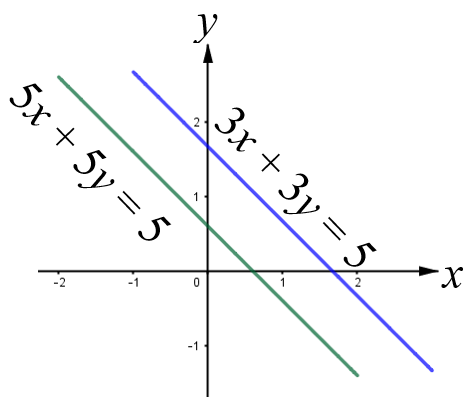
$ \displaystyle \text{When }m=3,\ \text{System (1) becomes}$

$ \displaystyle 3x+3y=5\text{ and }5x+5y=-3$

$ \displaystyle \begin{array}{l}\therefore \text{The two lines are parallel and }\\\text{there will be no solution}\text{.}\\\text{ }\end{array}$

Saturday, November 24, 2018

Characteristic Equation of a Square matrix of Order 2 : The Cayley-Hamilton Theorem


အကယ္၍ $ \displaystyle A=\left( {\begin{array}{*{20}{c}} a & b \\ c & d \end{array}} \right)$ ၊ $ \displaystyle I=\left( {\begin{array}{*{20}{c}} 1 & 0 \\ 0 & 1 \end{array}} \right)$ နဲ႔ $ \displaystyle xI-A$ ဟာ singular matrix ျဖစ္မယ္ဆိုရင္

          $ \displaystyle \begin{array}{l}xI-A=x\left( {\begin{array}{*{20}{c}} 1 & 0 \\ 0 & 1 \end{array}} \right)-\left( {\begin{array}{*{20}{c}} a & b \\ c & d \end{array}} \right)\\\\\ \ \ \ \ \ \ \ \ \ \ \ =\left( {\begin{array}{*{20}{c}} {x-a} & b \\ c & {x-d} \end{array}} \right)\end{array}$ 
  
ဒါဆိုရင္ $ \displaystyle xI-A$ ရဲ့ determinant ကို ရွာၾကည့္မယ္။

     $ \displaystyle \begin{array}{l} \det (xI-A)=(x-a)(x-d)-bc\\\\\ \ \ \ \ \ \ \ \ \ \ \ \ \ \ \ \ \ \ \ \ \ \ \ \ ={{x}^{2}}-(a+d)x+ad-bc\end{array}$

ဒီေနရာမွာ $ \displaystyle a+d$ ကို matrix  $ \displaystyle A$ ရဲ့ trace လို႔ ေခၚၿပီး  $ \displaystyle \operatorname{tr}(A)$ လို႔ သတ္မွတ္ပါမယ္။ $ \displaystyle ad-bc$ ကေတာ့ matrix $ \displaystyle A$ ရဲ့ determinant ျဖစ္ၿပီး $ \displaystyle \det (A)$ လို႔ သတ္မွတ္ပါမယ္။

      $ \displaystyle xI-A$ ဟာ singular matrix ျဖစ္လို႔ $ \displaystyle \det (xI-A)=0$ ျဖစ္မွာေပါ့။ ဒါဆိုရင္

     $ \displaystyle \begin{array}{l}\ \ \ \ \ \det (xI-A)=0\\\\\therefore {{x}^{2}}-(a+d)x+ad-bc=0\\\\\therefore {{x}^{2}}-\operatorname{tr}(A)x+\det (A)=0\end{array}$

အျမင္ရွင္းလင္း လြယ္ကူေအာင္ $ \displaystyle \operatorname{tr}(A)=a+d$ ကို $ p$ လို႔ထားၿပီး $ \displaystyle \det (A)=ad-bc$ ကိုေတာ့ $ q$ လို႔ထားလိုက္မယ္။

ဒါ့ေၾကာင့္ $ \displaystyle {{x}^{2}}-px+q=0$ ဆိုတဲ့ polynomial equation တစ္ခု ရပါတယ္။ ၎ equation ကို characteristic equation လို႔ ေခၚပါတယ္။

Chareateristic polynomial ကို $ \displaystyle f(x)$ လို႔ထားလိုက္မယ္ဆိုရင္ characteristic equation က $ \displaystyle f(x)=0$ ေပါ့။ $ \displaystyle x$ ေနရာမွာ matrix $ \displaystyle A$ ကို အစားသြင္းလိုက္ရင္ 

           $ \displaystyle f(A)=0$
     $ \displaystyle \therefore {{A}^{2}}-pA+qI=O$ 

real number မွာေတာ့ အေျမႇာက္ထပ္တူရကိန္းက 1 ျဖစ္ေသာ္လည္း matrix မွာေတာ့ အေျမႇာက္ ထပ္တူရ matrix က identity matrix  $ (I)$ ျဖစ္ တယ္ဆိုတာ သတိျပဳဖို႔ လိုပါတယ္။

ဒါ့ေၾကာင့္ မည္သည့္ square matrix မဆို ၎ရဲ့ characteristic equation ကို ေျပလည္ေစပါတယ္။
 
$ \displaystyle {{{A}^{2}}-\operatorname{tr}(A)A+\det (A)I=O}$
 

For 2× 2 matrix $ \displaystyle A=\left( {\begin{array}{*{20}{c}} a & b \\ c & d \end{array}} \right)$,
 
$\displaystyle {{A}^{2}}-(a+d)A+(ad-bc)I=O$
      
Proof : If $ \displaystyle A=\left( {\begin{array}{*{20}{c}} a & b \\ c & d \end{array}} \right)$, then 

     
     $ \displaystyle \begin{array}{l}\ \ \ {{A}^{2}}-(a+d)A+(ad-bc)I\\\\=\left( {\begin{array}{*{20}{c}} a & b \\ c & d \end{array}} \right)\left( {\begin{array}{*{20}{c}} a & b \\ c & d \end{array}} \right)-(a+d)\left( {\begin{array}{*{20}{c}} a & b \\ c & d \end{array}} \right)+(ad-bc)\left( {\begin{array}{*{20}{c}} 1 & 0 \\ 0 & 1 \end{array}} \right)\\\\=\left( {\begin{array}{*{20}{c}} {{{a}^{2}}+bc} & {ab+bd} \\ {ac+cd} & {bc+{{d}^{2}}} \end{array}} \right)-\left( {\begin{array}{*{20}{c}} {{{a}^{2}}+ad} & {ab+bd} \\ {ac+cd} & {ad+{{d}^{2}}} \end{array}} \right)+\left( {\begin{array}{*{20}{c}} {ad-bc} & 0 \\ 0 & {ad-bc} \end{array}} \right)\\\\=\left( {\begin{array}{*{20}{c}} 0 & 0 \\ 0 & 0 \end{array}} \right)\\\\=O\end{array}$

Extension of Characteristic Equation   
      $ \displaystyle \ \ \ \ {{A}^{2}}-pA+qI=O$

ႏွစ္ဘက္လံုးကို $ \displaystyle {{A}^{{-1}}}$ နဲ႔ ေျမႇာက္လိုက္ရင္ 

     $ \displaystyle \begin{array}{l}\ \ \ {{A}^{2}}{{A}^{{-1}}}-pA{{A}^{{-1}}}+qI{{A}^{{-1}}}=O\\\\\ \ \ AA{{A}^{{-1}}}-pA{{A}^{{-1}}}+qI{{A}^{{-1}}}=O\\\\\ \ \ AI-pI+q{{A}^{{-1}}}=O\\\\\therefore A-pI+q{{A}^{{-1}}}=O\\\\\therefore A-(a+d)I+(ad-bc){{A}^{{-1}}}=O\end{array}$

အကယ္၍ $ \displaystyle  A=\left( {\begin{array}{*{20}{c}} a & b \\ c & d \end{array}} \right)$ ျဖစ္ခဲ့ရင္ $ \displaystyle {\operatorname{tr}(A)=p=a+d}$ and $ \displaystyle \det (A)=q=ad-bc$ ဆိုတာ ေျပာခဲ့ၿပီးပါၿပီ။

    $ \displaystyle \begin{array}{l}\ \ \ {{A}^{2}}=\left( {\begin{array}{*{20}{c}} a & b \\ c & d \end{array}} \right)\left( {\begin{array}{*{20}{c}} a & b \\ c & d \end{array}} \right)\ \ \ \ \ \ \ \ \ \ \ \ \ \ \ \ \ \ \ \ \ \ \ \ \ \ \ \ \ \ \ \ \ \ \ \ \ \ \ \ \ \ -----(1)\\\\\ \ \ \ \ \ \ \ \ =\left( {\begin{array}{*{20}{c}} {{{a}^{2}}+bc} & {ab+bd} \\ {ac+cd} & {bc+{{d}^{2}}} \end{array}} \right)\\\\\ \ {{A}^{{-1}}}=\frac{1}{{ad-bc}}\left( {\begin{array}{*{20}{c}} d & {-b} \\ {-c} & a \end{array}} \right)\\\\\ \ pq{{A}^{{-1}}}=(a+d)(ad-bc)\frac{1}{{ad-bc}}\left( {\begin{array}{*{20}{c}} d & {-b} \\ {-c} & a \end{array}} \right)\ \ \\\\\ \ \ \ \ \ \ \ \ \ \ =(a+d)\left( {\begin{array}{*{20}{c}} d & {-b} \\ {-c} & a \end{array}} \right)\\\\\ \ \ \ \ \ \ \ \ \ \ =\left( {\begin{array}{*{20}{c}} {ad+{{d}^{2}}} & {-ab-bd} \\ {-ac-cd} & {{{a}^{2}}+ad} \end{array}} \right)\ \ \ \ \ \ \ \ \ \ \ \ \ \ \ \ \ \ \ \ \ \ \ \ \ \ \ \ -----(2)\\\\\ \ \ (q-{{p}^{2}})I=\left[ {(ad-bc)-{{{(a+d)}}^{2}}} \right]I\\\\\ \ \ \ \ \ \ \ \ \ \ \ \ \ \ \ \ =\left[ {-bc-ad-{{a}^{2}}-{{d}^{2}}} \right]\left( {\begin{array}{*{20}{c}} 1 & 0 \\ 0 & 1 \end{array}} \right)\\\\\ \ \ \ \ \ \ \ \ \ \ \ \ \ \ \ \ =\left( {\begin{array}{*{20}{c}} {-bc-ad-{{a}^{2}}-{{d}^{2}}} & 0 \\ 0 & {-bc-ad-{{a}^{2}}-{{d}^{2}}} \end{array}} \right)--(3)\end{array}$

ညီမွ်ျခင္း (1), (2), (3) ကို ေပါင္းလိုက္ရင္ 
    $ \displaystyle \begin{array}{l}\ \ \ {{A}^{2}}+pq{{A}^{{-1}}}+(q-{{p}^{2}})I\\\\=\left( {\begin{array}{*{20}{c}} {{{a}^{2}}+bc} & {ab+bd} \\ {ac+cd} & {bc+{{d}^{2}}} \end{array}} \right)+\left( {\begin{array}{*{20}{c}} {ad+{{d}^{2}}} & {-ab-bd} \\ {-ac-cd} & {{{a}^{2}}+ad} \end{array}} \right)+\left( {\begin{array}{*{20}{c}} {-bc-ad-{{a}^{2}}-{{d}^{2}}} & 0 \\ 0 & {-bc-ad-{{a}^{2}}-{{d}^{2}}} \end{array}} \right)\\\\=\left( {\begin{array}{*{20}{c}} 0 & 0 \\ 0 & 0 \end{array}} \right)\\\\=O\end{array}$

    $ \displaystyle \begin{array}{l}\therefore {{A}^{2}}+pq{{A}^{{-1}}}+(q-{{p}^{2}})I=O\\\\\therefore {{A}^{2}}+(a+d)(ad-bc){{A}^{{-1}}}+\left[ {(ad-bc)-{{{(a+d)}}^{2}}} \right]I=O\end{array}$

အားလံုးျပန္ခ်ဳပ္လိုက္ရင္ $ \displaystyle A=\left( {\begin{array}{*{20}{c}} a & b \\ c & d \end{array}} \right)\ $ ျဖစ္ခဲ့ရင္

$ \displaystyle \begin{array}{l}(1){{A}^{2}}-(a+d)A+(ad-bc)I=O\\\\(2){A}-(a+d)I+(ad-bc){{A}^{{-1}}}=O\\\\(3){{A}^{2}}+(a+d)(ad-bc){{A}^{{-1}}}+\left[ {(ad-bc)-{{{(a+d)}}^{2}}} \right]I=O\end{array}$

Example : If $ \displaystyle A=\left( {\begin{array}{*{20}{c}} {-2} & 3 \\ {-3} & 4 \end{array}} \right)\ $ then

       $ \displaystyle \begin{array}{l}(1)\ \ {{A}^{2}}-(-2+4)A+(-8+9)I=O\\\\\Rightarrow {{A}^{2}}-2A+I=O\\\\(2){A}-(-2+4)I+(-8+9){{A}^{{-1}}}=O\\\\\Rightarrow {A}+{{A}^{{-1}}}-2I=O\\\\(3){{A}^{2}}+(-2+4)(-8+9){{A}^{{-1}}}+\left[ {(-8+9)-{{{(-2+4)}}^{2}}} \right]I=O\\\\\Rightarrow {{A}^{2}}+2{{A}^{{-1}}}-3I=O\end{array}$.

ေမးခြန္းျပန္လုပ္ေသာ္

$ \displaystyle \begin{array}{l}\text{If}\ A=\left( {\begin{array}{*{20}{c}} {-2} & 3 \\ {-3} & 4 \end{array}} \right)\ \ \text{show that}\\\begin{array}{*{20}{l}} {(1){{A}^{2}}-2A+I=O} \\ {(2)A+{{A}^{{-1}}}-2I=O} \\ {(3){{A}^{2}}+2{{A}^{{-1}}}-3I=O} \end{array}\\\text{where}\ I\ \text{is a unit matrix of order 2}\text{.}\end{array}$

ဆရာႀကီး Dr. Shwe Kyaw ပို႔ခ်ခဲ့ေသာ post ကို မွီျငမ္း၍ ျပန္လည္ တင္ျပပါသည္။