الجمعة، 23 نوفمبر 2018

Problem Study : Definition of Inverse of a Square Matrix

 
Show that $ \displaystyle A=\left( {\begin{array}{*{20}{c}} 5 & 3 \\ {-1} & 2 \end{array}} \right)$ satisfies the equation $ \displaystyle {{A}^{2}}-3A-7I=O$ where $ \displaystyle I$ is a unit matrix of order 2. Hence using this result, find $ \displaystyle {{A}^{{-1}}}$.

Solution

      $ \displaystyle \ \ \ \ A\ \ =\left( {\begin{array}{*{20}{c}} 5 & 3 \\ {-1} & 2 \end{array}} \right)$

      $ \displaystyle \begin{array}{l}\therefore {{A}^{2}}=\left( {\begin{array}{*{20}{c}} 5 & 3 \\ {-1} & 2 \end{array}} \right)\left( {\begin{array}{*{20}{c}} 5 & 3 \\ {-1} & 2 \end{array}} \right)\\\\\ \ \ \ \ \ \ =\left( {\begin{array}{*{20}{c}} {25-3} \\ {-5+2} \end{array}\ \ \ \begin{array}{*{20}{c}} {15-6} \\ {-3+4} \end{array}} \right)\\\\\ \ \ \ \ \ \ =\left( {\begin{array}{*{20}{c}} {22} & 9 \\ {-3} & 1 \end{array}} \right)\end{array}$

      $ \displaystyle \begin{array}{l}\therefore {{A}^{2}}-3A-7I\\\\=\left( {\begin{array}{*{20}{c}} {22} & 9 \\ {-3} & 1 \end{array}} \right)-3\left( {\begin{array}{*{20}{c}} 5 & 3 \\ {-1} & 2 \end{array}} \right)-7\left( {\begin{array}{*{20}{c}} 1 & 0 \\ 0 & 1 \end{array}} \right)\\\\=\left( {\begin{array}{*{20}{c}} {22} & 9 \\ {-3} & 1 \end{array}} \right)+\left( {\begin{array}{*{20}{c}} {-15} \\ 3 \end{array}\ \ \ \begin{array}{*{20}{c}} {-9} \\ 6 \end{array}} \right)+\left( {\begin{array}{*{20}{c}} {-7} & 0 \\ 0 & {-7} \end{array}} \right)\\\\=\left( {\begin{array}{*{20}{c}} {22-15-7} & {9-9} \\ {-3+3} & {1+6-7} \end{array}} \right)\\\\=\left( {\begin{array}{*{20}{c}} 0 & 0 \\ 0 & 0 \end{array}} \right)\\\\=O\end{array}$

      $ \displaystyle \therefore {{A}^{2}}-3A-7I=O$

      Multiplying both sides with $ \displaystyle {{A}^{{-1}}}$,

      $ \displaystyle \begin{array}{l}{{A}^{2}}-3A-7I=O\\\\AA{{A}^{{-1}}}-3A{{A}^{{-1}}}-7I{{A}^{{-1}}}=O{{A}^{{-1}}}\\\\AI-3I-7{{A}^{{-1}}}=O\\\\AI-3I=7{{A}^{{-1}}}\end{array}$

      $ \displaystyle \begin{array}{l}\therefore 7{{A}^{{-1}}}=AI-3I\\\\\ \ \ \ \ \ \ \ \ \ =\left( {\begin{array}{*{20}{c}} 5 \\ {-1} \end{array}\ \ \ \begin{array}{*{20}{c}} 3 \\ {-2} \end{array}} \right)-3\left( {\begin{array}{*{20}{c}} 1 & 0 \\ 0 & 1 \end{array}} \right)\\\\\ \ \ \ \ \ \ \ \ \ =\left( {\begin{array}{*{20}{c}} {5-3} \\ {-1} \end{array}\ \ \ \begin{array}{*{20}{c}} 3 \\ {-2-3} \end{array}} \right)\\\\\ \ \ \ \ \ \ \ \ \ =\left( {\begin{array}{*{20}{c}} 2 \\ {-1} \end{array}\ \ \ \begin{array}{*{20}{c}} 3 \\ {-5} \end{array}} \right)\\\\\therefore {{A}^{{-1}}}\ \ =\frac{1}{7}\left( {\begin{array}{*{20}{c}} 2 \\ {-1} \end{array}\ \ \ \begin{array}{*{20}{c}} 3 \\ {-5} \end{array}} \right)\\\\\ \ \ \ \ \ \ \ \ \ =\left( {\begin{array}{*{20}{c}} {\frac{2}{7}} & {\frac{3}{7}} \\ {-\frac{1}{7}} & {-\frac{5}{7}} \end{array}} \right)\end{array}$


الخميس، 22 نوفمبر 2018

Trigonometry and Properties of Quadratic Equation

If $ \displaystyle \tan A$ and $ \displaystyle \tan B$ are the roots of the equation $ \displaystyle {{x}^{2}}-px+q=0$, where $ \displaystyle p$ and $ \displaystyle q$ are real constants, find the value of $ \displaystyle {{\sin }^{2}}(A+B)$ in terms of $ \displaystyle p$ and  $ \displaystyle q$.

Solution

             $ \displaystyle \ \ \ \ \tan A$ and $ \displaystyle \tan B$ are the roots of the equation $ \displaystyle {{x}^{2}}-px+q=0$,

             $ \displaystyle \therefore {{x}^{2}}-px+q=(x-\tan A)(x-\tan B)$

             $ \displaystyle \therefore {{x}^{2}}-px+q={{x}^{2}}-(\tan A+\tan B)x+\tan A\cdot \tan B$
         
             $ \displaystyle \therefore \tan A+\tan B=p$ and $ \displaystyle \tan A\cdot \tan B=q$

             $ \displaystyle \therefore \frac{{\tan A+\tan B}}{{1-\tan A\tan B}}=\frac{p}{{1-q}}$

             $ \displaystyle \therefore \tan (A+B)=\frac{p}{{1-q}}$

             $ \displaystyle \therefore \frac{{\sin (A+B)}}{{\cos (A+B)}}=\frac{p}{{1-q}}$

             $ \displaystyle \therefore \cos (A+B)=\frac{{1-q}}{p}\cdot \sin (A+B)$

             $ \displaystyle \ \ \ $ Since $ \displaystyle {{\sin }^{2}}(A+B)+{{\cos }^{2}}(A+B)=1$

             $ \displaystyle \ \ \ \ {{\sin }^{2}}(A+B)+{{\left( {\frac{{1-q}}{p}} \right)}^{2}}{{\sin }^{2}}(A+B)=1$

             $ \displaystyle \ \ \ \ {{\sin }^{2}}(A+B)\left( {1+\frac{{{{{\left( {1-q} \right)}}^{2}}}}{{{{p}^{2}}}}} \right)=1$

             $ \displaystyle \therefore {{\sin }^{2}}(A+B)=\frac{{{{p}^{2}}}}{{{{p}^{2}}+{{{\left( {1-q} \right)}}^{2}}}}$

Problem Study : Geometric Progression

Find the smallest  number in the progression 3, 12, 48, ... which is greater than 10 000.

Solution

          Given Sequence : $ \displaystyle 3, 12, 48, ...$

       $ \displaystyle \therefore \frac{{{{u}_{2}}}}{{{{u}_{1}}}}=\frac{{12}}{3}=4$

       $ \displaystyle \ \ \ \frac{{{{u}_{3}}}}{{{{u}_{2}}}}=\frac{{48}}{{12}}=4$

       $ \displaystyle \therefore \frac{{{{u}_{2}}}}{{{{u}_{1}}}}=\frac{{{{u}_{3}}}}{{{{u}_{2}}}}$

       Therefore the given sequence is a geometric progression with the first term $ \displaystyle 3$ and the commratio $ \displaystyle 4$.
     
       $ \displaystyle \therefore a=3$  and $ \displaystyle r=4$.

       Let the smallest number in the progression which is greater than $ \displaystyle 10\ 000$ be $ \displaystyle {{{u}_{n}}}$

      $ \displaystyle \therefore {{u}_{n}}>10\ 000$    

      $ \displaystyle \ \ a{{r}^{{n-1}}}>10\ 000$    

      $ \displaystyle \ 3({{4}^{{n-1}}})>10\ 000$    
 
      $ \displaystyle \ \ {{4}^{{n-1}}}>3333.33$

      But $ \displaystyle {{4}^{5}}=1024<3333 .33$ and $ \displaystyle {{4}^{6}}=4096>3333 .33$
 
     $ \displaystyle \therefore n-1=6$
 
     $ \displaystyle \therefore n=7$
 
     $ \displaystyle \therefore {{u}_{7}}=3({{4}^{6}})=12\ 288$
 
     Therefore the smallest number in the progression which is greater than $ \displaystyle 10\ 000$ is $ \displaystyle 12\ 288$.

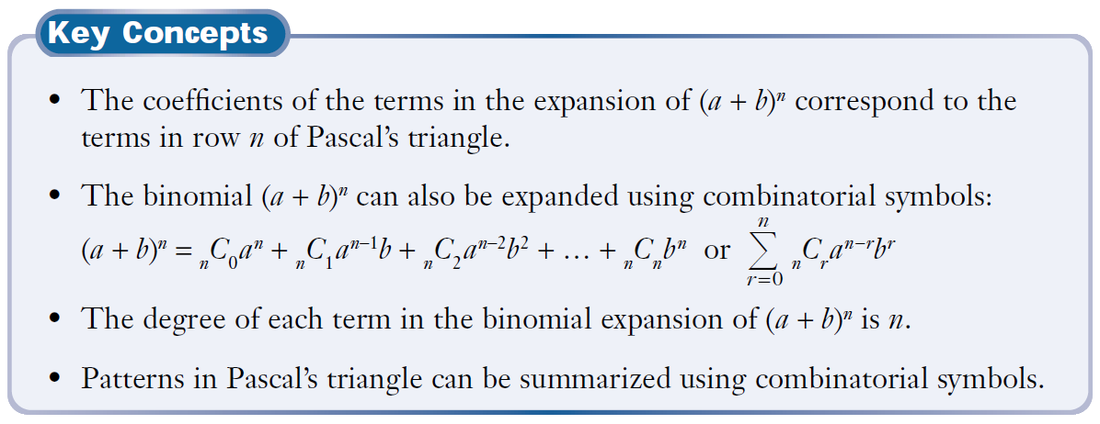
Problem Study : The Binomial Theorem

It is given that the coefficient of $ \displaystyle {{x}^{2}}$ is equal to the coefficient of  $ \displaystyle {{x}^{3}}$ in the binomial expansion of $ \displaystyle {{(2k\text{ }+\text{ }x)}^{n}}$, where $ \displaystyle k$ is a constant and $ \displaystyle n$ is a positive integer. Prove that $ \displaystyle n=6k+2$.

Solution

           $ \displaystyle {{(r+1)}^{{th}}}$ term in the expansion of $ \displaystyle {{(2k\text{ }+\text{ }x)}^{n}}={}^{n}{{C}_{r}}{{(2k)}^{{n-r}}}{{x}^{r}}$

           For  $ \displaystyle {{x}^{2}}$, $ \displaystyle r=2$

       $ \displaystyle \therefore $ coefficient of $ \displaystyle {{x}^{2}}={}^{n}{{C}_{2}}{{(2k)}^{{n-2}}}$
      
           For  $ \displaystyle {{x}^{3}}$, $ \displaystyle r=3$

       $ \displaystyle \therefore $ coefficient of $ \displaystyle {{x}^{3}}={}^{n}{{C}_{3}}{{(2k)}^{{n-3}}}$

           By the problem, 

           Coefficient of $ \displaystyle {{x}^{2}}=$ Coefficient of $ \displaystyle {{x}^{3}}$

       $ \displaystyle \therefore {}^{n}{{C}_{2}}{{(2k)}^{{n-2}}}={}^{n}{{C}_{3}}{{(2k)}^{{n-3}}}$

       $ \displaystyle \therefore \frac{{n(n-1)}}{{1\times 2}}(2k)=\frac{{n(n-1)(n-2)}}{{1\times 2\times 3}}$

       $ \displaystyle \therefore 2k=\frac{{n-2}}{3}$

       $\displaystyle \therefore n=6k+2$

Law of Cosines and to Find Extremum by Completing Square

 In $ \displaystyle \Delta ABC$, $ \displaystyle AB=(5-x)$ cm, $ \displaystyle BC=(4+x)$ cm, $ \displaystyle \angle AsBC=120{}^\circ $ and $ \displaystyle AC=y$ cm.

(a)     Show that $ \displaystyle {{y}^{2}}={{x}^{2}}-x+61$.

(b)     Find the minimum value of $ \displaystyle {{y}^{2}}$, and give the value of $ \displaystyle x$ for which this occurs.

Solution
          $ \displaystyle AB=(5-x)$ cm,  
          $ \displaystyle BC=(4+x)$ cm, 
          $ \displaystyle \angle ABC=120{}^\circ $ 
          $ \displaystyle AC=y$ cm. 

(a)      By the law of cosines, 

          $ \displaystyle A{{C}^{2}}=A{{B}^{2}}+B{{C}^{2}}-2\cdot AB\cdot AC\cos (\angle ABC)$ 
      
          $ \displaystyle {{y}^{2}}={{(5-x)}^{2}}+{{(4+x)}^{2}}-2(5-x)(4+x)\cos 120{}^\circ $

          $ \displaystyle {{y}^{2}}=25-10x+{{x}^{2}}+16+8x+{{x}^{2}}+2(5-x)(4+x)\left( {\frac{1}{2}} \right)$

          $ \displaystyle {{y}^{2}}=41-2x+2{{x}^{2}}-{{x}^{2}}+x+20$

          $ \displaystyle {{y}^{2}}={{x}^{2}}-x+61$

      $ \displaystyle \therefore {{y}^{2}}={{x}^{2}}-x+\frac{1}{4}+61-\frac{1}{4}$

      $ \displaystyle \therefore {{y}^{2}}={{\left( {x-\frac{1}{2}} \right)}^{2}}+60.75$

          Since $ \displaystyle {{\left( {x-\frac{1}{2}} \right)}^{2}}\ge 0\ $ for all $ \displaystyle x\in R$,

          $ \displaystyle {{\left( {x-\frac{1}{2}} \right)}^{2}}+60.75\ge 60.75$

      $ \displaystyle \therefore {{y}^{2}}\ge 60.75$.

          Therefore the minimum value of $\displaystyle {{y}^{2}}$ is $ \displaystyle 60.75$ and this value occurs when $ \displaystyle x=\frac{1}{2}$.     

الأربعاء، 21 نوفمبر 2018

Chapter (8) : Circles (Theorem, Problems and Solutions)


Missprint မ်ားရွိႏိုင္ပါသည္။ လိုအပ္သလို ျပင္ဆင္ဖတ္႐ွဳပါ။ print ထုတ္ သံုးဆြဲႏိုင္ပါသည္။ page header ကို မိမိ အမည္ေျပာင္းလဲ သံုးစြဲခြင့္မျပဳပါ။
Download
https://onedrive.live.com/redir?resid=7B4C542114885196%211264&authkey=%21AFxOlN4B0oyyFTo&page=Download
အဆင္ေျပပါေစ

Properties of Limits


1.     $ \displaystyle \underset{{x\to a}}{\mathop{{\lim }}}\,f(x)=f(a)$ when $ \displaystyle f(x)$ is continuous at $ \displaystyle x=a$.
        Function သည် $ \displaystyle x=a$ တွင် continuous ဖြစ်နေလျှင် [$ \displaystyle f(a)$ တန်ဖိုးရှာနိုင်လျှင် (သို့) $ \displaystyle f(a)$ သည် indeterminate form
        မဖြစ်လျှင်] $ \displaystyle \underset{{x\to a}}{\mathop{{\lim }}}\,f(x)=f(a)$ ဟု ရေးနိုင်ပါသည်။

       Assume that the limits of functions $\displaystyle \underset{{x\to a}}{\mathop{{\lim }}}\,f(x)$ and $\displaystyle \underset{{x\to a}}{\mathop{{\lim }}}\,g(x)$ exist and that $ \displaystyle c$ is any constant. Then 

2.  The limit of a constant times a function is the constant times the limit.
 
$ \displaystyle \underset{{x\to a}}{\mathop{{\lim }}}\,\left( {c\cdot f(x)} \right)=c\cdot \underset{{x\to a}}{\mathop{{\lim }}}\,f(x)$
      
       Function ကို constant ဖြင့် မြှောက်ထားလျှင် function ကိုသာ limit ယူပြီး constant ဖြင့် မြှောက်ပေးရပါသည်။

              Example :
          $ \displaystyle \ \ \ \underset{{x\to 3}}{\mathop{{\lim }}}\,(4x)$
          $ \displaystyle =4\underset{{x\to 3}}{\mathop{{\lim }}}\,(x)$
          $ \displaystyle =4(3)$
          $ \displaystyle =12$

3.  The limit of a constant times a function is the constant times the limit. If $ \displaystyle h(x)=c$ for all $ \displaystyle x$, then

$ \displaystyle \underset{{x\to a}}{\mathop{{\lim }}}\,h(x)=\underset{{x\to a}}{\mathop{{\lim }}}\,c=c$

      Function သည်ကိန်းသေ (constant function) ဖြစ်လျှင် function ကို limit ယူလျှင် မူလတန်ဘိုး constant သာ ပြန်ရသည်။

             Example :
             $ \displaystyle \underset{{x\to a}}{\mathop{{\lim }}}\,(3)=3$
             $ \displaystyle \underset{{x\to a}}{\mathop{{\lim }}}\,(2018)=2018$
             $ \displaystyle \underset{{x\to a}}{\mathop{{\lim }}}\,(\sqrt{5})=\sqrt{5}$

4.     The limit of a sum or difference is the sum or difference of the limits.

$ \displaystyle \underset{{x\to a}}{\mathop{{\lim }}}\,[f\left( x \right)\pm g\left( x \right)]\text{ }=~\underset{{x\to a}}{\mathop{{\lim }}}\,f\left( x \right)\pm \underset{{x\to a}}{\mathop{{\lim }}}\,g\left( x \right)$

        Function များ၏ ပေါင်းလဒ် နှုတ်လဒ်ကို Limit ယူလျှင် Function တစ်ခုချင်းစီကို Limit ယူပြီးမှ ပေါင်း၊ နှုတ် လုပ်ရသည်။

           Example :
           $ \displaystyle \ \ \ \underset{{x\to 1}}{\mathop{{\lim }}}\,\left( {3{{x}^{2}}+4x+1} \right)$
           $ \displaystyle =\underset{{x\to 1}}{\mathop{{\lim }}}\,3{{x}^{2}}+\underset{{x\to 1}}{\mathop{{\lim }}}\,4x+\underset{{x\to 1}}{\mathop{{\lim }}}\,1$ 
           $ \displaystyle =3+4+1$
           $ \displaystyle =8$

          လက်တွေ့ပုစ္ဆာများကို ဖြေရှင်းရာတွင် ရိုးရှင်းသော အလယ်အဆင့်များကို ကျော်တွက်လေ့ရှိသည်။ 

5.     The limit of the product of two functions is the product of their limits (if they exist):   
 
$ \displaystyle \underset{{x\to a}}{\mathop{{\lim }}}\,[f\left( x \right)\cdot g\left( x \right)]\text{ }=~\underset{{x\to a}}{\mathop{{\lim }}}\,f\left( x \right)\cdot \underset{{x\to a}}{\mathop{{\lim }}}\,g\left( x \right)$

        Function များ၏မြှောက်လဒ်ကို Limit ယူလျှင် Function တစ်ခုချင်းစီကို Limit ယူပြီးမှ မြှောက် ရသည်။

           Example :
           $ \displaystyle \ \ \ \underset{{x\to 4}}{\mathop{{\lim }}}\,\left( {x\cdot \sqrt{x}} \right)$
           $ \displaystyle =\underset{{x\to 4}}{\mathop{{\lim }}}\,x\cdot \underset{{x\to 4}}{\mathop{{\lim }}}\,\sqrt{x}$ 
           $ \displaystyle =4\sqrt{4}$
           $ \displaystyle =2$
      
          လက်တွေ့ပုစ္ဆာများကို ဖြေရှင်းရာတွင် ရိုးရှင်းသော အလယ်အဆင့်များကို ကျော်တွက်လေ့ရှိသည်။  

6.     The limit of quotient of two functions is the quotient of their limits, provided that 
        the limit in the denominator function is not zero: 

$ \displaystyle \underset{{x\to a}}{\mathop{{\lim }}}\,\frac{{f(x)}}{{g(x)}}=\frac{{\underset{{x\to a}}{\mathop{{\lim }}}\,f(x)}}{{\underset{{x\to a}}{\mathop{{\lim }}}\,g(x)}}$ if $ \displaystyle \underset{{x\to a}}{\mathop{{\lim }}}\,g(x)\ne 0$

        Function များ၏ စားလဒ်ကို Limit ယူလျှင် Function တစ်ခုချင်းစီကို Limit ယူပြီးမှ စား ရသည်။ 
          ပိုင်းခြေ Function Limit သည် 0 မဖြစ်ရပါ။

          Example :
          $ \displaystyle \ \ \ \ \underset{{x\to 1}}{\mathop{{\lim }}}\,\frac{{{{x}^{2}}+1}}{{2x-1}}$
          $ \displaystyle =\frac{{\underset{{x\to 1}}{\mathop{{\lim }}}\,\left( {{{x}^{2}}+1} \right)}}{{\underset{{x\to 1}}{\mathop{{\lim }}}\,\left( {2x-1} \right)}}$ 
          $ \displaystyle =\frac{{1+1}}{{2-1}}$
          $ \displaystyle =2$
     
      လက်တွေ့ပုစ္ဆာများကို ဖြေရှင်းရာတွင် ပိုင်းခြေ 0 မဖြစ်လျှင် ရိုးရှင်းသော အလယ်အဆင့်များ ကို ကျော်တွက်လေ့ရှိသည်။ 

7 .
$ \displaystyle \underset{{x\to a}}{\mathop{{\lim }}}\,{{\left[ {f\left( x \right)} \right]}^{n}}={{\left[ {\underset{{x\to a}}{\mathop{{\lim }}}\,f\left( x \right)} \right]}^{n}},\underset{{x\to a}}{\mathop{{\lim }}}\,\sqrt[n]{{f(x)}}=\sqrt[n]{{\underset{{x\to a}}{\mathop{{\lim }}}\,f(x)}}$ where the powr $ \displaystyle n$ can be any real number.

       ထပ်ကိန်း (ကိန်းရင်း) Function များကို Limit ယူလျှင် Function ကို Limit ယူပြီးမှ ထပ်ကိန်း (ကိန်းရင်း) ကို ရှာရပါသည်။

          Example (1)
          $ \displaystyle \ \ \ \underset{{x\to 2}}{\mathop{{\lim }}}\,{{x}^{5}}$
          $ \displaystyle ={{\left( {\underset{{x\to 2}}{\mathop{{\lim }}}\,x} \right)}^{5}}$ 
          $ \displaystyle ={{2}^{5}}$
          $ \displaystyle =32$
       
          Example (2): 
          $ \displaystyle \ \ \ \underset{{x\to 2}}{\mathop{{\lim }}}\,{{\left[ {2x-3} \right]}^{3}}$
          $ \displaystyle ={{\left[ {\underset{{x\to 2}}{\mathop{{\lim }}}\,(2x-3)} \right]}^{3}}$ 
          $ \displaystyle ={{\left[ {2\underset{{x\to 2}}{\mathop{{\lim }}}\,x-\underset{{x\to 2}}{\mathop{{\lim }}}\,3} \right]}^{3}}$
          $ \displaystyle ={{\left[ {2(2)-3} \right]}^{3}}$
          $ \displaystyle =1$
      
          Example (3): 
          $ \displaystyle \ \ \ \underset{{x\to 3}}{\mathop{{\lim }}}\,\sqrt[3]{{3{{x}^{2}}}}$
          $ \displaystyle =\sqrt[3]{{\underset{{x\to 3}}{\mathop{{\lim }}}\,\left( {3{{x}^{2}}} \right)}}$
          $ \displaystyle =\sqrt[3]{{\left( {3\cdot \underset{{x\to 3}}{\mathop{{\lim }}}\,{{{\left( x \right)}}^{2}}} \right)}}$ 
          $ \displaystyle =\sqrt[3]{{3\cdot {{{(3)}}^{2}}}}$
          $ \displaystyle =3$

       လက်တွေ့ပုစ္ဆာများကို ဖြေရှင်းရာတွင် ရိုးရှင်းသော အဆင့်များကို ကျော်တွက်လေ့ရှိသည်။