‏Ψ₯ΨΈΩ‡Ψ§Ψ± Ψ§Ω„Ψ±Ψ³Ψ§Ψ¦Ω„ Ψ°Ψ§Ψͺ Ψ§Ω„ΨͺΨ³Ω…ΩŠΨ§Ψͺ circles. Ψ₯ΨΈΩ‡Ψ§Ψ± كافة Ψ§Ω„Ψ±Ψ³Ψ§Ψ¦Ω„

Ψ§Ω„Ψ³Ψ¨Ψͺ، 3 ΩŠΩˆΩ„ΩŠΩˆ 2021

Chapter 9: Circles - Exercise (9.2) Solutions (grade 10 newsyllabus)

  1. In the following figures, $O$ is the centre of circles. Find the values of $x$ and $y$.

  2. [Show Solution (a)]

    [Show Solution (b)]

    [Show Solution (c)]

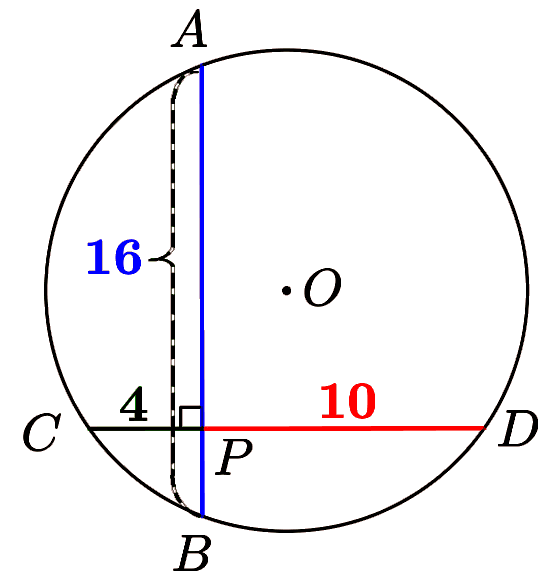
  3. In $\odot O$, chords $A B$ is perpendicular to $C D$ at $P, A B=16, C P=4 P D=10 .$ Find the radius.

  4. [Show Solution]

  5. In the figure, $O$ is the centre of the concentric circles and $O N \perp A B .$ If $O C=10, O N=8$ and $O B=17$ find $A C$.

  6. [Show Solution]

  7. Prove Theorem $10$: Of any two chords of a circle, the greater chord is nearer to the centre, and conversely, the chord nearer to the centre is larger.

  8. [Show Solution]

  9. Let $P$ be a point inside a circle. $A B$ is the diameter passes through $P$ and $C P D$ is the chord perpendicular to $A B .$ Show that $C D$ is the shortest of all chords passing through $P$.

  10. [Show Solution]

  11. Through a point $P$ in a circle, the longest chord that can be drawn is $10$ cm long and the shortest chord is $6$ cm long. What is the radius of the circle and how far is $P$ from the centre?

  12. [Show Solution]

  13. In $\odot O$, chords $A B$ and $C D$ are equal and intersect in the circle at $E$ such that $A E<E B$ and $C E<E D .$ Show that $\triangle B D E$ is isosceles with base $B D$

  14. [Show Solution]

  15. In $\odot O$, congruent chords $A B$ and $C D$ are produced to meet at $P$. Prove that $\triangle P A C$ is isosceles.

  16. [Show Solution]

  17. In $\odot O, A B$ and $B C$ are equal chords, $O V \perp A B$, and $O U \perp B C$. Prove that. $B$ is the midpoint of $\operatorname{arc} V U$.

  18. [Show Solution]

  19. In parallelogram $P Q R S$, $P Q=5$ cm $P R=8$ cm, $Q S=6$ cm. Calculate the lengths of $A R$ and $B R$.

  20. [Show Solution]

  21. Chords $A B$ and $C D$ intersect at $E$ and $A E=E B$. A semicircle is drawn with diameter $C D . E F$, perpendicular to $C D$, meets this semicircle at $F$. Prove that $A E=E F$.

  22. [Show Solution]

  23. $\odot O$ and $\odot P$ intersect at $A$ and $B .$ Show that $O P$ is the perpendicular bisector of the common chord $A B$.

  24. [Show Solution]

Ψ§Ω„Ψ¬Ω…ΨΉΨ©، 18 ΩŠΩˆΩ†ΩŠΩˆ 2021

Exercise (9.1) - Sloutions (Grade 10, New Syllabus)

Exercise (9.1) ၏ α€™ေးခွα€”်း ပုα€…္ဆာα€™ျားα€€ို α€–ြေα€›ှင်းα€›α€”် ပြα€Œာα€”်းα€…ာထုပ်ပါ Theorem (1) α€™ှ Theorem (4) ထထိ α€žီထိုα€›α€™် α€™ှα€”်α€€α€”်ချα€€်α€™ျားα€€ို ဦးα€…ွာα€œေ့α€œာထားα€›α€™α€Š် α€–ြα€…်ပါα€žα€Š်။ Theorem (1) α€™ှ Theorem (4) ထထိ α€›ှင်းα€œα€„်းချα€€်α€™ျားα€€ို α€’ီ post α€™ှာ α€œေ့α€œာα€”ိုင်ပါα€žα€Š်။

Ex 9.1-No (1)


The point $O$ is the centre of the given circle. Find the values of $x$, $y$ and $z$.

(a)
$\begin{array}{l} x=\angle A D C(\angle \mathrm{s} \text { on arc } A C) \\\\ \therefore x=70^{\circ}\\\\ A B C D \text { is cyclic quadrilateral. }\\\\ 70^{\circ}+\beta=180^{\circ}\\\\ \therefore \beta=180^{\circ}-70^{\circ}=110^{\circ} \\\\ \text { Since } A D / / \mathrm{BC}, \\\\ \theta=\angle C A D \\\\ \therefore \quad \theta=30^{\circ} \\\\ \therefore \quad y\ =180^{\circ}-(\beta+\theta) \\\\ \quad \quad\quad =180^{\circ}-\left(110^{\circ}+30^{\circ}\right) \\\\ \quad\quad\quad =40^{\circ} \end{array}$
(b)
$\begin{array}{l} \text { Since } A C=A D, \angle A C D=x \\\\ \text{In}\ \Delta A C D, x+x=150^{\circ} \\\\ \therefore\ 2 x=150^{\circ} \Rightarrow x=75^{\circ}\\\\ A B C D \text { is a cyclic quadrilateral. }\\\\ \therefore x+\phi=180^{\circ}\\\\ \therefore\ \ \phi\ =180^{\circ}-x \\\\ \quad\quad =180^{\circ}-75^{\circ} \\\\ \quad\quad =105^{\circ} \\\\ \text { Since } A B=B C, \angle B A C=y . \\\\ \text { In } \Delta A B C, 2 y+\phi=180^{\circ} \\\\ \therefore\ 2 y=180^{\circ}-\phi \\\\ \quad\quad\ =180^{\circ}-105^{\circ} \\\\ \quad\ y\ \ =37.5^{\circ} \end{array}$
(c)


$\begin{aligned} \angle B O D &=360^{\circ}-240^{\circ} \\\\ & =120^{\circ} \\\\ x &=\displaystyle\frac{1}{2} \angle B O D \\\\ &=\displaystyle\frac{1}{2}\left(120^{\circ}\right) \\\\ &=60^{\circ} \\\\ \theta &=\displaystyle\frac{1}{2}\left(240^{\circ}\right) \\\\ \therefore\quad\theta &=120^{\circ} \\\\ \therefore\quad y &=360^{\circ}-\left(120^{\circ}+120^{\circ}+55^{\circ}\right) \\\\ &=65^{\circ} \end{aligned}$
(d)
In $\Delta A D E$,

$\theta=180^{\circ}-\left(30^{\circ}+40^{\circ}\right)=110^{\circ}$

$A C D E$ is a cyclic quadrilateral.

$\begin{aligned} \therefore y+ \theta &=180^{\circ} \\\\ \therefore y \quad &=180^{\circ}-\theta \\\\ &=180^{\circ}-110^{\circ} \\\\ &=70^{\circ} \end{aligned}$

In $\Delta A C D, A C =A D$.

$\therefore\quad \angle A D C=y$

$A C D E$ is a cyclic quadrilateral.

$\begin{aligned} \therefore\quad x+y & =180^{\circ} \\\\ \therefore\quad x \quad &=180^{\circ}-y \\\\ &=180^{\circ}-70^{\circ} \\\\ &=110^{\circ} \end{aligned}$
(e)
Since $O A=O B\ \text{( radii )}$

$\therefore\quad \theta=50^{\circ}$

$A B D E$ is a cyclic quadrilateral.

$\therefore\quad x+60^{\circ}+\theta=180^{\circ}$

$\begin{aligned} \therefore \quad x & =180^{\circ}-\left(60^{\circ}+\theta\right) \\\\ & =180^{\circ}-\left(60^{\circ}+50^{\circ}\right) \\\\ & =70^{\circ} \end{aligned}$

$C E$ is a diameter.

$\therefore \angle C D E=90^{\circ}$

$\begin{aligned} \therefore \quad x+y & =90^{\circ}\\\\ \therefore \quad y & =90^{\circ}-x\\\\ & =90^{\circ}-70^{\circ}\\\\ & =20^{\circ} \end{aligned}$
(f)
$A B D E$ is a cyclic quadrilateral.

$\therefore y=110^{\circ}$

Since $\text{arc}\ A D=\text{arc}\ B C,$

$A D=B C$

$\therefore\quad A B D E$ is isosceles trapezium.

$\therefore\quad x=y=110^{\circ}$

$x+z=180^{\circ}$

$\therefore\quad z=180^{\circ}-x$

$\quad\quad =180^{\circ}-110^{\circ}$

$\quad\quad =70^{\circ}$

Ex 9.1-No (2)


$ABC$ is an acute triangle inscribed in $\odot O$, and $OD$ is the perpendicular drawn $O$ to $BC$. Prove that $\angle BOD = \angle BAC$.

$\begin{array}{l} \text { Join }\ O C.\\\\ \text { In }\ \triangle BOD\ \text { and }\ \triangle COD,\\\\ \angle BDO = \angle CDO \ \text{(right angles)}\\\\ OB=OC \ \text{(radii)}\\\\ OD=OD \ \text{(common side)}\\\\ \therefore\quad \triangle B O D \cong \triangle C O D\\\\ \therefore\quad\angle B O D=\angle C O D=\displaystyle\frac{1}{2} \angle B O C\\\\ \text { But }\ \angle B A C=\displaystyle\frac{1}{2} \angle B O C\\\\ \therefore\quad\angle B O D=\angle BAC \end{array}$

Ex 9.1-No (3)


In $\odot O$, two chords $A B$ and $C D$ intersect in the circle at $P$. Show that $\angle A P D=\displaystyle\frac{1}{2}(\angle A O D+\angle B O C)$.

Join $A C$

In $\triangle A P C$,

$\begin{aligned} \angle A P D & =\angle P C A+\angle P A C \\\\ & =\angle D C A+\angle B A C \\\\ & =\displaystyle\frac{1}{2} \angle A O D+\displaystyle\frac{1}{2} \angle B O C \\\\ & =\displaystyle\frac{1}{2}(\angle A O D+\angle B O C) \end{aligned}$

Ex 9.1-No (4)


Two circles intersect at $M, N$. From $M$, diameters $M A, M B$ are drawn in each circle. If $A, B$ are joined to $N$, prove that $A N B$ is a straight line.

$\begin{array}{lll} \text{Given} &: & \odot O\ \text{and}\ \odot P\ \text{intersect at}\ M \text{and}\ N.\\\\ & & M A\ \text{and}\ M B\ \text{are diameters of}\ \odot O\ \text{and}\\\\ & & \odot P\ \text{and respectively.}\\\\ \text{To Prove} &: & A N B\ \text{is a straight line.}\\\\ \text{Proof} &: & \text{Join}\ M N.\\\\ & & \text{In}\ \odot O, \angle A N M=90^{\circ} \quad(AM\ \text{is a diameter} )\\\\ & & \text{In}\ \odot P, \angle B N M=90^{\circ} \quad(BM\ \text{is a diameter} )\\\\ & & \therefore\quad \angle A N M+\angle B N M=180^{\circ}\\\\ & & \therefore\quad A N B\ \text{ is a straight line.} \end{array}$

Ex 9.1-No (5)


$OA$ and $O B$ are two radii of a circle meeting at right angles. From $A, B$ two parallel chords $A X, B Y$ are drawn. Prove that $A Y \perp B X$.

$\begin{array}{lll} \text{Given} &: & O A \perp O B, A X \parallel B Y\\\\ \text{To Prove} &: & A Y \perp B X .\\\\ \text{Proof} &: & \text{Let}\ A Y\ \text{cut}\ B X\ \text{at}\ D \\\\ & & \alpha=\gamma \quad(\angle\mathrm{s}\ \text{stand on arc}\ AB )\\\\ & & \text{But}\ \alpha=\gamma=\displaystyle\frac{1}{2} \angle A O B \\\\ & & \alpha=\gamma=\displaystyle\frac{1}{2}\left(90^{\circ}\right)=45^{\circ}\\\\ & & \text{Since} A X \parallel B Y,\\\\ & & \alpha=\beta \quad (\text{alternating} \angle \mathrm{s})\\\\ & & \therefore\quad \beta=45^{\circ}\\\\ & & \text{Since} \angle A D B=\beta+\gamma,\\\\ & & \angle A D B=90^{\circ}\\\\ & & \therefore\quad A Y \perp B X.\\\\ \end{array}$

Ex 9.1-No (6)


Two circles intersect at $R$ and $S$. Two straight lines $A R B$ and $C S D$ are drawn meeting one circle at $A, C$ and the other at $B, D$. Prove that $A C \parallel B D .$ If $A B \parallel C D$, show that $A B=C D$.

$ACSR$ is a cyclic quadrilateral.

$\therefore\quad \alpha=\theta$

$BDSR$ is also a cyclic quadrilateral.

$\therefore\quad \beta+\theta = 180^{\circ}$

$\therefore\quad \alpha+\theta = 180^{\circ}$

$\therefore\quad A C \parallel B D$

If $A B \parallel C D$, $ABDC$ is a parallelogram.

then we can say $A B=C D$


Circles - Definitions and Theorems (Part 1)

Circle and Centre of a Circle


A circle is the set of all points that are at a fixed distance from a fixed point. The fixed point producing a circle is called the centre of the circle.

A circle with centre $O$ is called circle $O$ and denoted by $\odot O$.

α€›ွေ့α€œျားα€™ှုα€™α€›ှိα€žော ထမှတ်တစ်ခုα€™ှ ထကွာထဝေးတူ ထမှတ်α€™ျားα€–ြင့် α€–ွဲ့α€…α€Š်းထားα€žော ထမှတ်ထစုထဝေးα€€ို α€…α€€်ဝိုင်းα€Ÿုခေါ်α€žα€Š်။ α€…α€€်ဝိုင်းတစ်ခုα€€ို α€–ြα€…်α€…ေα€žα€Š့် ထဆိုပါ α€›ွေ့α€œျားα€™ှုα€™α€›ှိα€žော ထမှတ်α€€ို α€—α€Ÿိုα€Ÿုခေါ်α€žα€Š်။

$O$ α€—α€Ÿိုα€›ှိα€žော α€…α€€်ဝိုင်းα€€ို $\odot O$ α€Ÿုခေါ်α€žα€Š်။


Concentric Circles


Circles having the same centre are called concentric circles.

α€—α€Ÿိုတစ်ခုα€α€Š်းα€™ှ α€–ြα€…်ပေါ်α€œာα€žော α€…α€€်ဝိုင်းα€™ျားα€€ို α€—α€Ÿိုတူα€…α€€်ဝိုင်းα€™ျား α€Ÿုခေါ်α€žα€Š်။


Radius


A radius is a segment joining the centre and a point on the circle.

α€—α€Ÿိုα€”ှင့် α€…α€€်ဝန်းပေါ်α€›ှိ ထမှတ်တစ်ခုα€€ု ဆက်α€žွα€š်ထားα€žော α€™ျဉ်းပြတ်α€€ို ထချင်းဝက် α€Ÿုခေါ်α€žα€Š်။


Chord


A segment joining two points on a circle is called a chord of the circle.

α€…α€€်ဝန်းပေါ်α€›ှိ ထမှတ်α€”ှα€…်ခုα€€ို ဆက်α€žွα€š်ထားα€žော α€™ျဉ်းပြတ်α€€ို α€œေးα€€ြိုးα€Ÿု ခေါ်α€žα€Š်။


Diameter


A diameter is a chord passing through the centre of a circle. In a circle, a diameter is a longest chord.

α€—α€Ÿိုα€€ိုα€–ြတ်၍ဆွဲα€žော α€œေးα€€ြိုးα€€ို ထချင်းα€™ျဉ်းα€Ÿု ခေါ်α€žα€Š်။ ထချင်းα€™ျဉ်းα€žα€Š် α€…α€€်ဝိုင်းတစ်ခု၏ ထရှα€Š်းဆုံး α€œေးα€€ြိုးα€œα€Š်း α€–ြα€…်α€žα€Š်။


Congruent Circles


Circles having the same radius are called congruent circles.

ထချင်းဝက် တူα€Šီα€žော α€…α€€်ဝိုင်းα€™ျားα€€ို ထပ်တူα€Šီα€…α€€်ဝိုင်းα€™ျား α€Ÿုခေါ်α€žα€Š်။


Secant


A secant of a circle is a line that intersects the circle at two points.

α€…α€€်ဝန်းပေါ်α€›ှိ ထမှတ်α€”ှα€…်ခုα€€ို α€–ြတ်α€žွားα€žော α€™ျဉ်းတစ်α€€ြောင်းα€€ိုဝန်းα€–ြတ်α€™ျဉ်း α€Ÿုခေါ်α€žα€Š်။


Tangent


A line touching the circle at one point only is called a tangent to the circle. This touching point is called the point of contact.

α€…α€€်ဝိုင်းα€€ို ထမှတ်တစ်ခု၌ ထိα€žွားα€žော α€™ျဉ်းတစ်α€€ြောင်းα€€ို ဝန်းထိα€™ျဉ်း α€Ÿုခေါ်α€žα€Š်။


Arc, Semicircle, Minor Arc, Major Arc


An arc is a part of a circle.

α€…α€€်ဝိုင်း၏ ထစိပ်ထပိုင်းα€€ို ထဝန်းပိုင်း α€Ÿုခေါ်α€žα€Š်။

A semicircle is a half part of a circle.

α€…α€€်ဝိုင်း၏ တစ်ဝက်တိတိα€›ှိα€žော ထစိပ်ထပိုင်းα€€ို α€…α€€်ဝိုင်းခြα€™်း α€Ÿုခေါ်α€žα€Š်။


Arc $ACB$ is a semicircle.


A minor arc is an arc shorter than a semicircle.

α€…α€€်ဝိုင်းခြα€™်းထောα€€် α€‘α€œျားတိုα€žော ထဝန်းပိုင်းα€€ို minor arc α€Ÿုခေါ်α€žα€Š်။

A major arc is an arc longer than a semicircle.

α€…α€€်ဝိုင်းခြα€™်းထက် α€‘α€œျားα€›ှα€Š်α€žော ထဝန်းပိုင်းα€€ို major arc α€Ÿုခေါ်α€žα€Š်။


Arc $AB$ is a minor arc and arc $ACB$ is a major arc.


Central Angles and Inscribed Angles


A central angle is an angle subtended by an arc (or chord) of a circle at the centre.

ထောင့်α€œα€€်တံα€”ှα€…်ခု၏ ထစွα€”်းα€™ှတ်α€™ျားα€žα€Š် ထဝန်းပိုင်း၏ ထစွα€”်းα€”ှα€…်α€˜α€€် (α€žို့α€™α€Ÿုတ်) α€œေးα€€ြိုး၏ ထစွα€”်းα€”ှα€…်α€˜α€€်၌ α€›ှိပြီး ထောင်းα€…ွα€”်းα€™ှတ်α€žα€Š် α€…α€€်ဝိုင်းတစ်ခု၏ α€—α€Ÿို၌α€›ှိα€žော ထောင့်α€€ို α€—α€Ÿိုခံထောင့်α€Ÿု ခေါ်α€žα€Š်။

An inscribed angle is an angle subtended by an arc (or chord) of a circle at a point on the other arc.

ထောင့်α€œα€€်တံα€”ှα€…်ခု၏ ထစွα€”်းα€™ှတ်α€™ျားα€žα€Š် ထဝန်းပိုင်း၏ ထစွα€”်းα€”ှα€…်α€˜α€€် (α€žို့α€™α€Ÿုတ်) α€œေးα€€ြိုး၏ ထစွα€”်းα€”ှα€…်α€˜α€€်၌ α€›ှိပြီး ထောင်းα€…ွα€”်းα€™ှတ်α€žα€Š် α€…α€€်ဝိုင်းတစ်ခု၏ ထဝန်း၌α€›ှိα€žော ထောင့်α€€ို ထဝန်းခံထောင့်α€Ÿု ခေါ်α€žα€Š်။


Theorem 1


The central angle is twice the inscribed angle subtended by the same arc.

ထဝန်းပိုင်းတစ်ခုα€™ှ α€…α€€်ဝိုင်း၏ α€—α€Ÿိုတွင်ခံဆောင်ထားα€žော ထောင့်α€žα€Š် ထဆိုပါထဝန်းပိုင်းα€€ိုပင် တစ်α€–α€€်ထဝန်းပိုင်းတွင် ခံဆောင်ထားα€žော ထောင့်၏ α€”ှα€…်ဆရှိα€žα€Š်။


Visual Proof


Corollary 1.1


Inscribed angles subtended by the same arc are equal.

တူα€Šီα€žော ထဝန်းပိုင်းတစ်ခုα€™ှ ထခြားထဝန်းပိုင်းတစ်ခုတွင် ခံဆောင်ထားα€žော ထဝန်းခံထောင့်α€™ျား တူα€Šီα€€ြα€žα€Š်။

Visual Proof

Corollary 1.2


An inscribed angle subtended by a diameter is a right angle.

ထချင်းα€™ျဉ်းα€€ို ထဝန်းပိုင်း၌ ခံဆောင်ထားα€žော ထဝန်းခံထောင့်α€žα€Š် ထောင့်α€™ှα€”်တစ်ခု α€–ြα€…်α€žα€Š်။


Cyclic Quadrilateral


A quadrilateral whose vertices lie on a circle is called a cyclic quadrilateral.

α€…α€€်ဝိုင်းပေါ်တွင် ထောင့်α€…ွα€”်းα€™ှတ်α€™ျားα€›ှိα€žော စတုဂံတစ်ခုα€€ို α€…α€€်ဝိုင်းတွင်းα€€ျစတုဂံ α€Ÿုခေါ်α€žα€Š်။

$ABCD$ is a cyclic quadrilateral.

Theorem 2


Opposite angles of a cyclic quadrilateral are supplementary.

α€…α€€်ဝိုင်းတွင်းα€€ျစတုဂံ စတုဂံတစ်ခု၏ ထတွင်းα€™ျα€€်α€”ှာချင်းဆိုင် ထောင့်တစ်α€…ုံα€žα€Š် ထောင့်α€–ြောင့်α€–ြα€Š့်α€˜α€€်α€™ျား α€–ြα€…်α€€ြα€žα€Š်။


Corollary 2.1


The exterior angle of a cyclic quadrilateral is equal to the opposite interior angle of the quadrilateral

α€…α€€်ဝိုင်းတွင်းα€€ျစတုဂံ စတုဂံတစ်ခု၏ ထနားတစ်α€–α€€်α€€ို ဆက်ဆွဲ၍ α€–ြα€…်ပေါ်α€œာα€žော ထပြင်ထောင့်α€žα€Š် ထတွင်းα€™ျα€€်α€”ှာချင်းဆိုင်ထောင့်α€”ှင့် ထမြဲ‌α€Šီα€žα€Š်။


Theorem 3


In the same circle or in congruent circles,
  1. equal arcs subtend equal central angles,
  2. arcs subtending equal central angles are equal.


α€…α€€်ဝိုင်းတစ်ခုα€α€Š်းတွင် α€–ြα€…်α€…ေ၊ ထပ်တူα€Šီα€žော α€…α€€်ဝိုင်းα€™ျားတွင် α€–ြα€…်α€…ေ၊ ထဝန်းပိုင်းα€™ျား ထပ်တူα€Šီα€œျှင် α€—α€Ÿိုခံထောင့်α€™ျား တူα€Šီပြီး၊ ထပြα€”်α€‘α€œှα€”်ထားα€–ြင့် α€—α€Ÿိုခံထောင့်α€™ျား တူα€Šီα€œျှင် ထဝန်းပိုင်းα€™ျား ထပ်တူα€Šီα€žα€Š်။


Theorem 4


In the same circle or in congruent circles, two inscribed angles are equal if and only if the corresponding arcs are equal.

α€…α€€်ဝိုင်းတစ်ခုα€α€Š်းတွင် α€–ြα€…်α€…ေ၊ ထပ်တူα€Šီα€žော α€…α€€်ဝိုင်းα€™ျားတွင် α€–ြα€…်α€…ေ၊ ထဝန်းပိုင်းα€™ျား ထပ်တူα€Šီα€œျှင် ထဝန်းခံထောင့်α€™ျား တူα€Šီပြီး၊ ထပြα€”်α€‘α€œှα€”်ထားα€–ြင့် ထဝန်းခံထောင့်α€™ျား တူα€Šီα€œျှင် ထဝန်းပိုင်းα€™ျား ထပ်တူα€Šီα€žα€Š်။


Ψ§Ω„Ψ¬Ω…ΨΉΨ©، 21 Ψ―ΩŠΨ³Ω…Ψ¨Ψ± 2018

Circles Theorem : Geogebra Applet

Theorem α€™ွα€”္α€€α€”္ခ်α€€္α€™်ားα€€ို α€œα€€္ေတြα‚• αΎα€€α€Š့္α€›α€”္ Slider (α€žိုα‚”) Moveable Point α€™်ာα€€ို ေα€›ႊα‚•αΎα€€α€Š့္ႏိုင္ပါα€žα€Š္။

Theorem (1)

α€…α€€္၀ိုင္းတစ္ခု၏ ထ၀န္းပိုင္း တစ္ခုα€™ွ α€—α€Ÿိုတြင္ ခံေဆာင္ထားေα€žာ ေထာင့္α€žα€Š္ ၎ထ၀န္းပိုင္းα€€ို ထ၀န္းတြင္ ခံေဆာင္ထားေα€žာ ေထာင့္၏ ႏွα€…္ဆရွိα€žα€Š္။


Corollary (1.1)

ထ၀န္းပိုင္း တစ္ခုα€™ွ ထျခားထ၀န္းပိုင္း တစ္ခုတြင္ ခံေဆာင္ထားေα€žာ ထ၀န္းခံေထာင့္α€™်ား တူα€ŠီαΎα€€α€žα€Š္။


Corollary (1.2)

α€…α€€္၀ိုင္းျခမ္းထတြင္း ထ၀န္းခံေထာင့္α€žα€Š္ ေထင့္α€™ွα€”္ တစ္ခုျα€–α€…္α€žα€Š္။


Corollary (1.3)

α€…α€€္၀ိုင္းတြင္းα€€် စတုဂံတစ္ခု၏ ထတြင္းα€™်α€€္ႏွာခ်င္းဆိုင္ ေထာင့္တစ္α€…ံုα€žα€Š္ ေထာင့္ေျα€–ာင့္ ျα€–α€Š့္α€˜α€€္α€™်ား ျα€–α€…္αΎα€€α€žα€Š္။


Corollary (1.4)

α€…α€€္၀ိုင္းတြင္းα€€် စတုဂံတစ္ခု၏ ထနားတစ္α€˜α€€္α€€ို ဆက္ဆြဲ၍ ျα€–α€…္α€œာေα€žာ ထျပင္ေထာင့္α€žα€Š္ ထတြင္း α€™်α€€္ႏွာခ်င္းဆိုင္ေထာင့္ ႏွင့္ α€Šီα€žα€Š္။


Ψ§Ω„Ψ«Ω„Ψ§Ψ«Ψ§Ψ‘، 18 Ψ―ΩŠΨ³Ω…Ψ¨Ψ± 2018

Circles : Problems and Solutions


Problem (1)

Given : $ \displaystyle SPT$ is the tangent to the circle at $ \displaystyle P$.

             $ \displaystyle PQ$ and $ \displaystyle RQ$ are the chords of the circle.

             $ \displaystyle PM\bot RQ$ and $ \displaystyle RN\bot SPT$.

Prove : $ \displaystyle MN\parallel PQ$

Show/Hide Solution
$ \displaystyle \begin{array}{l}\ \ \ \ \ \angle QPT=\angle QRP\ (\angle \ \text{between tangent and chord }\\\ \ \ \ \ \ \ \ \ \ \ \ \ \ \ \ \ \ \ \ \ \ \ \ \ \ \ \ \ \ \ \ \ \ \ \ \text{= }\angle \ \text{in alternate segment})\\\\\ \ \ \ \ \text{Since}\ PM\bot RQ\ \text{and}\ RN\bot SPT,\ \\\\\ \ \ \ \ \angle PMR=\angle PNR=90{}^\circ \\\\\therefore \ \ \ \angle PMR+\angle PNR=180{}^\circ \\\\\therefore \ \ \ PMRN\ \text{is cyclic}\text{.}\\\\\therefore \ \ \ \angle PNM=\angle QRP\ \ (\angle \ \text{in same arc)}\\\\\therefore \ \ \ \angle PNM=\angle QPT\\\\\ \ \ \ \ \text{Since}\ \angle PNM\ \text{and}\ \angle QPT\ \text{are alternating angles,}\\\\\ \ \ \ \ MN\parallel PQ.\ \end{array}$


Problem (2)

In the fgure, $ \displaystyle AP$ is a tangent to the circle at $ \displaystyle A$ and $ \displaystyle AP$ is parallel to $ \displaystyle BQ$. Prove that

(i) $ \displaystyle ∆ABC$ is similar to $ \displaystyle ∆AQB,$

(ii) $ \displaystyle AB^2 = AQ × AC.$

Show/Hide Solution
$ \displaystyle \begin{array}{l}\ \ \ \ \ \alpha =\beta \ (\angle \ \text{between tangent and chord }\\\ \ \ \ \ \ \ \ \ \ \ \ \ \ \ \ \text{= }\angle \ \text{in alternate segment})\\\\\ \ \ \ \ \text{Since}\ AP\parallel BQ,\ \ \alpha =\theta .\\\\\ \ \ \ \ \text{In }\Delta ABC\ \text{and}\ \Delta AQB,\\\\\ \ \ \ \ \alpha =\theta \ \text{(proved)}\\\\\ \ \ \ \ \delta =\delta \ \ \text{(common }\angle \text{)}\\\\\therefore \ \ \ \Delta ABC\sim \Delta AQB\ \ (\text{AA corollary)}\end{array}$

$ \displaystyle \therefore \ \ \ \frac{{AB}}{{AQ}}=\frac{{AC}}{{AB}}$

$ \displaystyle \therefore \ \ \ A{{B}^{2}}=AQ\times AC$


Problem (3)
In the fgure, $ \displaystyle O$ is the centre of the circle, $ \displaystyle PQ$ is a diameter and $ \displaystyle AB$ is a chord which is parallel to $ \displaystyle PQ.$ $ \displaystyle AQ$ and $ \displaystyle OB$ intersect at $ \displaystyle X$. Prove that $ \displaystyle ∠BXQ = 3∠PQA$.

Show/Hide Solution
$ \displaystyle \begin{array}{l}\ \ \ \ \text{Since}\ AB\parallel PQ,\\\\\ \ \ \ \beta =\phi .\ \ \ \text{(}\because \text{alternating }\angle \text{)}\\\\\ \ \ \ \alpha =\theta .\ \ \ \text{(}\because \text{alternating }\angle \text{)}\end{array}$

$ \displaystyle \ \ \ \ \alpha =\frac{1}{2}\phi \ \ \ \text{(}\because \text{inscribed }\angle =\frac{1}{2}\text{central }\angle \text{)}$

$ \displaystyle \begin{array}{l}\therefore \ \ \phi =\beta =2\alpha =2\theta \\\\\ \ \ \ \text{In }\Delta ABX,\ \\\\\ \ \ \ \gamma =\beta +\alpha \\\\\ \ \ \ \ \ \ =2\alpha +\alpha \\\\\ \ \ \ \ \ \ =3\alpha \\\\\ \ \ \ \ \ \ =3\theta \ \ \ \ (\because \alpha =\theta )\\\\\therefore \ \ \angle BXQ=3\angle PQA\end{array}$


Problem (4)
In the fgure, $ \displaystyle BD$ and $ \displaystyle CE$ are tangents to the circle, of which $ \displaystyle AB$ is a diameter and $ \displaystyle ACD$ is a straight line. Prove that

(i) $ \displaystyle \angle ABC=\angle ECD$

(ii) $ \displaystyle BE = ED.$

Show/Hide Solution
$ \displaystyle \begin{array}{l}\ \ \ \text{It is obvious that}\\\\\ \ \ \beta =\gamma \ \ (\because \angle \ \text{between tangent and chord}\\\ \ \ \ \ \ \ \ \ \ \ \ \ \ =\angle \ \text{in alternate segment})\\\\\ \ \ \text{But, }\gamma =\theta \ \ (\because \text{vertically opposite }\angle \text{s)}\\\\\therefore \ \beta =\theta \\\\\therefore \angle ABC=\angle ECD\\\\\ \ \ \ \text{Since }AB\ \text{is a diameter, }\\\\\ \ \ \ \angle ACB=90{}^\circ \ \ (\because \angle \ \text{in semicircle)}\\\\\therefore \ \ \angle BCD=90{}^\circ \\\\\ \ \ \ \text{Furthermore, }AB\ \text{is a diameter and }BD\ \text{is a tangent,}\\\\\ \ \ \ AB\bot BD.\\\\\therefore \ \ \Delta ABD\sim \Delta ACB\sim \Delta BCD\\\\\therefore \ \ \beta =\delta \\\\\therefore \ \ \theta =\delta \\\\\therefore \ \ \Delta BCD\ \text{is an isosceles triangle with base }CD.\\\\\therefore \ \ EC=ED\\\\\ \ \ \ \text{Since}\ BE=EC,\ \ (\because \text{tangents from same exterior point)}\\\\\ \ \ \ BE=ED\end{array}$


Problem (5)
 In the figure, $ \displaystyle ABCD$ and $ \displaystyle APRD$ are two circles intersecting at $ \displaystyle A$ and $ \displaystyle D$. $ \displaystyle ARC$ and $ \displaystyle BPD$ are straight lines. $ \displaystyle DR$ produced meets $ \displaystyle BC$ at $ \displaystyle S$. Prove that $ \displaystyle PR$ is parallel to $ \displaystyle BC.$

Show/Hide Solution
In circle $ \displaystyle APRD, \alpha = \phi \ \ \ (\angle \text{s}\ \text{in}\ \text{same}\ \text{arc})$

Similarly, In circle $ \displaystyle ABCD, \alpha = \beta \ \ \ (\angle \text{s}\ \text{in}\ \text{same}\ \text{arc})$

$ \displaystyle \therefore\ \phi= \beta$

Since $ \displaystyle \phi$ and $ \displaystyle \beta$ are corresponding angles,

$ \displaystyle PR \parallel BC$


Problem (6)
In the figure, $ \displaystyle HAE$ is the tangent to the circle at $ \displaystyle H, BH = BE$ and $ \displaystyle KH$ is the angle bisector of $ \displaystyle ∠BHE$ and it cuts the circle at $ \displaystyle D.$ Given that $ \displaystyle BD$ produced meets $ \displaystyle HE$ at $ \displaystyle A,$ prove that

(i) $ \displaystyle HD = BD,$

(ii) $ \displaystyle A, D, K$ and $ \displaystyle E$ are concyclic.

Show/Hide Solution
$ \displaystyle \begin{array}{l}\ \ \ \beta =\phi ,\ \ \ (\angle \ \text{between tangent and chord}\\\ \ \ \ \ \ \ \ \ \ \ \ \ \ \ \ \ \ \ =\angle \ \text{in alternate segment})\end{array}$

$ \displaystyle \ \ \ \text{Since}\ KH\ \text{is}\ \text{the}\ \text{angle}\ \text{bisector}\ \text{of}\ ∠BHE,$

$ \displaystyle \ \ \ \theta = \phi$

$ \displaystyle \therefore \theta = \beta$

$ \displaystyle \therefore HD = BD$

$ \displaystyle \ \ \ \text{Since}\ BH = BE,$

$ \displaystyle \ \ \ \varepsilon=\theta + \phi$

$ \displaystyle \therefore \varepsilon=\theta + \beta$

$ \displaystyle \ \ \ \text{In}\ \triangle BDH,$

$ \displaystyle \ \ \ \alpha=\theta + \beta$

$ \displaystyle \therefore \varepsilon=\alpha$

$ \displaystyle \text{Since}\ \alpha +\delta =180{}^\circ ,$

$ \displaystyle \ \ \ \varepsilon +\delta =180{}^\circ ,$

$ \displaystyle \therefore \ A,D,K,E\ \text{are concyclic}\text{.}$