الاثنين، 23 مارس 2015

Problems Study


1. Functions f and g are such that  g-1 (x) = x  -  1 3  and (f ∘ g ) (x) = 3x - 1.
    Find (g -1 ∘ f ) (x) where x ∈ R.

   Solution 

   Let g -1(x ) = y then g (y) = x.
   Hence x - 1 3 = y
            x = y + 1 3
            g (y) = y + 1 3
            g (x) = x + 1 3
           (f ∘ g) (x) = 3x - 1
           f (g ) (x)   = 3x - 1
           f (x + 1 3)  = 3x - 1
                          = 3 (x + 1 3) - 2
   Hence f (x ) = 3x - 2
           (g -1 ∘ f ) (x) = g -1 ( f   (x ) )
                             = g -1 ( 3x - 2)
                             = 3x - 7 3

2. If x, y and z are any three consecutive even numbers, Show that x2 + y2 + z2 = 3y2 + 8.

   Solution 

   Let x = 2a where a is an integer.
   Since x, y and z are any three consecutive even numbers,
   y = 2a + 2 and z = 2a + 4
   x2 + y2 + z2 = (2a)2 + (2a + 2)2 + (2a + 4)2 
                     = 4a2 + 4a2 + 8a + 4 + 4a2 + 16a + 16
                     = 12a2 + 24a + 20
                     = 12a2 + 24a + 12 + 8
                     = 3 (4a2 + 8a + 4) + 8 
                     = 3 (2a + 2)2 + 8 
                     = 3 y2 + 8

السبت، 5 مايو 2012

2012 ပထမလပတ္ စာေမးပြဲ ေမးခြန္းနဲ႔ အေျဖ

မေရးတာ ၾကာၿပီ။ အခုျပန္ေရးပါတယ္။ အဓိကေတာ့ ေလ့က်င့္ခန္းေတြပဲ ဦးစားေပး တင္ပါေတာ့မယ္ အဆင္ေျပညီညြတ္တဲ့ အခါလည္း သခၤန္းစာေတြ ေရးမွာပါ။ အခု 2012 ပထမဦးဆံုး လပတ္ စာေမးပြဲ ေမးခြန္းနဲ႔ အေျဖကို တင္ေပးလိုက္ပါတယ္။ ေအာက္မွာေပးထားတဲ့ download link ေတြကေန ဆြဲယူႏိုင္ပါတယ္။

Grade (11)

Photobucket

Grade (10)


Photobucket

الخميس، 15 مارس 2012

Factor Formulae - Derivation


$ \displaystyle \begin{array}{l}\sin (\alpha +\beta )=\sin \alpha \cos \beta +\cos \alpha \sin \beta ---(1)\\\\ \sin (\alpha -\beta )=\sin \alpha \cos \beta -\cos \alpha \sin \beta ---(2)\ \ \ \end{array}$

ဆိုတဲ့ Sum and Difference Formulae ေတြ ကို မွတ္မိၾကမယ္ ထင္ပါတယ္။

ညီမွ်ျခင္း (1) နဲ႔ (2) ကို ေပါင္းလိုက္မယ္...။

$ \displaystyle \sin (\alpha +\beta )+\ \sin (\alpha -\beta )=2\sin \alpha \cos \beta ---(*)$

ဆိုၿပီး ရလာမွာေပါ့...။

$ \displaystyle \alpha +\beta =\theta $ နဲ႔ $ \displaystyle \alpha -\beta =\phi $ လို႔ ထားလိုက္မယ္။

ဒါဆိုရင္ $ \displaystyle \alpha =\frac{{\theta +\phi }}{2}$ နဲ႔ $ \displaystyle \beta =\frac{{\theta -\phi }}{2}$ ျဖစ္သြားမွာေပါ့...။

$ \displaystyle \alpha +\beta =\theta ,\ \alpha -\beta =\phi ,\ \ \alpha =\frac{{\theta +\phi }}{2},\beta =\frac{{\theta -\phi }}{2}$ တို႔ကို (*) မွာ အစားသြင္းလိုက္တဲ့ အခါ မွာေတာ့ ေအာက္ပါ factor formula ကို ရရွိမွာ ျဖစ္ပါတယ္။

$ \displaystyle \sin \theta +\ \sin \phi =2\sin \frac{{\theta +\phi }}{2}\cos \frac{{\theta -\phi }}{2}$


ဒီတစ္ခါ ညီမွ်ျခင္း (1) ထဲက (2) ကို ႏႈတ္ပါမယ္...။

$ \displaystyle \sin (\alpha +\beta )-\ \sin (\alpha -\beta )=2\cos \alpha \sin \beta $

အထက္ကအတိုင္း သက္ဆိုင္ရာတန္ဖိုးေတြ အစားသြင္းလိုက္ရင္ ...။

$ \displaystyle \sin \theta -\ \sin \phi =2\cos \frac{{\theta +\phi }}{2}\sin \frac{{\theta -\phi }}{2}$


Identity တစ္ခု ထပ္ရပါမယ္...။

ေနာက္ထပ္ညီမွ်ျခင္း ႏွစ္ၾကာင္း ကို ဆက္ၾကည့္ရေအာင္...။

$ \displaystyle \begin{array}{l} \cos (\alpha +\beta )=\cos \alpha \cos \beta -\sin \alpha \sin \beta ---(3)\\\\ \cos (\alpha -\beta )=\cos \alpha \cos \beta +\sin \alpha \sin \beta ---(4)\ \ \ \end{array}$

အထက္ပါအတိုင္း ညီမ ွ်ျခင္း ႏွစ္ေၾကာင္း (3) နဲ႔ (4) ကို ေပါင္းတစ္လွည့္ ႏႈတ္တစ္လွည့္ လုပ္လိုက္ရင္ ...။

$ \displaystyle \begin{array}{l}(3)+(4)\Rightarrow \ \ \ \cos (\alpha +\beta )+\ \cos (\alpha -\beta )=2\cos \alpha \cos \beta \\\\(3)-(4)\Rightarrow \ \ \ \cos (\alpha +\beta )-\ \cos (\alpha -\beta )=-2\cos \alpha \cos \beta \end{array}$

အထက္မွာ ရွာခဲ့ၿပီး ျဖစ္တဲ့ $ \displaystyle \alpha +\beta =\theta ,\ \alpha -\beta =\phi ,\ \ \alpha =\frac{{\theta +\phi }}{2},\beta =\frac{{\theta -\phi }}{2}$ တို႔ကို သက္ဆိုင္ရာ တန္ဖိုးေတြမွာ အစားသြင္းလိုက္ရင္...။

$ \displaystyle \begin{array}{l}\cos \theta +\ \cos \phi =2\cos \displaystyle \frac{{\theta +\phi }}{2}\cos \displaystyle \frac{{\theta -\phi }}{2}\\\\\cos \theta -\ \cos \phi =-2\sin \displaystyle \frac{{\theta +\phi }}{2}\sin \displaystyle \frac{{\theta -\phi }}{2}\end{array}$


Half-Angle Formulae - Derivation


$ \displaystyle \ \cos 2\alpha =1-2{{\sin }^{2}}\alpha $ ဆိုတာ သိခဲ့ပါၿပီ။

$ \displaystyle 2\alpha = \theta$ လို႔ ထားလိုက္မယ္။ ဒါဆိုရင္ $ \displaystyle \theta =\frac{\alpha}{2}$ ေပါ့...။

မူလညီမွ်ျခင္းမွာ အစားသြင္းလိုက္ ရင္ ...

$ \displaystyle \begin{array}{l}2{{\sin }^{2}}\displaystyle \frac{\theta }{2}=1-\cos \theta \\\\{{\sin }^{2}}\displaystyle \frac{\theta }{2}=\displaystyle \frac{{1-\cos \theta }}{2}\end{array}$

ဒါ့ေၾကာင့္ . . .

$ \displaystyle \sin \frac{\theta }{2}=\pm \sqrt{{\frac{{1-\cos \theta }}{2}}}$


$ \displaystyle \cos 2\alpha =2{{\cos }^{2}}\alpha -1$ လို႔လည္း သိထားခဲ့ၿပီးသား မဟုတ္လား . . .။

အထက္မွာ ေျပာခဲ့တဲ့အတိုင္း $ \displaystyle 2\alpha =\theta ,\alpha =\frac{\theta }{2}$ ကို အစားသြင္းလိုက္ရင္ ...

$ \displaystyle \begin{array}{l}2{{\cos }^{2}}\displaystyle \frac{\theta }{2}=1+\cos \theta \\\\{{\cos }^{2}}\displaystyle \frac{\theta }{2}=\displaystyle \frac{{1+\cos \theta }}{2}\end{array}$

ဒါ့ေၾကာင့္ . . .

$ \displaystyle \cos \frac{\theta }{2}=\pm \sqrt{{\frac{{1+\cos \theta }}{2}}}$


$ \displaystyle \sin \frac{\theta }{2}$ နဲ႕ $ \displaystyle \cos \frac{\theta }{2}$ ကို သိၿပီဆိုေတာ့ ....

$ \displaystyle \tan \displaystyle \frac{\theta }{2}= \displaystyle \frac{{\sin \displaystyle \frac{\theta }{2}}}{{\cos \displaystyle \frac{\theta }{2}}}$ ဆိုတဲ့ basic identity ကို သံုးၿပီး ဆက္ရွာလို႔ရၿပီေပါ့။

$ \displaystyle \begin{array}{*{20}{l}} {\tan \displaystyle \frac{\theta }{2}=\displaystyle \frac{{\sin \displaystyle \frac{\theta }{2}}}{{\cos \displaystyle \frac{\theta }{2}}}} \\ {} \\ {\tan \displaystyle \frac{\theta }{2}=\pm \displaystyle \frac{{\sqrt{{\displaystyle \frac{{1-\cos \theta }}{2}}}}}{{\sqrt{{\displaystyle \frac{{1+\cos \theta }}{2}}}}}} \\ {} \\ {\tan \displaystyle \frac{\theta }{2}=\pm \sqrt{{\displaystyle \frac{{\displaystyle \frac{{1-\cos \theta }}{2}}}{{\displaystyle \frac{{1+\cos \theta }}{2}}}}}} \end{array}$

ဒါ့ေၾကာင့္ . . .

$ \displaystyle \tan \displaystyle \frac{\theta }{2}=\pm \sqrt{{\displaystyle \frac{{1-\cos \theta }}{{1+\cos \theta }}}}$


ဆက္ၿပီး derive လုပ္ၾကည့္မယ္ ...။

$ \displaystyle \begin{array}{*{20}{l}} {\tan \displaystyle \frac{\theta }{2}=\sqrt{{\displaystyle \frac{{1-\cos \theta }}{{1+\cos \theta }}\times \displaystyle \frac{{1+\cos \theta }}{{1+\cos \theta }}}}} \\ {} \\ {\tan \displaystyle \frac{\theta }{2}=\sqrt{{\displaystyle \frac{{1-{{{\cos }}^{2}}\theta }}{{{{{(1+\cos \theta )}}^{2}}}}}}} \\ {} \\ {\tan \displaystyle \frac{\theta }{2}=\sqrt{{\displaystyle \frac{{{{{\sin }}^{2}}\theta }}{{{{{(1+\cos \theta )}}^{2}}}}}}} \end{array}$

ဒါ့ေၾကာင့္ . . .

$ \displaystyle \tan \frac{\theta }{2}=\frac{{\sin \theta }}{{1+\cos \theta }}$


တဖန္ . . .

$ \displaystyle \begin{array}{*{20}{l}} {\tan \displaystyle \frac{\theta }{2}=\sqrt{{\displaystyle \frac{{1-\cos \theta }}{{1+\cos \theta }}\times \displaystyle \frac{{1-\cos \theta }}{{1-\cos \theta }}}}} \\ {} \\ {\tan \displaystyle \frac{\theta }{2}=\sqrt{{\displaystyle \frac{{{{{(1-\cos \theta )}}^{2}}}}{{1-{{{\cos }}^{2}}\theta }}}}} \\ {} \\ {\tan \displaystyle \frac{\theta }{2}=\sqrt{{\displaystyle \frac{{{{{(1-\cos \theta )}}^{2}}}}{{{{{\sin }}^{2}}\theta }}}}} \end{array}$

ဒါ့ေၾကာင့္ . . .

$ \displaystyle \tan \frac{\theta }{2}=\frac{{1-\cos \theta }}{{\sin \theta }}$


الأربعاء، 14 مارس 2012

Double Angle Formulae - Derivation

$ \displaystyle \sin (\alpha +\beta )=\sin \alpha \cos \beta +\cos \alpha \sin \beta $ ဆိုတာ သိခဲ့ၿပီး ျဖစ္မယ္ ထင္ပါတယ္။

ဒီ ပံုေသနည္းဟာ မည္သည့္ေထာင့္ $ \displaystyle \alpha$ နဲ႔ $ \displaystyle \beta$ အတြက္မဆို မွန္ပါတယ္။

ဒါဆိုရင္ $ \displaystyle \alpha=\beta$ အတြက္လည္း မွန္တာေပါ့။... ဒါေၾကာင့္

$ \displaystyle \sin (\alpha +\beta )=\sin \alpha \cos \beta +\cos \alpha \sin \beta $

$ \displaystyle \alpha=\beta,$ ျဖစ္တဲ့အခါ

$ \displaystyle \sin (\alpha +\alpha )=\sin \alpha \cos \alpha +\cos \alpha \sin \alpha $

ဒါ့ေၾကာင့္

$ \displaystyle \sin 2\alpha =2\sin \alpha \cos \alpha $


အလားတူပါပဲ.....။

$ \displaystyle \cos (\alpha +\beta )=\cos \alpha \cos \beta -\sin \alpha \sin \beta $

$ \displaystyle \alpha=\beta,$ ျဖစ္တဲ့အခါ

$ \displaystyle \cos (\alpha +\alpha )=\cos \alpha \cos \alpha -\sin \beta \sin \beta $

ဒါ့ေၾကာင့္...

$ \displaystyle \cos 2\alpha ={{\cos }^{2}}\alpha -{{\sin }^{2}}\alpha $


$ \displaystyle {{\sin }^{2}}\alpha +{{\cos }^{2}}\alpha =1$ ဆိုတဲ့ Pythagorean Identity ကို မွတ္မိမယ္ ထင္ပါတယ္။

$ \displaystyle {{\sin }^{2}}\alpha +{{\cos }^{2}}\alpha =1$ ျဖစ္တာေၾကာင့္ $ \displaystyle {{\sin }^{2}}\alpha =1-{{\cos }^{2}}\alpha $ နဲ႔ $ \displaystyle {{\cos }^{2}}\alpha =1-{{\sin }^{2}}\alpha $ ျဖစ္ပါတယ္။

$ \displaystyle \cos 2\alpha ={{\cos }^{2}}\alpha -{{\sin }^{2}}\alpha $ ဆိုတဲ့ equation မွာ သက္ဆိုင္ရာ တန္ဖိုးေတြကို အစားသြင္းလိုက္ရင္ ...

$ \displaystyle \begin{array}{l}\cos 2\alpha ={{\cos }^{2}}\alpha -{{\sin }^{2}}\alpha \\\\\cos 2\alpha =1-{{\sin }^{2}}\alpha -{{\sin }^{2}}\alpha \end{array}$

ဒါ့ေၾကာင့္...

$ \displaystyle \cos 2\alpha =1-2{{\sin }^{2}}\alpha $


အလားတူပါပဲ...။

$ \displaystyle \begin{array}{l}\cos 2\alpha ={{\cos }^{2}}\alpha -{{\sin }^{2}}\alpha \\\\\cos 2\alpha ={{\cos }^{2}}\alpha -(1-{{\cos }^{2}}\alpha )\end{array}$

ဒါ့ေၾကာင့္...

$ \displaystyle \cos 2\alpha =2{{\cos }^{2}}\alpha -1$


$ \displaystyle \tan 2\alpha $ အတြက္ ဆက္ရွာၾကည့္ပါမယ္။

$ \displaystyle \tan (\alpha +\beta )=\frac{{\tan \alpha +\tan \beta }}{{1-\tan \alpha \tan \beta }}$ လို႔ သိခဲ့ၿပီးပါၿပီ။..

$ \displaystyle \alpha=\beta,$ ျဖစ္တဲ့အခါ

$ \displaystyle \tan (\alpha +\alpha )=\frac{{\tan \alpha +\tan \alpha }}{{1-\tan \alpha \tan \alpha }}$ ..

ဒါ့ေၾကာင့္...

$ \displaystyle \tan 2\alpha =\frac{{2\tan \alpha }}{{1-{{{\tan }}^{2}}\alpha }}$

الاثنين، 12 مارس 2012

Sum and Difference Formulae - Derivation


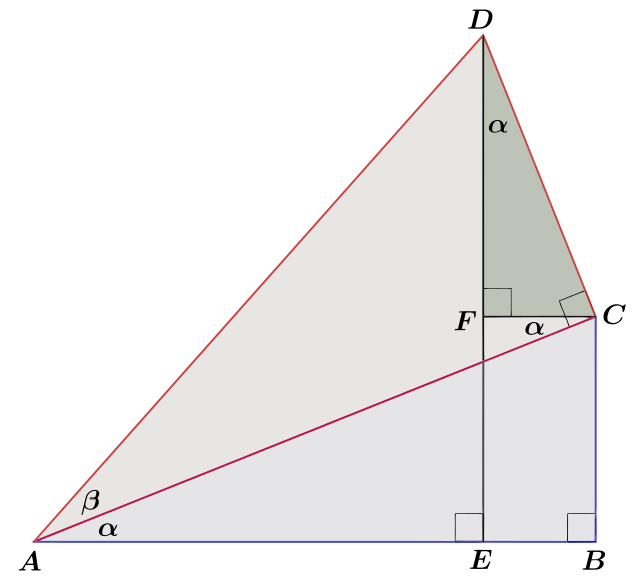
$ \displaystyle ΔABC, ΔACD$ နဲ႔ $ \displaystyle ΔCDF$ တို႔ဟာ ေထာင့္မွန္ႀတိဂံမ်ား ျဖစ္ၾကပါတယ္။

$ \displaystyle ΔABC$ မွာ $ \displaystyle ∠CAB$ ကို $ \displaystyle \alpha$ လို႔ သတ္မွတ္ပါမယ္။

$ \displaystyle ΔABC\simΔCDF$ ျဖစ္တာေၾကာင့္ $ \displaystyle ∠CDF=\alpha$ ျဖစ္ပါတယ္။

$ \displaystyle ΔACD$ မွာေတာ့ $ \displaystyle ∠CAD$ ကို $ \displaystyle \beta$ လို႔ သတ္မွတ္ပါမယ္။

ဒါဆိုရင္ $ \displaystyle ΔABC$ မွာ...
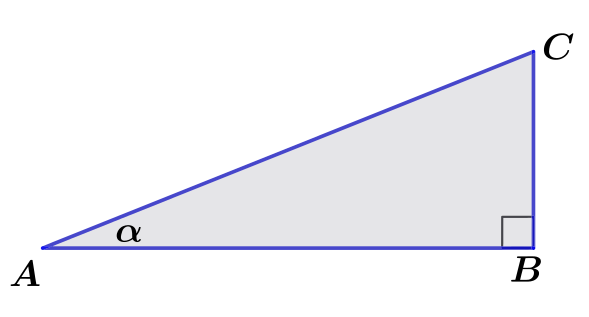
$ \displaystyle \sin \alpha=\frac{BC}{AC}$ နဲ႕ $ \displaystyle \cos \alpha=\frac{AB}{AC}$ ျဖစ္ပါတယ္။

ဒါ့ေၾကာင့္ $ \displaystyle BC =AC \sin \alpha$ နဲ႕ $ \displaystyle AB =AC \cos \alpha$ လို႔ ဆိုႏိုင္ပါတယ္။

တဖန္ $ \displaystyle ΔCDF$ မွာ...

$ \displaystyle \sin \alpha=\frac{FC}{DC}$ နဲ႕ $ \displaystyle \cos \alpha=\frac{DF}{DC}$ ျဖစ္ပါတယ္။

ဒီမွာလည္း $ \displaystyle FC =DC \sin \alpha$ နဲ႕ $ \displaystyle DF =DC \cos \alpha$ လို႔ ဆိုႏိုင္ပါတယ္။

$ \displaystyle ΔACD$ မွာလည္း ...
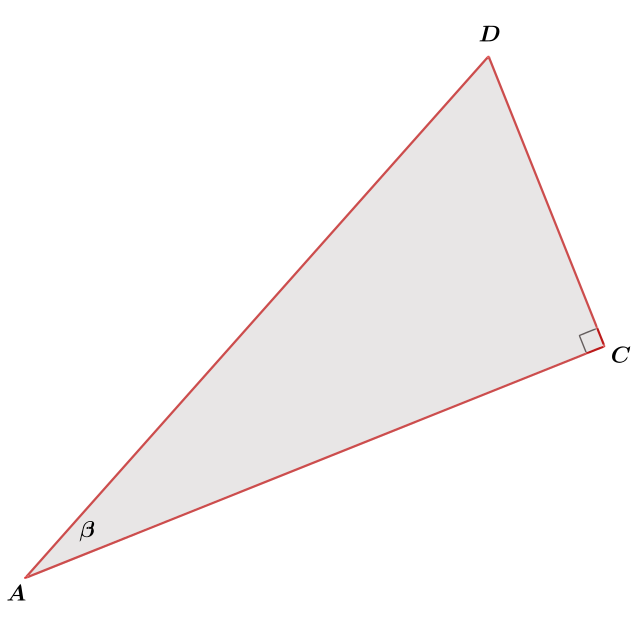
$ \displaystyle \sin \beta=\frac{DC}{AD}$ နဲ႕ $ \displaystyle \cos \beta=\frac{AC}{AD}$ ျဖစ္ပါတယ္။

ဒါဆိုရင္ $ \displaystyle DC =AD \sin \alpha$ နဲ႕ $ \displaystyle AC =AD \cos \alpha$ လို႔ ဆိုႏိုင္ပါတယ္။

$ \displaystyle ΔADE$ အတြက္ ဆက္ၾကည့္ရေအာင္...
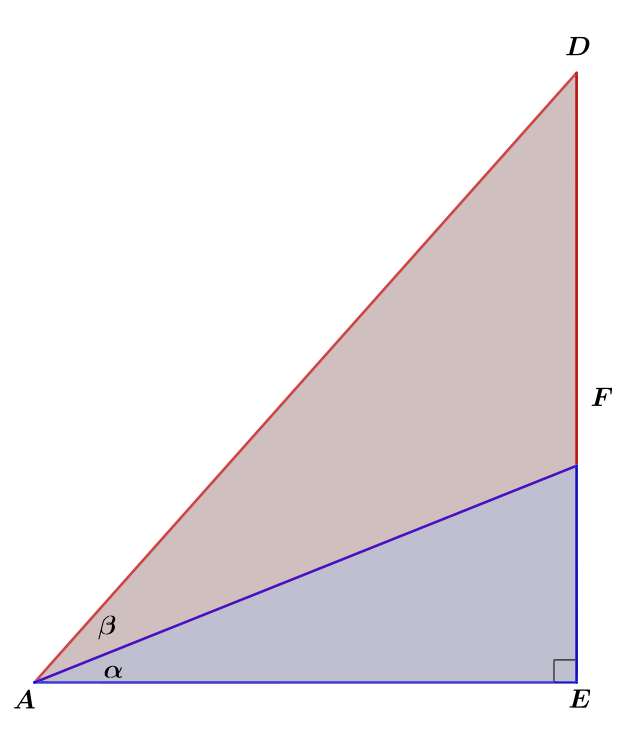
$ \displaystyle \sin (\alpha+\beta)=\frac{DE}{AD}$ ျဖစ္ပါတယ္။
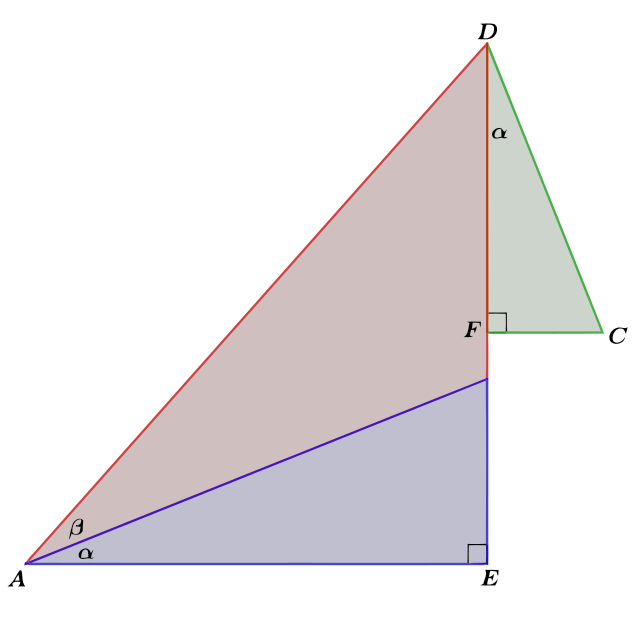
ပံုမွာ ေတြ႔ရတဲ့ အတိုင္း $ \displaystyle DE =DF+FE$ ျဖစ္ပါတယ္။။

ဒါ့ေၾကာင့္ $ \displaystyle \sin (\alpha +\beta )=\frac{{DF}}{{AD}}+\frac{{FE}}{{AD}}$ လို႔ ေျပာႏိုင္ပါတယ္။ ။

တဖန္ ့ $ \displaystyle BCFE$ က rectangle ျဖစ္တာေၾကာင့္ $ \displaystyle FE=BC$ လို႔ ေျပာႏိုင္ျပန္ပါတယ္။ ။

ဒါ့ေၾကာင့္ $ \displaystyle \sin (\alpha +\beta )=\frac{{DF}}{{AD}}+\frac{{BC}}{{AD}}$ လို႔ ေျပာႏိုင္ျပန္ပါတယ္။။

$ \displaystyle DF =DC \cos \alpha, BC =AC \sin \alpha$ လို႔ အထက္မွာ သိခဲ့ၿပီးပါၿပီ။ ဒါဆိုရင္ ။

$ \displaystyle \sin (\alpha +\beta )=\frac{{DC}}{{AD}}\cos \alpha +\frac{{AC}}{{AD}}\sin \alpha $ လို႔ ေျပာလို႔ရတာေပါ့။ ။

ဒီအခါမွာလည္း $ \displaystyle \sin \beta=\frac{DC}{AD}, \cos \beta=\frac{AC}{AD}$ လို႕သိခဲ့ၿပီးပါၿပီ။ ဒါေၾကာင့္။

$ \displaystyle \sin (\alpha +\beta )=\sin \beta \cos \alpha +\cos \beta \sin \alpha $ လို႔ ေျပာလို႔ရပါၿပီ။ ျပန္စီလိုက္ရင္ ...။

$ \displaystyle \sin (\alpha +\beta )=\sin \alpha \cos \beta +\cos \alpha \sin \beta $

အထက္ပါအတိုင္း ... $ \displaystyle \cos (\alpha +\beta )$ အတြက္ ပံုေသနည္းကို ဆက္ရွာႏိုင္ပါတယ္။ ..။

$ \displaystyle \begin{array}{l}\cos (\alpha +\beta )=\displaystyle \frac{{AE}}{{AD}}\\\\\cos (\alpha +\beta )=\displaystyle \frac{{AB-EB}}{{AD}}\\\\\cos (\alpha +\beta )=\displaystyle \frac{{AB-FC}}{{AD}}\ \ \ \ \left[ {\because EB=FC} \right]\\\\\cos (\alpha +\beta )=\displaystyle \frac{{AB}}{{AD}}-\displaystyle \frac{{FC}}{{AD}}\\\\\cos (\alpha +\beta )=\displaystyle \frac{{AC}}{{AD}}\cos \alpha -\displaystyle \frac{{DC}}{{AD}}\sin \alpha \\\\\text{Since}\ \displaystyle \frac{{AC}}{{AD}}=\cos \beta \ \operatorname{and}\ \displaystyle \frac{{DC}}{{AD}}=\sin \beta ,\\\\\text{Therefore,}\end{array}$

$ \displaystyle \cos (\alpha +\beta )=\cos \alpha \cos \beta -\sin \alpha \sin \beta $

$ \displaystyle \sin (\alpha +\beta )$ နဲ႔ $ \displaystyle \cos (\alpha +\beta )$ ကို သိၿပီဆိုေတာ့ $ \displaystyle \tan (\alpha +\beta )$ ကို ရွာႏိုင္ၿပီေပါ့။

$ \displaystyle \begin{array}{l}\tan (\alpha +\beta )=\displaystyle \frac{{\sin (\alpha +\beta )}}{{\cos (\alpha +\beta )}}\\\\\tan (\alpha +\beta )=\displaystyle \frac{{\sin \alpha \cos \beta +\cos \alpha \sin \beta }}{{\cos \alpha \cos \beta -\sin \alpha \sin \beta }}\\\\\text{Dividing the numerator and denominator }\\\text{with}\ \cos \alpha \cos \beta ,\\\\\tan (\alpha +\beta )=\displaystyle \frac{{\displaystyle \frac{{\sin \alpha \cos \beta }}{{\cos \alpha \cos \beta }}+\displaystyle \frac{{\cos \alpha \sin \beta }}{{\cos \alpha \cos \beta }}}}{{\displaystyle \frac{{\cos \alpha \cos \beta }}{{\cos \alpha \cos \beta }}-\displaystyle \frac{{\sin \alpha \sin \beta }}{{\cos \alpha \cos \beta }}}}\\\\\text{Therefore,}\end{array}$

$ \displaystyle \tan (\alpha +\beta )=\frac{{\tan \alpha +\tan \beta }}{{1-\tan \alpha \tan \beta }}$

$ \displaystyle \begin{array}{l}\ \ \ \ \sin (-\alpha )=-\sin \alpha ,\\\\\ \ \ \ \cos (-\alpha )=\cos \alpha ,\\\\\ \ \ \ \tan (-\alpha )=-\tan \alpha \\\\\ \ \ \ \sin \left( {\alpha -\beta } \right)=\sin \left[ {\alpha +(-\beta )} \right]\\\\\ \ \ \ \sin \left( {\alpha -\beta } \right)=\sin \alpha \cos (-\beta )+\cos \alpha \sin (-\beta )\\\\\text{Therefore,}\end{array}$

$ \displaystyle \sin \left( {\alpha -\beta } \right)=\sin \alpha \cos \beta -\cos \alpha \sin \beta $

$ \displaystyle \begin{array}{l}\ \ \ \ \cos \left( {\alpha -\beta } \right)=\cos \left[ {\alpha +(-\beta )} \right]\\\\\ \ \ \ \cos \left( {\alpha -\beta } \right)=\cos \alpha \cos (-\beta )-\sin \alpha \sin (-\beta )\\\\\text{Therefore,}\end{array}$

$ \displaystyle \cos \left( {\alpha -\beta } \right)=\cos \alpha \cos \beta +\sin \alpha \sin \beta $

$ \displaystyle \begin{array}{l}\ \ \ \ \tan \left( {\alpha -\beta } \right)=\tan \left[ {\alpha +(-\beta )} \right]\\\\\ \ \ \ \tan \left( {\alpha -\beta } \right)=\displaystyle \frac{{\tan \alpha +\tan (-\beta )}}{{1-\tan \alpha \tan (-\beta )}}\end{array}$

$ \displaystyle \tan \left( {\alpha -\beta } \right)=\frac{{\tan \alpha -\tan \beta }}{{1+\tan \alpha \tan \beta }}$

အားလံုးျပန္ေပါင္းရရင္....

$ \displaystyle \begin{array}{l} \sin \left( {\alpha \pm \beta } \right)=\sin \alpha \cos \beta \pm \cos \alpha \sin \beta \\\\ \cos \left( {\alpha \pm \beta } \right)=\cos \alpha \cos \beta \mp \sin \alpha \sin \beta \\\\ \tan \left( {\alpha \pm \beta } \right)=\displaystyle \frac{{\tan \alpha \pm \tan (-\beta )}}{{1\mp \tan \alpha \tan (-\beta )}}\end{array}$

السبت، 3 مارس 2012

Exercise (11.3) No(4, 5) - Solution


4. If $ \displaystyle α + β + γ = 180°$, prove that

$ \displaystyle \text{(a)}\ \ \sin (\alpha +\beta )=\cos (90{}^\circ -\gamma )$

$ \displaystyle \text{(b)}\ \ \sin (\frac{{\alpha +\beta }}{2})=\sin (90{}^\circ +\frac{\gamma }{2})$

$ \displaystyle \text{(c)}\ \ \tan \left( {\frac{\alpha }{2}} \right)=\cot \left( {180{}^\circ +\frac{{\beta +\gamma }}{2}} \right)$

Show/Hide Solution
$ \displaystyle \text{(a)}\ \ \alpha +\beta +\gamma =180{}^\circ $

$ \displaystyle \begin{array}{l}\ \ \ \ \ \ \alpha +\beta =180{}^\circ -\gamma \\\\\therefore \ \ \ \ \sin (\alpha +\beta )=\sin (180{}^\circ -\gamma )\\\ \ \ \\\ \ \ \ \ \ \ \ \ \ \ \ \ \ \ \ \ \ \ \ \ =\sin \gamma \\\\\ \ \ \ \ \ \ \ \ \ \ \ \ \ \ \ \ \ \ \ \ =\ \cos (90{}^\circ -\gamma )\end{array}$


$ \displaystyle \begin{array}{l}\text{(b)}\ \ \alpha +\beta +\gamma =180{}^\circ \\\\\ \ \ \ \ \ \alpha +\beta =180{}^\circ -\gamma \\\\\ \ \ \ \ \ \displaystyle \frac{{\alpha +\beta }}{2}=\displaystyle \frac{{180{}^\circ -\gamma }}{2}=90{}^\circ \displaystyle -\frac{\gamma }{2}\\\\\therefore \ \ \ \ \sin (\displaystyle \frac{{\alpha +\beta }}{2})=\sin (90{}^\circ \displaystyle -\frac{\gamma }{2})\\\ \ \ \\\ \ \ \ \ \ \ \ \ \ \ \ \ \ \ \ \ \ \ \ \ =\cos \displaystyle \frac{\gamma }{2}\\\\\ \ \ \ \ \ \ \ \ \ \ \ \ \ \ \ \ \ \ \ \ =\ \sin (90{}^\circ +\displaystyle \frac{\gamma }{2})\end{array}$


$ \displaystyle \begin{array}{l}\text{(c)}\ \ \alpha +\beta +\gamma =180{}^\circ \\\\\ \ \ \ \ \ \alpha =180{}^\circ -(\beta +\gamma )\\\\\ \ \ \ \ \ \displaystyle \frac{\alpha }{2}=\displaystyle \frac{{180{}^\circ -(\beta +\gamma )}}{2}=90{}^\circ \displaystyle -\frac{{\beta +\gamma }}{2}\\\\\therefore \ \ \ \ \tan \left( {\displaystyle \frac{\alpha }{2}} \right)=\tan (90{}^\circ \displaystyle -\frac{{\beta +\gamma }}{2})\\\ \ \ \\\ \ \ \ \ \ \ \ \ \ \ \ \ \ \ \ \ \ \ \ \ =\cot \displaystyle \frac{{\beta +\gamma }}{2}\\\\\ \ \ \ \ \ \ \ \ \ \ \ \ \ \ \ \ \ \ \ \ =\ \cot \left( {180{}^\circ +\displaystyle \frac{{\beta +\gamma }}{2}} \right)\end{array}$


5.    Prove that in any triangle $ \displaystyle ABC,$

(i) $ \displaystyle \sin (A+B) = \sin C.$

(ii) $ \displaystyle \cos(A+B) + \cos C = 0.$

(iii) $ \displaystyle \cos \frac{A+B}{2} = \sin \frac{C}{2}.$

(iv) $ \displaystyle \tan \frac{A+B}{2} = \cot \frac{C}{2}.$

Show/Hide Solution
(i) $ \displaystyle \text{Since}\ A+B+C=180{}^\circ ,$

$ \displaystyle \begin{array}{l}\therefore A+B=180{}^\circ -C\\\\\therefore \sin (A+B)=\sin (180{}^\circ -C)\\\\\therefore \sin (A+B)=\sin C\end{array}$


(ii) $ \displaystyle \text{Similarly, }\cos (A+B)=\cos (180{}^\circ -C)$

$ \displaystyle \begin{array}{l}\therefore \cos (A+B)=-\cos C\\\\\therefore \cos (A+B)+\cos C=0\end{array}$


(iii) $ \displaystyle \cos \left( {\frac{{A+B}}{2}} \right)=\cos \left( {\frac{{180{}^\circ -C}}{2}} \right)$

$ \displaystyle \therefore \ \cos \left( {\frac{{A+B}}{2}} \right)=\cos \left( {90{}^\circ -\frac{C}{2}} \right)$

$ \displaystyle \therefore \ \cos \left( {\frac{{A+B}}{2}} \right)=\sin \frac{C}{2}$


(iv) $ \displaystyle \tan \left( {\frac{{A+B}}{2}} \right)=\tan \left( {\frac{{180{}^\circ -C}}{2}} \right)$

$ \displaystyle \therefore \ \tan \left( {\frac{{A+B}}{2}} \right)=\tan \left( {90{}^\circ -\frac{C}{2}} \right)$

$ \displaystyle \therefore \ \tan \left( {\frac{{A+B}}{2}} \right)=\cot \frac{C}{2}$