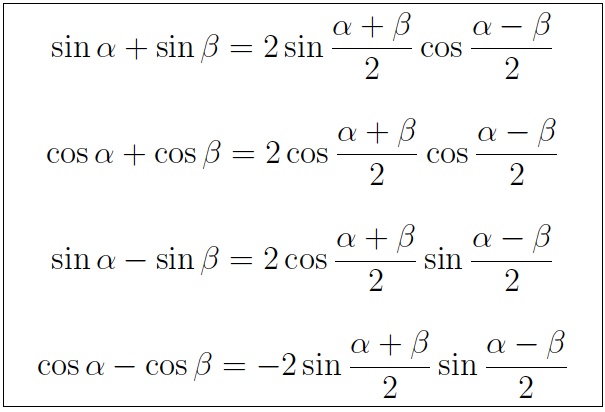
‏إظهار الرسائل ذات التسميات trigonometric identity. إظهار كافة الرسائل

السبت، 30 مارس 2019

Trigonometry (Practice Problems)

1.        Given that $ \displaystyle \sin 16{}^\circ =p,$ determine the following in terms of $ \displaystyle p$.

(a) $ \displaystyle \sin 196{}^\circ $.

(b) $ \displaystyle \cos 16{}^\circ $.

(c) $ \displaystyle \tan 32{}^\circ $.

Show/Hide Solution
$ \displaystyle \begin{array}{l}\ \ \ \ \ \ \ \sin 16{}^\circ =p\\\\\text{(a)}\ \ \ \sin 196{}^\circ =\sin (180{}^\circ +16{}^\circ )\\\\\ \ \ \ \ \ \ \ \ \ \ \ \ \ \ \ \ \ \ \ \ =-\sin 16{}^\circ \\\\\ \ \ \ \ \ \ \ \ \ \ \ \ \ \ \ \ \ \ \ \ =-p\\\\\\\text{(b)}\ \ \ \cos 16{}^\circ \ \ =\sqrt{{1-{{{\sin }}^{2}}16{}^\circ }}\\\\\ \ \ \ \ \ \ \ \ \ \ \ \ \ \ \ \ \ \ \ \ =\sqrt{{1-{{p}^{2}}}}\\\\\\\text{(c)}\ \ \ \tan 16{}^\circ \ \ =\displaystyle \frac{{\sin 16{}^\circ }}{{\cos 16{}^\circ }}\\\\\ \ \ \ \ \ \ \ \ \ \ \ \ \ \ \ \ \ \ \ \ =\displaystyle \frac{p}{{\sqrt{{1-{{p}^{2}}}}}}\\\\\ \ \ \ \ \ \ \tan 32{}^\circ \ \ =\displaystyle \frac{{2\tan 16{}^\circ }}{{1-{{{\tan }}^{2}}16{}^\circ }}\\\\\ \ \ \ \ \ \ \ \ \ \ \ \ \ \ \ \ \ \ \ =\displaystyle \frac{{\displaystyle \frac{{2p}}{{\sqrt{{1-{{p}^{2}}}}}}}}{{1-\displaystyle \frac{{{{p}^{2}}}}{{1-{{p}^{2}}}}}}\\\\\ \ \ \ \ \ \ \ \ \ \ \ \ \ \ \ \ \ \ \ =\displaystyle \frac{{2p}}{{\sqrt{{1-{{p}^{2}}}}}}\times \displaystyle \frac{{1-{{p}^{2}}}}{{1-2{{p}^{2}}}}\\\\\ \ \ \ \ \ \ \ \ \ \ \ \ \ \ \ \ \ \ \ =\displaystyle \frac{{2p\sqrt{{1-{{p}^{2}}}}}}{{1-2{{p}^{2}}}}\end{array}$

2.        Simplify $ \displaystyle \frac{{\sqrt{{1-{{{\cos }}^{2}}2\theta }}}}{{\cos (-\theta )\cos (90{}^\circ +\theta )}}$ completely, given that $ \displaystyle 0{}^\circ <\theta <90{}^\circ $.

Show/Hide Solution
$ \displaystyle \begin{array}{l}\ \ \ \ \ \ 1-{{\cos }^{2}}2\theta ={{\sin }^{2}}2\theta \\\\\ \ \ \ \ \ \cos (-\theta )=\cos \theta \\\\\ \ \ \ \ \ \cos (90{}^\circ +\theta )=-\sin \theta \\\\\therefore \ \ \ \ \ \displaystyle \frac{{\sqrt{{1-{{{\cos }}^{2}}2\theta }}}}{{\cos (-\theta )\cos (90{}^\circ +\theta )}}\\\\\ \ \ \ \ \ \ \ =\displaystyle \frac{{\sqrt{{{{{\sin }}^{2}}2\theta }}}}{{\cos \theta \left( {-\sin \theta } \right)}}\\\\\ \ \ \ \ \ \ \ =-\displaystyle \frac{{\sin 2\theta }}{{\cos \theta \sin \theta }}\\\\\ \ \ \ \ \ \ \ =-\displaystyle \frac{{2\sin \theta \cos \theta }}{{\cos \theta \sin \theta }}\\\\\ \ \ \ \ \ \ \ =-2\end{array}$


3.        In the diagram $\displaystyle \vartriangle TPS,\ PR\bot TS$. If $\displaystyle TR=2,RS = 3$ and $\displaystyle PR=1$, find the value of

(a) $ \displaystyle \sin T$ and $ \displaystyle \cos T$

(b) $ \displaystyle \sin S$ and $ \displaystyle \cos S$

Hence without using tables, calculate the value of $ \displaystyle \cos (S+T)$.

Show/Hide Solution
$ \displaystyle \begin{array}{l}\ \ \ \ \ \vartriangle TPS,\ PR\bot TS\\\\\ \ \ \ \ TR=2,RS=3,\ PR=1\\\\\therefore \ \ \ PT=\sqrt{{{{2}^{2}}+{{1}^{2}}}}=\sqrt{5}\\\\\ \ \ \ \ PS=\sqrt{{{{3}^{2}}+{{1}^{2}}}}=\sqrt{{10}}\\\\\therefore \ \ \ \sin T=\displaystyle \frac{1}{{\sqrt{5}}},\ \cos T=\displaystyle \frac{2}{{\sqrt{5}}}\\\\\ \ \ \ \ \sin S=\displaystyle \frac{1}{{\sqrt{{10}}}},\ \cos S=\displaystyle \frac{3}{{\sqrt{{10}}}}\\\\\therefore \ \ \ \cos \left( {S+T} \right)=\cos S\cos T-\sin S\sin T\\\\\ \ \ \ \ \ \ \ \ \ \ \ \ \ \ \ \ \ \ \ \ \ \ =\displaystyle \frac{3}{{\sqrt{{10}}}}\times \displaystyle \frac{2}{{\sqrt{5}}}-\displaystyle \frac{1}{{\sqrt{{10}}}}\times \displaystyle \frac{1}{{\sqrt{5}}}\\\\\ \ \ \ \ \ \ \ \ \ \ \ \ \ \ \ \ \ \ \ \ \ \ =\displaystyle \frac{5}{{\sqrt{{50}}}}\\\\\ \ \ \ \ \ \ \ \ \ \ \ \ \ \ \ \ \ \ \ \ \ \ =\displaystyle \frac{5}{{5\sqrt{2}}}\\\\\ \ \ \ \ \ \ \ \ \ \ \ \ \ \ \ \ \ \ \ \ \ \ =\displaystyle \frac{1}{{\sqrt{2}}}\end{array}$

4.        If $ \displaystyle \sin x-\cos x=\frac{3}{4}$, calculate the value of $ \displaystyle \sin 2x$ without using tables.

Show/Hide Solution
$ \displaystyle \begin{array}{l}\ \ \ \ \sin x-\cos x=\displaystyle \frac{3}{4}\\\\\therefore \ \ {{\left( {\sin x-\cos x} \right)}^{2}}=\displaystyle \frac{9}{{16}}\\\\\ \ \ \ {{\sin }^{2}}x-2\sin x\cos x+{{\cos }^{2}}x=\displaystyle \frac{9}{{16}}\\\\\ \ \ \ {{\sin }^{2}}x+{{\cos }^{2}}x-2\sin x\cos x=\displaystyle \frac{9}{{16}}\\\\\therefore \ \ 1-\sin 2x=\displaystyle \frac{9}{{16}}\\\\\therefore \ \ \sin 2x=\displaystyle \frac{7}{{16}}\end{array}$

5.        Simplify $ \displaystyle \frac{{4\sin x\cos x}}{{2{{{\sin }}^{2}}x-1}}$ to a single trigonometric ratio. Hence, find the value of $ \displaystyle \frac{{4\sin 15{}^\circ \cos 15{}^\circ }}{{2{{{\sin }}^{2}}15{}^\circ -1}}$ in surd form.

Show/Hide Solution
$ \displaystyle \begin{array}{l}\ \ \ \ \displaystyle \frac{{4\sin x\cos x}}{{2{{{\sin }}^{2}}x-1}}\\\\=\ \ \displaystyle \frac{{2\left( {2\sin x\cos x} \right)}}{{-\left( {1-2{{{\sin }}^{2}}x} \right)}}\\\\=\ \ \displaystyle \frac{{2\sin 2x}}{{-\cos 2x}}\\\\=\ \ -2\tan 2x\\\\\therefore \ \ \displaystyle \frac{{4\sin 15{}^\circ \cos 15{}^\circ }}{{2{{{\sin }}^{2}}15{}^\circ -1}}\\\\=\ -2\tan 30{}^\circ \\\\=\ -\displaystyle \frac{2}{{\sqrt{3}}}\end{array}$


6.        Points $ \displaystyle P(-\sqrt{7},3)$ and $ \displaystyle S(a,b)$ are on the Cartesian plane, as shown in figure. If $ \displaystyle \angle POR=\angle POS=\theta $, $ \displaystyle \angle POR=\angle POS=\theta $ and $ \displaystyle OS=6$,

(a) $ \displaystyle \tan \theta$

(b) $ \displaystyle \sin (-\theta )$

(c) $ \displaystyle a$

Show/Hide Solution

$ \displaystyle \begin{array}{l}\ \ \ \ \ \ P=(-\sqrt{7},3)\\\\\therefore \ \ \ \ OP=\sqrt{{7+9}}=4\\\\\therefore \ \ \ \ \sin \theta =\displaystyle \frac{3}{4}\\\\\text{(a)}\ \ \tan \theta =-\displaystyle \frac{3}{{\sqrt{7}}}\\\\\text{(b)}\ \ \sin \left( {-\theta } \right)=-\sin \theta =-\displaystyle \frac{3}{4}\\\\\text{(c)}\ \ \cos 2\theta =1-2{{\sin }^{2}}\theta =1-\displaystyle \frac{9}{8}=-\displaystyle \frac{1}{8}\\\\\ \ \ \ \ \text{Since}\ \cos 2\theta =\displaystyle \frac{a}{6},\ \\\\\ \ \ \ \ \displaystyle \frac{a}{6}=-\displaystyle \frac{1}{8}\\\\\therefore \ \ \ a\ =-\displaystyle \frac{3}{4}\end{array}$

7.        If $ \displaystyle \sin A = p$ and $ \displaystyle \cos A = q,$

(a) Show that $ \displaystyle \tan 2A=\frac{{2pq}}{{{{q}^{2}}-{{p}^{2}}}}$

(b) Express $ \displaystyle p^4-q^4$ as a single trigonometric ratio.

Show/Hide Solution

$ \displaystyle \begin{array}{l}\ \ \ \ \ \ \sin A=p,\ \ \cos A=q\\\\\therefore \ \ \ \ \tan A=\displaystyle \frac{p}{q}\ \\\\\text{(a)}\ \ \tan 2A=\ \ \displaystyle \frac{{2\tan A}}{{1-{{{\tan }}^{2}}A}}\\\\\ \ \ \ \ \ \ \ \ \ \ \ \ \ \ \ =\ \ \displaystyle \frac{{2\left( {\displaystyle \frac{p}{q}} \right)}}{{1-{{{\left( {\displaystyle \frac{p}{q}} \right)}}^{2}}}}\ \ \\\ \ \\\ \ \ \ \ \ \ \ \ \ \ \ \ \ \ \ =\ \ \displaystyle \frac{{\displaystyle \frac{{2p}}{q}}}{{\displaystyle \frac{{{{q}^{2}}-{{p}^{2}}}}{{{{q}^{2}}}}}}\ \\\\\ \ \ \ \ \ \ \ \ \ \ \ \ \ \ \ =\ \ \displaystyle \frac{{2p}}{q}\times \displaystyle \frac{{{{q}^{2}}}}{{{{q}^{2}}-{{p}^{2}}}}\ \\\\\ \ \ \ \ \ \ \ \ \ \ \ \ \ \ \ =\ \ \displaystyle \frac{{2pq}}{{{{q}^{2}}-{{p}^{2}}}}\\\\\text{(b)}\ \ {{p}^{4}}-{{q}^{4}}=\left( {{{p}^{2}}+{{q}^{2}}} \right)\left( {{{p}^{2}}-{{q}^{2}}} \right)\\\\\ \ \ \ \ \ \ \ \ \ \ \ \ \ \ \ \ \ \ \ =\left( {{{{\sin }}^{2}}A+{{{\cos }}^{2}}A} \right)\left( {{{{\sin }}^{2}}A-{{{\cos }}^{2}}A} \right)\\\\\ \ \ \ \ \ \ \ \ \ \ \ \ \ \ \ \ \ \ \ =-1\left( {{{{\cos }}^{2}}A-{{{\sin }}^{2}}A} \right)\\\\\ \ \ \ \ \ \ \ \ \ \ \ \ \ \ \ \ \ \ \ =-\cos 2A\end{array}$


8.       In the diagram below, $ \displaystyle T(x,p)$ is a point in the third quadrant and it is given that $ \displaystyle \sin \alpha =\frac{p}{{\sqrt{{1+{{p}^{2}}}}}}$.

(a) Show that $ \displaystyle x =-1$.

(b) Find $ \displaystyle \cos 2\alpha $ in terms of $ \displaystyle p$.

Show/Hide Solution

$ \displaystyle \begin{array}{l}\text{(a)}\ \ \sin \alpha =\displaystyle \frac{p}{{\sqrt{{1+{{p}^{2}}}}}}\ \ \ \left[ {\because \text{given}} \right]\\\\\ \ \ \ \ \sin \alpha =\displaystyle \frac{p}{h}\ \ \ \left[ {\text{diagram}} \right]\\\\\therefore \,\ \ \displaystyle \frac{p}{h}=\displaystyle \frac{p}{{\sqrt{{1+{{p}^{2}}}}}}\\\\\therefore \ \ h=\sqrt{{1+{{p}^{2}}}}\\\\\ \ \ \ \text{Since}\ {{x}^{2}}+{{p}^{2}}={{h}^{2}},\\\\\ \ \ \ {{x}^{2}}+{{p}^{2}}=1+{{p}^{2}}\\\\\therefore \ \ {{x}^{2}}=1\\\\\therefore \ \ x=\pm 1\\\\\ \ \ \ \text{Since}\ \alpha \,\ \text{lies in }{{\text{3}}^{{\text{rd}}}}\text{ quadrant,}\\\\\ \ \ x=-1.\\\\\\\text{(b)}\ \ \cos 2\alpha =1-2{{\sin }^{2}}\alpha \\\\\therefore \,\ \ \ \cos 2\alpha =1-\displaystyle \frac{{2{{p}^{2}}}}{{1+{{p}^{2}}}}\\\\\ \ \ \ \ \ \ \ \ \ \ \ \ \ \ \ \ =\displaystyle \frac{{1-{{p}^{2}}}}{{1+{{p}^{2}}}}\end{array}$

9.        If $ \displaystyle \sin 76{}^\circ = x$ and $ \displaystyle \cos 76{}^\circ = y$, show that $ \displaystyle x^2- y^2 = \sin 62{}^\circ$.

Show/Hide Solution
$ \displaystyle \begin{array}{l}\ \ \ \ \sin 76{}^\circ =x,\ \cos 76{}^\circ =y\\\\\ \ \ {{x}^{2}}-{{y}^{2}}={{\sin }^{2}}76{}^\circ -{{\cos }^{2}}76{}^\circ \\\\\ \ \ \ \ \ \ \ \ \ \ \ \ \ \ =-\left( {{{{\cos }}^{2}}76{}^\circ -{{{\sin }}^{2}}76{}^\circ } \right)\\\\\ \ \ \ \ \ \ \ \ \ \ \ \ \ \ =-\cos \left( {2\times 76{}^\circ } \right)\\\\\ \ \ \ \ \ \ \ \ \ \ \ \ \ \ =-\cos 152{}^\circ \\\\\ \ \ \ \ \ \ \ \ \ \ \ \ \ \ =-\cos \left( {90{}^\circ +62{}^\circ } \right)\\\\\ \ \ \ \ \ \ \ \ \ \ \ \ \ \ =-\left( {-\sin 62{}^\circ } \right)\\\\\ \ \ \ \ \ \ \ \ \ \ \ \ \ \ =\sin 62{}^\circ \end{array}$


10.      $ \displaystyle T(8, k)$ is a point in the first quadrant as shown in figure. If $ \displaystyle \tan β = \frac{1}{4},$ determine, without using tables,

(a) the value of $ \displaystyle k$.

(b) the value of $ \displaystyle \sin β$ in surd form.

Show/Hide Solution

$ \displaystyle \begin{array}{l}\,\ \ \tan \beta =\displaystyle \frac{1}{4}\ \ \left[ {\text{given}} \right]\\\\\,\ \ \tan \beta =\displaystyle \frac{k}{8}\ \ \left[ {\text{diagram}} \right]\\\\\therefore \displaystyle \frac{k}{8}=\displaystyle \frac{1}{4}\\\\\therefore \ k=2\\\\\ \ \ \text{Since}\ O{{T}^{2}}={{8}^{2}}+{{k}^{2}},\\\\\ \ \ O{{T}^{2}}={{8}^{2}}+{{2}^{2}}=68\\\\\therefore \ OT=\sqrt{{68}}=2\sqrt{{17}}\\\\\therefore \ \sin \beta =\displaystyle \frac{k}{{OT}}\\\\\ \ \ \ \ \ \ \ \ \ \ =\displaystyle \frac{2}{{2\sqrt{{17}}}}\\\\\ \ \ \ \ \ \ \ \ \ \ =\displaystyle \frac{1}{{\sqrt{{17}}}}\end{array}$

الخميس، 27 ديسمبر 2018

Trigonometric Identities


1.        Prove that in any triangle $ \displaystyle ABC,$

(i) $ \displaystyle \sin (A+B) = \sin C.$

(ii) $ \displaystyle \cos(A+B) + \cos C = 0.$

(iii) $ \displaystyle \cos \frac{A+B}{2} = \sin \frac{C}{2}.$

(iv) $ \displaystyle \tan \frac{A+B}{2} = \cot \frac{C}{2}.$

Show/Hide Solution
(i) $ \displaystyle \text{Since}\ A+B+C=180{}^\circ ,$

$ \displaystyle \begin{array}{l}\therefore A+B=180{}^\circ -C\\\\\therefore \sin (A+B)=\sin (180{}^\circ -C)\\\\\therefore \sin (A+B)=\sin C\end{array}$

(ii) $ \displaystyle \text{Similarly, }\cos (A+B)=\cos (180{}^\circ -C)$

$ \displaystyle \begin{array}{l}\therefore \cos (A+B)=-\cos C\\\\\therefore \cos (A+B)+\cos C=0\end{array}$

(iii) $ \displaystyle \cos \left( {\frac{{A+B}}{2}} \right)=\cos \left( {\frac{{180{}^\circ -C}}{2}} \right)$

$ \displaystyle \therefore \ \cos \left( {\frac{{A+B}}{2}} \right)=\cos \left( {90{}^\circ -\frac{C}{2}} \right)$

$ \displaystyle \therefore \ \cos \left( {\frac{{A+B}}{2}} \right)=\sin \frac{C}{2}$

(iv) $ \displaystyle \tan \left( {\frac{{A+B}}{2}} \right)=\tan \left( {\frac{{180{}^\circ -C}}{2}} \right)$

$ \displaystyle \therefore \ \tan \left( {\frac{{A+B}}{2}} \right)=\tan \left( {90{}^\circ -\frac{C}{2}} \right)$

$ \displaystyle \therefore \ \tan \left( {\frac{{A+B}}{2}} \right)=\cot \frac{C}{2}$

2.        In any quadrilateral $ \displaystyle ABCD,$ prove that

(i) $ \displaystyle \sin (A+B) + \sin (C+D)=0.$

(ii) $ \displaystyle \cos (A+B) = \cos (C+D).$

Show/Hide Solution
(i) $ \displaystyle \text{In}\ \text{any}\ \text{quadrilateral}\ ABCD,$

$ \displaystyle \begin{array}{l}\ \ \ \ A+B+C+D=360{}^\circ \\\\\therefore \ \ A+B=360{}^\circ -(C+D)\\\\\therefore \ \ \sin (A+B)=\sin \left[ {360{}^\circ -(C+D)} \right]\\\\\therefore \ \ \sin (A+B)=-\sin (C+D)\\\\\therefore \ \ \sin (A+B)+\sin (C+D)=0\end{array}$

(ii) $ \displaystyle \ \text{Since }A+B+C+D=360{}^\circ ,$

$ \displaystyle \begin{array}{l}\ \ \ \ \ \ A+B=360{}^\circ -(C+D)\\\\\therefore \ \ \cos (A+B)=\cos \left[ {360{}^\circ -(C+D)} \right]\\\\\therefore \ \ \sin (A+B)=\cos (C+D)\end{array}$

3.        If $ \displaystyle A, B, C, D$ be the angles of a cyclic quadrilateral, taken in order, prove that

(i) $ \displaystyle \cos A + \cos B + \cos C + \cos D=0.$

(ii) $ \displaystyle \cos (180{}^\circ +A)+\cos (180{}^\circ +B)+\cos (180{}^\circ +C)-\sin (90{}^\circ +D)=0.$

Show/Hide Solution
(i) $ \displaystyle \text{Since }ABCD\ \text{is a cyclic quadrilateral},$

$ \displaystyle \begin{array}{l}\ \ \ \ A+C=180{}^\circ \Rightarrow A=180{}^\circ -C\\\\\ \ \ \ B+D=180{}^\circ \Rightarrow B=180{}^\circ -D\\\\\therefore \ \ \cos A=\cos (180{}^\circ -C)\Rightarrow \cos A=-\cos C\ \ \ \ \ \ \ \ \ \ \ \ \ \ \ --(1)\\\\\ \ \ \ \text{Similarly,}\cos B=\cos (180{}^\circ -D)\Rightarrow \cos B=-\cos D--(2)\\\\\ \ \ \ (1)+(2)\Rightarrow \cos A+\cos B=-\cos C-\cos D\end{array}$

(ii) $ \displaystyle \ \cos (180{}^\circ +A)+\cos (180{}^\circ +B)+\cos (180{}^\circ +C)-\sin (90{}^\circ +D)$

$ \displaystyle \begin{array}{l}\ \ \ \ =-\cos A-\cos B-\cos C-\cos D\\\\ \ \ \ \ =-(\cos A+\cos B+\cos C+\cos D)\\\\ \ \ \ \ =0\ \ \ \ \ \left[ {\because \text{by}\ (\text{i})} \right]\end{array}$

4.        If $ \displaystyle \tan 35{}^\circ =x,$ prove that $ \displaystyle \frac{{\tan 145{}^\circ -\tan 125{}^\circ }}{{1+\tan 145{}^\circ \tan 125{}^\circ }}=\frac{{1-{{x}^{2}}}}{{2x}}.$

Show/Hide Solution
$ \displaystyle \begin{array}{l}\ \ \ \ \tan 35{}^\circ =x\\\\\ \ \ \ \tan 145{}^\circ =\tan (180{}^\circ -35{}^\circ )\\\\\ \ \ \ \ \ \ \ \ \ \ \ \ \ \ \ =-\tan 35{}^\circ \\\\\ \ \ \ \ \ \ \ \ \ \ \ \ \ \ \ =-x\\\\\ \ \ \ \tan 125{}^\circ =\tan (90{}^\circ +35{}^\circ )\\\\\ \ \ \ \ \ \ \ \ \ \ \ \ \ \ \ =-\cot 35{}^\circ \end{array}$

$ \displaystyle \ \ \ \ \ \ \ \ \ \ \ \ \ \ \ \ =-\frac{1}{{\tan 35{}^\circ }}$

$ \displaystyle \ \ \ \ \ \ \ \ \ \ \ \ \ \ \ \ =-\frac{1}{x}$

$ \displaystyle \ \ \ \ \ \ \frac{{\tan 145{}^\circ -\tan 125{}^\circ }}{{1+\tan 145{}^\circ \tan 125{}^\circ }}$

$ \displaystyle \ \ \ \ =\ \ \frac{{-x-\left(\displaystyle {-\frac{1}{x}} \right)}}{{1-x\left(\displaystyle {-\frac{1}{x}} \right)}}$

$ \displaystyle \ \ \ \ =\ \ \frac{{\displaystyle \frac{{1-{{x}^{2}}}}{x}}}{2}$

$ \displaystyle \ \ \ \ =\ \ \frac{{1-{{x}^{2}}}}{{2x}}$

5.        Prove that

(i) $ \displaystyle \sin (A+B)\sin (A-B)={{\sin }^{2}}A-{{\sin }^{2}}B.$

(ii) $ \displaystyle \sin (A+B)\sin (A-B)={{\cos }^{2}}B-{{\cos }^{2}}A.$

(iii) $ \displaystyle \cos (A+B)\cos (A-B)={{\cos }^{2}}A-{{\sin }^{2}}B.$

(iv) $ \displaystyle \cos (A+B)\cos (A-B)={{\cos }^{2}}B-{{\sin }^{2}}A.$

Show/Hide Solution
(i)$ \displaystyle \ \ \ \sin (A+B)\sin (A-B)$

$ \displaystyle \begin{array}{l}\ \ \ \ \ =(\sin A\cos B+\cos A\sin B)(\sin A\cos B-\cos A\sin B)\\\\ \ \ \ \ \ ={{\sin }^{2}}A{{\cos }^{2}}B-{{\cos }^{2}}A{{\sin }^{2}}B\\\\ \ \ \ \ \ ={{\sin }^{2}}A(1-{{\sin }^{2}}B)-(1-{{\sin }^{2}}A){{\sin }^{2}}B\\\\ \ \ \ \ \ ={{\sin }^{2}}A-{{\sin }^{2}}A{{\sin }^{2}}B-{{\sin }^{2}}B+{{\sin }^{2}}A{{\sin }^{2}}B\\\\ \ \ \ \ \ ={{\sin }^{2}}A-{{\sin }^{2}}B\end{array}$

(ii)$ \displaystyle \ \ \ \sin (A+B)\sin (A-B)$

$ \displaystyle \begin{array}{l}\ \ \ \ \ =(\sin A\cos B+\cos A\sin B)(\sin A\cos B-\cos A\sin B)\\\\ \ \ \ \ \ ={{\sin }^{2}}A{{\cos }^{2}}B-{{\cos }^{2}}A{{\sin }^{2}}B\\\\ \ \ \ \ \ =(1-{{\cos }^{2}}A){{\cos }^{2}}B-{{\cos }^{2}}A(1-{{\cos }^{2}}B)\\\\\ \ \ \ \ ={{\cos }^{2}}B-{{\cos }^{2}}A{{\cos }^{2}}B-{{\cos }^{2}}A+{{\cos }^{2}}A{{\cos }^{2}}B\\\\ \ \ \ \ \ ={{\cos }^{2}}A-{{\cos }^{2}}B\end{array}$

(iii)$ \displaystyle \ \ \ \cos (A+B)\cos (A-B)$

$ \displaystyle \begin{array}{l}\ \ \ \ \ =(\cos A\cos B-\sin A\sin B)(\cos A\cos B+\sin A\sin B)\\\\\ \ \ \ \ \ ={{\cos }^{2}}A{{\cos }^{2}}B-{{\sin }^{2}}A{{\sin }^{2}}B\\\\\ \ \ \ \ \ ={{\cos }^{2}}A(1-{{\sin }^{2}}B)-(1-{{\cos }^{2}}A){{\sin }^{2}}B\\\\\ \ \ \ \ \ ={{\cos }^{2}}A-{{\cos }^{2}}A{{\sin }^{2}}B-{{\sin }^{2}}B+{{\cos }^{2}}A{{\sin }^{2}}B\\\\\ \ \ \ \ \ ={{\cos }^{2}}A-{{\sin }^{2}}B\end{array}$

(iv) $ \displaystyle \ \ \ \cos (A+B)\cos (A-B)$

$ \displaystyle \begin{array}{l}\ \ \ \ \ \ \ =(\cos A\cos B-\sin A\sin B)(\cos A\cos B+\sin A\sin B)\\\\\ \ \ \ \ \ \ ={{\cos }^{2}}A{{\cos }^{2}}B-{{\sin }^{2}}A{{\sin }^{2}}B\\\\\ \ \ \ \ \ \ =(1-{{\sin }^{2}}A){{\cos }^{2}}B-{{\sin }^{2}}A(1-{{\cos }^{2}}B)\\\\\ \ \ \ \ \ \ ={{\cos }^{2}}B-{{\sin }^{2}}A{{\cos }^{2}}B-{{\sin }^{2}}A+{{\sin }^{2}}A{{\cos }^{2}}B\\\\\ \ \ \ \ \ \ ={{\cos }^{2}}B-{{\sin }^{2}}A\end{array}$

6.        Prove that $ \displaystyle \frac{{\sin (A-B)}}{{\cos A\cos B}}+\frac{{\sin (B-C)}}{{\cos B\cos C}}+\frac{{\sin (C-A)}}{{\cos C\cos A}}=0.$

Show/Hide Solution
$ \displaystyle \ \ \ \ \frac{{\sin (A-B)}}{{\cos A\cos B}}=\frac{{\sin A\cos B-\cos A\sin B}}{{\cos A\cos B}}$

$ \displaystyle \ \ \ \ \ \ \ \ \ \ \ \ \ \ \ \ \ \ \ \ \ \ \ \ \ =\frac{{\sin A\cos B}}{{\cos A\cos B}}-\frac{{\cos A\sin B}}{{\cos A\cos B}}$

$ \displaystyle \ \ \ \ \ \ \ \ \ \ \ \ \ \ \ \ \ \ \ \ \ \ \ \ \ =\tan A-\tan B$

$ \displaystyle \ \ \ \ \frac{{\sin (B-C)}}{{\cos B\cos C}}=\frac{{\sin B\cos C-\cos B\sin C}}{{\cos B\cos C}}$

$ \displaystyle \ \ \ \ \ \ \ \ \ \ \ \ \ \ \ \ \ \ \ \ \ \ \ \ \ =\frac{{\sin B\cos C}}{{\cos B\cos C}}-\frac{{\cos B\sin C}}{{\cos B\cos C}}$

$ \displaystyle \ \ \ \ \ \ \ \ \ \ \ \ \ \ \ \ \ \ \ \ \ \ \ \ \ =\tan B-\tan C$

$ \displaystyle \ \ \ \ \frac{{\sin (C-A)}}{{\cos C\cos A}}=\frac{{\sin C\cos A-\cos C\sin A}}{{\cos C\cos A}}$

$ \displaystyle \ \ \ \ \ \ \ \ \ \ \ \ \ \ \ \ \ \ \ \ \ \ \ \ \ =\frac{{\sin C\cos A}}{{\cos C\cos A}}-\frac{{\cos C\sin A}}{{\cos C\cos A}}$

$ \displaystyle \ \ \ \ \ \ \ \ \ \ \ \ \ \ \ \ \ \ \ \ \ \ \ \ \ =\tan C-\tan A$

$ \displaystyle \therefore \ \ \ \frac{{\sin (A-B)}}{{\cos A\cos B}}+\frac{{\sin (B-C)}}{{\cos B\cos C}}+\frac{{\sin (C-A)}}{{\cos C\cos A}}$

$ \displaystyle \ \ =\tan A-\tan B+\tan B-\tan C+\tan C-\tan A$ $ \displaystyle \ \ =0$

7.        Prove that

(i) $ \displaystyle \frac{{\cos 17{}^\circ +\sin 17{}^\circ }}{{\cos 17{}^\circ -\sin 17{}^\circ }}=\tan 62{}^\circ .$

(ii) $ \displaystyle \tan 50{}^\circ =\tan 40{}^\circ +2\tan 10{}^\circ .$

(iii) $ \displaystyle \tan 70{}^\circ =2\tan 50{}^\circ +\tan 20{}^\circ .$

(iv) $ \displaystyle \tan 3A-\tan 2A-\tan A=\tan 3A\tan 2A\tan A.$

Show/Hide Solution
(i) $ \displaystyle \ \ \ \ \frac{{\cos 17{}^\circ +\sin 17{}^\circ }}{{\cos 17{}^\circ -\sin 17{}^\circ }}$

$ \displaystyle \ \ \ \ \ \ =\frac{{\displaystyle \frac{{\cos 17{}^\circ }}{{\cos 17{}^\circ }}+\displaystyle \frac{{\sin 17{}^\circ }}{{\cos 17{}^\circ }}}}{{\displaystyle \frac{{\cos 17{}^\circ }}{{\cos 17{}^\circ }}-\displaystyle \frac{{\sin 17{}^\circ }}{{\cos 17{}^\circ }}}}$

$ \displaystyle \ \ \ \ \ \ =\frac{{1+\tan 17{}^\circ }}{{1+\tan 17{}^\circ }}$

$ \displaystyle \ \ \ \ \ \ =\frac{{\tan 45{}^\circ +\tan 17{}^\circ }}{{1+\tan 45{}^\circ \tan 17{}^\circ }}$

$ \displaystyle \ \ \ \ \ \ =\tan (45{}^\circ +17{}^\circ )$

$ \displaystyle \ \ \ \ \ \ =\tan 62{}^\circ $


(ii) $ \displaystyle \ \ \ \ \ \ \tan 50{}^\circ =\tan (40{}^\circ +10{}^\circ )$

$ \displaystyle \ \ \ \ \ \ \ \ \ \ \ \ \tan 50{}^\circ =\frac{{\tan 40{}^\circ +\tan 10{}^\circ }}{{1-\tan 40{}^\circ \tan 10{}^\circ }}$

$ \displaystyle \begin{array}{l}\ \ \ \ \ \ \ \ \ \ \ \tan 50{}^\circ -\tan 50{}^\circ \tan 40{}^\circ \tan 10{}^\circ =\tan 40{}^\circ +\tan 10{}^\circ \\\\\ \ \ \ \ \ \ \ \ \ \ \tan 50{}^\circ =\tan 40{}^\circ +\tan 10{}^\circ +\tan 50{}^\circ \tan 40{}^\circ \tan 10{}^\circ \\\\\ \ \ \ \ \ \ \ \ \ \ \tan 50{}^\circ =\tan 40{}^\circ +\tan 10{}^\circ +\tan (90{}^\circ -40{}^\circ )\tan 40{}^\circ \tan 10{}^\circ \\\\\ \ \ \ \ \ \ \ \ \ \ \tan 50{}^\circ =\tan 40{}^\circ +\tan 10{}^\circ +\cot 40{}^\circ \tan 40{}^\circ \tan 10{}^\circ \end{array}$

$ \displaystyle \ \ \ \ \ \ \ \ \ \ \ \ \tan 50{}^\circ =\tan 40{}^\circ +\tan 10{}^\circ +\frac{1}{{\tan 40{}^\circ }}(\tan 40{}^\circ \tan 10{}^\circ )$

$ \displaystyle \therefore \ \ \ \ \ \ \ \ \tan 50{}^\circ =\tan 40{}^\circ +2\tan 10{}^\circ $


(iii) $ \displaystyle \ \ \ \ \tan 70{}^\circ =\tan (50{}^\circ +20{}^\circ )$

$ \displaystyle \ \ \ \ \ \ \ \ \ \ \tan 70{}^\circ =\frac{{\tan 50{}^\circ +\tan 20{}^\circ }}{{1-\tan 50{}^\circ \tan 20{}^\circ }}$

$ \displaystyle \ \ \ \ \ \ \ \ \ \ \tan 70{}^\circ -\tan 70{}^\circ \tan 50{}^\circ \tan 20{}^\circ =\tan 50{}^\circ +\tan 20{}^\circ $

$ \displaystyle \ \ \ \ \ \ \ \ \ \ \tan 70{}^\circ =\tan 50{}^\circ +\tan 20{}^\circ +\tan 70{}^\circ \tan 50{}^\circ \tan 20{}^\circ $

$ \displaystyle \ \ \ \ \ \ \ \ \ \ \tan 70{}^\circ =\tan 50{}^\circ +\tan 20{}^\circ +\tan (90{}^\circ -20{}^\circ )\tan 50{}^\circ \tan 20{}^\circ $

$ \displaystyle \ \ \ \ \ \ \ \ \ \ \tan 70{}^\circ =\tan 50{}^\circ +\tan 50{}^\circ +\cot 20{}^\circ \tan 50{}^\circ \tan 20{}^\circ $

$ \displaystyle \ \ \ \ \ \ \ \ \ \ \tan 70{}^\circ =\tan 50{}^\circ +\tan 20{}^\circ +\frac{1}{{\tan 20{}^\circ }}(\tan 50{}^\circ \tan 20{}^\circ )$

$ \displaystyle \therefore \ \ \ \ \ \ \tan 70{}^\circ =2\tan 50{}^\circ +\tan 20{}^\circ $


(iv) $ \displaystyle \ \ \tan 3A=\tan (2A+A)$

$ \displaystyle \ \ \ \ \ \ \ \ \tan 3A=\frac{{\tan 2A+\tan A}}{{1-\tan 2A\tan A}}$

$ \displaystyle \ \ \ \ \ \ \ \ \tan 3A-\tan 3A\tan 2A\tan A=\tan 2A+\tan A$

$ \displaystyle \therefore \ \ \ \ \tan 3A-\tan 2A-\tan A=\tan 3A\tan 2A\tan A$

8.        (i) If $ \displaystyle A+B=45{}^\circ, $ prove that $ \displaystyle (1+\tan A)(1+\tan B)=2.$

(ii) If $ \displaystyle A+B=45{}^\circ, $ prove that $ \displaystyle (\cot A - 1)(\cot B - 1)=2.$

(iii) If $ \displaystyle A-B=45{}^\circ, $ prove that $ \displaystyle (1+\tan A)(1+\tan B)=2\tan A.$

Show/Hide Solution
(i) $ \displaystyle \ A+B=45{}^\circ $

$ \displaystyle \therefore \ \ \ \tan (A+B)=\tan 45{}^\circ =1$

$ \displaystyle \therefore \ \ \ \frac{{\tan A+\tan B}}{{1-\tan A\tan B}}=1$

$ \displaystyle \begin{array}{l}\therefore \ \ \ \tan A+\tan B=1-\tan A\tan B\\\\\therefore \ \ \ \tan A+\tan B+\tan A\tan B=1\\\\\therefore \ \ \ 1+\tan A+\tan B+\tan A\tan B=2\\\\\therefore \ \ \ \left( {1+\tan A} \right)+\tan B\left( {1+\tan A} \right)=2\\\\\therefore \ \ \ \left( {1+\tan A} \right)(1+\tan B)=2\end{array}$


(ii) $ \displaystyle \ A+B=45{}^\circ $

$ \displaystyle \therefore \ \ \ \tan (A+B)=\tan 45{}^\circ =1$

$ \displaystyle \therefore \ \ \ \frac{{\tan A+\tan B}}{{1-\tan A\tan B}}=1$

$ \displaystyle \therefore \ \ \ \tan A+\tan B=1-\tan A\tan B$

$ \displaystyle \therefore \ \ \ \frac{1}{{\cot A}}+\frac{1}{{\cot B}}=1-\frac{1}{{\cot A\cot B}}$

$ \displaystyle \begin{array}{l}\ \ \ \ \ \text{Multiplying}\ \text{both}\ \text{sides}\ \text{with }\cot A\cot B,\\\\\ \ \ \ \ \cot B+\cot A=\cot A\cot B-1\\\\\ \ \ \ \ \cot A\cot B-\cot B-\cot A=1\\\\\ \ \ \ \ \cot A\cot B-\cot B-\cot A+1=2\\\\\therefore \ \ \ \cot B\left( {\cot A-1} \right)-\left( {\cot A-1} \right)=2\end{array}$


(iii)$ \displaystyle \ A-B=45{}^\circ $

$ \displaystyle \therefore \ \ \ \tan (A-B)=\tan 45{}^\circ =1$

$ \displaystyle \therefore \ \ \ \frac{{\tan A-\tan B}}{{1+\tan A\tan B}}=1$

$ \displaystyle \begin{array}{l}\therefore \ \ \ \tan A-\tan B=1+\tan A\tan B\\\\\therefore \ \ \ 1+\tan A\tan B+\tan B=\tan A\\\\\ \ \ \ \ \text{Adding }\tan A\ \text{to both}\ \text{sides,}\ \\\\\ \ \ \ \ 1+\tan A+\tan A\tan B+\tan B=2\tan A\\\\\ \ \ \ \ \left( {1+\tan A} \right)+\tan B\left( {1+\tan A} \right)=2\tan A\end{array}$

9.        Prove that $ \displaystyle \frac{{\tan (A+B)}}{{\cot (A-B)}}=\frac{{{{{\sin }}^{2}}A-{{{\sin }}^{2}}B}}{{{{{\cos }}^{2}}A-{{{\sin }}^{2}}B}}.$

Show/Hide Solution
$ \displaystyle \ \ \ \ \ \ \ \ \ \ \tan (A+B)=\frac{{\sin (A+B)}}{{\cos (A+B)}}$

$ \displaystyle \ \ \ \ \ \ \ \ \ \ \tan (A+B)=\frac{{\sin A\cos B+\cos A\sin B}}{{\cos A\cos B-\sin A\sin B}}--(1)$

$ \displaystyle \ \ \ \ \ \ \ \ \ \ \text{Similarly,}$

$ \displaystyle \ \ \ \ \ \ \ \ \ \ \tan (A-B)=\frac{{\sin A\cos B-\cos A\sin B}}{{\cos A\cos B+\sin A\sin B}}--(2)$

$ \displaystyle \begin{array}{l}\ \ \ \ \ \ \ \ \ \ \text{By (1)}\times \text{(2), we get}\\\\\ \ \ \ \ \ \ \ \ \ \tan (A+B)\tan (A-B)\end{array}$

$ \displaystyle \ \ \ =\ \ \frac{{{{{\sin }}^{2}}A{{{\cos }}^{2}}B-{{{\cos }}^{2}}A{{{\sin }}^{2}}B}}{{{{{\cos }}^{2}}A{{{\cos }}^{2}}B-{{{\sin }}^{2}}A{{{\sin }}^{2}}B}}$

$ \displaystyle \ \ \ =\ \ \frac{{{{{\sin }}^{2}}A(1-{{{\sin }}^{2}}B)-(1-{{{\sin }}^{2}}A){{{\sin }}^{2}}B}}{{{{{\cos }}^{2}}A(1-{{{\sin }}^{2}}B)-(1-{{{\cos }}^{2}}A){{{\sin }}^{2}}B}}$

$ \displaystyle \ \ \ =\ \ \frac{{{{{\sin }}^{2}}A-{{{\sin }}^{2}}A{{{\sin }}^{2}}B-{{{\sin }}^{2}}B+{{{\sin }}^{2}}A{{{\sin }}^{2}}B}}{{{{{\cos }}^{2}}A-{{{\cos }}^{2}}A{{{\sin }}^{2}}B-{{{\sin }}^{2}}B+{{{\cos }}^{2}}A{{{\sin }}^{2}}B}}$

$ \displaystyle \ \ \ =\ \ \frac{{{{{\sin }}^{2}}A-{{{\sin }}^{2}}B}}{{{{{\cos }}^{2}}A-{{{\sin }}^{2}}B}}$

$ \displaystyle \ \ \ \ \ \ \ \ \ \ \frac{{\tan (A+B)}}{{\cot (A-B)}}=\tan (A+B)\tan (A-B)$

$ \displaystyle \therefore \ \ \ \ \ \ \frac{{\tan (A+B)}}{{\cot (A-B)}}=\frac{{{{{\sin }}^{2}}A-{{{\sin }}^{2}}B}}{{{{{\cos }}^{2}}A-{{{\sin }}^{2}}B}}$

10.        If $ \displaystyle 3\tan A\tan B=1,$ prove that $ \displaystyle 2\cos (A+B)=\cos (A-B).$

Show/Hide Solution
$ \displaystyle \ \ \ \ \ \ \ \ 3\tan A\tan B=1$

$ \displaystyle \ \ \ \ \ \ \ \tan A\tan B=\frac{1}{3}$

$ \displaystyle \ \ \ \ \ \ \ \cot A\cot B=3$

$ \displaystyle \ \ \ \ \ \ \ \frac{{\cos A\cos B}}{{\sin A\sin B}}=3$

$ \displaystyle \ \ \ \ \ \ \ \text{By Componendo - Dividendo,}$

$ \displaystyle \ \ \ \ \ \ \ \frac{{\cos A\cos B+\sin A\sin B}}{{\cos A\cos B-\sin A\sin B}}=\frac{{3+1}}{{3-1}}$

$ \displaystyle \ \ \ \ \ \ \ \frac{{\cos (A-B)}}{{\cos (A+B)}}=2$

$ \displaystyle \therefore \ \ \ \ 2\cos (A+B)=\cos (A-B)$

11.        Prove that $ \displaystyle \frac{{\cos 2\theta }}{{\sin \theta }}+\frac{{\sin 2\theta }}{{\cos \theta }}=\operatorname{cosec}\theta $

Show/Hide Solution
Solution

$ \displaystyle \begin{array}{l}\ \ \ \ \ \ \ \ \displaystyle \frac{{\cos 2\theta }}{{\sin \theta }}+\displaystyle \frac{{\sin 2\theta }}{{\cos \theta }}\\\\=\ \ \ \displaystyle \frac{{\cos 2\theta \cos \theta }}{{\sin \theta \cos \theta }}+\displaystyle \frac{{\sin 2\theta \sin \theta }}{{\sin \theta \cos \theta }}\\\\=\ \ \ \displaystyle \frac{{\cos 2\theta \cos \theta +\sin 2\theta \sin \theta }}{{\sin \theta \cos \theta }}\\\\=\ \ \ \displaystyle \frac{{\cos 2\theta \cos \theta +\sin 2\theta \sin \theta }}{{\sin \theta \cos \theta }}\\\\=\ \ \ \displaystyle \frac{{\cos \left( {2\theta -\theta } \right)}}{{\sin \theta \cos \theta }}\\\\=\ \ \ \displaystyle \frac{{\cos \theta }}{{\sin \theta \cos \theta }}\\\\=\ \ \ \displaystyle \frac{1}{{\sin \theta }}\\\\=\ \ \ \operatorname{cosec}\theta \end{array}$

الجمعة، 30 نوفمبر 2018

Problem Study : Trigonometric Identity


1.          Prove that $ \displaystyle \frac{{\tan (A+B)}}{{\cot (A-B)}}=\frac{{{{{\sin }}^{2}}A-{{{\sin }}^{2}}B}}{{{{{\cos }}^{2}}A-{{{\sin }}^{2}}B}}$.

Show/Hide Solution
Solution

$ \displaystyle \frac{{\tan (A+B)}}{{\cot (A-B)}}=\tan (A+B)\tan (A-B)$

$ \displaystyle \ \ \ \ \ \ \ \ \ \ \ \ \ \ \ \ \ \ \ \ \ \ =\frac{{\sin (A+B)}}{{\cos (A+B)}}\frac{{\sin (A-B)}}{{\cos (A-B)}}$

$ \displaystyle \ \ \ \ \ \ \ \ \ \ \ \ \ \ \ \ \ \ \ \ \ \ =\frac{{\sin A\cos B+\cos A\sin B}}{{\cos A\cos B-\sin A\sin B}}\times \frac{{\sin A\cos B-\cos A\sin B}}{{\cos A\cos B+\sin A\sin B}}$

$ \displaystyle \ \ \ \ \ \ \ \ \ \ \ \ \ \ \ \ \ \ \ \ \ \ =\frac{{{{{\sin }}^{2}}A{{{\cos }}^{2}}B-{{{\cos }}^{2}}A{{{\sin }}^{2}}B}}{{{{{\cos }}^{2}}A{{{\cos }}^{2}}B-{{{\sin }}^{2}}A{{{\sin }}^{2}}B}}$

$ \displaystyle \ \ \ \ \ \ \ \ \ \ \ \ \ \ \ \ \ \ \ \ \ \ =\frac{{{{{\sin }}^{2}}A(1-{{{\sin }}^{2}}B)-(1-{{{\sin }}^{2}}A){{{\sin }}^{2}}B}}{{{{{\cos }}^{2}}A(1-{{{\sin }}^{2}}B)-(1-{{{\cos }}^{2}}A){{{\sin }}^{2}}B}}$

$ \displaystyle \ \ \ \ \ \ \ \ \ \ \ \ \ \ \ \ \ \ \ \ \ \ =\frac{{{{{\sin }}^{2}}A-{{{\sin }}^{2}}A{{{\sin }}^{2}}B-{{{\sin }}^{2}}B+{{{\sin }}^{2}}A{{{\sin }}^{2}}B}}{{{{{\cos }}^{2}}A-{{{\cos }}^{2}}A{{{\sin }}^{2}}B-{{{\sin }}^{2}}B+{{{\cos }}^{2}}A{{{\sin }}^{2}}B}}$

$ \displaystyle \ \ \ \ \ \ \ \ \ \ \ \ \ \ \ \ \ \ \ \ \ \ =\frac{{{{{\sin }}^{2}}A-{{{\sin }}^{2}}B}}{{{{{\cos }}^{2}}A-{{{\sin }}^{2}}B}}$

2.           Prove that $ \displaystyle \frac{{\cos 2\theta }}{{\sin \theta }}+\frac{{\sin 2\theta }}{{\cos \theta }}=\operatorname{cosec}\theta $

Show/Hide Solution
Solution

$ \displaystyle \begin{array}{l}\ \ \ \ \ \ \ \ \displaystyle \frac{{\cos 2\theta }}{{\sin \theta }}+\displaystyle \frac{{\sin 2\theta }}{{\cos \theta }}\\\\=\ \ \ \displaystyle \frac{{\cos 2\theta \cos \theta }}{{\sin \theta \cos \theta }}+\displaystyle \frac{{\sin 2\theta \sin \theta }}{{\sin \theta \cos \theta }}\\\\=\ \ \ \displaystyle \frac{{\cos 2\theta \cos \theta +\sin 2\theta \sin \theta }}{{\sin \theta \cos \theta }}\\\\=\ \ \ \displaystyle \frac{{\cos 2\theta \cos \theta +\sin 2\theta \sin \theta }}{{\sin \theta \cos \theta }}\\\\=\ \ \ \displaystyle \frac{{\cos \left( {2\theta -\theta } \right)}}{{\sin \theta \cos \theta }}\\\\=\ \ \ \displaystyle \frac{{\cos \theta }}{{\sin \theta \cos \theta }}\\\\=\ \ \ \displaystyle \frac{1}{{\sin \theta }}\\\\=\ \ \ \operatorname{cosec}\theta \end{array}$

الأحد، 18 نوفمبر 2018

Trigonometric Function and Solving Trigonometric Equation

Let $ \displaystyle f(x)=\frac{{\cos x}}{{1+\sin x}}+\frac{{1+\sin x}}{{\cos x}}.$

(a) Prove that $ \displaystyle f(x)=2\sec x.$

(b) Hence solve the equation $ \displaystyle f(x)=4$ where 0 < x < 2π.

 Solution 

(a)  $ \displaystyle f(x)=\frac{{\cos x}}{{1+\sin x}}+\frac{{1+\sin x}}{{\cos x}}$

     $ \displaystyle \ \ \ \ \ \ \ =\frac{{{{{\cos }}^{2}}x+{{{(1+\sin x)}}^{2}}}}{{(1+\sin x)\cos x}}$

     $ \displaystyle \ \ \ \ \ \ \ =\frac{{{{{\cos }}^{2}}x+1+2\sin x+\sin^{2}{{x}}}}{{(1+\sin x)\cos x}}$

    $ \displaystyle \ \ \ \ \ \ \ =\frac{{\sin {{x}^{2}}+{{{\cos }}^{2}}x+1+2\sin x}}{{(1+\sin x)\cos x}}$

    $ \displaystyle \ \ \ \ \ \ \ =\frac{{1+1+2\sin x}}{{(1+\sin x)\cos x}}$

    $ \displaystyle \ \ \ \ \ \ \ =\frac{{2(1+\sin x)}}{{(1+\sin x)\cos x}}$

    $ \displaystyle \ \ \ \ \ \ \ =\frac{2}{{\cos x}}$

    $ \displaystyle \ \ \ \ \ \ \ =2\sec x$

(b)    $\displaystyle \  f(x)=4$

     $ \displaystyle \therefore 2\sec x=4$

     $ \displaystyle \ \ \ \sec x=2$

    $ \displaystyle \ \ \ x=\frac{\pi }{3}$ or $ \displaystyle \ \ \ x=\frac{5\pi }{3}$

Problem Study (Trigonometric Identity)

Prove that $ \displaystyle 4\sin (x+30{}^\circ )\sin (x-30{}^\circ )=3-4{{\cos }^{2}}x.$

$ \displaystyle \begin{array}{l}\ \ \ 4\sin (x+30{}^\circ )\sin (x-30{}^\circ )\\=4(\sin x\cos 30{}^\circ +\cos x\sin 30{}^\circ )(\sin x\cos 30{}^\circ -\cos x\sin 30{}^\circ )\ \\=4(\frac{{\sqrt{3}}}{2}\sin x+\frac{1}{2}\cos x)(\frac{{\sqrt{3}}}{2}\sin x-\frac{1}{2}\cos x)\\=4(\frac{3}{4}{{\sin }^{2}}x-\frac{{\sqrt{3}}}{4}\sin x\cos x+\frac{{\sqrt{3}}}{4}\sin x\cos x-\frac{1}{4}{{\cos }^{2}}x)\\=3{{\sin }^{2}}x-{{\cos }^{2}}x\\=3{{\sin }^{2}}x+3{{\cos }^{2}}x-3{{\cos }^{2}}x-{{\cos }^{2}}x\ \\=3({{\sin }^{2}}x+{{\cos }^{2}}x)-4{{\cos }^{2}}x\\=3(1)-4{{\cos }^{2}}x\\=3-4{{\cos }^{2}}x\end{array}$

ဒုတိယ အဆင့္ $\displaystyle 4(\sin x\cos 30{}^\circ +\cos x\sin 30{}^\circ )(\sin x\cos 30{}^\circ -\cos x\sin 30{}^\circ )\ $
မွာ sum difference formula ကို သံုးလိုက္ပါတယ္။

တတိယအဆင့္မွာ special angle ရဲ့ trigonometric ratio ေတြျဖစ္တဲ့ $ \displaystyle \cos 30{}^\circ =\frac{{\sqrt{3}}}{2}$ နဲ႔ $ \displaystyle \sin30{}^\circ =\frac{1}{2}$  ကို သံုးပါတယ္။

အဆင့္ (5) မွာ $ \displaystyle -a+a=0$ ဆိုတဲ့ identity ကို သံုးပါတယ္။

အဆင့္ (7) မွာ $ \displaystyle {{\sin }^{2}}x+{{\cos }^{2}}x=1$ ဆိုတဲ့ identity ကို သံုးပါတယ္။

အဆင္ေျပပါေစ.....။

الجمعة، 3 يونيو 2016

Problem Study (Trigonometric Identity)


Given that , Prove that .
Solution 


=                                   
=  

الخميس، 15 مارس 2012

Half-Angle Formulae - Derivation


$ \displaystyle \ \cos 2\alpha =1-2{{\sin }^{2}}\alpha $ ဆိုတာ သိခဲ့ပါၿပီ။

$ \displaystyle 2\alpha = \theta$ လို႔ ထားလိုက္မယ္။ ဒါဆိုရင္ $ \displaystyle \theta =\frac{\alpha}{2}$ ေပါ့...။

မူလညီမွ်ျခင္းမွာ အစားသြင္းလိုက္ ရင္ ...

$ \displaystyle \begin{array}{l}2{{\sin }^{2}}\displaystyle \frac{\theta }{2}=1-\cos \theta \\\\{{\sin }^{2}}\displaystyle \frac{\theta }{2}=\displaystyle \frac{{1-\cos \theta }}{2}\end{array}$

ဒါ့ေၾကာင့္ . . .

$ \displaystyle \sin \frac{\theta }{2}=\pm \sqrt{{\frac{{1-\cos \theta }}{2}}}$


$ \displaystyle \cos 2\alpha =2{{\cos }^{2}}\alpha -1$ လို႔လည္း သိထားခဲ့ၿပီးသား မဟုတ္လား . . .။

အထက္မွာ ေျပာခဲ့တဲ့အတိုင္း $ \displaystyle 2\alpha =\theta ,\alpha =\frac{\theta }{2}$ ကို အစားသြင္းလိုက္ရင္ ...

$ \displaystyle \begin{array}{l}2{{\cos }^{2}}\displaystyle \frac{\theta }{2}=1+\cos \theta \\\\{{\cos }^{2}}\displaystyle \frac{\theta }{2}=\displaystyle \frac{{1+\cos \theta }}{2}\end{array}$

ဒါ့ေၾကာင့္ . . .

$ \displaystyle \cos \frac{\theta }{2}=\pm \sqrt{{\frac{{1+\cos \theta }}{2}}}$


$ \displaystyle \sin \frac{\theta }{2}$ နဲ႕ $ \displaystyle \cos \frac{\theta }{2}$ ကို သိၿပီဆိုေတာ့ ....

$ \displaystyle \tan \displaystyle \frac{\theta }{2}= \displaystyle \frac{{\sin \displaystyle \frac{\theta }{2}}}{{\cos \displaystyle \frac{\theta }{2}}}$ ဆိုတဲ့ basic identity ကို သံုးၿပီး ဆက္ရွာလို႔ရၿပီေပါ့။

$ \displaystyle \begin{array}{*{20}{l}} {\tan \displaystyle \frac{\theta }{2}=\displaystyle \frac{{\sin \displaystyle \frac{\theta }{2}}}{{\cos \displaystyle \frac{\theta }{2}}}} \\ {} \\ {\tan \displaystyle \frac{\theta }{2}=\pm \displaystyle \frac{{\sqrt{{\displaystyle \frac{{1-\cos \theta }}{2}}}}}{{\sqrt{{\displaystyle \frac{{1+\cos \theta }}{2}}}}}} \\ {} \\ {\tan \displaystyle \frac{\theta }{2}=\pm \sqrt{{\displaystyle \frac{{\displaystyle \frac{{1-\cos \theta }}{2}}}{{\displaystyle \frac{{1+\cos \theta }}{2}}}}}} \end{array}$

ဒါ့ေၾကာင့္ . . .

$ \displaystyle \tan \displaystyle \frac{\theta }{2}=\pm \sqrt{{\displaystyle \frac{{1-\cos \theta }}{{1+\cos \theta }}}}$


ဆက္ၿပီး derive လုပ္ၾကည့္မယ္ ...။

$ \displaystyle \begin{array}{*{20}{l}} {\tan \displaystyle \frac{\theta }{2}=\sqrt{{\displaystyle \frac{{1-\cos \theta }}{{1+\cos \theta }}\times \displaystyle \frac{{1+\cos \theta }}{{1+\cos \theta }}}}} \\ {} \\ {\tan \displaystyle \frac{\theta }{2}=\sqrt{{\displaystyle \frac{{1-{{{\cos }}^{2}}\theta }}{{{{{(1+\cos \theta )}}^{2}}}}}}} \\ {} \\ {\tan \displaystyle \frac{\theta }{2}=\sqrt{{\displaystyle \frac{{{{{\sin }}^{2}}\theta }}{{{{{(1+\cos \theta )}}^{2}}}}}}} \end{array}$

ဒါ့ေၾကာင့္ . . .

$ \displaystyle \tan \frac{\theta }{2}=\frac{{\sin \theta }}{{1+\cos \theta }}$


တဖန္ . . .

$ \displaystyle \begin{array}{*{20}{l}} {\tan \displaystyle \frac{\theta }{2}=\sqrt{{\displaystyle \frac{{1-\cos \theta }}{{1+\cos \theta }}\times \displaystyle \frac{{1-\cos \theta }}{{1-\cos \theta }}}}} \\ {} \\ {\tan \displaystyle \frac{\theta }{2}=\sqrt{{\displaystyle \frac{{{{{(1-\cos \theta )}}^{2}}}}{{1-{{{\cos }}^{2}}\theta }}}}} \\ {} \\ {\tan \displaystyle \frac{\theta }{2}=\sqrt{{\displaystyle \frac{{{{{(1-\cos \theta )}}^{2}}}}{{{{{\sin }}^{2}}\theta }}}}} \end{array}$

ဒါ့ေၾကာင့္ . . .

$ \displaystyle \tan \frac{\theta }{2}=\frac{{1-\cos \theta }}{{\sin \theta }}$


الأربعاء، 14 مارس 2012

Double Angle Formulae - Derivation

$ \displaystyle \sin (\alpha +\beta )=\sin \alpha \cos \beta +\cos \alpha \sin \beta $ ဆိုတာ သိခဲ့ၿပီး ျဖစ္မယ္ ထင္ပါတယ္။

ဒီ ပံုေသနည္းဟာ မည္သည့္ေထာင့္ $ \displaystyle \alpha$ နဲ႔ $ \displaystyle \beta$ အတြက္မဆို မွန္ပါတယ္။

ဒါဆိုရင္ $ \displaystyle \alpha=\beta$ အတြက္လည္း မွန္တာေပါ့။... ဒါေၾကာင့္

$ \displaystyle \sin (\alpha +\beta )=\sin \alpha \cos \beta +\cos \alpha \sin \beta $

$ \displaystyle \alpha=\beta,$ ျဖစ္တဲ့အခါ

$ \displaystyle \sin (\alpha +\alpha )=\sin \alpha \cos \alpha +\cos \alpha \sin \alpha $

ဒါ့ေၾကာင့္

$ \displaystyle \sin 2\alpha =2\sin \alpha \cos \alpha $


အလားတူပါပဲ.....။

$ \displaystyle \cos (\alpha +\beta )=\cos \alpha \cos \beta -\sin \alpha \sin \beta $

$ \displaystyle \alpha=\beta,$ ျဖစ္တဲ့အခါ

$ \displaystyle \cos (\alpha +\alpha )=\cos \alpha \cos \alpha -\sin \beta \sin \beta $

ဒါ့ေၾကာင့္...

$ \displaystyle \cos 2\alpha ={{\cos }^{2}}\alpha -{{\sin }^{2}}\alpha $


$ \displaystyle {{\sin }^{2}}\alpha +{{\cos }^{2}}\alpha =1$ ဆိုတဲ့ Pythagorean Identity ကို မွတ္မိမယ္ ထင္ပါတယ္။

$ \displaystyle {{\sin }^{2}}\alpha +{{\cos }^{2}}\alpha =1$ ျဖစ္တာေၾကာင့္ $ \displaystyle {{\sin }^{2}}\alpha =1-{{\cos }^{2}}\alpha $ နဲ႔ $ \displaystyle {{\cos }^{2}}\alpha =1-{{\sin }^{2}}\alpha $ ျဖစ္ပါတယ္။

$ \displaystyle \cos 2\alpha ={{\cos }^{2}}\alpha -{{\sin }^{2}}\alpha $ ဆိုတဲ့ equation မွာ သက္ဆိုင္ရာ တန္ဖိုးေတြကို အစားသြင္းလိုက္ရင္ ...

$ \displaystyle \begin{array}{l}\cos 2\alpha ={{\cos }^{2}}\alpha -{{\sin }^{2}}\alpha \\\\\cos 2\alpha =1-{{\sin }^{2}}\alpha -{{\sin }^{2}}\alpha \end{array}$

ဒါ့ေၾကာင့္...

$ \displaystyle \cos 2\alpha =1-2{{\sin }^{2}}\alpha $


အလားတူပါပဲ...။

$ \displaystyle \begin{array}{l}\cos 2\alpha ={{\cos }^{2}}\alpha -{{\sin }^{2}}\alpha \\\\\cos 2\alpha ={{\cos }^{2}}\alpha -(1-{{\cos }^{2}}\alpha )\end{array}$

ဒါ့ေၾကာင့္...

$ \displaystyle \cos 2\alpha =2{{\cos }^{2}}\alpha -1$


$ \displaystyle \tan 2\alpha $ အတြက္ ဆက္ရွာၾကည့္ပါမယ္။

$ \displaystyle \tan (\alpha +\beta )=\frac{{\tan \alpha +\tan \beta }}{{1-\tan \alpha \tan \beta }}$ လို႔ သိခဲ့ၿပီးပါၿပီ။..

$ \displaystyle \alpha=\beta,$ ျဖစ္တဲ့အခါ

$ \displaystyle \tan (\alpha +\alpha )=\frac{{\tan \alpha +\tan \alpha }}{{1-\tan \alpha \tan \alpha }}$ ..

ဒါ့ေၾကာင့္...

$ \displaystyle \tan 2\alpha =\frac{{2\tan \alpha }}{{1-{{{\tan }}^{2}}\alpha }}$