السبت، 5 مايو 2012
الخميس، 15 مارس 2012
Factor Formulae - Derivation
$ \displaystyle \begin{array}{l}\sin (\alpha +\beta )=\sin \alpha \cos \beta +\cos \alpha \sin \beta ---(1)\\\\ \sin (\alpha -\beta )=\sin \alpha \cos \beta -\cos \alpha \sin \beta ---(2)\ \ \ \end{array}$
ဆိုတဲ့ Sum and Difference Formulae ေတြ ကို မွတ္မိၾကမယ္ ထင္ပါတယ္။
ညီမွ်ျခင္း (1) နဲ႔ (2) ကို ေပါင္းလိုက္မယ္...။
$ \displaystyle \sin (\alpha +\beta )+\ \sin (\alpha -\beta )=2\sin \alpha \cos \beta ---(*)$
ဆိုၿပီး ရလာမွာေပါ့...။
$ \displaystyle \alpha +\beta =\theta $ နဲ႔ $ \displaystyle \alpha -\beta =\phi $ လို႔ ထားလိုက္မယ္။
ဒါဆိုရင္ $ \displaystyle \alpha =\frac{{\theta +\phi }}{2}$ နဲ႔ $ \displaystyle \beta =\frac{{\theta -\phi }}{2}$ ျဖစ္သြားမွာေပါ့...။
$ \displaystyle \alpha +\beta =\theta ,\ \alpha -\beta =\phi ,\ \ \alpha =\frac{{\theta +\phi }}{2},\beta =\frac{{\theta -\phi }}{2}$ တို႔ကို (*) မွာ အစားသြင္းလိုက္တဲ့ အခါ မွာေတာ့ ေအာက္ပါ factor formula ကို ရရွိမွာ ျဖစ္ပါတယ္။
| $ \displaystyle \sin \theta +\ \sin \phi =2\sin \frac{{\theta +\phi }}{2}\cos \frac{{\theta -\phi }}{2}$ |
ဒီတစ္ခါ ညီမွ်ျခင္း (1) ထဲက (2) ကို ႏႈတ္ပါမယ္...။
$ \displaystyle \sin (\alpha +\beta )-\ \sin (\alpha -\beta )=2\cos \alpha \sin \beta $
အထက္ကအတိုင္း သက္ဆိုင္ရာတန္ဖိုးေတြ အစားသြင္းလိုက္ရင္ ...။
| $ \displaystyle \sin \theta -\ \sin \phi =2\cos \frac{{\theta +\phi }}{2}\sin \frac{{\theta -\phi }}{2}$ |
Identity တစ္ခု ထပ္ရပါမယ္...။
ေနာက္ထပ္ညီမွ်ျခင္း ႏွစ္ၾကာင္း ကို ဆက္ၾကည့္ရေအာင္...။
$ \displaystyle \begin{array}{l} \cos (\alpha +\beta )=\cos \alpha \cos \beta -\sin \alpha \sin \beta ---(3)\\\\ \cos (\alpha -\beta )=\cos \alpha \cos \beta +\sin \alpha \sin \beta ---(4)\ \ \ \end{array}$
အထက္ပါအတိုင္း ညီမ ွ်ျခင္း ႏွစ္ေၾကာင္း (3) နဲ႔ (4) ကို ေပါင္းတစ္လွည့္ ႏႈတ္တစ္လွည့္ လုပ္လိုက္ရင္ ...။
$ \displaystyle \begin{array}{l}(3)+(4)\Rightarrow \ \ \ \cos (\alpha +\beta )+\ \cos (\alpha -\beta )=2\cos \alpha \cos \beta \\\\(3)-(4)\Rightarrow \ \ \ \cos (\alpha +\beta )-\ \cos (\alpha -\beta )=-2\cos \alpha \cos \beta \end{array}$
အထက္မွာ ရွာခဲ့ၿပီး ျဖစ္တဲ့ $ \displaystyle \alpha +\beta =\theta ,\ \alpha -\beta =\phi ,\ \ \alpha =\frac{{\theta +\phi }}{2},\beta =\frac{{\theta -\phi }}{2}$ တို႔ကို သက္ဆိုင္ရာ တန္ဖိုးေတြမွာ အစားသြင္းလိုက္ရင္...။
| $ \displaystyle \begin{array}{l}\cos \theta +\ \cos \phi =2\cos \displaystyle \frac{{\theta +\phi }}{2}\cos \displaystyle \frac{{\theta -\phi }}{2}\\\\\cos \theta -\ \cos \phi =-2\sin \displaystyle \frac{{\theta +\phi }}{2}\sin \displaystyle \frac{{\theta -\phi }}{2}\end{array}$ |
Half-Angle Formulae - Derivation
$ \displaystyle \ \cos 2\alpha =1-2{{\sin }^{2}}\alpha $ ဆိုတာ သိခဲ့ပါၿပီ။
$ \displaystyle 2\alpha = \theta$ လို႔ ထားလိုက္မယ္။ ဒါဆိုရင္ $ \displaystyle \theta =\frac{\alpha}{2}$ ေပါ့...။
မူလညီမွ်ျခင္းမွာ အစားသြင္းလိုက္ ရင္ ...
$ \displaystyle \begin{array}{l}2{{\sin }^{2}}\displaystyle \frac{\theta }{2}=1-\cos \theta \\\\{{\sin }^{2}}\displaystyle \frac{\theta }{2}=\displaystyle \frac{{1-\cos \theta }}{2}\end{array}$
ဒါ့ေၾကာင့္ . . .
| $ \displaystyle \sin \frac{\theta }{2}=\pm \sqrt{{\frac{{1-\cos \theta }}{2}}}$ |
$ \displaystyle \cos 2\alpha =2{{\cos }^{2}}\alpha -1$ လို႔လည္း သိထားခဲ့ၿပီးသား မဟုတ္လား . . .။
အထက္မွာ ေျပာခဲ့တဲ့အတိုင္း $ \displaystyle 2\alpha =\theta ,\alpha =\frac{\theta }{2}$ ကို အစားသြင္းလိုက္ရင္ ...
$ \displaystyle \begin{array}{l}2{{\cos }^{2}}\displaystyle \frac{\theta }{2}=1+\cos \theta \\\\{{\cos }^{2}}\displaystyle \frac{\theta }{2}=\displaystyle \frac{{1+\cos \theta }}{2}\end{array}$
ဒါ့ေၾကာင့္ . . .
| $ \displaystyle \cos \frac{\theta }{2}=\pm \sqrt{{\frac{{1+\cos \theta }}{2}}}$ |
$ \displaystyle \sin \frac{\theta }{2}$ နဲ႕ $ \displaystyle \cos \frac{\theta }{2}$ ကို သိၿပီဆိုေတာ့ ....
$ \displaystyle \tan \displaystyle \frac{\theta }{2}= \displaystyle \frac{{\sin \displaystyle \frac{\theta }{2}}}{{\cos \displaystyle \frac{\theta }{2}}}$ ဆိုတဲ့ basic identity ကို သံုးၿပီး ဆက္ရွာလို႔ရၿပီေပါ့။
$ \displaystyle \begin{array}{*{20}{l}} {\tan \displaystyle \frac{\theta }{2}=\displaystyle \frac{{\sin \displaystyle \frac{\theta }{2}}}{{\cos \displaystyle \frac{\theta }{2}}}} \\ {} \\ {\tan \displaystyle \frac{\theta }{2}=\pm \displaystyle \frac{{\sqrt{{\displaystyle \frac{{1-\cos \theta }}{2}}}}}{{\sqrt{{\displaystyle \frac{{1+\cos \theta }}{2}}}}}} \\ {} \\ {\tan \displaystyle \frac{\theta }{2}=\pm \sqrt{{\displaystyle \frac{{\displaystyle \frac{{1-\cos \theta }}{2}}}{{\displaystyle \frac{{1+\cos \theta }}{2}}}}}} \end{array}$
ဒါ့ေၾကာင့္ . . .
| $ \displaystyle \tan \displaystyle \frac{\theta }{2}=\pm \sqrt{{\displaystyle \frac{{1-\cos \theta }}{{1+\cos \theta }}}}$ |
ဆက္ၿပီး derive လုပ္ၾကည့္မယ္ ...။
$ \displaystyle \begin{array}{*{20}{l}} {\tan \displaystyle \frac{\theta }{2}=\sqrt{{\displaystyle \frac{{1-\cos \theta }}{{1+\cos \theta }}\times \displaystyle \frac{{1+\cos \theta }}{{1+\cos \theta }}}}} \\ {} \\ {\tan \displaystyle \frac{\theta }{2}=\sqrt{{\displaystyle \frac{{1-{{{\cos }}^{2}}\theta }}{{{{{(1+\cos \theta )}}^{2}}}}}}} \\ {} \\ {\tan \displaystyle \frac{\theta }{2}=\sqrt{{\displaystyle \frac{{{{{\sin }}^{2}}\theta }}{{{{{(1+\cos \theta )}}^{2}}}}}}} \end{array}$
ဒါ့ေၾကာင့္ . . .
| $ \displaystyle \tan \frac{\theta }{2}=\frac{{\sin \theta }}{{1+\cos \theta }}$ |
တဖန္ . . .
$ \displaystyle \begin{array}{*{20}{l}} {\tan \displaystyle \frac{\theta }{2}=\sqrt{{\displaystyle \frac{{1-\cos \theta }}{{1+\cos \theta }}\times \displaystyle \frac{{1-\cos \theta }}{{1-\cos \theta }}}}} \\ {} \\ {\tan \displaystyle \frac{\theta }{2}=\sqrt{{\displaystyle \frac{{{{{(1-\cos \theta )}}^{2}}}}{{1-{{{\cos }}^{2}}\theta }}}}} \\ {} \\ {\tan \displaystyle \frac{\theta }{2}=\sqrt{{\displaystyle \frac{{{{{(1-\cos \theta )}}^{2}}}}{{{{{\sin }}^{2}}\theta }}}}} \end{array}$
ဒါ့ေၾကာင့္ . . .
| $ \displaystyle \tan \frac{\theta }{2}=\frac{{1-\cos \theta }}{{\sin \theta }}$ |
الأربعاء، 14 مارس 2012
Double Angle Formulae - Derivation
ဒီ ပံုေသနည္းဟာ မည္သည့္ေထာင့္ $ \displaystyle \alpha$ နဲ႔ $ \displaystyle \beta$ အတြက္မဆို မွန္ပါတယ္။
ဒါဆိုရင္ $ \displaystyle \alpha=\beta$ အတြက္လည္း မွန္တာေပါ့။... ဒါေၾကာင့္
$ \displaystyle \sin (\alpha +\beta )=\sin \alpha \cos \beta +\cos \alpha \sin \beta $
$ \displaystyle \alpha=\beta,$ ျဖစ္တဲ့အခါ
$ \displaystyle \sin (\alpha +\alpha )=\sin \alpha \cos \alpha +\cos \alpha \sin \alpha $
ဒါ့ေၾကာင့္
| $ \displaystyle \sin 2\alpha =2\sin \alpha \cos \alpha $ |
အလားတူပါပဲ.....။
$ \displaystyle \cos (\alpha +\beta )=\cos \alpha \cos \beta -\sin \alpha \sin \beta $
$ \displaystyle \alpha=\beta,$ ျဖစ္တဲ့အခါ
$ \displaystyle \cos (\alpha +\alpha )=\cos \alpha \cos \alpha -\sin \beta \sin \beta $
ဒါ့ေၾကာင့္...
| $ \displaystyle \cos 2\alpha ={{\cos }^{2}}\alpha -{{\sin }^{2}}\alpha $ |
$ \displaystyle {{\sin }^{2}}\alpha +{{\cos }^{2}}\alpha =1$ ဆိုတဲ့ Pythagorean Identity ကို မွတ္မိမယ္ ထင္ပါတယ္။
$ \displaystyle {{\sin }^{2}}\alpha +{{\cos }^{2}}\alpha =1$ ျဖစ္တာေၾကာင့္ $ \displaystyle {{\sin }^{2}}\alpha =1-{{\cos }^{2}}\alpha $ နဲ႔ $ \displaystyle {{\cos }^{2}}\alpha =1-{{\sin }^{2}}\alpha $ ျဖစ္ပါတယ္။
$ \displaystyle \cos 2\alpha ={{\cos }^{2}}\alpha -{{\sin }^{2}}\alpha $ ဆိုတဲ့ equation မွာ သက္ဆိုင္ရာ တန္ဖိုးေတြကို အစားသြင္းလိုက္ရင္ ...
$ \displaystyle \begin{array}{l}\cos 2\alpha ={{\cos }^{2}}\alpha -{{\sin }^{2}}\alpha \\\\\cos 2\alpha =1-{{\sin }^{2}}\alpha -{{\sin }^{2}}\alpha \end{array}$
ဒါ့ေၾကာင့္...
| $ \displaystyle \cos 2\alpha =1-2{{\sin }^{2}}\alpha $ |
အလားတူပါပဲ...။
$ \displaystyle \begin{array}{l}\cos 2\alpha ={{\cos }^{2}}\alpha -{{\sin }^{2}}\alpha \\\\\cos 2\alpha ={{\cos }^{2}}\alpha -(1-{{\cos }^{2}}\alpha )\end{array}$
ဒါ့ေၾကာင့္...
| $ \displaystyle \cos 2\alpha =2{{\cos }^{2}}\alpha -1$ |
$ \displaystyle \tan 2\alpha $ အတြက္ ဆက္ရွာၾကည့္ပါမယ္။
$ \displaystyle \tan (\alpha +\beta )=\frac{{\tan \alpha +\tan \beta }}{{1-\tan \alpha \tan \beta }}$ လို႔ သိခဲ့ၿပီးပါၿပီ။..
$ \displaystyle \alpha=\beta,$ ျဖစ္တဲ့အခါ
$ \displaystyle \tan (\alpha +\alpha )=\frac{{\tan \alpha +\tan \alpha }}{{1-\tan \alpha \tan \alpha }}$ ..
ဒါ့ေၾကာင့္...
| $ \displaystyle \tan 2\alpha =\frac{{2\tan \alpha }}{{1-{{{\tan }}^{2}}\alpha }}$ |
الاثنين، 12 مارس 2012
Sum and Difference Formulae - Derivation
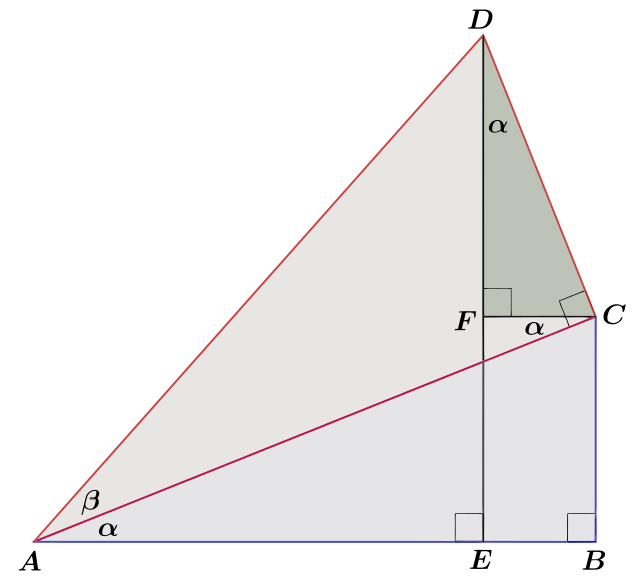
$ \displaystyle ΔABC$ မွာ $ \displaystyle ∠CAB$ ကို $ \displaystyle \alpha$ လို႔ သတ္မွတ္ပါမယ္။
$ \displaystyle ΔABC\simΔCDF$ ျဖစ္တာေၾကာင့္ $ \displaystyle ∠CDF=\alpha$ ျဖစ္ပါတယ္။
$ \displaystyle ΔACD$ မွာေတာ့ $ \displaystyle ∠CAD$ ကို $ \displaystyle \beta$ လို႔ သတ္မွတ္ပါမယ္။
ဒါဆိုရင္ $ \displaystyle ΔABC$ မွာ...
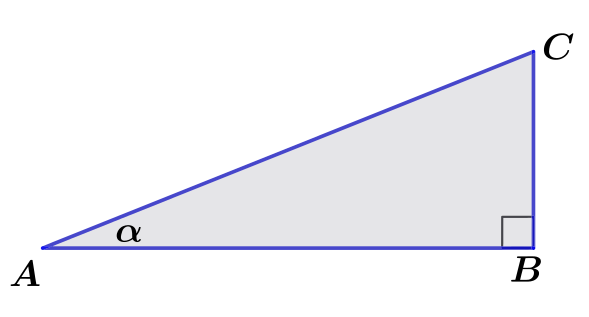
$ \displaystyle \sin \alpha=\frac{BC}{AC}$ နဲ႕ $ \displaystyle \cos \alpha=\frac{AB}{AC}$ ျဖစ္ပါတယ္။
ဒါ့ေၾကာင့္ $ \displaystyle BC =AC \sin \alpha$ နဲ႕ $ \displaystyle AB =AC \cos \alpha$ လို႔ ဆိုႏိုင္ပါတယ္။
တဖန္ $ \displaystyle ΔCDF$ မွာ...
$ \displaystyle \sin \alpha=\frac{FC}{DC}$ နဲ႕ $ \displaystyle \cos \alpha=\frac{DF}{DC}$ ျဖစ္ပါတယ္။
ဒီမွာလည္း $ \displaystyle FC =DC \sin \alpha$ နဲ႕ $ \displaystyle DF =DC \cos \alpha$ လို႔ ဆိုႏိုင္ပါတယ္။
$ \displaystyle ΔACD$ မွာလည္း ...
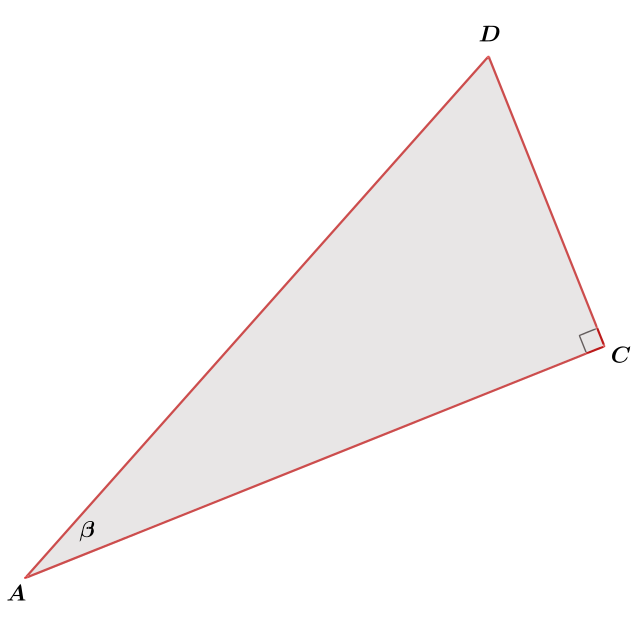
$ \displaystyle \sin \beta=\frac{DC}{AD}$ နဲ႕ $ \displaystyle \cos \beta=\frac{AC}{AD}$ ျဖစ္ပါတယ္။
ဒါဆိုရင္ $ \displaystyle DC =AD \sin \alpha$ နဲ႕ $ \displaystyle AC =AD \cos \alpha$ လို႔ ဆိုႏိုင္ပါတယ္။
$ \displaystyle ΔADE$ အတြက္ ဆက္ၾကည့္ရေအာင္...
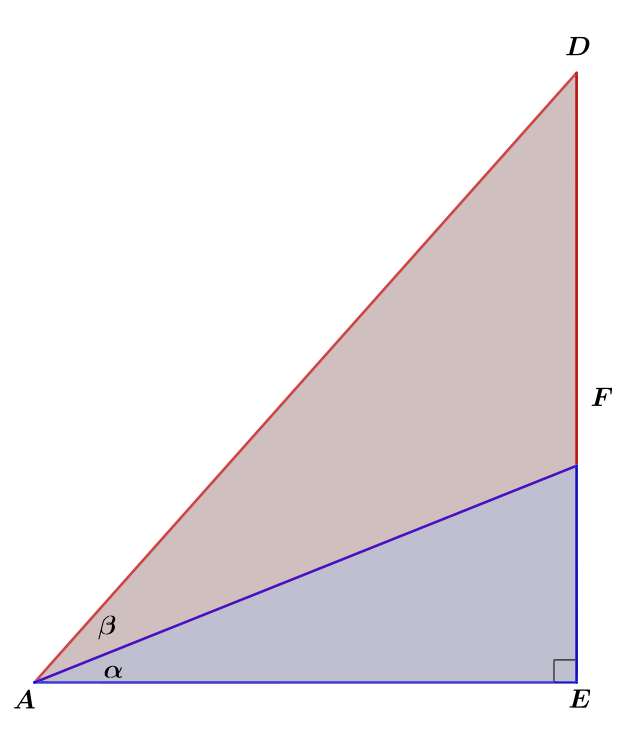
$ \displaystyle \sin (\alpha+\beta)=\frac{DE}{AD}$ ျဖစ္ပါတယ္။
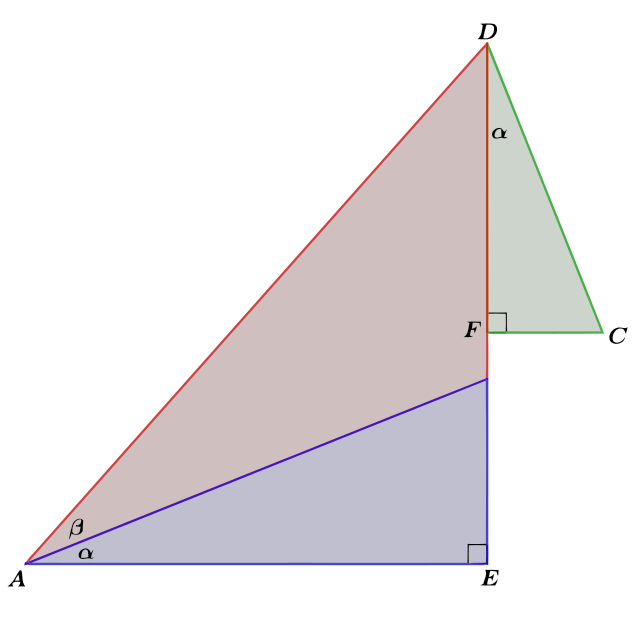
ဒါ့ေၾကာင့္ $ \displaystyle \sin (\alpha +\beta )=\frac{{DF}}{{AD}}+\frac{{FE}}{{AD}}$ လို႔ ေျပာႏိုင္ပါတယ္။ ။
တဖန္ ့ $ \displaystyle BCFE$ က rectangle ျဖစ္တာေၾကာင့္ $ \displaystyle FE=BC$ လို႔ ေျပာႏိုင္ျပန္ပါတယ္။ ။
ဒါ့ေၾကာင့္ $ \displaystyle \sin (\alpha +\beta )=\frac{{DF}}{{AD}}+\frac{{BC}}{{AD}}$ လို႔ ေျပာႏိုင္ျပန္ပါတယ္။။
$ \displaystyle DF =DC \cos \alpha, BC =AC \sin \alpha$ လို႔ အထက္မွာ သိခဲ့ၿပီးပါၿပီ။ ဒါဆိုရင္ ။
$ \displaystyle \sin (\alpha +\beta )=\frac{{DC}}{{AD}}\cos \alpha +\frac{{AC}}{{AD}}\sin \alpha $ လို႔ ေျပာလို႔ရတာေပါ့။ ။
ဒီအခါမွာလည္း $ \displaystyle \sin \beta=\frac{DC}{AD}, \cos \beta=\frac{AC}{AD}$ လို႕သိခဲ့ၿပီးပါၿပီ။ ဒါေၾကာင့္။
$ \displaystyle \sin (\alpha +\beta )=\sin \beta \cos \alpha +\cos \beta \sin \alpha $ လို႔ ေျပာလို႔ရပါၿပီ။ ျပန္စီလိုက္ရင္ ...။
| $ \displaystyle \sin (\alpha +\beta )=\sin \alpha \cos \beta +\cos \alpha \sin \beta $ |
အထက္ပါအတိုင္း ... $ \displaystyle \cos (\alpha +\beta )$ အတြက္ ပံုေသနည္းကို ဆက္ရွာႏိုင္ပါတယ္။ ..။
$ \displaystyle \begin{array}{l}\cos (\alpha +\beta )=\displaystyle \frac{{AE}}{{AD}}\\\\\cos (\alpha +\beta )=\displaystyle \frac{{AB-EB}}{{AD}}\\\\\cos (\alpha +\beta )=\displaystyle \frac{{AB-FC}}{{AD}}\ \ \ \ \left[ {\because EB=FC} \right]\\\\\cos (\alpha +\beta )=\displaystyle \frac{{AB}}{{AD}}-\displaystyle \frac{{FC}}{{AD}}\\\\\cos (\alpha +\beta )=\displaystyle \frac{{AC}}{{AD}}\cos \alpha -\displaystyle \frac{{DC}}{{AD}}\sin \alpha \\\\\text{Since}\ \displaystyle \frac{{AC}}{{AD}}=\cos \beta \ \operatorname{and}\ \displaystyle \frac{{DC}}{{AD}}=\sin \beta ,\\\\\text{Therefore,}\end{array}$
| $ \displaystyle \cos (\alpha +\beta )=\cos \alpha \cos \beta -\sin \alpha \sin \beta $ |
$ \displaystyle \sin (\alpha +\beta )$ နဲ႔ $ \displaystyle \cos (\alpha +\beta )$ ကို သိၿပီဆိုေတာ့ $ \displaystyle \tan (\alpha +\beta )$ ကို ရွာႏိုင္ၿပီေပါ့။
$ \displaystyle \begin{array}{l}\tan (\alpha +\beta )=\displaystyle \frac{{\sin (\alpha +\beta )}}{{\cos (\alpha +\beta )}}\\\\\tan (\alpha +\beta )=\displaystyle \frac{{\sin \alpha \cos \beta +\cos \alpha \sin \beta }}{{\cos \alpha \cos \beta -\sin \alpha \sin \beta }}\\\\\text{Dividing the numerator and denominator }\\\text{with}\ \cos \alpha \cos \beta ,\\\\\tan (\alpha +\beta )=\displaystyle \frac{{\displaystyle \frac{{\sin \alpha \cos \beta }}{{\cos \alpha \cos \beta }}+\displaystyle \frac{{\cos \alpha \sin \beta }}{{\cos \alpha \cos \beta }}}}{{\displaystyle \frac{{\cos \alpha \cos \beta }}{{\cos \alpha \cos \beta }}-\displaystyle \frac{{\sin \alpha \sin \beta }}{{\cos \alpha \cos \beta }}}}\\\\\text{Therefore,}\end{array}$
| $ \displaystyle \tan (\alpha +\beta )=\frac{{\tan \alpha +\tan \beta }}{{1-\tan \alpha \tan \beta }}$ |
$ \displaystyle \begin{array}{l}\ \ \ \ \sin (-\alpha )=-\sin \alpha ,\\\\\ \ \ \ \cos (-\alpha )=\cos \alpha ,\\\\\ \ \ \ \tan (-\alpha )=-\tan \alpha \\\\\ \ \ \ \sin \left( {\alpha -\beta } \right)=\sin \left[ {\alpha +(-\beta )} \right]\\\\\ \ \ \ \sin \left( {\alpha -\beta } \right)=\sin \alpha \cos (-\beta )+\cos \alpha \sin (-\beta )\\\\\text{Therefore,}\end{array}$
| $ \displaystyle \sin \left( {\alpha -\beta } \right)=\sin \alpha \cos \beta -\cos \alpha \sin \beta $ |
$ \displaystyle \begin{array}{l}\ \ \ \ \cos \left( {\alpha -\beta } \right)=\cos \left[ {\alpha +(-\beta )} \right]\\\\\ \ \ \ \cos \left( {\alpha -\beta } \right)=\cos \alpha \cos (-\beta )-\sin \alpha \sin (-\beta )\\\\\text{Therefore,}\end{array}$
| $ \displaystyle \cos \left( {\alpha -\beta } \right)=\cos \alpha \cos \beta +\sin \alpha \sin \beta $ |
$ \displaystyle \begin{array}{l}\ \ \ \ \tan \left( {\alpha -\beta } \right)=\tan \left[ {\alpha +(-\beta )} \right]\\\\\ \ \ \ \tan \left( {\alpha -\beta } \right)=\displaystyle \frac{{\tan \alpha +\tan (-\beta )}}{{1-\tan \alpha \tan (-\beta )}}\end{array}$
| $ \displaystyle \tan \left( {\alpha -\beta } \right)=\frac{{\tan \alpha -\tan \beta }}{{1+\tan \alpha \tan \beta }}$ |
အားလံုးျပန္ေပါင္းရရင္....
| $ \displaystyle \begin{array}{l} \sin \left( {\alpha \pm \beta } \right)=\sin \alpha \cos \beta \pm \cos \alpha \sin \beta \\\\ \cos \left( {\alpha \pm \beta } \right)=\cos \alpha \cos \beta \mp \sin \alpha \sin \beta \\\\ \tan \left( {\alpha \pm \beta } \right)=\displaystyle \frac{{\tan \alpha \pm \tan (-\beta )}}{{1\mp \tan \alpha \tan (-\beta )}}\end{array}$ |
السبت، 3 مارس 2012
Exercise (11.3) No(4, 5) - Solution
4. If $ \displaystyle α + β + γ = 180°$, prove that
$ \displaystyle \text{(a)}\ \ \sin (\alpha +\beta )=\cos (90{}^\circ -\gamma )$
$ \displaystyle \text{(b)}\ \ \sin (\frac{{\alpha +\beta }}{2})=\sin (90{}^\circ +\frac{\gamma }{2})$
$ \displaystyle \text{(c)}\ \ \tan \left( {\frac{\alpha }{2}} \right)=\cot \left( {180{}^\circ +\frac{{\beta +\gamma }}{2}} \right)$
Show/Hide Solution
$ \displaystyle \text{(a)}\ \ \alpha +\beta +\gamma =180{}^\circ $
$ \displaystyle \begin{array}{l}\ \ \ \ \ \ \alpha +\beta =180{}^\circ -\gamma \\\\\therefore \ \ \ \ \sin (\alpha +\beta )=\sin (180{}^\circ -\gamma )\\\ \ \ \\\ \ \ \ \ \ \ \ \ \ \ \ \ \ \ \ \ \ \ \ \ =\sin \gamma \\\\\ \ \ \ \ \ \ \ \ \ \ \ \ \ \ \ \ \ \ \ \ =\ \cos (90{}^\circ -\gamma )\end{array}$
$ \displaystyle \begin{array}{l}\text{(b)}\ \ \alpha +\beta +\gamma =180{}^\circ \\\\\ \ \ \ \ \ \alpha +\beta =180{}^\circ -\gamma \\\\\ \ \ \ \ \ \displaystyle \frac{{\alpha +\beta }}{2}=\displaystyle \frac{{180{}^\circ -\gamma }}{2}=90{}^\circ \displaystyle -\frac{\gamma }{2}\\\\\therefore \ \ \ \ \sin (\displaystyle \frac{{\alpha +\beta }}{2})=\sin (90{}^\circ \displaystyle -\frac{\gamma }{2})\\\ \ \ \\\ \ \ \ \ \ \ \ \ \ \ \ \ \ \ \ \ \ \ \ \ =\cos \displaystyle \frac{\gamma }{2}\\\\\ \ \ \ \ \ \ \ \ \ \ \ \ \ \ \ \ \ \ \ \ =\ \sin (90{}^\circ +\displaystyle \frac{\gamma }{2})\end{array}$
$ \displaystyle \begin{array}{l}\text{(c)}\ \ \alpha +\beta +\gamma =180{}^\circ \\\\\ \ \ \ \ \ \alpha =180{}^\circ -(\beta +\gamma )\\\\\ \ \ \ \ \ \displaystyle \frac{\alpha }{2}=\displaystyle \frac{{180{}^\circ -(\beta +\gamma )}}{2}=90{}^\circ \displaystyle -\frac{{\beta +\gamma }}{2}\\\\\therefore \ \ \ \ \tan \left( {\displaystyle \frac{\alpha }{2}} \right)=\tan (90{}^\circ \displaystyle -\frac{{\beta +\gamma }}{2})\\\ \ \ \\\ \ \ \ \ \ \ \ \ \ \ \ \ \ \ \ \ \ \ \ \ =\cot \displaystyle \frac{{\beta +\gamma }}{2}\\\\\ \ \ \ \ \ \ \ \ \ \ \ \ \ \ \ \ \ \ \ \ =\ \cot \left( {180{}^\circ +\displaystyle \frac{{\beta +\gamma }}{2}} \right)\end{array}$
$ \displaystyle \begin{array}{l}\ \ \ \ \ \ \alpha +\beta =180{}^\circ -\gamma \\\\\therefore \ \ \ \ \sin (\alpha +\beta )=\sin (180{}^\circ -\gamma )\\\ \ \ \\\ \ \ \ \ \ \ \ \ \ \ \ \ \ \ \ \ \ \ \ \ =\sin \gamma \\\\\ \ \ \ \ \ \ \ \ \ \ \ \ \ \ \ \ \ \ \ \ =\ \cos (90{}^\circ -\gamma )\end{array}$
$ \displaystyle \begin{array}{l}\text{(b)}\ \ \alpha +\beta +\gamma =180{}^\circ \\\\\ \ \ \ \ \ \alpha +\beta =180{}^\circ -\gamma \\\\\ \ \ \ \ \ \displaystyle \frac{{\alpha +\beta }}{2}=\displaystyle \frac{{180{}^\circ -\gamma }}{2}=90{}^\circ \displaystyle -\frac{\gamma }{2}\\\\\therefore \ \ \ \ \sin (\displaystyle \frac{{\alpha +\beta }}{2})=\sin (90{}^\circ \displaystyle -\frac{\gamma }{2})\\\ \ \ \\\ \ \ \ \ \ \ \ \ \ \ \ \ \ \ \ \ \ \ \ \ =\cos \displaystyle \frac{\gamma }{2}\\\\\ \ \ \ \ \ \ \ \ \ \ \ \ \ \ \ \ \ \ \ \ =\ \sin (90{}^\circ +\displaystyle \frac{\gamma }{2})\end{array}$
$ \displaystyle \begin{array}{l}\text{(c)}\ \ \alpha +\beta +\gamma =180{}^\circ \\\\\ \ \ \ \ \ \alpha =180{}^\circ -(\beta +\gamma )\\\\\ \ \ \ \ \ \displaystyle \frac{\alpha }{2}=\displaystyle \frac{{180{}^\circ -(\beta +\gamma )}}{2}=90{}^\circ \displaystyle -\frac{{\beta +\gamma }}{2}\\\\\therefore \ \ \ \ \tan \left( {\displaystyle \frac{\alpha }{2}} \right)=\tan (90{}^\circ \displaystyle -\frac{{\beta +\gamma }}{2})\\\ \ \ \\\ \ \ \ \ \ \ \ \ \ \ \ \ \ \ \ \ \ \ \ \ =\cot \displaystyle \frac{{\beta +\gamma }}{2}\\\\\ \ \ \ \ \ \ \ \ \ \ \ \ \ \ \ \ \ \ \ \ =\ \cot \left( {180{}^\circ +\displaystyle \frac{{\beta +\gamma }}{2}} \right)\end{array}$
5. Prove that in any triangle $ \displaystyle ABC,$
(i) $ \displaystyle \sin (A+B) = \sin C.$
(ii) $ \displaystyle \cos(A+B) + \cos C = 0.$
(iii) $ \displaystyle \cos \frac{A+B}{2} = \sin \frac{C}{2}.$
(iv) $ \displaystyle \tan \frac{A+B}{2} = \cot \frac{C}{2}.$
Show/Hide Solution
(i) $ \displaystyle \text{Since}\ A+B+C=180{}^\circ ,$
$ \displaystyle \begin{array}{l}\therefore A+B=180{}^\circ -C\\\\\therefore \sin (A+B)=\sin (180{}^\circ -C)\\\\\therefore \sin (A+B)=\sin C\end{array}$
(ii) $ \displaystyle \text{Similarly, }\cos (A+B)=\cos (180{}^\circ -C)$
$ \displaystyle \begin{array}{l}\therefore \cos (A+B)=-\cos C\\\\\therefore \cos (A+B)+\cos C=0\end{array}$
(iii) $ \displaystyle \cos \left( {\frac{{A+B}}{2}} \right)=\cos \left( {\frac{{180{}^\circ -C}}{2}} \right)$
$ \displaystyle \therefore \ \cos \left( {\frac{{A+B}}{2}} \right)=\cos \left( {90{}^\circ -\frac{C}{2}} \right)$
$ \displaystyle \therefore \ \cos \left( {\frac{{A+B}}{2}} \right)=\sin \frac{C}{2}$
(iv) $ \displaystyle \tan \left( {\frac{{A+B}}{2}} \right)=\tan \left( {\frac{{180{}^\circ -C}}{2}} \right)$
$ \displaystyle \therefore \ \tan \left( {\frac{{A+B}}{2}} \right)=\tan \left( {90{}^\circ -\frac{C}{2}} \right)$
$ \displaystyle \therefore \ \tan \left( {\frac{{A+B}}{2}} \right)=\cot \frac{C}{2}$
$ \displaystyle \begin{array}{l}\therefore A+B=180{}^\circ -C\\\\\therefore \sin (A+B)=\sin (180{}^\circ -C)\\\\\therefore \sin (A+B)=\sin C\end{array}$
(ii) $ \displaystyle \text{Similarly, }\cos (A+B)=\cos (180{}^\circ -C)$
$ \displaystyle \begin{array}{l}\therefore \cos (A+B)=-\cos C\\\\\therefore \cos (A+B)+\cos C=0\end{array}$
(iii) $ \displaystyle \cos \left( {\frac{{A+B}}{2}} \right)=\cos \left( {\frac{{180{}^\circ -C}}{2}} \right)$
$ \displaystyle \therefore \ \cos \left( {\frac{{A+B}}{2}} \right)=\cos \left( {90{}^\circ -\frac{C}{2}} \right)$
$ \displaystyle \therefore \ \cos \left( {\frac{{A+B}}{2}} \right)=\sin \frac{C}{2}$
(iv) $ \displaystyle \tan \left( {\frac{{A+B}}{2}} \right)=\tan \left( {\frac{{180{}^\circ -C}}{2}} \right)$
$ \displaystyle \therefore \ \tan \left( {\frac{{A+B}}{2}} \right)=\tan \left( {90{}^\circ -\frac{C}{2}} \right)$
$ \displaystyle \therefore \ \tan \left( {\frac{{A+B}}{2}} \right)=\cot \frac{C}{2}$
Exercise (11.3) No (2) Solution
Find the value of θ, 0° ≤ θ ≤ 360° for the following equations. Do not use table.
(a) $ \displaystyle \ \ \ \ \ \ \sin \theta =-\frac{1}{2}$
Show/Hide Solution
$ \displaystyle \therefore \ \ \ \ \text{basic acute angle}=30{}^\circ $
$ \displaystyle \begin{array}{l}\ \ \ \ \ \ \text{But }\sin \theta \ \text{is negative, }\theta \ \text{may be }\\\ \ \ \ \ \ \text{either in the }{{\text{3}}^{{\text{rd}}}}\text{ or }{{\text{4}}^{{\text{th}}}}\text{ quadrant}\text{.}\end{array}$
$ \displaystyle \therefore \,\ \ \ \theta =180{}^\circ +30{}^\circ \ (\text{or)}\ \theta =360{}^\circ -30{}^\circ \ $
$ \displaystyle \therefore \,\ \ \ \theta =210{}^\circ \ (\text{or)}\ \theta =330{}^\circ $
$ \displaystyle \begin{array}{l}\ \ \ \ \ \ \text{But }\sin \theta \ \text{is negative, }\theta \ \text{may be }\\\ \ \ \ \ \ \text{either in the }{{\text{3}}^{{\text{rd}}}}\text{ or }{{\text{4}}^{{\text{th}}}}\text{ quadrant}\text{.}\end{array}$
$ \displaystyle \therefore \,\ \ \ \theta =180{}^\circ +30{}^\circ \ (\text{or)}\ \theta =360{}^\circ -30{}^\circ \ $
$ \displaystyle \therefore \,\ \ \ \theta =210{}^\circ \ (\text{or)}\ \theta =330{}^\circ $
(b) $ \displaystyle \ \ \ \ \ \ \cos \theta =-\frac{{\sqrt{3}}}{2}$
Show/Hide Solution
$ \displaystyle \therefore \ \ \ \ \text{basic acute angle}=30{}^\circ $
$ \displaystyle \begin{array}{l}\ \ \ \ \ \ \text{But }\cos \theta \ \text{is negative, }\theta \ \text{may be }\\\ \ \ \ \ \ \text{either in the }{{\text{2}}^{{\text{nd}}}}\text{ or }{{\text{3}}^{{\text{rd}}}}\text{ quadrant}\text{.}\end{array}$
$ \displaystyle \therefore \,\ \ \ \theta =180{}^\circ -30{}^\circ \ (\text{or)}\ \theta =180{}^\circ +30{}^\circ \ $
$ \displaystyle \therefore \,\ \ \ \theta =150{}^\circ \ (\text{or)}\ \theta =210{}^\circ $
$ \displaystyle \begin{array}{l}\ \ \ \ \ \ \text{But }\cos \theta \ \text{is negative, }\theta \ \text{may be }\\\ \ \ \ \ \ \text{either in the }{{\text{2}}^{{\text{nd}}}}\text{ or }{{\text{3}}^{{\text{rd}}}}\text{ quadrant}\text{.}\end{array}$
$ \displaystyle \therefore \,\ \ \ \theta =180{}^\circ -30{}^\circ \ (\text{or)}\ \theta =180{}^\circ +30{}^\circ \ $
$ \displaystyle \therefore \,\ \ \ \theta =150{}^\circ \ (\text{or)}\ \theta =210{}^\circ $
(c) $ \displaystyle \ \ \ \ \ \ \cos \theta =-\frac{1}{{\sqrt{2}}}$
Show/Hide Solution
$ \displaystyle \therefore \ \ \ \ \text{basic acute angle}=45{}^\circ $
$ \displaystyle \begin{array}{l}\ \ \ \ \ \ \text{But }\cos \theta \ \text{is negative, }\theta \ \text{may be }\\\ \ \ \ \ \ \text{either in the }{{\text{2}}^{{\text{nd}}}}\text{ or }{{\text{3}}^{{\text{rd}}}}\text{ quadrant}\text{.}\end{array}$
$ \displaystyle \therefore \,\ \ \ \theta =180{}^\circ -45{}^\circ \ (\text{or)}\ \theta =180{}^\circ +45{}^\circ \ $
$ \displaystyle \therefore \,\ \ \ \theta =135{}^\circ \ (\text{or)}\ \theta =225{}^\circ $
$ \displaystyle \begin{array}{l}\ \ \ \ \ \ \text{But }\cos \theta \ \text{is negative, }\theta \ \text{may be }\\\ \ \ \ \ \ \text{either in the }{{\text{2}}^{{\text{nd}}}}\text{ or }{{\text{3}}^{{\text{rd}}}}\text{ quadrant}\text{.}\end{array}$
$ \displaystyle \therefore \,\ \ \ \theta =180{}^\circ -45{}^\circ \ (\text{or)}\ \theta =180{}^\circ +45{}^\circ \ $
$ \displaystyle \therefore \,\ \ \ \theta =135{}^\circ \ (\text{or)}\ \theta =225{}^\circ $
(d) $ \displaystyle \ \ \ \ \ \ \tan \theta =\sqrt{3}$
Show/Hide Solution
$ \displaystyle \therefore \ \ \ \ \text{basic acute angle}=60{}^\circ $
$ \displaystyle \begin{array}{l}\ \ \ \ \ \ \text{But }\tan \theta \ \text{is positive, }\theta \ \text{may be }\\\ \ \ \ \ \ \text{either in the }{{\text{1}}^{{\text{st}}}}\text{ or }{{\text{3}}^{{\text{rd}}}}\text{ quadrant}\text{.}\end{array}$
$ \displaystyle \therefore \,\ \ \ \theta =60{}^\circ \ (\text{or)}\ \theta =180{}^\circ +60{}^\circ \ $
$ \displaystyle \therefore \,\ \ \ \theta =60{}^\circ \ (\text{or)}\ \theta =240{}^\circ $
$ \displaystyle \begin{array}{l}\ \ \ \ \ \ \text{But }\tan \theta \ \text{is positive, }\theta \ \text{may be }\\\ \ \ \ \ \ \text{either in the }{{\text{1}}^{{\text{st}}}}\text{ or }{{\text{3}}^{{\text{rd}}}}\text{ quadrant}\text{.}\end{array}$
$ \displaystyle \therefore \,\ \ \ \theta =60{}^\circ \ (\text{or)}\ \theta =180{}^\circ +60{}^\circ \ $
$ \displaystyle \therefore \,\ \ \ \theta =60{}^\circ \ (\text{or)}\ \theta =240{}^\circ $
(e) $ \displaystyle \ \ \ \ \ \ \tan 2\theta =1$
Show/Hide Solution
$ \displaystyle \therefore \ \ \ \ \text{basic acute angle}=45{}^\circ $
$ \displaystyle \begin{array}{l}\ \ \ \ \ \ \text{But }\tan 2\theta \ \text{is positive, }2\theta \ \text{may be }\\\ \ \ \ \ \ \text{either in the }{{\text{1}}^{{\text{st}}}}\text{ or }{{\text{3}}^{{\text{rd}}}}\text{ quadrant}\text{.}\end{array}$
$ \displaystyle \underline{{\text{For }{{\text{1}}^{{\text{st}}}}\ \text{quadrant}}}\text{,}$
$ \displaystyle \therefore \,\ \ \ 2\theta =45{}^\circ \ (\text{or)}\ 2\theta =360{}^\circ +45{}^\circ \ $
$ \displaystyle \ \ \ \ \ 2\theta =45{}^\circ \ (\text{or)}\ 2\theta =405{}^\circ \ $
$ \displaystyle \ \ \ \ \ \theta =22{}^\circ 3{0}'(\text{or)}\ \theta =\ 202{}^\circ 3{0}'$
$ \displaystyle \underline{{\text{For }{{\text{3}}^{{\text{rd}}}}\ \text{quadrant}}}\text{,}$
$ \displaystyle \ \,\ \ \ 2\theta =180{}^\circ +45{}^\circ \ (\text{or)}\ 2\theta =360{}^\circ +180{}^\circ +45{}^\circ $
$ \displaystyle \ \ \ \ \ 2\theta =225{}^\circ \ (\text{or)}\ 2\theta =585{}^\circ $
$ \displaystyle \ \ \ \ \ \theta =112{}^\circ 3{0}'(\text{or)}\ \theta =292{}^\circ 3{0}'$
$ \displaystyle \begin{array}{l}\ \ \ \ \ \ \text{But }\tan 2\theta \ \text{is positive, }2\theta \ \text{may be }\\\ \ \ \ \ \ \text{either in the }{{\text{1}}^{{\text{st}}}}\text{ or }{{\text{3}}^{{\text{rd}}}}\text{ quadrant}\text{.}\end{array}$
$ \displaystyle \underline{{\text{For }{{\text{1}}^{{\text{st}}}}\ \text{quadrant}}}\text{,}$
$ \displaystyle \therefore \,\ \ \ 2\theta =45{}^\circ \ (\text{or)}\ 2\theta =360{}^\circ +45{}^\circ \ $
$ \displaystyle \ \ \ \ \ 2\theta =45{}^\circ \ (\text{or)}\ 2\theta =405{}^\circ \ $
$ \displaystyle \ \ \ \ \ \theta =22{}^\circ 3{0}'(\text{or)}\ \theta =\ 202{}^\circ 3{0}'$
$ \displaystyle \underline{{\text{For }{{\text{3}}^{{\text{rd}}}}\ \text{quadrant}}}\text{,}$
$ \displaystyle \ \,\ \ \ 2\theta =180{}^\circ +45{}^\circ \ (\text{or)}\ 2\theta =360{}^\circ +180{}^\circ +45{}^\circ $
$ \displaystyle \ \ \ \ \ 2\theta =225{}^\circ \ (\text{or)}\ 2\theta =585{}^\circ $
$ \displaystyle \ \ \ \ \ \theta =112{}^\circ 3{0}'(\text{or)}\ \theta =292{}^\circ 3{0}'$
(f) $ \displaystyle \ \ \ \ \ \ \tan 3\theta =-1$
Show/Hide Solution
$ \displaystyle \therefore \ \ \ \ \text{basic acute angle}=45{}^\circ $
$ \displaystyle \begin{array}{l}\ \ \ \ \ \ \text{But }\tan 3\theta \ \text{is negative, 3}\theta \ \text{may be }\\\ \ \ \ \ \ \text{either in the }{{\text{2}}^{{\text{nd}}}}\text{ or }{{\text{4}}^{{\text{th}}}}\text{ quadrant}\text{.}\end{array}$
$ \displaystyle \underline{{\text{For }{{\text{2}}^{{\text{nd}}}}\ \text{quadrant}}}\text{,}$
$ \displaystyle \ \,\ \ \ 3\theta =180{}^\circ -45{}^\circ \ $
$ \displaystyle \ \,\ \ \ 3\theta =135{}^\circ \ $
$ \displaystyle \ \,\ \ \ \theta =45{}^\circ \ $
$ \displaystyle \ \ \ \ \ \ \ \ \ \ \ (\text{or)}$
$ \displaystyle \ \ \ \ \ 3\theta =360{}^\circ +180{}^\circ -45{}^\circ \ $
$ \displaystyle \ \,\ \ \ 3\theta =495{}^\circ \ $
$ \displaystyle \ \,\ \ \ \theta =165{}^\circ \ $
$ \displaystyle \ \ \ \ \ \ \ \ \ \ \ (\text{or)}\ $
$ \displaystyle \ \ \ \ \ 3\theta =360{}^\circ +360{}^\circ +180{}^\circ -45{}^\circ \ $
$ \displaystyle \ \,\ \ \ 3\theta =855{}^\circ \ $
$ \displaystyle \ \,\ \ \ \theta =285{}^\circ $
$ \displaystyle \underline{{\text{For }{{\text{4}}^{{\text{th}}}}\ \text{quadrant}}}\text{,}$
$ \displaystyle \ \,\ \ \ 3\theta =360{}^\circ -45{}^\circ $
$ \displaystyle \ \,\ \ \ 3\theta =315{}^\circ \ $
$ \displaystyle \ \,\ \ \ \theta =105{}^\circ \ $
$ \displaystyle \ \ \ \ \ \ \ \ \ \ \ (\text{or)}\ $
$ \displaystyle \ \ \ \ \ 3\theta =360{}^\circ +360{}^\circ -45{}^\circ $
$ \displaystyle \ \,\ \ \ 3\theta =675{}^\circ \ $
$ \displaystyle \ \,\ \ \ \theta =225{}^\circ \ \ $
$ \displaystyle \ \ \ \ \ \ \ \ \ \ \ (\text{or)}\ $
$ \displaystyle \ \ \ \ \ 3\theta =360{}^\circ +360{}^\circ +360{}^\circ -45{}^\circ \ $
$ \displaystyle \ \,\ \ \ 3\theta =1035{}^\circ \ $
$ \displaystyle \ \,\ \ \ \theta =345{}^\circ \ \ $
$ \displaystyle \begin{array}{l}\ \ \ \ \ \ \text{But }\tan 3\theta \ \text{is negative, 3}\theta \ \text{may be }\\\ \ \ \ \ \ \text{either in the }{{\text{2}}^{{\text{nd}}}}\text{ or }{{\text{4}}^{{\text{th}}}}\text{ quadrant}\text{.}\end{array}$
$ \displaystyle \underline{{\text{For }{{\text{2}}^{{\text{nd}}}}\ \text{quadrant}}}\text{,}$
$ \displaystyle \ \,\ \ \ 3\theta =180{}^\circ -45{}^\circ \ $
$ \displaystyle \ \,\ \ \ 3\theta =135{}^\circ \ $
$ \displaystyle \ \,\ \ \ \theta =45{}^\circ \ $
$ \displaystyle \ \ \ \ \ \ \ \ \ \ \ (\text{or)}$
$ \displaystyle \ \ \ \ \ 3\theta =360{}^\circ +180{}^\circ -45{}^\circ \ $
$ \displaystyle \ \,\ \ \ 3\theta =495{}^\circ \ $
$ \displaystyle \ \,\ \ \ \theta =165{}^\circ \ $
$ \displaystyle \ \ \ \ \ \ \ \ \ \ \ (\text{or)}\ $
$ \displaystyle \ \ \ \ \ 3\theta =360{}^\circ +360{}^\circ +180{}^\circ -45{}^\circ \ $
$ \displaystyle \ \,\ \ \ 3\theta =855{}^\circ \ $
$ \displaystyle \ \,\ \ \ \theta =285{}^\circ $
$ \displaystyle \underline{{\text{For }{{\text{4}}^{{\text{th}}}}\ \text{quadrant}}}\text{,}$
$ \displaystyle \ \,\ \ \ 3\theta =360{}^\circ -45{}^\circ $
$ \displaystyle \ \,\ \ \ 3\theta =315{}^\circ \ $
$ \displaystyle \ \,\ \ \ \theta =105{}^\circ \ $
$ \displaystyle \ \ \ \ \ \ \ \ \ \ \ (\text{or)}\ $
$ \displaystyle \ \ \ \ \ 3\theta =360{}^\circ +360{}^\circ -45{}^\circ $
$ \displaystyle \ \,\ \ \ 3\theta =675{}^\circ \ $
$ \displaystyle \ \,\ \ \ \theta =225{}^\circ \ \ $
$ \displaystyle \ \ \ \ \ \ \ \ \ \ \ (\text{or)}\ $
$ \displaystyle \ \ \ \ \ 3\theta =360{}^\circ +360{}^\circ +360{}^\circ -45{}^\circ \ $
$ \displaystyle \ \,\ \ \ 3\theta =1035{}^\circ \ $
$ \displaystyle \ \,\ \ \ \theta =345{}^\circ \ \ $
diagram မ်ားသည္ principal angle မ်ား ကို ဆံုးျဖတ္ရာတြင္ အေထာက္အကူ ျဖစ္ေစရန္ ေရးဆြဲ ေဖၚျပျခင္း ျဖစ္သည္။ နားလည္ ကၽြမ္းက်င္ သြားလ်င္ diagram မ်ား မေရးဆြဲပဲ ေျဖဆိုႏိုင္ ပါသည္။ က်န္ေသာပုစာၦမ်ားအတြက္ diagram မဆြဲေတာ့ပဲ ေျဖဆိုပါမည္။
(g) $ \displaystyle \ \ \ \ \ \ \tan (3\theta -30{}^\circ )=-1$
Show/Hide Solution
$ \displaystyle \begin{array}{l}\therefore \ \ \ \ \text{basic acute angle}=45{}^\circ \\\\\ \ \ \ \ \ \text{But }\tan (3\theta -30{}^\circ )\ \text{is negative, }(3\theta -30{}^\circ )\ \text{may be }\\\ \ \ \ \ \ \text{either in the }{{\text{2}}^{{\text{nd}}}}\text{ or }{{\text{4}}^{{\text{th}}}}\text{ quadrant}\text{.}\\\\\underline{{\text{For }{{\text{2}}^{{\text{nd}}}}\ \text{quadrant}}}\text{,}\\\\\ \,\ \ \ 3\theta -30{}^\circ =180{}^\circ -45{}^\circ \\\ \\\ \,\ \ \ 3\theta =165{}^\circ \ \\\\\ \,\ \ \ \theta =55{}^\circ \ \\\\\ \ \ \ \ \ \ \ \ \ \ (\text{or)}\ \\\\\ \ \ \ \ 3\theta -30{}^\circ =360{}^\circ +180{}^\circ -45{}^\circ \ \\\\\ \,\ \ \ 3\theta =525{}^\circ \ \\\\\ \,\ \ \ \theta =175{}^\circ \ \\\\\ \ \ \ \ \ \ \ \ \ \ (\text{or)}\ \\\\\ \ \ \ \ 3\theta -30{}^\circ =360{}^\circ +360{}^\circ +180{}^\circ -45{}^\circ \ \\\\\ \,\ \ \ 3\theta =885{}^\circ \ \\\\\ \,\ \ \ \theta =295{}^\circ \ \ \ \\\\\underline{{\text{For }{{\text{4}}^{{\text{th}}}}\ \text{quadrant}}}\text{,}\\\\\ \,\ \ \ 3\theta -30{}^\circ =360{}^\circ -45{}^\circ \\\\\ \,\ \ \ 3\theta =345{}^\circ \ \\\\\ \,\ \ \ \theta =115{}^\circ \ \ \\\\\ \ \ \ \ \ \ \ \ \ \ (\text{or)}\ \\\\\ \ \ \ \ 3\theta -30{}^\circ =360{}^\circ +360{}^\circ -45{}^\circ \\\\\ \,\ \ \ 3\theta =705{}^\circ \ \\\\\ \,\ \ \ \theta =295{}^\circ \ \ \\\\\ \ \ \ \ \ \ \ \ \ \ (\text{or)}\ \\\\\ \ \ \ \ 3\theta -30{}^\circ =360{}^\circ +360{}^\circ +360{}^\circ -45{}^\circ \ \\\\\ \,\ \ \ 3\theta =1065{}^\circ \ \\\\\ \,\ \ \ \theta =355{}^\circ \ \ \end{array}$
(h) $ \displaystyle \ \ \ \ \ \ \cos 2\theta =-\frac{1}{2}$
Show/Hide Solution
$ \displaystyle \begin{array}{l}\therefore \ \ \ \ \text{basic acute angle}=60{}^\circ \\\\\ \ \ \ \ \ \text{But }\cos 2\theta \ \text{is negative, }2\theta \ \text{may be }\\\ \ \ \ \ \ \text{either in the }{{\text{2}}^{{\text{nd}}}}\text{ or }{{\text{3}}^{{\text{rd}}}}\text{ quadrant}\text{.}\\\\\underline{{\text{For }{{\text{2}}^{{\text{nd}}}}\ \text{quadrant}}}\text{,}\\\\\ \,\ \ \ 2\theta =180{}^\circ -60{}^\circ \\\ \\\ \,\ \ \ 2\theta =120{}^\circ \ \\\\\ \,\ \ \ \theta =60{}^\circ \ \\\\\ \ \ \ \ \ \ \ \ \ \ (\text{or)}\ \\\\\ \ \ \ \ 2\theta =360{}^\circ +180{}^\circ -60{}^\circ \ \\\\\ \,\ \ \ 2\theta =480{}^\circ \ \\\\\ \,\ \ \ \theta =240{}^\circ \ \\\\\underline{{\text{For }{{\text{3}}^{{\text{rd}}}}\ \text{quadrant}}}\text{,}\\\\\ \,\ \ \ 2\theta =180{}^\circ +60{}^\circ \\\\\ \,\ \ \ 2\theta =240{}^\circ \ \\\\\ \,\ \ \ \theta =120{}^\circ \ \ \\\\\ \ \ \ \ \ \ \ \ \ \ (\text{or)}\ \\\\\ \ \ \ \ 2\theta =360{}^\circ +180{}^\circ +60{}^\circ \\\\\ \,\ \ \ 2\theta =600{}^\circ \ \\\\\ \,\ \ \ \theta =300{}^\circ \ \ \ \ \end{array}$
(i) $ \displaystyle \ \ \ \ \ \sin (2\theta +30{}^\circ )=\frac{{\sqrt{3}}}{2}$
Show/Hide Solution
$ \displaystyle \begin{array}{l}\therefore \ \ \ \ \text{basic acute angle}=60{}^\circ \\\\\ \ \ \ \ \ \text{But }\sin (2\theta +30{}^\circ )\ \text{is positive, }2\theta +30{}^\circ \ \text{may be }\\\ \ \ \ \ \ \text{either in the }{{\text{1}}^{{\text{st}}}}\text{ or }{{\text{2}}^{{\text{nd}}}}\text{ quadrant}\text{.}\\\\\underline{{\text{For }{{\text{1}}^{{\text{st}}}}\ \text{quadrant}}}\text{,}\\\\\ \,\ \ \ 2\theta +30{}^\circ =60{}^\circ \\\ \\\ \,\ \ \ 2\theta =30{}^\circ \ \\\\\ \,\ \ \ \theta =15{}^\circ \ \\\\\ \ \ \ \ \ \ \ \ \ \ (\text{or)}\ \\\\\ \ \ \ \ 2\theta =360{}^\circ +60{}^\circ \ \\\\\ \,\ \ \ 2\theta =420{}^\circ \ \\\\\ \,\ \ \ \theta =210{}^\circ \ \\\\\underline{{\text{For }{{\text{2}}^{{\text{nd}}}}\ \text{quadrant}}}\text{,}\\\\\ \,\ \ \ 2\theta +30{}^\circ =180{}^\circ -60{}^\circ \\\ \\\ \,\ \ \ 2\theta =120{}^\circ \ \\\\\ \,\ \ \ \theta =60{}^\circ \ \\\\\ \ \ \ \ \ \ \ \ \ \ (\text{or)}\ \\\\\ \ \ \ \ 2\theta =360{}^\circ +180{}^\circ -60{}^\circ \ \\\\\ \,\ \ \ 2\theta =480{}^\circ \ \\\\\ \,\ \ \ \theta =240{}^\circ \ \end{array}$
(j) $ \displaystyle \ \ \ \ \ \ \tan \frac{1}{2}\theta =-\frac{1}{{\sqrt{3}}}$
Show/Hide Solution
$ \displaystyle \therefore \ \ \ \ \text{basic acute angle}=30{}^\circ $
$ \displaystyle \ \ \ \ \ \ \text{But}\ \tan \frac{1}{2}\theta \ \text{is positive, }\frac{1}{2}\theta \ \text{may be }$
$ \displaystyle \ \ \ \ \ \ \text{either in the }{{\text{2}}^{{\text{nd}}}}\text{ or }{{\text{4}}^{{\text{th}}}}\text{ quadrant}\text{.}$
$ \displaystyle \therefore \ \ \ \ \frac{1}{2}\theta =180{}^\circ -30{}^\circ \ (\text{or})\ \frac{1}{2}\theta =360{}^\circ -30{}^\circ $
$ \displaystyle \therefore \ \ \ \ \frac{1}{2}\theta =150{}^\circ \ (\text{or})\ \frac{1}{2}\theta =330{}^\circ $
$ \displaystyle \therefore \ \ \ \ \theta =300{}^\circ \ (\text{or})\ \theta =660{}^\circ $
$ \displaystyle \begin{array}{l}\ \ \ \ \ \ \text{But}\ 0{}^\circ \le \theta \le 360{}^\circ ,\theta =660{}^\circ \ \text{is not in domain}\text{.}\\\\\therefore \ \ \ \ \theta =300{}^\circ \ \text{is the only solution}\text{.}\end{array}$
$ \displaystyle \ \ \ \ \ \ \text{But}\ \tan \frac{1}{2}\theta \ \text{is positive, }\frac{1}{2}\theta \ \text{may be }$
$ \displaystyle \ \ \ \ \ \ \text{either in the }{{\text{2}}^{{\text{nd}}}}\text{ or }{{\text{4}}^{{\text{th}}}}\text{ quadrant}\text{.}$
$ \displaystyle \therefore \ \ \ \ \frac{1}{2}\theta =180{}^\circ -30{}^\circ \ (\text{or})\ \frac{1}{2}\theta =360{}^\circ -30{}^\circ $
$ \displaystyle \therefore \ \ \ \ \frac{1}{2}\theta =150{}^\circ \ (\text{or})\ \frac{1}{2}\theta =330{}^\circ $
$ \displaystyle \therefore \ \ \ \ \theta =300{}^\circ \ (\text{or})\ \theta =660{}^\circ $
$ \displaystyle \begin{array}{l}\ \ \ \ \ \ \text{But}\ 0{}^\circ \le \theta \le 360{}^\circ ,\theta =660{}^\circ \ \text{is not in domain}\text{.}\\\\\therefore \ \ \ \ \theta =300{}^\circ \ \text{is the only solution}\text{.}\end{array}$
(k) $ \displaystyle \ \ \ \ \ \ \sin \theta =0.6521$
Show/Hide Solution
$ \displaystyle \begin{array}{l}\therefore \ \ \ \ \text{basic acute angle}=40{}^\circ 4{2}'\ (\text{using table)}\\\\\ \ \ \ \ \ \text{But}\ \sin \theta \ \text{is positive, }\theta \ \text{may be }\\\ \ \ \ \ \ \text{either in the }{{\text{1}}^{{\text{st}}}}\text{ or }{{\text{2}}^{{\text{nd}}}}\text{ quadrant}\text{.}\\\\\therefore \ \ \ \ \theta =40{}^\circ 4{2}'\ (\text{or})\ \theta =180{}^\circ -40{}^\circ 4{2}'\\\\\therefore \ \ \ \ \theta =40{}^\circ 4{2}'\ (\text{or})\ \theta =139{}^\circ 1{8}'\\\ \end{array}$
(l) $ \displaystyle \ \ \ \ \ \ \cos \theta =-0.3854$
Show/Hide Solution
$ \displaystyle \begin{array}{l}\therefore \ \ \ \ \text{basic acute angle}=67{}^\circ 2{0}'\ (\text{using table)}\\\\\ \ \ \ \ \ \text{But}\ \cos \theta \ \text{is negative, }\theta \ \text{may be }\\\ \ \ \ \ \ \text{either in the }{{\text{2}}^{{\text{nd}}}}\text{ or }{{\text{3}}^{{\text{rd}}}}\text{ quadrant}\text{.}\\\\\therefore \ \ \ \ \theta =180{}^\circ -67{}^\circ 2{0}'\ (\text{or})\ \theta =180{}^\circ +67{}^\circ 2{0}'\\\\\therefore \ \ \ \ \theta =112{}^\circ 4{0}'\ (\text{or})\ \theta =247{}^\circ 2{0}'\end{array}$
الاشتراك في:
الرسائل (Atom)


