Showing posts with label sample question. Show all posts

Friday, December 20, 2019

Sample Question for 2020 Matriculation Examination


2020
MATRICULATION EXAMINATION
Sample Question Set (3)
MATHEMATICS                        Time allowed: 3hours
WRITE YOUR ANSWERS IN THE ANSWER BOOKLET.
SECTION (A)
(Answer ALL questions.) 

1 (a).     Let $ \displaystyle f:R\backslash \{\pm 2\}\to R$ be a function defined by $ \displaystyle f(x)=\frac{{3x}}{{{{x}^{2}}-4}}$.Find the positive value of $z$ such that $f(z) = 1$.

(3 marks)

Show/Hide Solution

$ \displaystyle \begin{array}{l}f(x)=\displaystyle \frac{{3x}}{{{{x}^{2}}-4}}\\[2ex]f(z)=1\\[2ex]\displaystyle \frac{{3z}}{{{{z}^{2}}-4}}=1\\[2ex]{{z}^{2}}-4=3z\\[2ex]{{z}^{2}}-3z-4=0\\[2ex](z+1)(z-4)=0\\[2ex]z=-1\ \text{or}\ z=4\\[2ex]\text{Since }z>0,\ z=4\end{array}$

1(b).     If the polynomial $x^3 - 3x^2 + ax - b$ is divided by $(x - 2 )$ and $(x + 2)$, the remainders are $21$ and $1$ respectively. Find the values of $a$ and $b$.


(3 marks)

Show/Hide Solution

$ \displaystyle \begin{array}{l}\text{Let}\ f(x)={{x}^{3}}-3{{x}^{2}}+ax-b\\[2ex]\text{When}\ f(x)\ \text{is divided by }(x-2),\ \\[2ex]\text{The remainder is }21.\\[2ex]f(2)=21\\[2ex]{{(2)}^{3}}-3{{(2)}^{2}}+a(2)-b=21\\[2ex]2a-b=25\ --------(1)\\[2ex]\text{When}\ f(x)\ \text{is divided by }(x+2),\ \\[2ex]\text{The remainder is }1.\\[2ex]f(-2)=1\\[2ex]{{(-2)}^{3}}-3{{(-2)}^{2}}+a(-2)-b=1\\[2ex]2a+b=-21\ --------(2)\\[2ex](1)+(2)\Rightarrow 4a=4\Rightarrow a=1\\[2ex](1)-(2)\Rightarrow -2b=46\Rightarrow b=-23\end{array}$

2(a).     Find the middle term in the expansion of $(x^2 - 2y)^{10}$.
(3 marks)

Show/Hide Solution

$ \displaystyle \begin{array}{l}{{(r+1)}^{{\text{th}}}}\ \text{term in the expansion of }{{({{x}^{2}}-2y)}^{{10}}}={}^{{10}}{{C}_{r}}{{\left( {{{x}^{2}}} \right)}^{{10-r}}}{{\left( {-2y} \right)}^{r}}\text{ }\\[2ex]\text{middle term in the expansion of }{{({{x}^{2}}-2y)}^{{10}}}={{6}^{{\text{th}}}}\ \text{term}\\[2ex]\ \ \ \ \ \ \ \ \ \ \ \ \ \ \ \ \ \ \ \ \ \ \ \ \ \ \ \ \ \ \ \ \ \ \ \ \ \ \ \ \ \ \ \ \ \ \ \ \ \ \ \ \ \ \ \ \ \ \ \ \ \ ={{(5+1)}^{{\text{th}}}}\ \text{term}\\[2ex]\ \ \ \ \ \ \ \ \ \ \ \ \ \ \ \ \ \ \ \ \ \ \ \ \ \ \ \ \ \ \ \ \ \ \ \ \ \ \ \ \ \ \ \ \ \ \ \ \ \ \ \ \ \ \ \ \ \ \ \ \ \ ={}^{{10}}{{C}_{5}}{{\left( {{{x}^{2}}} \right)}^{{10-5}}}{{\left( {-2y} \right)}^{5}}\\[2ex]\ \ \ \ \ \ \ \ \ \ \ \ \ \ \ \ \ \ \ \ \ \ \ \ \ \ \ \ \ \ \ \ \ \ \ \ \ \ \ \ \ \ \ \ \ \ \ \ \ \ \ \ \ \ \ \ \ \ \ \ \ \ =\displaystyle \frac{{10\times 9\times 8\times 7\times 6}}{{1\times 2\times 3\times 4\times 5}}{{x}^{{10}}}\left( {-32{{y}^{5}}} \right)\\[2ex]\ \ \ \ \ \ \ \ \ \ \ \ \ \ \ \ \ \ \ \ \ \ \ \ \ \ \ \ \ \ \ \ \ \ \ \ \ \ \ \ \ \ \ \ \ \ \ \ \ \ \ \ \ \ \ \ \ \ \ \ \ \ =-8064{{x}^{{10}}}{{y}^{5}}\end{array}$

2(b).     In a sequence if $u_1=1$ and $u_{n+1}=u_n+3(n+1)$, find $u_5$ .
(3 marks)

Show/Hide Solution

$ \displaystyle \begin{array}{l}{{u}_{1}}=1,\ {{u}_{{n+1}}}={{u}_{n}}+3(n+1)\\[2ex]\therefore {{u}_{2}}={{u}_{{1+1}}}={{u}_{1}}+3(1+1)=1+6=7\\[2ex]\ \ \ {{u}_{3}}={{u}_{{2+1}}}={{u}_{2}}+3(2+1)=7+9=16\\[2ex]\ \ \ {{u}_{4}}={{u}_{{3+1}}}={{u}_{3}}+3(3+1)=16+12=28\\[2ex]\ \ \ {{u}_{5}}={{u}_{{4+1}}}={{u}_{4}}+3(4+1)=28+15=43\end{array}$

3(a).     If $ \displaystyle P=\left( {\begin{array}{*{20}{c}} x & {-4} \\ {8-y} & {-9} \end{array}} \right)$ and $ \displaystyle {{P}^{{-1}}}=\left( {\begin{array}{*{20}{c}} {-3x} & 4 \\ {-7y} & 3 \end{array}} \right)$, find the values of $x$ and $y$.
(3 marks)

Show/Hide Solution

$ \displaystyle \begin{array}{l}P=\left( {\begin{array}{*{20}{c}} x & {-4} \\[2ex] {8-y} & {-9} \end{array}} \right),\ {{P}^{{-1}}}=\left( {\begin{array}{*{20}{c}} {-3x} & 4 \\[2ex] {-7y} & 3 \end{array}} \right)\\[2ex]\text{Since}\ P{{P}^{{-1}}}=I,\\[2ex]\left( {\begin{array}{*{20}{c}} x & {-4} \\[2ex] {8-y} & {-9} \end{array}} \right)\left( {\begin{array}{*{20}{c}} {-3x} & 4 \\[2ex] {-7y} & 3 \end{array}} \right)=\left( {\begin{array}{*{20}{c}} 1 & 0 \\[2ex] 0 & 1 \end{array}} \right)\\[2ex]\left( {\begin{array}{*{20}{c}} {-3{{x}^{2}}+28y} & {4x-12} \\[2ex] {-24x+3xy+63y} & {5-4y} \end{array}} \right)=\left( {\begin{array}{*{20}{c}} 1 & 0 \\[2ex] 0 & 1 \end{array}} \right)\\[2ex]\therefore -3{{x}^{2}}+28y=1\Rightarrow y=\displaystyle \frac{{3{{x}^{2}}+1}}{{28}}\\[2ex]\ \ \ 4x-12=0\Rightarrow x=3\\[2ex]\ \ -24x+3xy+63y=0\\[2ex]\ \ \ 5-4y=1\Rightarrow y=1\\[2ex]\therefore \ x=3\ \text{and}\ y=1.\end{array}$

3(b).     A bag contains tickets, numbered $11, 12, 13, ...., 30$. A ticket is taken out from the bag at random. Find the probability that the number on the drawn ticket is


(i) a multiple of $7$

(ii) greater than $15$ and a multiple of $5$.


(3 marks)

Show/Hide Solution

$ \displaystyle \begin{array}{l}\text{Set of possible outcomes}\ =\{11,\ 12,\ 13,\ ...,\ 30\}\\[2ex]\text{Number of possible outcomes}\ =20\\[2ex]\text{Set of favourable outcomes}\ \text{for a number }\\[2ex]\text{multiple of 7= }\!\!\{\!\!\text{ 14,}\ \text{21,}\ \text{28 }\!\!\}\!\!\text{ }\\[2ex]\text{Number of favourable outcomes}\ =3\\[2ex]P(\text{a number multiple of 7)}=\displaystyle \frac{3}{{20}}\\[2ex]\text{Set of favourable outcomes}\ \text{for a number }\\[2ex]\text{greater than 15 and a multiple of 5 = }\!\!\{\!\!\text{ }\ \text{20,}\ \text{25,}\ \text{30 }\!\!\}\!\!\text{ }\\[2ex]\text{Number of favourable outcomes}\ =3\\[2ex]P(\text{a number greater than 15 and amultiple of 5)}=\displaystyle \frac{3}{{20}}\end{array}$

4(a).     Draw a circle and a tangent $TAS$ meeting it at $A$. Draw a chord $AB$ making $ \displaystyle \angle TAB=\text{ }60{}^\circ $ and another chord $BC \parallel TS$. Prove that $\triangle ABC$ is equilateral.


(3 marks)

Show/Hide Solution

$ \displaystyle \begin{array}{l}\text{Since}\ BC\parallel TS,\\[2ex]\ \ \ \beta =\angle TAB\ \ \ [\text{alternating }\angle \text{s }\!\!]\!\!\text{ }\\[2ex]\therefore \beta =60{}^\circ \\[2ex]\ \ \ \gamma =\angle TAB\ \ \ [\angle \text{ between tangent and chord}\\[2ex]\ \ \ \ \ \ \ \ \ \ \ \ \ \ \ \ \ \ \ \ \ \ \ \text{ }\text{=}\angle \ \text{in alternate segment }\!\!]\!\!\text{ }\\[2ex]\therefore \gamma =60{}^\circ \\[2ex]\text{Since}\ \alpha +\beta +\gamma =180{}^\circ ,\\[2ex]\alpha =180{}^\circ -(\beta +\gamma )\\[2ex]\alpha =180{}^\circ -(60{}^\circ +60{}^\circ )\\[2ex]\therefore \alpha =60{}^\circ \\[2ex]\therefore \alpha =\beta =\gamma \\[2ex]\therefore \ \triangle ABC\ \text{is equilateral}\text{.}\end{array}$

4(b).     If $ \displaystyle 3~\overrightarrow{{OA}}-2\overrightarrow{{OB}}-\overrightarrow{{OC}}~=\vec{0}$, show that the points $A, B$ and $C$ are collinear.
(3 marks)

Show/Hide Solution

$ \displaystyle \begin{array}{l}\ \ \ 3~\overrightarrow{{OA}}-2\overrightarrow{{OB}}-\overrightarrow{{OC}}~=\vec{0}\\[2ex]\therefore 2~\overrightarrow{{OA}}-2\overrightarrow{{OB}}+\overrightarrow{{OA}}-\overrightarrow{{OC}}~=\vec{0}\\[2ex]\ \ \ 2~\left( {\overrightarrow{{OA}}-\overrightarrow{{OB}}} \right)+\left( {\overrightarrow{{OA}}-\overrightarrow{{OC}}} \right)~=\vec{0}\\[2ex]\ \ \ 2\overrightarrow{{BA}}+\overrightarrow{{CA}}=\vec{0}\\[2ex]\therefore 2\overrightarrow{{BA}}=-\overrightarrow{{CA}}\\[2ex]\therefore 2\overrightarrow{{BA}}=\overrightarrow{{AC}}\\[2ex]\therefore \ A,\ B\ \text{and }C\ \text{are collinear}\text{.}\end{array}$

5(a).     Solve the equation $2 \sin x \cos x -\cos x + 2\sin x - 1 = 0$ for $ \displaystyle 0{}^\circ \le x\le \text{ }360{}^\circ $.
(3 marks)

Show/Hide Solution

$ \displaystyle \begin{array}{l}\text{For}\ 0{}^\circ \le x\le \text{ }360{}^\circ ,\\[2ex]2\sin x\cos x-\cos x+2\sin x-1=0\\[2ex]\cos x\left( {2\sin x-1} \right)+\left( {2\sin x-1} \right)=0\\[2ex]\left( {2\sin x-1} \right)\left( {\cos x+1} \right)=0\\[2ex]\therefore \sin x=\displaystyle \frac{1}{2}\ \text{or}\ \cos x=-1\\[2ex](\text{i})\ \sin x=\displaystyle \frac{1}{2}\\[2ex]\ \ \ \ x=30{}^\circ \ \text{or}\ x=150{}^\circ \\[2ex](\text{ii})\ \cos x=-1\\[2ex]\ \ \ \ \ x=180{}^\circ \\[2ex]\therefore x=30{}^\circ \ \text{or}\ x=150{}^\circ \ \text{or}\ x=180{}^\circ \end{array}$

5(b).     Differentiate $ \displaystyle y=\frac{1}{{\sqrt[3]{x}}}$ from the first principles.
(3 marks)

Show/Hide Solution

$ \displaystyle \begin{array}{l}y=\displaystyle \frac{1}{{\sqrt[3]{x}}}\\[2.5ex]y+\delta y=\displaystyle \frac{1}{{\sqrt[3]{{x+\delta x}}}}\\[2.5ex]\delta y=\displaystyle \frac{1}{{\sqrt[3]{{x+\delta x}}}}-\displaystyle \frac{1}{{\sqrt[3]{x}}}\\[2.5ex]\delta y=\displaystyle \frac{{\sqrt[3]{x}-\sqrt[3]{{x+\delta x}}}}{{\sqrt[3]{x}\sqrt[3]{{x+\delta x}}}}\\[2.5ex]\displaystyle \frac{{\delta y}}{{\delta x}}=\displaystyle \frac{1}{{\sqrt[3]{x}\sqrt[3]{{x+\delta x}}}}\cdot \displaystyle \frac{{\sqrt[3]{x}-\sqrt[3]{{x+\delta x}}}}{{\delta x}}\\[2.5ex]\ \ \ \ \ =\displaystyle \frac{1}{{\sqrt[3]{x}\sqrt[3]{{x+\delta x}}}}\cdot \displaystyle \frac{{\sqrt[3]{x}-\sqrt[3]{{x+\delta x}}}}{{x+\delta x-x}}\\[2.5ex]\ \ \ \ \ =\displaystyle \frac{1}{{\sqrt[3]{x}\sqrt[3]{{x+\delta x}}}}\cdot \displaystyle \frac{{\sqrt[3]{x}-\sqrt[3]{{x+\delta x}}}}{{{{{\left( {\sqrt[3]{{x+\delta x}}} \right)}}^{3}}-{{{\left( {\sqrt[3]{x}} \right)}}^{3}}}}\\[2.5ex]\ \ \ \ \ =\displaystyle \frac{1}{{\sqrt[3]{x}\sqrt[3]{{x+\delta x}}}}\cdot \displaystyle \frac{{-\left( {\sqrt[3]{{x+\delta x}}-\sqrt[3]{x}} \right)}}{{{{{\left( {\sqrt[3]{{x+\delta x}}} \right)}}^{3}}-{{{\left( {\sqrt[3]{x}} \right)}}^{3}}}}\\[2.5ex]\ \ \ \ \ =\displaystyle \frac{1}{{\sqrt[3]{x}\sqrt[3]{{x+\delta x}}}}\cdot \displaystyle \frac{{-\left( {\sqrt[3]{{x+\delta x}}-\sqrt[3]{x}} \right)}}{{\left( {\sqrt[3]{{x+\delta x}}-\sqrt[3]{x}} \right)\left[ {{{{\left( {\sqrt[3]{{x+\delta x}}} \right)}}^{2}}+\left( {\sqrt[3]{{x+\delta x}}} \right)\left( {\sqrt[3]{x}} \right)+{{{\left( {\sqrt[3]{x}} \right)}}^{2}}} \right]}}\\[2.5ex]\ \ \ \ \ =\displaystyle \frac{1}{{\sqrt[3]{x}\sqrt[3]{{x+\delta x}}}}\cdot \displaystyle \frac{{-1}}{{{{{\left( {\sqrt[3]{{x+\delta x}}} \right)}}^{2}}+\left( {\sqrt[3]{{x+\delta x}}} \right)\left( {\sqrt[3]{x}} \right)+{{{\left( {\sqrt[3]{x}} \right)}}^{2}}}}\\[2.5ex]\displaystyle \frac{{dy}}{{dx}}=\underset{{\delta x\to 0}}{\mathop{{\lim }}}\,\displaystyle \frac{{\delta y}}{{\delta x}}\\[2.5ex]\ \ \ \ \ =\underset{{\delta x\to 0}}{\mathop{{\lim }}}\,\left[ {\displaystyle \frac{1}{{\sqrt[3]{x}\sqrt[3]{{x+\delta x}}}}\cdot \displaystyle \frac{{-1}}{{{{{\left( {\sqrt[3]{{x+\delta x}}} \right)}}^{2}}+\left( {\sqrt[3]{{x+\delta x}}} \right)\left( {\sqrt[3]{x}} \right)+{{{\left( {\sqrt[3]{x}} \right)}}^{2}}}}} \right]\\[2.5ex]\ \ \ \ \ =\displaystyle \frac{1}{{\sqrt[3]{x}\sqrt[3]{x}}}\cdot \displaystyle \frac{{-1}}{{{{{\left( {\sqrt[3]{x}} \right)}}^{2}}+\left( {\sqrt[3]{x}} \right)\left( {\sqrt[3]{x}} \right)+{{{\left( {\sqrt[3]{x}} \right)}}^{2}}}}\\[2.5ex]\ \ \ \ \ =\displaystyle \frac{1}{{{{{\left( {\sqrt[3]{x}} \right)}}^{2}}}}\cdot \displaystyle \frac{{-1}}{{{{{\left( {\sqrt[3]{x}} \right)}}^{2}}+{{{\left( {\sqrt[3]{x}} \right)}}^{2}}+{{{\left( {\sqrt[3]{x}} \right)}}^{2}}}}\\[2.5ex]\ \ \ \ \ =\displaystyle \frac{{-1}}{{3\cdot {{{\left( {\sqrt[3]{x}} \right)}}^{2}}{{{\left( {\sqrt[3]{x}} \right)}}^{2}}}}\\[2.5ex]\ \ \ \ \ =\displaystyle \frac{{-1}}{{3\cdot {{{\left( {\sqrt[3]{x}} \right)}}^{4}}}}\\[2.5ex]\ \ \ \ \ \end{array}$

SECTION (B)
(Answer Any FOUR questions.) 

6 (a).    Given that Given $ \displaystyle A=\{x\in R|\ x\ne -\frac{1}{2},x\ne \frac{3}{2}\}$. If $f:A\to A$ and $g:A\to A$ are defined by $f(x)=\displaystyle \frac{3x-5}{2x+1}$ and $g(x)=\displaystyle \frac{x+5}{3-2x}$, show that $f$ and $g$ are inverse of each other.
(5 marks)

Show/Hide Solution

$\displaystyle \begin{array}{l}\begin{array}{c|c} { \displaystyle \begin{array}{l}A=\{x\in R|\ x\ne -\displaystyle \frac{1}{2},x\ne \displaystyle \frac{3}{2}\}\\[2ex]f:A\to A,f(x)=\displaystyle \frac{{3x-5}}{{2x+1}}\\[2ex]g:A\to A,g(x)=\displaystyle \frac{{x+5}}{{3-2x}}\\[2ex](f\cdot g)(x)=f\left( {g(x)} \right)\\[2ex]\ \ \ \ \ \ \ \ \ \ \ \ \ =f\left( {\displaystyle \frac{{x+5}}{{3-2x}}} \right)\\[2ex]\ \ \ \ \ \ \ \ \ \ \ \ \ =\displaystyle \frac{{3\left( {\displaystyle \frac{{x+5}}{{3-2x}}} \right)-5}}{{2\left( {\displaystyle \frac{{x+5}}{{3-2x}}} \right)+1}}\\[2ex]\ \ \ \ \ \ \ \ \ \ \ \ \ =\displaystyle \frac{{\displaystyle \frac{{3x+15-15+10x}}{{3-2x}}}}{{\displaystyle \frac{{2x+10+3-2x}}{{3-2x}}}}\\[2ex]\ \ \ \ \ \ \ \ \ \ \ \ \ =\displaystyle \frac{{\displaystyle \frac{{13x}}{{3-2x}}}}{{\displaystyle \frac{{13}}{{3-2x}}}}\\[2ex]\ \ \ \ \ \ \ \ \ \ \ \ \ =x\\[2ex]\ \ \ \ \ \ \ \ \ \ \ \ \ =I(x)\end{array}} & { \displaystyle \begin{array}{l}(g\cdot f)(x)=g\left( {f(x)} \right)\\[2ex]\ \ \ \ \ \ \ \ \ \ \ \ \ =g\left( {\displaystyle \frac{{3x-5}}{{2x+1}}} \right)\\[2ex]\ \ \ \ \ \ \ \ \ \ \ \ \ =\displaystyle \frac{{\left( {\displaystyle \frac{{3x-5}}{{2x+1}}} \right)+5}}{{3-2\left( {\displaystyle \frac{{3x-5}}{{2x+1}}} \right)}}\\[2ex]\ \ \ \ \ \ \ \ \ \ \ \ \ =\displaystyle \frac{{\displaystyle \frac{{3x-5+10x+5}}{{2x+1}}}}{{\displaystyle \frac{{6x+3-6x+10}}{{2x+1}}}}\\[2ex]\ \ \ \ \ \ \ \ \ \ \ \ \ =\displaystyle \frac{{\displaystyle \frac{{13x}}{{2x+1}}}}{{\displaystyle \frac{{13}}{{2x+1}}}}\\[2ex]\ \ \ \ \ \ \ \ \ \ \ \ \ =x\\[2ex]\ \ \ \ \ \ \ \ \ \ \ \ \ =I(x)\\[2ex]\therefore (f\cdot g)(x)=(g\cdot f)(x)=I(x)\\[2ex]\therefore f={{g}^{{-1}}}\ \text{and}\ g={{f}^{{-1}}}\end{array}}\end{array}\end{array}$

6 (b).     Given that $x^5 + ax^3 + bx^2 - 3 = (x^2 - 1) Q(x) - x - 2$, where $Q(x)$ is a polynomial. State the degree of $Q (x)$ and find the values of $a$ and $b$. Find also the remainder when $Q (x)$ is divided by $x + 2$.

(5 marks)

Show/Hide Solution

$ \displaystyle \begin{array}{l}{{x}^{5}}+a{{x}^{3}}+b{{x}^{2}}-3=({{x}^{2}}-1)Q(x)-x-2\\[2ex]{{x}^{5}}+a{{x}^{3}}+b{{x}^{2}}+x-1=({{x}^{2}}-1)Q(x)\\[2ex]\text{degree}\ \text{of }Q\left( x \right)=3\\[2ex]{{x}^{5}}+a{{x}^{3}}+b{{x}^{2}}+x-1=({{x}^{2}}-1)Q(x)\\[2ex]{{x}^{5}}+a{{x}^{3}}+b{{x}^{2}}+x-1=(x-1)(x+1)Q(x)\\[2ex]\text{When}\ x=1\\[2ex]1+a+b+1-1=(1-1)(1+1)Q(x)\\[2ex]1+a+b=0\\[2ex]a+b=-1\ -------(1)\\[2ex]\text{When}\ x=-1\\[2ex]-1-a+b-1-1=(-1-1)(-1+1)Q(x)\\[2ex]-3-a+b=0\\[2ex]-a+b=3\ \ \ ------(2)\\[2ex](1)+(2)\Rightarrow 2b=2\Rightarrow b=1\\[2ex](1)-(2)\Rightarrow 2a=-4\Rightarrow a=-2\\[2ex]{{x}^{5}}-2{{x}^{3}}+{{x}^{2}}+x-1=({{x}^{2}}-1)Q(x)\\[2ex]\therefore Q(x)=\displaystyle \frac{{{{x}^{5}}-2{{x}^{3}}+{{x}^{2}}+x-1}}{{{{x}^{2}}-1}}\\[2ex]\text{When }Q(x)\text{ is divided by }x+2\text{, }\\[2ex]\text{the remainder is }Q(-2).\\[2ex]\therefore Q(-2)=\displaystyle \frac{{{{{(-2)}}^{5}}-2{{{(-2)}}^{3}}+{{{(-2)}}^{2}}+(-2)-1}}{{{{{(-2)}}^{2}}-1}}\\[2ex]\ \ \ \ \ \ \ \ \ \ \ \ =-5\end{array}$

7 (a).     The binary operation $\odot$ on $R$ be defined by $x\odot y=x+y+10xy$ Show that the binary operation is commutative. Find the values $b$ such that $ (1\odot b)\odot b=485$.

(5 marks)

Show/Hide Solution

$ \displaystyle \begin{array}{l}x\odot y=x+y+10xy\\[2ex]y\odot x=y+x+10yx\\[2ex]\ \ \ \ \ \ \ \ =x+y+10xy\\[2ex]\therefore x\odot y=y\odot x\\[2ex]\therefore \ \text{The binary operation is commutative}\text{.}\\[2ex]1\odot b=1+b+10b\\[2ex](1\odot b)\odot b=(1+b+10b)\odot b\\[2ex]\ \ \ \ \ \ \ \ \ \ \ \ \ \ \ =(1+b+10b)+b+10(1+b+10b)b\\[2ex]\ \ \ \ \ \ \ \ \ \ \ \ \ \ \ =1+22b+110{{b}^{2}}\\[2ex](1\odot b)\odot b=485\\[2ex]1+22b+110{{b}^{2}}=485\\[2ex]110{{b}^{2}}+22b-484=0\\[2ex]5{{b}^{2}}+b-22=0\\[2ex](5b+11)(b-2)=0\\[2ex]b=-\displaystyle \frac{{11}}{5}\ \text{or}\ b=2\end{array}$

7 (b).     If, in the expansion of $(1 + x)^m (1 - x)^n$, the coefficient of $x$ and $x^2$ are $-5$ and $7$ respectively, then find the value of $m$ and $n$.

(5 marks)

Show/Hide Solution

$ \displaystyle \begin{array}{l}{{(1+x)}^{m}}{{(1-x)}^{n}}=\left( {1+{}^{m}{{C}_{1}}x+{}^{m}{{C}_{2}}{{x}^{2}}+...} \right)\left( {1-{}^{n}{{C}_{1}}x+{}^{n}{{C}_{2}}{{x}^{2}}+...} \right)\\[2ex]\ \ \ \ \ \ \ \ \ \ \ \ \ \ \ \ \ \ \ \ \ =1+\left( {{}^{m}{{C}_{1}}-{}^{n}{{C}_{1}}} \right)x+\left( {{}^{m}{{C}_{2}}-{}^{m}{{C}_{1}}{}^{n}{{C}_{1}}+{}^{n}{{C}_{2}}} \right){{x}^{2}}+...\\[2ex]\ \ \ \ \ \ \ \ \ \ \ \ \ \ \ \ \ \ \ \ \ =1+\left( {m-n} \right)x+\left( {\displaystyle \frac{{m(m-1)}}{2}-mn+\displaystyle \frac{{n(n-1)}}{2}} \right){{x}^{2}}+...\\[2ex]\ \ \ \ \ \ \ \ \ \ \ \ \ \ \ \ \ \ \ \ \ =1+\left( {m-n} \right)x+\left( {\displaystyle \frac{{{{m}^{2}}-2mn+{{n}^{2}}-(m+n)}}{2}} \right){{x}^{2}}+...\\[2ex]\ \ \ \ \ \ \ \ \ \ \ \ \ \ \ \ \ \ \ \ \ =1+\left( {m-n} \right)x+\left( {\displaystyle \frac{{{{{(m-n)}}^{2}}-(m+n)}}{2}} \right){{x}^{2}}+...\\[2ex]\text{By the problem,}\\[2ex]\ \ \ \ m-n=-5\ \ \ \ \ \ \ \ \ \ \ \ \ \ \ \ \ \ \ \ \ \ ------(1)\\[2ex]\ \ \ \displaystyle \frac{{{{{(m-n)}}^{2}}-(m+n)}}{2}=7\\[2ex]\therefore \displaystyle \frac{{{{{(-5)}}^{2}}-(m+n)}}{2}=7\\[2ex]\ \ \ 25-(m+n)=14\\[2ex]\ \ \ m+n=11\ \ \ \ \ \ \ \ \ \ \ \ \ \ \ \ \ \ \ \ \ \ ------(2)\\[2ex](1)+(2)\Rightarrow 2m=6\Rightarrow m=3\\[2ex](1)-(2)\Rightarrow -2n=-16\Rightarrow n=8\end{array}$

8 (a).     Find the solution set in $R$ for the inequation $2x (x + 2)\ge (x + 1) (x + 3)$ and illustrate it on the number line.

(5 marks)

Show/Hide Solution

$ \displaystyle \begin{array}{l}2x(x+2)\ge (x+1)(x+3)\\[2ex]2{{x}^{2}}+4x\ge {{x}^{2}}+4x+3\\[2ex]{{x}^{2}}-3\ge 0\\[2ex]\left( {x+\sqrt{3}} \right)\left( {x-\sqrt{3}} \right)\ge 0\\[2ex]\left( {x+\sqrt{3}\ge 0\ \text{and}\ x-\sqrt{3}\ge 0} \right)\ \text{or}\ \left( {x+\sqrt{3}\le 0\ \text{and}\ x-\sqrt{3}\le 0} \right)\ \\[2ex]\left( {x\ge -\sqrt{3}\ \text{and}\ x\ge \sqrt{3}} \right)\ \text{or}\ \left( {x\le -\sqrt{3}\ \text{and}\ x\le \sqrt{3}} \right)\ \\[2ex]\therefore x\ge \sqrt{3}\ \text{or}\ x\le -\sqrt{3}\\[2ex]\therefore \ \text{Solution Set = }\left\{ {x\ |\ x\le -\sqrt{3}\ \text{or}\ x\ge \sqrt{3}} \right\}\\[2ex]\text{Number Line}\end{array}$


8 (b).     If the $ {{m}^{{\text{th}}}}$ term of an A.P. is $ \displaystyle \frac{1}{n}$ and $ {{n}^{{\text{th}}}}$ term is $ \displaystyle \frac{1}{m}$ where $m\ne n$, then show that $u_{mn} = 1$.

(5 marks)

Show/Hide Solution

$ \displaystyle \begin{array}{l}\text{Let the first and the common difference }\\[2ex]\text{of the give A}\text{.P}\text{. be }a\ \text{and }d\ \text{respectively}\text{.}\\[2ex]\text{By the problem,}\\[2ex]{{u}_{m}}=\displaystyle \frac{1}{n}\\[2ex]a+(m-1)d=\displaystyle \frac{1}{n}\\[2ex]na+mnd-nd=1\ \ \ \ \ \ -----(1)\\[2ex]{{u}_{n}}=\displaystyle \frac{1}{m}\\[2ex]a+(n-1)d=\displaystyle \frac{1}{m}\\[2ex]ma+mnd-md=1\ \ \ \ -----(2)\\[2ex](1)-(2)\Rightarrow a(n-m)-(n-m)d=0\\[2ex]\therefore (n-m)(a-d)=0\\[2ex]\text{Since}\ m\ne n,n-m\ne 0.\\[2ex]\therefore a-d=0\Rightarrow a=d\\[2ex]\text{By equation (2), }\\[2ex]am+mnd-md=1\ \Rightarrow mnd=1\Rightarrow mna=1\\[2ex]\therefore {{u}_{{mn}}}=a+(mn-1)d\\[2ex]\ \ \ \ \ \ \ \ =d+mnd-d\\[2ex]\ \ \ \ \ \ \ \ =1\end{array}$

9 (a).     The sum of the first two terms of a geometric progression is $12$ and the sum of the first four terms is $120$. Calculate the two possible values of the fourth term in the progression.

(5 marks)

Show/Hide Solution

$ \displaystyle \begin{array}{l}\text{Let the first and the common ratio }\\[2ex]\text{of the give G}\text{.P}\text{. be }a\ \text{and }r\ \text{respectively}\text{.}\\[2ex]\text{By the problem,}\\[2ex]{{u}_{1}}+{{u}_{2}}=12\\[2ex]a+ar=12\\[2ex]a\left( {1+r} \right)=12\ \ \ \ \ \ \ -----(1)\\[2ex]{{u}_{1}}+{{u}_{2}}+{{u}_{3}}+{{u}_{4}}=120\\[2ex]12+{{u}_{3}}+{{u}_{4}}=120\\[2ex]{{u}_{3}}+{{u}_{4}}=108\\[2ex]a{{r}^{2}}+a{{r}^{3}}=108\\[2ex]a{{r}^{2}}\left( {1+r} \right)=108-----(2)\\[2ex]\therefore \displaystyle \frac{{a{{r}^{2}}\left( {1+r} \right)}}{{a\left( {1+r} \right)}}=\displaystyle \frac{{108}}{{12}}\\[2ex]\ \ \ {{r}^{2}}=9\Rightarrow r=\pm 3\\[2ex]\text{When}\ r=-3,\ a\left( {1-3} \right)=12\ \Rightarrow -6\\[2ex]\therefore {{u}_{4}}=a{{r}^{3}}=-6{{(-3)}^{3}}=162\\[2ex]\text{When}\ r=3,\ a\left( {1+3} \right)=12\ \Rightarrow 3\\[2ex]\therefore {{u}_{4}}=a{{r}^{3}}=3{{(3)}^{3}}=81\end{array}$

9 (b).     Given that $ A=\left( {\begin{array}{*{20}{c}} {\cos \theta } & {-\sin \theta } \\ {\sin \theta } & {\cos \theta } \end{array}} \right)$. If $A + A' = I$ where $I$ is a unit matrix of order $2$, find the value of $\theta$ for $ \displaystyle 0{}^\circ <\theta <90{}^\circ $.

(5 marks)

Show/Hide Solution

$ \displaystyle \begin{array}{l}A=\left( {\begin{array}{*{20}{c}} {\cos \theta } & {-\sin \theta } \\[2ex] {\sin \theta } & {\cos \theta } \end{array}} \right)\\[2ex]{A}'=\left( {\begin{array}{*{20}{c}} {\cos \theta } & {\sin \theta } \\[2ex] {-\sin \theta } & {\cos \theta } \end{array}} \right)\\[2ex]\text{By the problem,}\\[2ex]A+{A}'=I\\[2ex]\left( {\begin{array}{*{20}{c}} {\cos \theta } & {-\sin \theta } \\[2ex] {\sin \theta } & {\cos \theta } \end{array}} \right)+\left( {\begin{array}{*{20}{c}} {\cos \theta } & {\sin \theta } \\[2ex] {-\sin \theta } & {\cos \theta } \end{array}} \right)=\left( {\begin{array}{*{20}{c}} 1 & 0 \\[2ex] 0 & 1 \end{array}} \right)\\[2ex]\left( {\begin{array}{*{20}{c}} {2\cos \theta } & 0 \\[2ex] 0 & {2\cos \theta } \end{array}} \right)=\left( {\begin{array}{*{20}{c}} 1 & 0 \\[2ex] 0 & 1 \end{array}} \right)\\[2ex]\therefore 2\cos \theta =1\\[2ex]\ \ \ \cos \theta =\displaystyle \frac{1}{2}\\[2ex]\ \ \ \theta =60{}^\circ \end{array}$

10 (a).   The matrix $A$ is given by $ \displaystyle A=\left( {\begin{array}{*{20}{c}} 2 & 3 \\ 4 & 5 \end{array}} \right)$.
(a) Prove that $A^2 = 7A + 2I$ where $I$ is the unit matrix of order $2$.
(b) Hence, show that $ \displaystyle {{A}^{{-1}}}=\frac{1}{2}~\left( {A-7I} \right)$.

(5 marks)

Show/Hide Solution

$ \displaystyle \begin{array}{l}A=\left( {\begin{array}{*{20}{c}} 2 & 3 \\[2ex] 4 & 5 \end{array}} \right)\\[2ex]{{A}^{2}}=\left( {\begin{array}{*{20}{c}} 2 & 3 \\[2ex] 4 & 5 \end{array}} \right)\left( {\begin{array}{*{20}{c}} 2 & 3 \\[2ex] 4 & 5 \end{array}} \right)=\left( {\begin{array}{*{20}{c}} {2\times 2+3\times \;4} & {2\times \;3+3\times \;5} \\[2ex] {4\times \;2+5\times \;4} & {4\times \;3+5\times \;5} \end{array}} \right)=\left( {\begin{array}{*{20}{c}} {16} & {21} \\[2ex] {28} & {37} \end{array}} \right)\\[2ex]7A+2I=7\left( {\begin{array}{*{20}{c}} 2 & 3 \\[2ex] 4 & 5 \end{array}} \right)+2\left( {\begin{array}{*{20}{c}} 1 & 0 \\[2ex] 0 & 1 \end{array}} \right)=\left( {\begin{array}{*{20}{c}} {14} & {21} \\[2ex] {28} & {35} \end{array}} \right)+\left( {\begin{array}{*{20}{c}} 2 & 0 \\[2ex] 0 & 2 \end{array}} \right)=\left( {\begin{array}{*{20}{c}} {16} & {21} \\[2ex] {28} & {37} \end{array}} \right)\\[2ex]\therefore {{A}^{2}}=7A+2I\\[2ex]\therefore A\cdot A\cdot {{A}^{{-1}}}=7A\cdot {{A}^{{-1}}}+2I\cdot {{A}^{{-1}}}\\[2ex]\therefore A\cdot I=7I+2{{A}^{{-1}}}\\[2ex]\therefore A=7I+2{{A}^{{-1}}}\\[2ex]\therefore 2{{A}^{{-1}}}=A-7I\\[2ex]\therefore {{A}^{{-1}}}=\displaystyle \frac{1}{2}\left( {A-7I} \right)\end{array}$

10 (b).   Draw a tree diagram to list all possible outcomes when four fair coins are tossed simultaneously. Hence determine the probability of getting:
(a) all heads,
(b) two heads and two tails,
(c) more tails than heads,
(d) at least one tail,
(e) exactly one head.

(5 marks)

Show/Hide Solution

$ \displaystyle \begin{array}{l}\therefore \ \ \text{Number of possible outcomes}\ =16\\[2ex](\text{i})\ \text{The set of favourable outcomes for getting all heads}\ \text{=}\left\{ {(H,H,H,H)} \right\}\\[2ex]\ \ \ \ \text{Number of favourable outcomes = 1}\\[2ex]\ \ \ \ P\text{ (getting all heads) =}\displaystyle \frac{1}{{16}}\\[2ex](\text{ii})\ \text{The set of favourable outcomes for getting two heads and two tails}\\[2ex]\ \ \ \ \ \text{=}\left\{ {(H,H,T,T),\text{ }(H,T,H,T),\text{ }(H,T,T,H),\text{ }(T,H,H,T),\text{ }(T,H,T,H),\text{ }(T,T,H,H)} \right\}\\[2ex]\ \ \ \ \text{Number of favourable outcomes = 6}\\[2ex]\ \ \ \ P\text{ (getting two heads and two tails) =}\displaystyle \frac{6}{{16}}=\displaystyle \frac{3}{8}\\[2ex](\text{iii})\ \text{The set of favourable outcomes for getting more tails than heads}\\[2ex]\ \ \ \ \ \text{=}\left\{ {(H,T,T,T),\text{ }(T,H,T,T),\text{ }(T,T,H,T),\text{ }(T,T,T,H)} \right\}\\[2ex]\ \ \ \ \text{Number of favourable outcomes = 4}\\[2ex]\ \ \ \ P\text{ (getting more tails than heads) =}\displaystyle \frac{4}{{16}}=\displaystyle \frac{1}{4}\\[2ex](\text{iv})\ P\text{ (getting at least one tail)}=1-P\text{ (no tail)}\\[2ex]\ \ \ \ \ \ \ \ \ \ \ \ \ \ \ \ \ \ \ \ \ \ \ \ \ \ \ \ \ \ \ \ \ \ \ \ \ \ \ \ \ \ \ \ =1-P\text{ (all head)}\\[2ex]\ \ \ \ \ \ \ \ \ \ \ \ \ \ \ \ \ \ \ \ \ \ \ \ \ \ \ \ \ \ \ \ \ \ \ \ \ \ \ \ \ \ \ \ =1-\displaystyle \frac{1}{{16}}\\[2ex]\ \ \ \ \ \ \ \ \ \ \ \ \ \ \ \ \ \ \ \ \ \ \ \ \ \ \ \ \ \ \ \ \ \ \ \ \ \ \ \ \ \ \ \ =\displaystyle \frac{{15}}{{16}}\\[2ex](\text{v})\ \text{The set of favourable outcomes for getting exactly one head}\\[2ex]\ \ \ \ \ \text{=}\left\{ {(H,T,T,T),\text{ }(T,H,T,T),\text{ }(T,T,H,T),\text{ }(T,T,T,H)} \right\}\\[2ex]\ \ \ \ \text{Number of favourable outcomes = 4}\\[2ex]\ \ \ \ P\text{ (getting exactly one head) =}\displaystyle \frac{4}{{16}}=\displaystyle \frac{1}{4}\end{array}$

SECTION (C)
(Answer Any THREE questions.) 

11 (a).   $PQR$ is a triangle inscribed in a circle. The tangent at $P$ meet $RQ$ produced at $T$,and $PC$ bisecting $\angle RPQ$ meets side $RQ$ at $C$. Prove $\triangle TPC$ is isosceles.

(5 marks)

Show/Hide Solution

$\displaystyle \begin{array}{l}\angle TPC=\beta +\gamma \\[2ex]\angle R=\gamma \ \ \ [\angle \ \text{between tangent and chord}\\[2ex]\ \ \ \ \ \ \ \ \ \ \ \ \ \ \ \ \ =\angle \ \text{in alternate segment }\!\!]\!\!\text{ }\\[2ex]\text{Since }PC\ \text{bisects}\ \angle RPQ,\ \\[2ex]\beta =\alpha \\[2ex]\therefore \angle TPC=\alpha +\angle R\\[2ex]\text{In}\ \triangle RPC,\ \angle PCT=\alpha +\angle R\\[2ex]\angle TPC=\angle PCT\\[2ex]\therefore \,\triangle TPC\ \text{is isosceles}\text{.}\end{array}$

11 (b).   In $\triangle ABC$, $D$ is a point of $AC$ such that $AD = 2CD$. $E$ is on $BC$ such that $DE \parallel AB$. Compare the areas of $\triangle CDE$ and $\triangle ABC$. If $\alpha (ABED) = 40$, what is $\alpha(ΔABC)$?

(5 marks)

Show/Hide Solution

$ \displaystyle \begin{array}{l}\ \ \ AD=\text{ }2CD\ \text{ }\!\![\!\!\text{ given }\!\!]\!\!\text{ }\\[2ex]\ \ \ DE\parallel AB\\[2ex]\therefore \ \triangle CAB\sim\triangle CDE\\[2ex]\therefore \displaystyle \frac{{\alpha (\triangle CAB)}}{{\alpha (\triangle CDE)}}=\displaystyle \frac{{A{{C}^{2}}}}{{C{{D}^{2}}}}\\[2ex]\ \ \ \ \ \ \ \ \ \ \ \ \ \ \ \ \ \ =\displaystyle \frac{{{{{(AD+CD)}}^{2}}}}{{C{{D}^{2}}}}\\[2ex]\ \ \ \ \ \ \ \ \ \ \ \ \ \ \ \ \ \ =\displaystyle \frac{{{{{(2CD+CD)}}^{2}}}}{{C{{D}^{2}}}}\\[2ex]\ \ \ \ \ \ \ \ \ \ \ \ \ \ \ \ \ \ =\displaystyle \frac{{9C{{D}^{2}}}}{{C{{D}^{2}}}}\\[2ex]\ \ \ \ \ \ \ \ \ \ \ \ \ \ \ \ \ \ =9\\[2ex]\therefore \displaystyle \frac{{\alpha (\triangle CAB)}}{{\alpha (\triangle CAB)-\alpha (\triangle CDE)}}=\displaystyle \frac{9}{{9-1}}\\[2ex]\therefore \displaystyle \frac{{\alpha (\triangle CAB)}}{{\alpha (ABED)}}=\displaystyle \frac{9}{8}\\[2ex]\therefore \alpha (\triangle CAB)=\displaystyle \frac{9}{8}\alpha (ABED)\\[2ex]\ \ \ \ \ \ \ \ \ \ \ \ \ \ \ \ \ =\displaystyle \frac{9}{8}\times 40\\[2ex]\ \ \ \ \ \ \ \ \ \ \ \ \ \ \ \ \ =45\ \text{sq-unit}\end{array}$

12 (a).   If $L, M, N,$ are the middle points of the sides of the $\triangle ABC$, and $P$ is the foot of perpendicular from $A$ to $BC$. Prove that $L, N, P, M$ are concyclic.

(5 marks)

Show/Hide Solution

$ \displaystyle \begin{array}{l}\text{Since }AP\bot BC\text{ and }M\text{ is the midpoint of }AC\text{, }\\[2ex]\text{a circle with centre }M\text{ and diameter }AC\text{ }\\[2ex]\text{will pass through }P\text{.}\\[2ex]\therefore MP\text{ = }MC\text{ }\!\![\!\!\text{ radii of }\odot M\text{ }\!\!]\!\!\text{ }\\[2ex]\therefore \gamma \ \text{=}\ \phi \text{.}\\[2ex]\text{Since }L\text{ and }N\text{ are the midpoints of }AB\text{ and }BC\text{, }\\[2ex]LN\parallel AC\ \text{and }LN=\displaystyle \frac{1}{2}AC.\\[2ex]\text{Similarly }LM\parallel BC\ \text{and }LM=\displaystyle \frac{1}{2}BC.\\[2ex]LMCN\ \text{is a parallelogram}\text{.}\\[2ex]\therefore \gamma \ \text{=}\theta \Rightarrow \phi \ \text{=}\theta \\[2ex]\text{Since}\ \phi +\angle MPN=\text{ }180{}^\circ ,\\[2ex]\ \theta +\angle MPN=\text{ }180{}^\circ ,\\[2ex]L,\ N,\ P,\ M\ \text{are concyclic}\text{.}\end{array}$

12 (b).   Solve the equation $\displaystyle \sqrt{3}\cos \theta +\sin \theta =\sqrt{2}$ for $ \displaystyle 0{}^\circ \le \theta \le 360{}^\circ $.

(5 marks)

Show/Hide Solution

$ \displaystyle \begin{array}{l}\sqrt{3}\cos \theta +\sin \theta =\sqrt{2},\ 0{}^\circ \le \theta \le 360{}^\circ \\[2ex]\text{Let}\ R\cos \alpha =\sqrt{3}\ \text{and}\ R\sin \alpha =1\ \\[2ex]\text{where }R>0\ \text{and}\ \alpha <90{}^\circ .\\[2ex]\therefore {{R}^{2}}{{\cos }^{2}}\alpha +{{R}^{2}}{{\sin }^{2}}\alpha =3+1\\[2ex]\therefore \ {{R}^{2}}\left( {{{{\cos }}^{2}}\alpha +{{{\sin }}^{2}}\alpha } \right)=4\\[2ex]\therefore \ {{R}^{2}}=4\Rightarrow R=2\text{ }\\[2ex]\ \ \ \displaystyle \frac{{R\sin \alpha }}{{R\cos \alpha }}=\displaystyle \frac{1}{{\sqrt{3}}}\\[2ex]\therefore \ \tan \alpha =\ \displaystyle \frac{1}{{\sqrt{3}}}\Rightarrow \alpha =30{}^\circ \\[2ex]\text{Now}\ \ \ \sqrt{3}\cos \theta +\sin \theta \\[2ex]\ \ \ \ \ \ \ \ =R\cos \theta \cos \alpha +R\sin \theta \sin \alpha \\[2ex]\ \ \ \ \ \ \ \ =R\left( {\cos \theta \cos \alpha +\sin \theta \sin \alpha } \right)\\[2ex]\ \ \ \ \ \ \ \ =R\cos \left( {\theta -\alpha } \right)\\[2ex]\ \ \ \ \ \ \ \ =2\cos \left( {\theta -30{}^\circ } \right)\\[2ex]\therefore 2\cos \left( {\theta -30{}^\circ } \right)=\sqrt{2}\\[2ex]\therefore \cos \left( {\theta -30{}^\circ } \right)=\displaystyle \frac{{\sqrt{2}}}{2}\\[2ex]\therefore \theta -30{}^\circ =45{}^\circ \ \text{or}\ \theta -30{}^\circ =315{}^\circ \\[2ex]\therefore \theta =75{}^\circ \ \text{or}\ \theta =345{}^\circ \end{array}$

13 (a).   In $\triangle ABC, AB = x, BC = x + 2$, $AC = x - 2$ where $x > 4$, prove that $ \displaystyle \cos A=\frac{{x-8}}{{2(x-2)}}$. Find the integral values of $x$ for which $A$ is obtuse.

(5 marks)

Show/Hide Solution

$ \displaystyle \vartriangle ABC,AB=x,BC=x+2,AC=x-2,\ x>4$

$ \displaystyle \cos A=\displaystyle \frac{{A{{B}^{2}}+A{{C}^{2}}-B{{C}^{2}}}}{{2\cdot AB\cdot AC}}$

$ \displaystyle \ \ \ \ \ \ \ \ =\displaystyle \frac{{{{x}^{2}}+{{{(x-2)}}^{2}}-{{{(x+2)}}^{2}}}}{{2\cdot x\cdot (x-2)}}$

$ \displaystyle \ \ \ \ \ \ \ \ =\displaystyle \frac{{{{x}^{2}}+{{x}^{2}}-4x+4-{{x}^{2}}-4x-4}}{{2\cdot x\cdot (x-2)}}$

$ \displaystyle \ \ \ \ \ \ \ \ =\displaystyle \frac{{{{x}^{2}}-8x}}{{2\cdot x\cdot (x-2)}}$

$ \displaystyle \ \ \ \ \ \ \ \ =\displaystyle \frac{{x(x-8)}}{{2x(x-2)}}$

$ \displaystyle \ \ \ \ \ \ \ \ =\displaystyle \frac{{x-8}}{{2(x-2)}}$

$ \displaystyle \text{Since} A\ \text{is obtuse}.$

$ \displaystyle \cos A<0$

$ \displaystyle \displaystyle \frac{{x-8}}{{2(x-2)}}<0$

$ \displaystyle \text{Since}\ x>4,\ x-2>2.$

$ \displaystyle \therefore x-8<0\Rightarrow x<8$

$ \displaystyle \therefore 4
$ \displaystyle \therefore \ \text{The integral value of }x\text{ are }5,\ 6\ \text{and }7.$


13 (b).   The sum of the perimeters of a circle and square is $k$, where $k$ is some constant. Using calculus, prove that the sum of their areas is least, when the side of the square is double the radius of the circle.

(5 marks)

Show/Hide Solution

$ \displaystyle \begin{array}{l}\begin{array}{*{20}{l}} {\text{ Let the side-length of a square be }x} \\[2ex] {\text{ and the radius of the circle be }r} \\[2ex] {\text{ Sum of perimeters }=k(\text{ given })} \\[2ex] {4x+2\pi r=k} \\[2ex] {\therefore r=\displaystyle \frac{{k-4x}}{{2\pi }}} \\[2ex] {\text{ Let the sum of the areas be }A.} \\[2ex] {\therefore A={{x}^{2}}+\pi {{r}^{2}}} \end{array}\\[2ex]\begin{array}{*{20}{l}} {\therefore A={{x}^{2}}+\pi {{{\left( {\displaystyle \frac{{k-4x}}{{2\pi }}} \right)}}^{2}}} \\[2ex] {\therefore A={{x}^{2}}+\displaystyle \frac{{{{{(k-4x)}}^{2}}}}{{4\pi }}} \\[2ex] {\displaystyle \frac{{dA}}{{dx}}=2x+\displaystyle \frac{{2(-4)(k-4x)}}{{4\pi }}} \\[2ex] {\quad =2\left( {x+\displaystyle \frac{{4x-k}}{\pi }} \right)} \\[2ex] {\quad =\displaystyle \frac{2}{\pi }[(\pi +4)x-k]} \end{array}\\[2ex]\begin{array}{*{20}{l}} {\displaystyle \frac{{dA}}{{dx}}=0\text{ when }\displaystyle \frac{2}{\pi }[(\pi +4)x-k]=0} \\[2ex] {\therefore (\pi +4)x-k=0\Rightarrow x=\displaystyle \frac{k}{{\pi +4}}} \\[2ex] {\displaystyle \frac{{{{d}^{2}}A}}{{d{{x}^{2}}}}=\displaystyle \frac{{2(\pi +4)}}{\pi }>0} \\[2ex] {\therefore A\text{ is minimum when }x=\displaystyle \frac{k}{{\pi +4}}} \end{array}\\[2ex]\therefore r=\displaystyle \frac{1}{{2\pi }}\left[ {k-\displaystyle \frac{{4k}}{{\pi +4}}} \right]\\[2ex]\ \ \ \ \ =\displaystyle \frac{1}{{2\pi }}\left[ {\displaystyle \frac{{\pi k+4k-4k}}{{\pi +4}}} \right]\\[2ex]\ \ \ \ \ =\displaystyle \frac{1}{2}\left( {\displaystyle \frac{k}{{\pi +4}}} \right)\\[2ex]\ \ \ \ \ =\displaystyle \frac{x}{2}\\[2ex]\therefore x=2r\\[2ex]\text{Hence the sum of their areas is least,}\\[2ex]\text{when the side of the square is double }\\[2ex]\text{the}\ \text{radius of the circle}\text{.}\end{array}$

14 (a).  The vector $ \overrightarrow{{OA}}$ has magnitude $39$ units and has the same direction as $ \displaystyle 5\hat{i}+12\hat{j}$. The vector $ \overrightarrow{{OB}}$ has magnitude $25$ units and has the same direction as $ \displaystyle -3\hat{i}+4\hat{j}$. Express $ \overrightarrow{{OA}}$ and $ \overrightarrow{{OB}}$ in terms of $ \hat{i}$ and $\hat{j}$ and find the magnitude of $ \overrightarrow{{AB}}.$

(5 marks)

Show/Hide Solution

$ \displaystyle \begin{array}{*{20}{l}} {\text{ Let }\vec{p}=5\hat{\imath }+12\hat{\jmath }\text{ and }\vec{q}=-3\hat{\imath }+4\hat{\jmath }} \\[2ex] \begin{array}{l}\therefore \ |\vec{p}|=\sqrt{{{{5}^{2}}+{{{12}}^{2}}}}=\sqrt{{169}}=13\text{ and }\\[2ex]\ \ |\vec{q}|=\sqrt{{{{{(-3)}}^{2}}+{{4}^{2}}}}=\sqrt{{25}}=5\end{array} \\[2ex] \begin{array}{l}\therefore \hat{p}=\displaystyle \frac{{\vec{p}}}{{|\vec{p}|}}=\displaystyle \frac{1}{{13}}(5\hat{\imath }+12\hat{\jmath })\text{ and }\\[2ex]\ \ \ \hat{q}=\displaystyle \frac{{\vec{q}}}{{|\vec{q}|}}=\displaystyle \frac{1}{5}(-3\hat{\imath }+4\hat{\jmath })\end{array} \\[2ex] {\ \ \ |\overrightarrow{{OA}}|=39\text{ and }\overrightarrow{{OA}}\text{ has the same direction }\hat{p}.} \\[2ex] \begin{array}{l}\therefore \overrightarrow{{OA}}=39\hat{p}\\[2ex]\ \ \ \ \ \ \ \ =39\times \displaystyle \frac{1}{{13}}(5\hat{\imath }+12\hat{\jmath })=15\hat{\imath }+36\hat{\jmath }\\[2ex]\ \ \ \ \ \ \ \ =15\hat{\imath }+36\hat{\jmath }\\[2ex]\begin{array}{*{20}{l}} \begin{array}{l}\text{ Similarly, }\\[2ex]\ \ |\overrightarrow{{OB}}|\ =25\text{ and }\overrightarrow{{OB}}\text{ has the same direction }\hat{q}\text{ }\text{. }\end{array} \\[2ex] \begin{array}{l}\therefore \overrightarrow{{OB}}=25\hat{q}\\[2ex]\ \ \ \ \ \ \ \ =25\times \displaystyle \frac{1}{5}(-3\hat{\imath }+4\hat{\jmath })=-15\hat{\imath }+20\hat{\jmath }\\[2ex]\ \ \ \ \ \ \ \ =-15\hat{\imath }+20\hat{\jmath }\end{array} \\[2ex] \begin{array}{l}\therefore \overrightarrow{{AB}}=\overrightarrow{{OB}}-\overrightarrow{{OA}}\\[2ex]\ \ \ \ \ \ \ \ =(-15\hat{\imath }+20\hat{\jmath })-(15\hat{\imath }+36\hat{\jmath })\\[2ex]\ \ \ \ \ \ \ \ =-30\hat{\imath }-16\hat{\jmath }\end{array} \\[2ex] \begin{array}{l}\therefore \ |\overrightarrow{{AB}}|\ =\sqrt{{{{{(-30)}}^{2}}+{{{(-16)}}^{2}}}}\\[2ex]\ \ \ \ \ \ \ \ \ \ \ =\sqrt{{1156}}\\[2ex]\ \ \ \ \ \ \ \ \ \ \ =34\end{array} \end{array}\end{array} \end{array}$

14 (b).  Find the coordinates of the stationary points of the curve $y = x\ln x - 2x$. Determine whether it is a maximum or a minimum point.

(5 marks)

Show/Hide Solution

$ \displaystyle \begin{array}{*{20}{l}} {\text{Curve : }y=x\ln x-2x} \\[2ex] \begin{array}{l}\displaystyle \frac{{dy}}{{dx}}=x\left( {\displaystyle \frac{1}{x}} \right)+\ln x-2\\[2ex]\,\ \ \ \ =\ln x-1\end{array} \\[2ex] {\displaystyle \frac{{dy}}{{dx}}=0\text{ when }\ln x-1=0} \\[2ex] \begin{array}{l}\text{ln }x=1\\[2ex]x=e\left( {\ln x={{{\log }}_{e}}x} \right)\end{array} \\[2ex] \begin{array}{l}\text{When }x=e,\\[2ex]y=e\ln e-2e\\[2ex]\ \ \ =-e\end{array} \\[2ex] {\therefore \text{ The stationary point is }(e,-e)} \\[2ex] \begin{array}{l}\displaystyle \frac{{{{d}^{2}}y}}{{d{{x}^{2}}}}=\displaystyle \frac{1}{x}\\[2ex]{{\left. {\displaystyle \frac{{{{d}^{2}}y}}{{d{{x}^{2}}}}} \right|}_{{x=e}}}=\displaystyle \frac{1}{e}>0\end{array} \\[2ex] {\therefore (e,-e)\text{ is a minimum point}\text{. }} \end{array}$
နားလည်လွယ်ကူစေရန် illustration ထည့်ပေးခြင်း ဖြစ်သည်။ ဖြေဆိုသည့်အခါ ပုံထည့်ဆွဲပေးရန်မလိုပါ။

Friday, January 25, 2019

Sample Math Paper (2) - Section (C) Solution

ဒီေနရာမွာ တင္ေပးလိုက္တဲ့ ေမးခြန္းရဲ့ section (C) အေျဖျဖစ္ပါတယ္။


Section (C)

11. (a) In the diagram, two circles are tangent at $ \displaystyle A$ and have a common tangent touching them $ \displaystyle B$ and $ \displaystyle C$ respectively. If $ \displaystyle BA$ is produced to meet the second circle at $ \displaystyle D,$ show that $ \displaystyle CD$ is a diameter.
(5 marks)

Show/Hide Solution
$ \displaystyle \begin{array}{l}\ \ \ \ \ \ \text{Draw a common tangent to both }\\\ \ \ \ \ \ \text{circles at }A\text{ to cut }BC\text{ at }E\text{.}\\\\\ \ \ \ \ \ \text{For smaller circle, }\\\\\ \ \ \ \ \ EA=EB\\\\\therefore \ \ \ \ \alpha =\beta \\\\\ \ \ \ \ \ \text{Similarly, for larger circle,}\\\\\ \ \ \ \ \ EA=EB\\\\\therefore \ \ \ \ \delta =\gamma \\\\\ \ \ \ \ \ \text{Since }\alpha +\beta +\delta +\gamma =180{}^\circ ,\\\\\ \ \ \ \ \ 2\alpha +2\delta =180{}^\circ \\\\\therefore \ \ \ \ \alpha +\delta =90{}^\circ \\\\\therefore \ \ \ \ \angle CAD=90{}^\circ \\\\\therefore \ \ \ \ \text{Arc }CAD\text{ is a semicircle}\text{.}\\\\\therefore \ \ \ \ CD\text{ is a diameter}\text{.}\end{array}$


     (b) $ \displaystyle ABC$ is a right triangle with $ \displaystyle A$ the right angle. $ \displaystyle E$ and $ \displaystyle D$ are points on opposite side of $ \displaystyle AC,$ with $ \displaystyle E$ on the same side of $ \displaystyle AC$ as $ \displaystyle B,$ such that $ \displaystyle ΔACD$ and $ \displaystyle ΔBCE$ are both equilateral. If $ \displaystyle α (ΔBCE) = 2 α (ΔACD),$ prove that $ \displaystyle ABC$ is an isosceles right triangle.
(5 marks)

Show/Hide Solution

$ \displaystyle \begin{array}{l}\ \ \ \ \ \alpha \text{(}\vartriangle BCE\text{) = 2}\alpha \text{(}\vartriangle ACD\text{) }\left[ {\because \text{given}} \right]\\\\\ \ \ \ \ \displaystyle \frac{{\alpha \text{(}\vartriangle BCE\text{)}}}{{\alpha \text{(}\vartriangle ACD\text{)}}}=2\\\\\ \ \ \ \ \text{Since }\vartriangle ACD\text{ and }\vartriangle BCE\text{ are equilateral,}\\\\\ \ \ \ \ \vartriangle ACD\sim \vartriangle BCE\\\\\ \ \ \ \ \displaystyle \frac{{\alpha \text{(}\vartriangle BCE\text{)}}}{{\alpha \text{(}\vartriangle ACD\text{)}}}=\displaystyle \frac{{B{{C}^{2}}}}{{A{{C}^{2}}}}\\\\\therefore \ \ \ \displaystyle \frac{{B{{C}^{2}}}}{{A{{C}^{2}}}}=2\Rightarrow B{{C}^{2}}=2A{{C}^{2}}\\\\\ \ \ \ \ \text{But in rt}\text{. }\vartriangle ABC,\\\\\ \ \ \ \ B{{C}^{2}}=A{{B}^{2}}+A{{C}^{2}}\\\\\therefore \ \ \ A{{B}^{2}}+A{{C}^{2}}=2A{{C}^{2}}\\\\\therefore \ \ \ A{{B}^{2}}=A{{C}^{2}}\Rightarrow AB=AC\\\\\therefore \ \ \ \vartriangle ABC\ \text{is an isosceles right triangle}\\\ \ \ \ \ \end{array}$


12. (a) Two circles are drawn intersecting at $ \displaystyle A, B$ and so that the circumference of each passes through the centre of the another. Through $ \displaystyle A,$ a line is drawn meeting the circumference at $ \displaystyle C, D$ respectively. Prove that $ \displaystyle \vartriangle BCD$ is equilateral.
(5 marks)

Show/Hide Solution
$ \displaystyle \begin{array}{l}\ \ \ \ \ \ \ \ \text{Draw}\ OA,OB,OP,PA\ \operatorname{and}PB.\\\\\ \ \ \ \ \ \ \ \text{Since}\odot O\ \operatorname{and}\ \odot P\ \text{are congruent,}\ \ \\\ \ \ \ \ \ \ \ OA,OB,OP,PA\ \operatorname{and}PB\ \text{are equal }\\\ \ \ \ \ \ \ \ \text{radii}\ \text{of congruent circles}.\\\\\ \ \ \ \ \ \ \ \vartriangle AOP\ \operatorname{and}\ \vartriangle BOP\ \text{are equilateral }\vartriangle \text{s}.\\\\\therefore \ \ \ \ \ \ \alpha =\beta =\gamma =\delta =60{}^\circ \\\\\ \ \ \ \ \ \ \ \text{But}\ \angle C=\displaystyle \frac{1}{2}(\alpha +\beta ),\\\\\therefore \ \ \ \ \ \ \ \angle C=60{}^\circ \\\\\ \ \ \ \ \ \ \ \text{Similarly,}\ \angle D=\displaystyle \frac{1}{2}(\gamma +\delta ),\\\ \\\therefore \ \ \ \ \ \ \ \angle D=60{}^\circ \\\\\therefore \ \ \ \ \ \ \angle CBD=60{}^\circ \\\\\therefore \ \ \ \ \ \ \vartriangle BCD\ \text{is equilateral triangle}\text{.}\end{array}$


     (b) Given that $ \displaystyle \sin \alpha =\frac{3}{5}$ and $ \displaystyle \cos \beta =\frac{{12}}{{13}}$, where $ \displaystyle α$ is obtuse and $ \displaystyle β$ is acute, find the exact values of $ \displaystyle \cos (α+β)$ and $ \displaystyle \cot (α- β).$
(5 marks)

Show/Hide Solution
$ \displaystyle \begin{array}{l}\ \ \ \ \sin \alpha =\displaystyle \frac{3}{5},\ 90{}^\circ <\alpha <180{}^\circ \\\\\ \ \ \ \text{Since}\ {{\sin }^{2}}\alpha +{{\cos }^{2}}\alpha =1\\\\\ \ \ \ \cos \alpha =-\sqrt{{1-{{{\sin }}^{2}}\alpha }}\ \ \ \ \left[ {\because 90{}^\circ <\alpha <180{}^\circ } \right]\\\\\therefore \ \ \cos \alpha =-\sqrt{{1-\displaystyle \frac{9}{{25}}}}=-\displaystyle \frac{4}{5}\\\\\therefore \ \ \tan \alpha =\displaystyle \frac{{\sin \alpha }}{{\cos \alpha }}=-\displaystyle \frac{3}{4}\\\\\ \ \ \ \cos \beta =\displaystyle \frac{{12}}{{13}},\ 0{}^\circ <\beta <90{}^\circ \\\\\ \ \ \ \text{Since}\ {{\sin }^{2}}\beta +{{\cos }^{2}}\beta =1\\\\\ \ \ \ \sin \beta =\sqrt{{1-{{{\cos }}^{2}}\beta }}\ \ \ \ \left[ {\because 0{}^\circ <\beta <90{}^\circ } \right]\\\\\therefore \ \ \sin \beta =\sqrt{{1-\displaystyle \frac{{144}}{{169}}}}=\displaystyle \frac{5}{{13}}\\\\\therefore \ \ \tan \beta =\displaystyle \frac{{\sin \beta }}{{\cos \beta }}=\displaystyle \frac{5}{{12}}\\\\\therefore \ \ \cos (\alpha +\beta )=\cos \alpha \cos \beta -\sin \alpha \sin \beta \\\\\therefore \ \ \cos (\alpha +\beta )=\left( {-\displaystyle \frac{4}{5}} \right)\left( {\displaystyle \frac{{12}}{{13}}} \right)-\left( {\displaystyle \frac{3}{5}} \right)\left( {\displaystyle \frac{5}{{13}}} \right)\\\\\therefore \ \ \cos (\alpha +\beta )=-\displaystyle \frac{{63}}{{65}}\\\\\therefore \ \ \tan (\alpha -\beta )=\displaystyle \frac{{\tan \alpha -\tan \beta }}{{1+\tan \alpha \tan \beta }}\\\\\therefore \ \ \tan (\alpha -\beta )=\displaystyle \frac{{-\displaystyle \frac{3}{4}-\displaystyle \frac{5}{{12}}}}{{1+\left( {-\displaystyle \frac{3}{4}} \right)\left( {\displaystyle \frac{5}{{12}}} \right)}}\\\\\therefore \ \ \tan (\alpha -\beta )=\displaystyle \frac{{-\displaystyle \frac{{56}}{{48}}}}{{\displaystyle \frac{{33}}{{48}}}}=-\displaystyle \frac{{56}}{{33}}\\\\\therefore \ \ \cot (\alpha -\beta )=-\displaystyle \frac{{33}}{{56}}\\\ \ \ \ \,\end{array}$


13. (a) Solve $ \displaystyle ΔABC$ with $ \displaystyle b=12.5, c=23$ and $ \displaystyle α=38°20′.$
(5 marks)

Show/Hide Solution

$ \displaystyle \begin{array}{l}\ \ \ \ \ \ \ b=12.5,\ \ c=23,\ \ \alpha =38{}^\circ 2{0}'.\\\\\ \ \ \ \ \ \ a=?\,\ \ \ \beta =?\ \ \ \ \ \gamma =?\\\\\ \ \ \ \ \ \ \text{By the law of cosines,}\\\\\ \ \ \ \ \ \ {{a}^{2}}={{b}^{2}}+{{c}^{2}}-2bc\cos \alpha \\\\\therefore \ \ \ \ \ {{a}^{2}}={{(12.5)}^{2}}+{{23}^{2}}-2(12.5)(23)\cos 38{}^\circ 2{0}'\\\\\therefore \ \ \ \ \ {{a}^{2}}=156.25+529-575\cos 38{}^\circ 2{0}' \\\\ \ \ \ \ \ \ \ \ \ \ \ \ \ \ \ \ \ \ \begin{array}{l}\begin{array}{|r||l|l|l|c|c|c|c|c|c|} \hline {\text{No}} & {\text{Log}} \\ \hline {575} & {2.7597} \\ { \cos 38 {}^\circ2{0}' } & {\overline{1}.8945}\\ \hline {451} & {2.6542} \\ \hline \end{array}\end{array} \\\\\therefore \ \ \ \ \ {{a}^{2}}=685.25-451=234.25\\\\\therefore \ \ \ \ \ a=\sqrt{{234.25}}=15.31\\\\\ \ \ \ \ \ \ \text{By the law of sines,}\\\\\ \ \ \ \ \ \ \displaystyle \frac{{\sin \beta }}{b}=\displaystyle \frac{{\sin \alpha }}{a}\\\\\therefore \ \ \ \ \ \sin \beta =\displaystyle \frac{{b\sin \alpha }}{a}\\\\\therefore \ \ \ \ \ \sin \beta =\displaystyle \frac{{12.5\sin 38{}^\circ 2{0}'}}{{15.31}}\\\\\therefore \ \ \ \ \ \sin \beta =\displaystyle \frac{{12.5\sin 38{}^\circ 2{0}'}}{{15.31}} \\\\ \ \ \ \ \ \ \ \ \ \ \ \ \ \ \ \ \ \ \begin{array}{l}\begin{array}{|r||l|l|l|c|c|c|c|c|c|} \hline {\text{No}} & {\text{Log}} \\ \hline { 12.5} & {1.0969} \\ { \sin 38 {}^\circ2{0}' } & {\overline{1}.7926}\\ \hline {} & {0.8895} \\ \hline {15.31} & {1.1850} \\ \hline {\sin 30 {}^\circ{25}'} & {\overline{1}.7045} \\ \hline \end{array}\end{array} \\\\\therefore \ \ \ \ \beta =30{}^\circ 2{5}'\ \\\\\therefore \ \ \ \ \gamma =180{}^\circ -(38{}^\circ 2{0}'+30{}^\circ 2{5}')=111{}^\circ 1{5}'\end{array}$


     (b) Find the stationary points on the curve $ \displaystyle y=x^4(x^2-6)$ and determine their natures.
(5 marks)

Show/Hide Solution
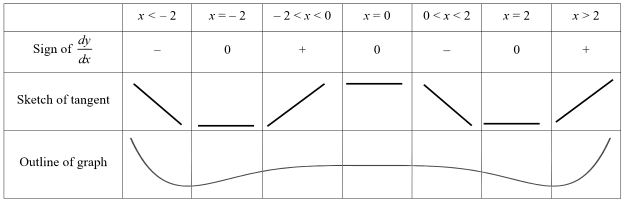
$ \displaystyle \begin{array}{l}\ \ \ \ \ \ y={{x}^{4}}({{x}^{2}}-6)={{x}^{6}}-6{{x}^{4}}\\\\\ \ \ \ \ \ \displaystyle \frac{{dy}}{{dx}}=6{{x}^{5}}-24{{x}^{3}}=6{{x}^{3}}({{x}^{2}}-4)\\\\\ \ \ \ \ \ \displaystyle \frac{{dy}}{{dx}}=0\ \text{when}\ 6{{x}^{3}}({{x}^{2}}-4)=0\\\\\therefore \ \ \ \ x=0\ \text{(or)}\ x=\pm 2\\\\\ \ \ \ \ \ \text{When}\ x=-2,y=16(4-6)=-32\\\\\ \ \ \ \ \ \text{When}\ x=0,y=0\\\\\ \ \ \ \ \ \text{When}\ x=2,y=16(4-6)=-32\\\\\therefore \ \ \ \ \text{The stationary points are}\ (-2,-32),(0,0)\\\\\ \ \ \ \ \ \operatorname{and}\ (2,-32).\end{array}$


$ \displaystyle \begin{array}{l}\therefore \ \ \ \ (-2,-32)\ \operatorname{and}\ (2,-32)\ \text{are minimum turning} \\\ \ \ \ \ \ \text{ points and}\ (0,0)\ \text{is maximum turning point.}\end{array}$


14. (a) Show that the tangent to the curve $ \displaystyle y=e^{-2x}-3x$ at the point $ \displaystyle (a,0)$ meets the $ \displaystyle y$-axis at the point whose $ \displaystyle y$-coordinate is $ \displaystyle 2ae^{-2a} +3a.$
(5 marks)

Show/Hide Solution
$ \displaystyle \begin{array}{l}\ \ \ \ \ y={{e}^{{-2x}}}-3x\\\\\ \ \ \ \ \frac{{dy}}{{dx}}=-2{{e}^{{-2x}}}-3\\\\\ \ \ \ \ \text{At}\ (a,0),\ \frac{{dy}}{{dx}}=-2{{e}^{{-2a}}}-3\\\\\therefore \ \ \ \text{Equation of tangent at}\ (a,0)\ \text{is}\\\\\ \ \ \ \ y-0=\left( {-2{{e}^{{-2a}}}-3} \right)(x-a)\\\\\therefore \ \ \ y=\left( {-2{{e}^{{-2a}}}-3} \right)(x-a)\\\\\ \ \ \ \ \text{When the tangent meets the y-axis},\ x=0.\\\\\therefore \ \ \ y=\left( {-2{{e}^{{-2a}}}-3} \right)(0-a)=2a{{e}^{{-2a}}}+3a\\\\\therefore \ \ \ \text{The tangent to the curve}\ \text{meets the y-axis}\\\ \ \ \ \ \text{at the point whose}\ \text{y}\ \text{oordinate is}\ 2a{{e}^{{-2a}}}+3a.\\\end{array}$


     (b) Points $ \displaystyle A$ and $ \displaystyle B$ have position vectors $ \displaystyle {\vec{a}}$ and $ \displaystyle {\vec{b}}$ respectively, relative to an origin $ \displaystyle O.$ The point $ \displaystyle C$ lies on $ \displaystyle OA$ produced such that $ \displaystyle OC = 3OA,$ and $ \displaystyle D$ lies on $ \displaystyle OB$ such that $ \displaystyle OD = \frac {1}{4}OB.$ Express $ \displaystyle \overrightarrow{{AB}}$ and $ \displaystyle \overrightarrow{{CD}}$ in terms of $ \displaystyle {\vec{a}}$ and $ \displaystyle {\vec{b}}$. The line segments $ \displaystyle AB$ and $ \displaystyle CD$ intersect at $ \displaystyle P.$ If $ \displaystyle CP = hCD$ and $ \displaystyle AP = kAB,$ calculate the values of $ \displaystyle h$ and $ \displaystyle k.$
(5 marks)

Show/Hide Solution

$ \displaystyle \begin{array}{l}\ \ \ \ \ \overrightarrow{{OA}}=\vec{a},\ \ \overrightarrow{{OB}}=\vec{b}\\\\\ \ \ \ \ OC=\text{ }3OA\ \operatorname{and}\ O,A\ \operatorname{and}\ C\ \text{are collinear}.\\\\\therefore \ \ \ \overrightarrow{{OC}}=3\vec{a}\ \operatorname{and}\ \overrightarrow{{AC}}=2\vec{a}\\\\\ \ \ \ \ \text{Similarly,}\ OD=\text{ }\displaystyle \frac{1}{4}OB\operatorname{and}\ O,D,B\ \text{are collinear}.\\\\\therefore \ \ \ \overrightarrow{{OD}}=\displaystyle \frac{1}{4}\vec{b}\ \operatorname{and}\ \ \overrightarrow{{DB}}=\displaystyle \frac{3}{4}\vec{b}.\\\\\therefore \ \ \ \overrightarrow{{AB}}=\overrightarrow{{OB}}-\overrightarrow{{OA}}=\vec{b}-\vec{a}\\\\\therefore \ \ \ \overrightarrow{{CD}}=\overrightarrow{{OD}}-\overrightarrow{{OC}}=\displaystyle \frac{1}{4}\vec{b}-3\vec{a}\\\\\ \ \ \ \ \text{Since }CP\text{ = }hCD\ \text{and }C\text{, }P\text{ and }D\ \text{are collinear,}\\\\\ \ \ \ \ \overrightarrow{{CP}}=h\overrightarrow{{CD}}=\displaystyle \frac{h}{4}\vec{b}-3h\vec{a}\\\\\ \ \ \ \ \text{Similarly, }AP\text{ = }kAB\text{, }A\text{, }P\text{ and }P\text{ are collinear,}\\\\\therefore \ \ \ \overrightarrow{{AP}}=k\overrightarrow{{AB}}=k\vec{b}-k\vec{a}\\\\\ \ \ \ \ \text{Since}\ \overrightarrow{{AP}}=\overrightarrow{{AC}}+\overrightarrow{{CP}},\\\\\therefore \ \ \ \overrightarrow{{AC}}+\overrightarrow{{CP}}=k\vec{b}-k\vec{a}\\\\\therefore \ \ \ 2\vec{a}+\displaystyle \frac{h}{4}\vec{b}-3h\vec{a}\ =k\vec{b}-k\vec{a}\\\\\therefore \ \ \ \displaystyle \frac{h}{4}\vec{b}+(2-3h)\vec{a}\ =k\vec{b}-k\vec{a}\\\\\therefore \ \ \ \displaystyle \frac{h}{4}=k\Rightarrow h=4k\\\ \\\ \ \ \ \ 2-3h=-k\Rightarrow 2-12k=-k\\\\\therefore \ \ \ 11k=2\Rightarrow k=\displaystyle \frac{2}{{11}}\\\\\therefore \ \ \ h=\displaystyle \frac{8}{{11}}\end{array}$


Thursday, January 24, 2019

Sample Math Paper (2) - Section (B) Solution

ဒီေနရာမွာ တင္ေပးလိုက္တဲ့ ေမးခြန္းရဲ့ section (B) အေျဖျဖစ္ပါတယ္။


Section (B)

6.  (a) Given that $ \displaystyle f(x) =2x^2-1$ and $ \displaystyle g(x) = \cos x$ where $ \displaystyle x\in A=\{x|0\le x\le \frac{\pi}{2}\}.$ Solve the equation $ \displaystyle (f∘g)(x)=0,$ where $ \displaystyle x\in A.$
(5 marks)

Show/Hide Solution
$ \displaystyle \begin{array}{l}\ \ \ \ \ \ \ f(x)=2{{x}^{2}}-1,g(x)=\cos x\\\\\ \ \ \ \ \ \ (f\circ g)(x)=f\left( {g(x)} \right)\\\\\ \ \ \ \ \ \ \ \ \ \ \ \ \ \ \ \ \ \ \ \ \ \ \ =f(\cos x)\\\\\ \ \ \ \ \ \ \ \ \ \ \ \ \ \ \ \ \ \ \ \ \ \ \ =2{{\cos }^{2}}x-1\\\\\ \ \ \ \ \ \ \ (f\circ g)(x)=0\\\\\ \ \ \ \ \ \ \ 2{{\cos }^{2}}x-1=0\\\\\ \ \ \ \ \ \ \ \cos 2x=0\\\\\ \therefore \ \ \ \ \ 2x=\displaystyle \frac{\pi }{2}\ \ \text{(or)}\ 2x=\displaystyle \frac{{3\pi }}{2}\\\\\therefore \ \ \ \ \ \ x=\displaystyle \frac{\pi }{4}\ \text{(or)}\ x=\displaystyle \frac{{3\pi }}{4}>\displaystyle \frac{\pi }{2}\ \text{(reject)}\\\\\therefore \ \ \ \ \ \ x=\displaystyle \frac{\pi }{4}\ \end{array}$


     (b) The curve of the polynomial $ \displaystyle f(x)=-x^3+2x^2+ax-10$ cuts the $ \displaystyle x$-axis at $ \displaystyle x=p, x=2$ and $ \displaystyle x=q.$ Find the value of $ \displaystyle p$ and $ \displaystyle q.$ Hence show that $ \displaystyle a=5.$
(5 marks)

Show/Hide Solution
$ \displaystyle \begin{array}{l}\ \ \ \ \ \ f(x)=-{{x}^{3}}+2{{x}^{2}}+ax-10\\\\\ \ \ \ \ \ \text{Since the graph of }f(x)\text{ cuts the x-axis at }x=p\text{, }x=2\text{ and }x=q\text{,}\\\\\ \ \ \ \ \ x-p,x-2\ \operatorname{and}\ x-q\ \text{are factors of }f(x).\\\\\ \ \ \ \ \ \text{Since the coefficient of }{{x}^{3}}\ \text{is }-1,\\\\\ \ \ \ \ f(x)=-(x-p)(x-q)(x-2)\\\\\therefore \ \ \ \ f(x)=-\left( {{{x}^{2}}-(p+q)x+pq} \right)(x-2)\\\\\therefore \ \ \ \ f(x)=-\left( {{{x}^{3}}-(p+q){{x}^{2}}+pqx-2{{x}^{2}}+2(p+q)x-2pq} \right)\\\\\therefore \ \ \ \ f(x)=-{{x}^{3}}+(p+q){{x}^{2}}-pqx+2{{x}^{2}}-2(p+q)x+2pq\\\\\therefore \ \ \ \ f(x)=-{{x}^{3}}+(p+q+2){{x}^{2}}-(2p+2q+pq)x+2pq\\\\\therefore \ \ \ \ -{{x}^{3}}+2{{x}^{2}}+ax-10=-{{x}^{3}}+(p+q+2){{x}^{2}}-(2p+2q+pq)x+2pq\\\\\therefore \ \ \ \ 2pq=-10\Rightarrow pq=-5\Rightarrow q=-\displaystyle \frac{5}{p}\\\\\therefore \ \ \ \ p+q+2=2\Rightarrow p+q=0\\\\\therefore \ \ \ \ p-\displaystyle \frac{5}{p}=0\Rightarrow {{p}^{2}}=5\Rightarrow p=\sqrt{5}\\\\\therefore \ \ \ \ q=-\displaystyle \frac{5}{{\sqrt{5}}}=-\sqrt{5}\\\\\therefore \ \ \ \ a=-(2p+2q+pq)=-(2\sqrt{5}-2\sqrt{5}-5)=5\end{array}$


7.  (a) If $ \displaystyle f(x+y,x-y)=xy$ where $ \displaystyle x,y\in R$, show that $ \displaystyle f(x,y)+f(y,x) =0$.
(5 marks)

Show/Hide Solution
$ \displaystyle \begin{array}{*{20}{l}} \begin{array}{l}\ \ \ \ \ \ \ \ f(x+y,x-y)=xy\\\end{array} \\\\ \begin{array}{l}\ \ \ \ \ \ \ \ \text{Let }x+y=a\ \ \operatorname{and}x-y=b\\\end{array} \\\\ \begin{array}{l}\therefore \ \ \ \ \ \ \ 2x=a+b\Rightarrow x=\displaystyle \frac{{a+b}}{2}\\\end{array} \\\\ \begin{array}{l}\ \ \ \ \ \ \ \ \ 2y=a-b\Rightarrow y=\displaystyle \frac{{a-b}}{2}\\\end{array} \\\\ \begin{array}{l}\therefore \ \ \ \ \ \ f(a,b)=\displaystyle \frac{{a+b}}{2}\times \displaystyle \frac{{a-b}}{2}=\displaystyle \frac{{{{a}^{2}}-{{b}^{2}}}}{4}\\\end{array} \\\\ \begin{array}{l}\therefore \ \ \ \ \ \ f(x,y)=\displaystyle \frac{{{{x}^{2}}-{{y}^{2}}}}{4}\\\end{array} \\\\ \begin{array}{l}\therefore \ \ \ \ \ \ f(y,x)=\displaystyle \frac{{{{y}^{2}}-{{x}^{2}}}}{4}\\\end{array} \\\\ {\therefore \ \ \ \ \ \ f(x,y)+f(y,x)=\displaystyle \frac{{{{x}^{2}}-{{y}^{2}}}}{4}+\displaystyle \frac{{{{y}^{2}}-{{x}^{2}}}}{4}=0} \end{array}$


     (b) If the coefficients of $ \displaystyle (2p + 4)^{\text{th}}$ and $ \displaystyle (p - 2)^{\text{th}}$ terms in the expansion of $ \displaystyle (1 + x)^{18}$ are equal, find the value of $ \displaystyle p.$
(5 marks)

Show/Hide Solution
$ \displaystyle \begin{array}{l}\ \ \ \ \ \ \ {{(r+1)}^{{\text{th}}}}\text{ term in the expansion of}\ {{(1+x)}^{{18}}}\\\\\ \ \ \ \ \ ={}^{{18}}{{C}_{r}}{{x}^{r}}\\\\\therefore \ \ \ \ {{(2p+4)}^{{\text{th}}}}\ \text{term}={{(2p+3+1)}^{{\text{th}}}}\ \text{term}={}^{{18}}{{C}_{{2p+3}}}{{x}^{{2p+3}}}\\\\\ \ \ \ \ \ {{(p-2)}^{{\text{th}}}}\ \text{term}={{(p-3+1)}^{{\text{th}}}}\ \text{term}={}^{{18}}{{C}_{{p-3}}}{{x}^{{r-3}}}\\\\\ \ \ \ \ \ \text{By the problem, }\\\\\ \ \ \ \ \ \text{coefficient of}\ {{(2p+4)}^{{\text{th}}}}\ \text{term}=\text{coefficient of}\ {{(r-2)}^{{\text{th}}}}\ \text{term}\\\\\therefore \ \ \ \ {}^{{18}}{{C}_{{2p+3}}}={}^{{18}}{{C}_{{p-3}}}\ \text{(or)}{}^{{18}}{{C}_{{2p+3}}}={}^{{18}}{{C}_{{18-(p-3)}}}\ \left[ {\because {}^{n}{{C}_{r}}={}^{n}{{C}_{{n-r}}}} \right]\\\\\therefore \ \ \ \ 2p+3=p-3\ \text{(or)}\ 2p+3=18-(p-3)\\\\\therefore \ \ \ \ p=-6\ \ \text{(or)}\ p=6\\\\\ \ \ \ \ \ \text{Since}\ p>0,p=6\end{array}$


8.  (a) Find the solution set of the in equation $ \displaystyle 3(x-\frac{3}{2})^2>2x^2-4x+\frac{3}{4}$ and illustrate it on the number line.
(5 marks)

Show/Hide Solution
$ \displaystyle \begin{array}{l}\ \ \ \ \ \ \ 3{{\left( {x-\displaystyle \frac{3}{2}} \right)}^{2}}>2{{x}^{2}}-4x+\displaystyle \frac{3}{4}\\\\\ \ \ \ \ \ \ 3\left( {{{x}^{2}}-3x+\displaystyle \frac{9}{4}} \right)>2{{x}^{2}}-4x+\displaystyle \frac{3}{4}\\\\\ \ \ \ \ \ \ 3{{x}^{2}}-9x+\displaystyle \frac{{27}}{4}>2{{x}^{2}}-4x+\displaystyle \frac{3}{4}\\\\\ \ \ \ \ \ \ 3{{x}^{2}}-9x+\displaystyle \frac{{27}}{4}-2{{x}^{2}}+4x-\displaystyle \frac{3}{4}>0\\\\\ \ \ \ \ \ \ {{x}^{2}}-5x+6>0\\\\\ \ \ \ \ \ \ \text{Let}\ y={{x}^{2}}-5x+6.\\\\\ \ \ \ \ \ \ \text{When}\ y=0,{{x}^{2}}-5x+6=0\ \\\\\therefore \ \ \ \ \ (x-2)(x-3)=0\\\\\therefore \ \ \ \ \ x=2\ (\text{or})\ x=3\\\\\therefore \ \ \ \ \ \text{The graph cuts the x-axis at (2,0) and (3,0)}\text{.}\\\\\ \ \ \ \ \ \ \text{When}\ x=0,y=6\ \\\\\therefore \ \ \ \ \ \text{The graph cuts the y-axis at (0,6)}\text{.}\end{array}$


$ \displaystyle \begin{array}{*{20}{l}} {\therefore \ \ \ \ \ \text{Solution set}=\left\{ {x\ |\ x<2\ \text{(or)}\ x>3} \right\}} \\ \begin{array}{l}\\\ \ \ \ \ \ \text{Number line}\end{array} \end{array}$


     (b) Find three numbers in A.P. whose sum is $ \displaystyle 21$ and whose product is $ \displaystyle 315.$
(5 marks)

Show/Hide Solution
$ \displaystyle \begin{array}{l}\ \ \ \ \ \ \ \text{Let the three numbers in A}\text{.P}\text{. be}\\\ \ \ \ \ \ \ a,a+d\ \operatorname{and}\ a+2d.\\\\\ \ \ \ \ \ \ \text{By the problem,}\\\\\ \ \ \ \ \ \ a+a+d\ +\ a+2d=21\\\\\therefore \ \ \ \ \ a+d=7\ \ \ \ \ \ \ \ \ -------(1)\\\\\ \ \ \ \ \ \ a(a+d)(a+2d)=315\\\\\ \ \ \ \ \ \ 7a(7+d)=315\ \ \ \ \left[ {\because a+d=7} \right]\\\\\therefore \ \ \ \ \ a=\displaystyle \frac{{45}}{{7+d}}\ \ \ \ \ \ \ \ -------(2)\\\\\therefore \ \ \ \ \ \displaystyle \frac{{45}}{{7+d}}+d=7\\\ \\\therefore \ \ \ \ \ {{d}^{2}}=4\Rightarrow d=\pm 2\\\\\ \ \ \ \ \ \text{When}\ d=-2,a=9\\\\\ \ \ \ \ \ \text{When}\ d=2,a=5\\\\\therefore \ \ \ \ \text{The numbers are}\ 5,7\ \operatorname{and}\ 9.\end{array}$


9.  (a) If $ \displaystyle S_1, S_2,$ and $ \displaystyle S_3$ are the sums of $ \displaystyle n, 2n$ and $ \displaystyle 3n$ terms of a G.P., show that $ \displaystyle S_1(S_3- S_2) = (S_2-S_1)^2.$
(5 marks)

Show/Hide Solution
$ \displaystyle \begin{array}{l}\ \ \ \ \ \ \ \text{Let the first term and the common ratio }\\\ \ \ \ \ \ \ \text{of given G}\text{.P}\text{. be }a\text{ and }r\text{ respectively}\text{.}\\\\\ \ \ \ \ \ \ \text{By the problem,}\\\\\ \ \ \ \ \ {{S}_{1}}={{S}_{n}}=\displaystyle \frac{{a(1-{{r}^{n}})}}{{1-r}}\\\\\ \ \ \ \ \ {{S}_{2}}={{S}_{{2n}}}=\displaystyle \frac{{a(1-{{r}^{{2n}}})}}{{1-r}}\\\\\ \ \ \ \ \ {{S}_{3}}={{S}_{{3n}}}=\displaystyle \frac{{a(1-{{r}^{{3n}}})}}{{1-r}}\\\\\therefore \ \ \ \ {{S}_{3}}-{{S}_{2}}=\displaystyle \frac{a}{{1-r}}\left( {1-{{r}^{{3n}}}-1+{{r}^{{2n}}}} \right)\\\\\therefore \ \ \ \ {{S}_{3}}-{{S}_{2}}=\displaystyle \frac{a}{{1-r}}\left( {{{r}^{{2n}}}-{{r}^{{3n}}}} \right)\\\\\therefore \ \ \ \ {{S}_{1}}\left( {{{S}_{3}}-{{S}_{2}}} \right)=\displaystyle \frac{{a(1-{{r}^{n}})}}{{1-r}}\times \displaystyle \frac{a}{{1-r}}\left( {{{r}^{{2n}}}-{{r}^{{3n}}}} \right)\\\\\therefore \ \ \ \ {{S}_{1}}\left( {{{S}_{3}}-{{S}_{2}}} \right)=\displaystyle \frac{{{{a}^{2}}}}{{{{{\left( {1-r} \right)}}^{2}}}}\left( {{{r}^{{2n}}}-{{r}^{{3n}}}-{{r}^{{3n}}}+{{r}^{{4n}}}} \right)\\\\\therefore \ \ \ \ {{S}_{1}}\left( {{{S}_{3}}-{{S}_{2}}} \right)=\displaystyle \frac{{{{a}^{2}}}}{{{{{\left( {1-r} \right)}}^{2}}}}\left( {{{r}^{{2n}}}-2{{r}^{{3n}}}+{{r}^{{4n}}}} \right)---(1)\\\\\ \ \ \ \ \ {{S}_{2}}-{{S}_{1}}=\displaystyle \frac{a}{{1-r}}\left( {1-{{r}^{{2n}}}-1+{{r}^{n}}} \right)\\\\\therefore \ \ \ \ {{S}_{2}}-{{S}_{1}}=\displaystyle \frac{a}{{1-r}}\left( {{{r}^{n}}-{{r}^{{2n}}}} \right)\\\\\therefore \ \ \ \ {{\left( {{{S}_{2}}-{{S}_{1}}} \right)}^{2}}=\displaystyle \frac{{{{a}^{2}}}}{{{{{\left( {1-r} \right)}}^{2}}}}{{\left( {{{r}^{n}}-{{r}^{{2n}}}} \right)}^{2}}\\\\\therefore \ \ \ \ {{\left( {{{S}_{2}}-{{S}_{1}}} \right)}^{2}}=\displaystyle \frac{{{{a}^{2}}}}{{{{{\left( {1-r} \right)}}^{2}}}}\left( {{{r}^{{2n}}}-2{{r}^{{3n}}}+{{r}^{{4n}}}} \right)---(2)\\\\\therefore \ \ \ \ \text{By}\ (1)\ \operatorname{and}\ (2),\\\\\ \ \ \ \ \ {{S}_{1}}\left( {{{S}_{3}}-{{S}_{2}}} \right)={{\left( {{{S}_{2}}-{{S}_{1}}} \right)}^{2}}\end{array}$


     (b) Given that $ \displaystyle A=\left( {\begin{array}{*{20}{c}} {\cos \theta } & {-\sin \theta } \\ {\sin \theta } & {\cos \theta } \end{array}} \right).$ If $ \displaystyle A + A' = I$ where $ \displaystyle I$ is a unit matrix of order $ \displaystyle 2,$ find the value of $ \displaystyle \theta$ for $ \displaystyle 0°<\theta< 90°.$
(5 marks)

Show/Hide Solution
$ \displaystyle \begin{array}{l}\ \ \ \ \ A=\displaystyle \left( {\begin{array}{*{20}{c}} {\cos \theta } & {-\sin \theta } \\ {\sin \theta } & {\cos \theta } \end{array}} \right)\\\\\therefore \ \ \ {A}'=\displaystyle \left( {\begin{array}{*{20}{c}} {\cos \theta } & {\sin \theta } \\ {-\sin \theta } & {\cos \theta } \end{array}} \right)\\\\\ \ \ \ \ \text{By the problem,}\\\\\ \ \ \ \ A+{A}'=I\\\\\therefore \ \ \ \displaystyle \left( {\begin{array}{*{20}{c}} {\cos \theta } & {-\sin \theta } \\ {\sin \theta } & {\cos \theta } \end{array}} \right)+\displaystyle \left( {\begin{array}{*{20}{c}} {\cos \theta } & {\sin \theta } \\ {-\sin \theta } & {\cos \theta } \end{array}} \right)=\displaystyle \left( {\begin{array}{*{20}{c}} 1 & 0 \\ 0 & 1 \end{array}} \right)\\\\\therefore \ \ \ \displaystyle \left( {\begin{array}{*{20}{c}} {2\cos \theta } & 0 \\ 0 & {2\cos \theta } \end{array}} \right)=\displaystyle \left( {\begin{array}{*{20}{c}} 1 & 0 \\ 0 & 1 \end{array}} \right)\\\\\therefore \ \ \ 2\cos \theta =1\Rightarrow \cos \theta =\displaystyle \frac{1}{2}\\\\\therefore \ \ \ \theta =60{}^\circ \end{array}$


10. (a) Given that $ \displaystyle A=\left( {\begin{array}{*{20}{c}} {\cos \theta } & {-\sin \theta } \\ {\sin \theta } & {\cos \theta } \end{array}} \right).$ Determine whether $\displaystyle {{A}^{{-1}}}$ exists or not, if exists find $\displaystyle {{A}^{{-1}}}.$ Hence solve the system of equations $\displaystyle x\cos \theta -y\sin \theta =2$ and $\displaystyle x\sin \theta +y\cos \theta =2\sqrt{3}$ when $\displaystyle \theta=30°.$
(5 marks)

Show/Hide Solution
$ \displaystyle \begin{array}{l}\ \ \ \ \ A=\displaystyle \left( {\begin{array}{*{20}{c}} {\cos \theta } & {-\sin \theta } \\ {\sin \theta } & {\cos \theta } \end{array}} \right)\\\\\therefore \ \ \ \det A={{\cos }^{2}}\theta +{{\sin }^{2}}\theta =1\ne 0\\\\\therefore \ \ \ {{A}^{{-1}}}\ \text{exists}.\\\\\therefore \ \ \ {{A}^{{-1}}}=\displaystyle \left( {\begin{array}{*{20}{c}} {\cos \theta } & {\sin \theta } \\ {-\sin \theta } & {\cos \theta } \end{array}} \right)\\\\\ \ \ \ \ \displaystyle \left. \begin{array}{l}x\cos \theta -y\sin \theta =2\\x\sin \theta +y\cos \theta =2\sqrt{3}\end{array} \right\}-------(1)\\\\\ \ \ \ \ \text{Transforming into matrix form},\\\\\ \ \ \ \ \displaystyle \left( {\begin{array}{*{20}{c}} {\cos \theta } & {-\sin \theta } \\ {\sin \theta } & {\cos \theta } \end{array}} \right)\displaystyle \left( {\begin{array}{*{20}{c}} x \\ y \end{array}} \right)=\displaystyle \left( {\begin{array}{*{20}{c}} 2 \\ {2\sqrt{3}} \end{array}} \right)---(2)\\\\\ \ \ \ \ \text{Let}\ X=\displaystyle \left( {\begin{array}{*{20}{c}} x \\ y \end{array}} \right)\operatorname{and}\ B=\displaystyle \left( {\begin{array}{*{20}{c}} 2 \\ {2\sqrt{3}} \end{array}} \right).\\\\\ \ \ \ \ \text{Equation (2) becomes,}\ AX=B.\\\\\therefore \ \ \ {{A}^{{-1}}}AX={{A}^{{-1}}}B\\\\\therefore \ \ \ IX={{A}^{{-1}}}B\\\\\therefore \ \ \ X={{A}^{{-1}}}B\\\\\therefore \ \ \ X=\displaystyle \left( {\begin{array}{*{20}{c}} {\cos \theta } & {\sin \theta } \\ {-\sin \theta } & {\cos \theta } \end{array}} \right)\displaystyle \left( {\begin{array}{*{20}{c}} 2 \\ {2\sqrt{3}} \end{array}} \right)\\\\\ \ \ \ \ \text{When}\ \theta =30{}^\circ ,\\\\\ \ \ \ \ X=\displaystyle \left( {\begin{array}{*{20}{c}} {\cos 30{}^\circ } & {\sin 30{}^\circ } \\ {-\sin 30{}^\circ } & {\cos 30{}^\circ } \end{array}} \right)\displaystyle \left( {\begin{array}{*{20}{c}} 2 \\ {2\sqrt{3}} \end{array}} \right)\\\\\ \ \ \ \ X=\displaystyle \left( {\begin{array}{*{20}{c}} {\displaystyle \frac{{\sqrt{3}}}{2}} & {\displaystyle \frac{1}{2}} \\ {-\displaystyle \frac{1}{2}} & {\displaystyle \frac{{\sqrt{3}}}{2}} \end{array}} \right)\displaystyle \left( {\begin{array}{*{20}{c}} 2 \\ {2\sqrt{3}} \end{array}} \right)\\\\\therefore \ \ \ X=\displaystyle \left( {\begin{array}{*{20}{c}} {\displaystyle \frac{{2\sqrt{3}}}{2}+\displaystyle \frac{{2\sqrt{3}}}{2}} \\ {-1+3} \end{array}} \right)\\\\\therefore \ \ \ \displaystyle \left( {\begin{array}{*{20}{c}} x \\ y \end{array}} \right)=\displaystyle \left( {\begin{array}{*{20}{c}} {2\sqrt{3}} \\ 2 \end{array}} \right)\Rightarrow x=2\sqrt{3},y=2.\end{array}$


     (b) A set of cards bearing the number from $ \displaystyle 200$ to $ \displaystyle 299$ is used in a game. If a card is drawn at random, what is the probability that it is divisible by $ \displaystyle 3?$
(5 marks)

Show/Hide Solution
$ \displaystyle \begin{array}{l}\ \ \ \ \ \ \text{Set of possible outcomes}=\left\{ {200,201,202,...,299} \right\}\\\\\therefore \ \ \ \ \text{Number of possible outcomes}=100\\\\\ \ \ \ \ \ \text{The numbers between 200 and 299 }\\\ \ \ \ \ \ \text{which are divisible by 3 are}\ \\\\\ \ \ \ \ \ 201,204,205,...,297.\\\\\ \ \ \ \ \ \text{It is an A}\text{.P with }a=201\ \operatorname{and}\ d=3.\\\\\therefore \ \ \ \ {{u}_{n}}=99\\\\\therefore \ \ \ \ a+(n-1)d=297\\\\\therefore \ \ \ \ 201+(n-1)3=297\\\\\therefore \ \ \ \ n=33\\\\\therefore \ \ \ \ \text{Number of favourable outcomes}=33\\\\\therefore \ \ \ \ P(\text{a number divisible by3)}=\displaystyle \frac{{33}}{{100}}.\end{array}$