1. Find the unit vector in the direction of $ \displaystyle \overrightarrow{{PQ}}$ where $ \displaystyle P$ and $ \displaystyle Q$ are points $ \displaystyle (2, 3)$ and $ \displaystyle (7, – 9)$.
Show/Hide Solution
| $ \displaystyle \begin{array}{l}\ \ \ \ P\operatorname{and}\ Q\ \text{are points}\ (2,3)\ \operatorname{and}\ (7,-9).\\\\\therefore \ \ \overrightarrow{{OP}}=\left( {\begin{array}{*{20}{c}} 2 \\ 3 \end{array}} \right)\ \operatorname{and}\ \ \overrightarrow{{OQ}}=\left( {\begin{array}{*{20}{c}} 7 \\ {-9} \end{array}} \right)\\\\\ \ \ \ \overrightarrow{{PQ}}=\overrightarrow{{OQ}}-\ \overrightarrow{{OP}}\\\\\ \ \ \ \ \ \ \ \ \ =\left( {\begin{array}{*{20}{c}} 7 \\ {-9} \end{array}} \right)-\left( {\begin{array}{*{20}{c}} 2 \\ 3 \end{array}} \right)\\\\\ \ \ \ \ \ \ \ \ \ =\left( {\begin{array}{*{20}{c}} 5 \\ {-12} \end{array}} \right)\\\\\therefore \ \ \left| {\ \overrightarrow{{PQ}}} \right|=\sqrt{{{{5}^{2}}+{{{\left( {-12} \right)}}^{2}}}}=13\\\\\therefore \ \ \text{The unit vector in }\\\ \ \ \ \text{the direction of}\ \ \ \ =\displaystyle \frac{{\overrightarrow{{PQ}}}}{{\left| {\ \overrightarrow{{PQ}}} \right|}}\\\\\ \ \ \ \ \ \ \ \ \ \ \ \ \ \ \ \ \ \ \ \ \ \ \ \ \ \ \ \ =\displaystyle \frac{1}{{13}}\left( {\begin{array}{*{20}{c}} 5 \\ {-12} \end{array}} \right)\\\\\ \ \ \ \ \ \ \ \ \ \ \ \ \ \ \ \ \ \ \ \ \ \ \ \ \ \ \ \ =\left( {\begin{array}{*{20}{c}} {\displaystyle \frac{5}{{13}}} \\ {-\displaystyle \frac{{12}}{{13}}} \end{array}} \right)\end{array}$ |
2. Given that $ \displaystyle \overrightarrow{{OP}}=\widehat{\text{i}}+2\widehat{\text{j}}$ and $ \displaystyle \overrightarrow{{OQ}}=7\widehat{\text{i}}-4\widehat{\text{j}}$. Find the position vector of a point $ \displaystyle R$ which lies on the line $ \displaystyle PQ$ such that $ \displaystyle PR : RQ = 2 : 1$.
Show/Hide Solution
 $ \displaystyle \begin{array}{l}\ \ \ \ \ \overrightarrow{{OP}}=\widehat{\text{i}}+2\widehat{\text{j}}\\\\\ \ \ \ \ \overrightarrow{{OQ}}=7\widehat{\text{i}}-4\widehat{\text{j}}\\\\\ \ \ \ \ PR:RQ=2:1\\\\\ \ \ \ \ \text{By section formula},\ \\\\\ \ \ \ \ \ \overrightarrow{{OR}}=\displaystyle \frac{{\left( {1\times \overrightarrow{{OP}}} \right)+\left( {2\times \overrightarrow{{OQ}}} \right)}}{{1+2}}\ \\\\\ \ \ \ \ \ \ \ \ \ \ \ =\displaystyle \frac{1}{3}\ \left[ {\widehat{\text{i}}+2\widehat{\text{j}}+2\left( {7\widehat{\text{i}}-4\widehat{\text{j}}} \right)} \right]\\\\\ \ \ \ \ \ \ \ \ \ \ \ =5\widehat{\text{i}}-2\widehat{\text{j}}\end{array}$ |
3. If $ \displaystyle \overrightarrow{{OA}}=-5\widehat{\text{i}}+6\widehat{\text{j}}$, $ \displaystyle \overrightarrow{{OB}}=2\widehat{\text{i}}+5\widehat{\text{j}}$ and $ \displaystyle \overrightarrow{{OC}}=9\widehat{\text{i}}+4\widehat{\text{j}}$, show that $ \displaystyle A, B$ and $ \displaystyle C$ are collinear.
Show/Hide Solution
| $ \displaystyle \begin{array}{l}\ \ \ \ \ \overrightarrow{{OA}}=-5\widehat{\text{i}}+6\widehat{\text{j}}\\\\\ \ \ \ \ \overrightarrow{{OB}}=2\widehat{\text{i}}+5\widehat{\text{j}}\\\\\ \ \ \ \ \overrightarrow{{OC}}=9\widehat{\text{i}}+4\widehat{\text{j}}\\\ \ \ \ \ \\\therefore \ \ \ \overrightarrow{{AB}}=\overrightarrow{{OB}}-\overrightarrow{{OA}}\\\\\ \ \ \ \ \ \ \ \ \ =\left( {2\widehat{\text{i}}+5\widehat{\text{j}}} \right)-\left( {-5\widehat{\text{i}}+6\widehat{\text{j}}} \right)\\\\\ \ \ \ \ \ \ \ \ \ =7\widehat{\text{i}}-\widehat{\text{j}}\\\\\ \ \ \ \ \overrightarrow{{BC}}=\overrightarrow{{OC}}-\overrightarrow{{OB}}\\\\\ \ \ \ \ \ \ \ \ \ =\left( {9\widehat{\text{i}}+4\widehat{\text{j}}} \right)-\left( {2\widehat{\text{i}}+5\widehat{\text{j}}} \right)\\\\\ \ \ \ \ \ \ \ \ \ =7\widehat{\text{i}}-\widehat{\text{j}}\\\\\therefore \ \ \ \overrightarrow{{AB}}=\overrightarrow{{BC}}\\\\\therefore \ \ \ A,B\ \operatorname{and}\ C\ \text{are collinear}.\end{array}$ |
4. Given that $ \displaystyle \overrightarrow{{OP}}=\left( {\begin{array}{*{20}{c}} k \\ 5 \end{array}} \right)$, $ \displaystyle \overrightarrow{{OQ}}=\left( {\begin{array}{*{20}{c}} {-2} \\ 8 \end{array}} \right)$ and $ \displaystyle \overrightarrow{{OR}}=\left( {\begin{array}{*{20}{c}} 3 \\ {11} \end{array}} \right)$. If $ \displaystyle P, Q$ and $ \displaystyle R$ are collinear, find the value of $ \displaystyle k$.
Show/Hide Solution
| $ \displaystyle \begin{array}{l}\ \ \ \ \ \overrightarrow{{OP}}=\left( {\begin{array}{*{20}{c}} k \\ 5 \end{array}} \right),\\\\\ \ \ \ \overrightarrow{{OQ}}=\left( {\begin{array}{*{20}{c}} {-2} \\ 8 \end{array}} \right),\\\\\ \ \ \ \overrightarrow{{OR}}=\left( {\begin{array}{*{20}{c}} 3 \\ {11} \end{array}} \right),\\\\\therefore \ \ \overrightarrow{{PQ}}=\overrightarrow{{OQ}}-\overrightarrow{{OP}}\\\\\ \ \ \ \ \ \ \ \ =\left( {\begin{array}{*{20}{c}} {-2} \\ 8 \end{array}} \right)-\left( {\begin{array}{*{20}{c}} k \\ 5 \end{array}} \right)\\\\\ \ \ \ \ \ \ \ \ =\left( {\begin{array}{*{20}{c}} {-2-k} \\ 3 \end{array}} \right)\\\\\ \ \ \ \overrightarrow{{QR}}=\overrightarrow{{OR}}-\overrightarrow{{OQ}}\\\\\ \ \ \ \ \ \ \ \ =\left( {\begin{array}{*{20}{c}} 3 \\ {11} \end{array}} \right)-\left( {\begin{array}{*{20}{c}} {-2} \\ 8 \end{array}} \right)\\\\\ \ \ \ \ \ \ \ \ =\left( {\begin{array}{*{20}{c}} 5 \\ 3 \end{array}} \right)\\\\\ \ \ \ \text{By the problem,}\ \\\\\ \ \ P,\ Q\ \operatorname{and}\ R\ \text{are collinear}.\\\\\therefore \ \ \text{Let}\ \overrightarrow{{PQ}}=h\overrightarrow{{QR}}\\\\\therefore \ \ \left( {\begin{array}{*{20}{c}} {-2-k} \\ 3 \end{array}} \right)=h\left( {\begin{array}{*{20}{c}} 5 \\ 3 \end{array}} \right)\\\\\ \ \ \ \left( {\begin{array}{*{20}{c}} {-2-k} \\ 3 \end{array}} \right)=\left( {\begin{array}{*{20}{c}} {5h} \\ {3h} \end{array}} \right)\\\\\therefore \ \ 3h=3\\\\\ \ \ \ h=1\\\\\ \ \ \ -2-k=5h\\\\\ \ \ k=-2-5h\\\\\ \ \ k=-7\\\ \ \ \end{array}$ |
5. Using a vector method, show that the points $ \displaystyle A (– 8, 10), B (– 1, 9)$ and $ \displaystyle C (6, 8)$ are collinear and hence find the ratio $ \displaystyle AB : BC$.
Show/Hide Solution
| $ \displaystyle \begin{array}{l}\ \ \ \ \ \overrightarrow{{OA}}=\left( {\begin{array}{*{20}{c}} {-8} \\ {10} \end{array}} \right),\\\\\ \ \ \ \overrightarrow{{OB}}=\left( {\begin{array}{*{20}{c}} {-1} \\ 9 \end{array}} \right),\\\\\ \ \ \ \overrightarrow{{OC}}=\left( {\begin{array}{*{20}{c}} 6 \\ 8 \end{array}} \right),\\\\\therefore \ \ \overrightarrow{{AB}}=\overrightarrow{{OB}}-\overrightarrow{{OA}}\\\\\ \ \ \ \ \ \ \ \ =\left( {\begin{array}{*{20}{c}} {-1} \\ 9 \end{array}} \right)-\left( {\begin{array}{*{20}{c}} {-8} \\ {10} \end{array}} \right)\\\\\ \ \ \ \ \ \ \ \ =\left( {\begin{array}{*{20}{c}} 7 \\ {-1} \end{array}} \right)\\\\\ \ \ \ \overrightarrow{{BC}}=\overrightarrow{{OC}}-\overrightarrow{{OB}}\\\\\ \ \ \ \ \ \ \ \ =\left( {\begin{array}{*{20}{c}} 6 \\ 8 \end{array}} \right)-\left( {\begin{array}{*{20}{c}} {-1} \\ 9 \end{array}} \right)\\\\\ \ \ \ \ \ \ \ \ =\left( {\begin{array}{*{20}{c}} 7 \\ {-1} \end{array}} \right)\\\\\therefore \ \ \overrightarrow{{AB}}=\overrightarrow{{BC}}\\\\\ \ \ A,\ B\ \operatorname{and}\ C\ \text{are collinear and }\\\\\ \ \ AB:BC=1:1\ \end{array}$ |
6. If $ \displaystyle \overrightarrow{{OP}}=\left( {\begin{array}{*{20}{c}} {-3} \\ 8 \end{array}} \right)$, $ \displaystyle \overrightarrow{{OQ}}=\left( {\begin{array}{*{20}{c}} {-5} \\ {14} \end{array}} \right)$ and $ \displaystyle \overrightarrow{{OR}}=\left( {\begin{array}{*{20}{c}} 9 \\ {12} \end{array}} \right)$, show that $ \displaystyle \Delta PQR$ is a right triangle.
Show/Hide Solution
| $ \displaystyle \begin{array}{l}\ \ \ \ \ \overrightarrow{{OP}}=\left( {\begin{array}{*{20}{c}} {-3} \\ 8 \end{array}} \right),\\\\\ \ \ \ \overrightarrow{{OQ}}=\left( {\begin{array}{*{20}{c}} {-5} \\ {14} \end{array}} \right),\\\\\ \ \ \ \overrightarrow{{OR}}=\left( {\begin{array}{*{20}{c}} 9 \\ {12} \end{array}} \right),\\\\\therefore \ \ \overrightarrow{{PQ}}=\overrightarrow{{OQ}}-\overrightarrow{{OP}}\\\\\ \ \ \ \ \ \ \ \ =\left( {\begin{array}{*{20}{c}} {-5} \\ {14} \end{array}} \right)-\left( {\begin{array}{*{20}{c}} {-3} \\ 8 \end{array}} \right)\\\\\ \ \ \ \ \ \ \ \ =\left( {\begin{array}{*{20}{c}} {-2} \\ 6 \end{array}} \right)\\\\\therefore \ PQ=\sqrt{{{{{\left( {-2} \right)}}^{2}}+{{6}^{2}}}}=\sqrt{{40}}\\\\\ \ \ \ \overrightarrow{{QR}}=\overrightarrow{{OR}}-\overrightarrow{{OQ}}\\\\\ \ \ \ \ \ \ \ \ =\left( {\begin{array}{*{20}{c}} 9 \\ {12} \end{array}} \right)-\left( {\begin{array}{*{20}{c}} {-5} \\ {14} \end{array}} \right)\\\\\ \ \ \ \ \ \ \ \ =\left( {\begin{array}{*{20}{c}} {14} \\ {-2} \end{array}} \right)\\\\\therefore \ QR=\sqrt{{{{{14}}^{2}}+{{{\left( {-2} \right)}}^{2}}}}=\sqrt{{200}}\\\\\ \overrightarrow{{PR}}=\overrightarrow{{OR}}-\overrightarrow{{OP}}\\\\\ \ \ \ \ \ \ \ \ =\left( {\begin{array}{*{20}{c}} 9 \\ {12} \end{array}} \right)-\left( {\begin{array}{*{20}{c}} {-3} \\ 8 \end{array}} \right)\\\\\ \ \ \ \ \ \ \ \ =\left( {\begin{array}{*{20}{c}} {12} \\ 4 \end{array}} \right)\\\\\therefore \ \ PR=\sqrt{{{{{12}}^{2}}+{{4}^{2}}}}=\sqrt{{160}}\\\\\ \ \ \ P{{Q}^{2}}+P{{R}^{2}}=40+160=200\\\\\ \ \ \ Q{{R}^{2}}=200\\\\\therefore \ \ P{{Q}^{2}}+P{{R}^{2}}=\ Q{{R}^{2}}\\\\\therefore \ \ \Delta PQR\ \text{is a right triangle}\text{.}\end{array}$ |
7. If the position vectors of the points $ \displaystyle A, B$ and $ \displaystyle C$ are $ \displaystyle 9\widehat{\text{i}}+6\widehat{\text{j}}$, $ \displaystyle 4\widehat{\text{i}}+3\widehat{\text{j}}$ and $\displaystyle -5\widehat{\text{i}}+8\widehat{\text{j}}$ respectively, show that the $ \displaystyle \Delta ABC$ is an obtuse triangle.
Show/Hide Solution
| $ \displaystyle \begin{array}{l}\ \ \ \ \ \overrightarrow{{OA}}=9\widehat{\text{i}}+6\widehat{\text{j}}\\\\\ \ \ \ \ \overrightarrow{{OB}}=4\widehat{\text{i}}+3\widehat{\text{j}}\\\\\ \ \ \ \ \overrightarrow{{OC}}=-5\widehat{\text{i}}+8\widehat{\text{j}}\\\\\therefore \ \ \ \overrightarrow{{AB}}=\overrightarrow{{OB}}-\overrightarrow{{OA}}\\\\\ \ \ \ \ \ \ \ \ \ =-5\widehat{\text{i}}-3\widehat{\text{j}}\\\\\therefore \ \ \ A{{B}^{2}}={{\left( {-5} \right)}^{2}}+{{\left( {-3} \right)}^{2}}=34\\\\\therefore \ \ \ \overrightarrow{{BC}}=\overrightarrow{{OC}}-\overrightarrow{{OB}}\\\\\ \ \ \ \ \ \ \ \ \ =-9\widehat{\text{i}}+5\widehat{\text{j}}\\\\\therefore \ \ \ B{{C}^{2}}={{\left( {-9} \right)}^{2}}+{{5}^{2}}=106\\\\\therefore \ \ \ \overrightarrow{{AC}}=\overrightarrow{{OC}}-\overrightarrow{{OA}}\\\\\ \ \ \ \ \ \ \ \ \ =-14\widehat{\text{i}}+2\widehat{\text{j}}\\\\\therefore \ \ \ A{{C}^{2}}={{\left( {-14} \right)}^{2}}+{{2}^{2}}=200\\\\\therefore \ \ \ A{{B}^{2}}+B{{C}^{2}}=140\\\\\therefore \ \ \ A{{C}^{2}}>A{{B}^{2}}+B{{C}^{2}}\\\\\therefore \ \ \ \Delta ABC\ \text{is an obtuse triangle}\text{.}\end{array}$ |
8. The position vectors of the points A, B, and C are $ \displaystyle \left( {\begin{array}{*{20}{c}} 5 \\ 2 \end{array}} \right)$, $ \displaystyle \left( {\begin{array}{*{20}{c}} 3 \\ {-4} \end{array}} \right)$ and $ \displaystyle \left( {\begin{array}{*{20}{c}} {-1} \\ 4 \end{array}} \right)$ respectively. Prove that $ \displaystyle \Delta ABC$ is an isosceles right triangle.
Show/Hide Solution
| $ \displaystyle \begin{array}{l}\ \ \ \overrightarrow{{OA}}=\left( {\begin{array}{*{20}{c}} 5 \\ 2 \end{array}} \right),\\\\\ \ \ \overrightarrow{{OB}}=\left( {\begin{array}{*{20}{c}} 3 \\ {-4} \end{array}} \right),\\\\\ \ \ \overrightarrow{{OC}}=\left( {\begin{array}{*{20}{c}} {-1} \\ 4 \end{array}} \right)\\\\\ \ \ \overrightarrow{{AB}}=\overrightarrow{{OB}}-\overrightarrow{{OA}}\\\\\ \ \ \ \ \ \ \ \ =\left( {\begin{array}{*{20}{c}} 3 \\ {-4} \end{array}} \right)-\left( {\begin{array}{*{20}{c}} 5 \\ 2 \end{array}} \right)\\\\\ \ \ \ \ \ \ \ \ =\left( {\begin{array}{*{20}{c}} {-2} \\ {-6} \end{array}} \right)\\\\\therefore \ \ AB=\sqrt{{{{{\left( {-2} \right)}}^{2}}+{{{\left( {-6} \right)}}^{2}}}}=\sqrt{{40}}\\\\\ \ \ \overrightarrow{{BC}}=\overrightarrow{{OC}}-\overrightarrow{{OB}}\\\\\ \ \ \ \ \ \ \ \ =\left( {\begin{array}{*{20}{c}} {-1} \\ 4 \end{array}} \right)-\left( {\begin{array}{*{20}{c}} 3 \\ {-4} \end{array}} \right)\\\\\ \ \ \ \ \ \ \ \ =\left( {\begin{array}{*{20}{c}} {-4} \\ 8 \end{array}} \right)\\\\\therefore \ \ BC=\sqrt{{{{{\left( {-4} \right)}}^{2}}+{{8}^{2}}}}=\sqrt{{80}}\\\\\ \ \ \overrightarrow{{AC}}=\overrightarrow{{OC}}-\overrightarrow{{OA}}\\\\\ \ \ \ \ \ \ \ \ =\left( {\begin{array}{*{20}{c}} {-1} \\ 4 \end{array}} \right)-\left( {\begin{array}{*{20}{c}} 5 \\ 2 \end{array}} \right)\\\\\ \ \ \ \ \ \ \ \ =\left( {\begin{array}{*{20}{c}} {-6} \\ 2 \end{array}} \right)\\\\\therefore \ \ AC=\sqrt{{{{{\left( {-6} \right)}}^{2}}+{{2}^{2}}}}=\sqrt{{40}}\\\\\therefore \ \ AB=AC\\\\\ \ \ \ A{{B}^{2}}+A{{C}^{2}}=40+40=80=B{{C}^{2}}\\\\\therefore \ \ \ \Delta ABC\ \text{is an isosceles right triangle}\text{.}\end{array}$ |
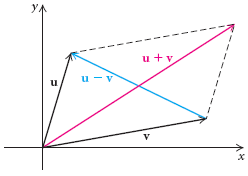
9. $ \displaystyle OABC$ is a parallelogram such that $ \displaystyle \overrightarrow{{OA}}=5\widehat{\text{i}}+3\widehat{\text{j}}$ and $ \displaystyle \overrightarrow{{OC}}=-2\widehat{\text{i}}+\widehat{\text{j}}$. Find the unit vector in the direction of $ \displaystyle \ \overrightarrow{{OB}}$ and $ \displaystyle \ \overrightarrow{{AC}}$.
Show/Hide Solution
 $ \displaystyle \begin{array}{l}\ \ \ \ \ \overrightarrow{{OA}}=5\widehat{\text{i}}+3\widehat{\text{j}}\\\\\ \ \ \ \ \overrightarrow{{OC}}=-2\widehat{\text{i}}+\widehat{\text{j}}\\\\\ \ \ \ \ OABC\ \text{is a parallelogram}.\\\\\therefore \ \ \ \overrightarrow{{OB}}=\overrightarrow{{OA}}+\overrightarrow{{OC}}\ \ \ \left( {\because \text{parallelogram rule}\text{.}} \right)\\\\\ \ \ \ \ \overrightarrow{{OB}}=5\widehat{\text{i}}+3\widehat{\text{j}}-2\widehat{\text{i}}+\widehat{\text{j}}=3\widehat{\text{i}}+4\widehat{\text{j}}\\\\\therefore \ \ \ OB=\sqrt{{{{3}^{2}}+{{4}^{2}}}}=5\\\\\therefore \ \ \ \text{the unit vector in }\\\ \ \ \ \ \text{the direction of}\ \overrightarrow{{OB}}=\displaystyle \frac{{\overrightarrow{{OB}}}}{{OB}}\\\\\ \ \ \ \ \ \ \ \ \ \ \ \ \ \ \ \ \ \ \ \ \ \ \ \ \ \ \ \ \ \ \ \ \ =\displaystyle \frac{1}{5}\left( {3\widehat{\text{i}}+4\widehat{\text{j}}} \right)\\\\\ \ \ \ \ \ \text{Again}\ \overrightarrow{{AC}}=\overrightarrow{{OC}}-\overrightarrow{{OA}}\\\ \ \\\ \ \ \ \ \overrightarrow{{AC}}=\left( {-2\widehat{\text{i}}+\widehat{\text{j}}} \right)-\left( {5\widehat{\text{i}}+3\widehat{\text{j}}} \right)=-7\widehat{\text{i}}-2\widehat{\text{j}}\\\\\therefore \ \ \ AC=\sqrt{{{{{\left( {-7} \right)}}^{2}}+{{{\left( {-2} \right)}}^{2}}}}=\sqrt{{53}}\\\\\therefore \ \ \ \text{the unit vector in }\\\ \ \ \ \ \text{the direction of}\ \overrightarrow{{AC}}=\displaystyle \frac{{\overrightarrow{{AC}}}}{{AC}}\\\\\ \ \ \ \ \ \ \ \ \ \ \ \ \ \ \ \ \ \ \ \ \ \ \ \ \ \ \ \ \ \ \ \ \ =\displaystyle \frac{1}{{\sqrt{{53}}}}\left( {-7\widehat{\text{i}}-2\widehat{\text{j}}} \right)\end{array}$ |
10. Given that the position vectors of the points $ \displaystyle A, B$ and $ \displaystyle C$ relative to origin $ \displaystyle O$ are $ \displaystyle -\widehat{\text{i}}+\widehat{\text{j}}$, $ \displaystyle 5\widehat{\text{i}}+\widehat{\text{j}}$ and $ \displaystyle p\widehat{\text{i}}+q\widehat{\text{j}}$ respectively. If $ \displaystyle \Delta ABC$ is equilateral, find the possible values of $ \displaystyle p$ and $ \displaystyle q$.
Show/Hide Solution
| $ \displaystyle \begin{array}{l}\ \ \ \ \ \overrightarrow{{OA}}=-\widehat{\text{i}}+\widehat{\text{j}}\\\\\ \ \ \ \ \overrightarrow{{OB}}=5\widehat{\text{i}}+\widehat{\text{j}}\\\\\ \ \ \ \ \overrightarrow{{OC}}=p\widehat{\text{i}}+q\widehat{\text{j}}\\\\\therefore \ \ \ \overrightarrow{{AB}}=\overrightarrow{{OB}}-\overrightarrow{{OA}}\\\\\ \ \ \ \ \ \ \ \ \ =6\widehat{\text{i}}\\\\\therefore \ \ \ AB=6\\\\\ \ \ \ \ \overrightarrow{{BC}}=\overrightarrow{{OC}}-\overrightarrow{{OB}}\\\\\ \ \ \ \ \ \ \ \ \ =\left( {p-5} \right)\widehat{\text{i}}+\left( {q-1} \right)\widehat{\text{j}}\\\\\ \ \ \ \ BC=\sqrt{{{{{\left( {p-5} \right)}}^{2}}+{{{\left( {q-1} \right)}}^{2}}}}\\\\\ \ \ \ \ \overrightarrow{{AC}}=\overrightarrow{{OC}}-\overrightarrow{{OA}}\\\\\ \ \ \ \ \ \ \ \ \ \ =\left( {p+1} \right)\widehat{\text{i}}+\left( {q-1} \right)\widehat{\text{j}}\\\\\ \ \ \ \ AC=\sqrt{{{{{\left( {p+1} \right)}}^{2}}+{{{\left( {q-1} \right)}}^{2}}}}\\\\\ \ \ \ \ \text{Since }\Delta ABC\ \text{is equilateral,}\\\\\ \ \ \ \ AB=BC=AC=6.\\\\\therefore \ \ \sqrt{{{{{\left( {p-5} \right)}}^{2}}+{{{\left( {q-1} \right)}}^{2}}}}=6\\\\\ \ \ \ {{\left( {p-5} \right)}^{2}}+{{\left( {q-1} \right)}^{2}}=36\\\\\ \ \ \ {{p}^{2}}+{{q}^{2}}-10p-2q=10\ ---(1)\\\\\ \ \ \ \text{Similarly,}\\\\\ \ \ \ \sqrt{{{{{\left( {p+1} \right)}}^{2}}+{{{\left( {q-1} \right)}}^{2}}}}=6\\\\\ \ \ \ {{\left( {p+1} \right)}^{2}}+{{\left( {q-1} \right)}^{2}}=36\\\\\ \ \ \ {{p}^{2}}+{{q}^{2}}+2p-2q=34\ ---(2)\\\\\ \ \ \ \text{By (2)}-\text{(1),}\\\text{ }\\\ \ \ \ 12p=24\\\\\therefore \ \ p=2\\\\\ \ \ \ \text{Substituting}\ p=2\text{ in (1),}\\\text{ }\\\therefore \ \ 4+{{q}^{2}}-20-2q=10\\\ \\\ \ \ \ {{q}^{2}}-2q=26\\\\\ \ \ \ {{q}^{2}}-2q+1=27\\\\\ \ \ \ {{(q-1)}^{2}}=27\\\\\ \ \ \ q-1=\pm \sqrt{{27}}\\\\\ \ \ \ q=1\pm 3\sqrt{3}\end{array}$ |