‏إظهار الرسائل ذات التسميات Sum to n terms. إظهار كافة الرسائل

الخميس، 9 ديسمبر 2021

Sum of the first n terms of an arithmetic progression : Problems and Solutions (Part 2)

Sum of the first $n$ terms of an arithmetic progression $\left(S_{n}\right)$

$S_{n}=u_{1}+u_{22}+u_{3}+\ldots u_{n-1}+ u_{n}$

$S_{n}=$ sum of the first $n$ terms

If $u_{1}=a$ and $u_{n}=l$ then

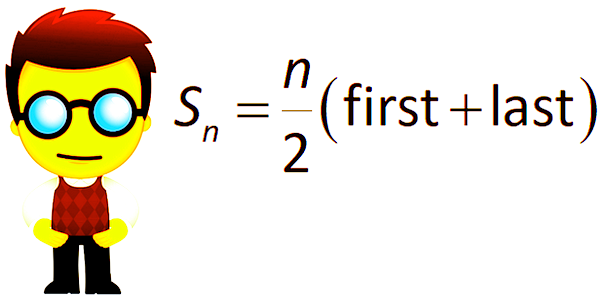
$\begin{array}{|l|} \hline S_{n}=\dfrac{n}{2}(a+l)\\ \quad \text{(or) }\\ \quad S_{n}=\dfrac{n}{2}\{2 a+(n-1) d\}\\ \hline \end{array}$

$a=$ first term

$l=$ last term or $n^{\text {th }}$ term

$d=$ common difference


Arithmetic Series နှင့်ဆိုင်သော သင်ရိုးပြင်ပ ဉာဏ်စမ်းမေးခွန်းများ ကို စုစည်းပေးထားပြီး အဖြေနှင့်တကွ လေ့လာနိုင်ရန် ဖြစ်ပါသည်။ Part (1) ကို ဒီနေရာမှာ (Click Here) ရေးခဲ့ပြီး ဖြစ်ပါသည်။

Exercises

  1. If the $n^{\text {th }}$ term of an A.P. is $p$, show that the sum of first $(2 n-1)$ terms of the A.P. is $(2 n-1) p$.


  2. Let the first term and the conmon difference of given A.P.be $a$ and $d$ respectively.
    By the problem,
    $\begin{aligned} u_{n}&=p \\\\ a+(n-1) d&=p\\\\ S_{2 n-1}&=\dfrac{2 n-1}{2}\left\{2 a+((2 n-1)-1) d\right\} \\\\ S_{2 n-1}&=\dfrac{2 n-1}{2}\left\{2 a+(2 n-2) d\right\} \\\\ S_{2 n-1}&=\dfrac{2 n-1}{2}\left\{2(a)+2(n-1) d\right\} \\\\ S_{2 n-1}&=\dfrac{2 n-1}{2}\left\{2(a+(n-1) d\right\} \\\\ S_{2 n-1}&=\dfrac{2 n-1}{2}\left\{2 p\right\} \\\\ S_{2 n-1}&=(2 n-1) p \end{aligned}$

  3. The digits of a positive integer having three digits are in A.P. The sum of the digits is 15 and the number obtained by reversing the digits is 594 less than the original number. Find the number.


  4. Let the hundred's digit, ten's digit and one's digit of given number be $x, y$ and $z$ respectively.
    $\therefore$ Given number $=100 x+10 y+z$
    $\therefore x, y, z$ are in A.P.
    Let tho common differenee be $d$.
    $\therefore y=x+d, z=x+2 d$
    By the problen,
    $\begin{aligned} x+y+z &=15 \\\\ 3 x+3 d &=15 \\\\ x+d &=5 \\\\ x &=5-d \\\\ \text { reversed-digit number } &=100 z+10 y+x \\\\ \text { By the problem, }\hspace{4cm} & \\\\ 100 x+10 y+z-100 z-10 y-x &=594 \\\\ 99 x-99 z &=594 \\\\ x-z &=6 \\\\ 5-d-(5-d+2 d) &=6 \\\\ 5-d-5+d-2 d &=6 \\\\ \therefore d &=-3 \\\\ \therefore x &=5-(-3) \\\\ &=8\\\\ \therefore y=5 \text { and } z &=2 \\\\ \therefore \text { Given number } &=100 x+10 y+z \\\\ &=100(8)+10(5)+2 \\\\ &=852 \end{aligned}$

  5. In an A.P., the last three terms are $45,51$ and $57$. Which of the numbers $-180$, $-210$ and $-288$ can be the sum of that A.P. and what is the first term of that A.P.


  6. Let the first term and the conmon difference of given A.P.be $a$ and $d$ respectively.
    $\begin{aligned} \therefore\ d &=57-51=6 \\\\ u_{n} &=a+(n-1) d \\\\ 57 &=a+(n-1) 6 \\\\ a &=57-6(n-1) \\\\ &=63-6 n\\\\ S_{n} &=\dfrac{n}{2}(a+57) \\\\ &=\dfrac{n}{2}(63-6 n+57) \\\\ &=\dfrac{n}{2}(120-6 n) \\\\ &=60 n-3 n^{2} \\\\ \text { When } 60 n-3 n^{2}&=-180 \\\\ & n^{2}-20 n=60 \\\\ & n^{2}-20 n+100=160 \\\\ &(n-10)^{2}=160 \\\\ & n=10+4 \sqrt{10} \notin \mathbb{N}.\\\\ \therefore S_{n} &=-180 \text { is impossible. } \\\\ \text { When } 60 n-3 n^{2} &=-210 \\\\ n^{2}-20 n &=70 \\\\ n^{2}-20 n+100 &=170 \\\\ (n-10)^{2} &=170 \\\\ n &=10+\sqrt{170} \notin \mathbb{N} \\\\ \therefore S_{n}&=-210 \text { is impossible. } \\\\ \text { When } 60 n-3 n^{2} & =-288 \\\\ n^{2}-20 n & =96 \\\\ n^{2}-20 n+100 & =196 \\\\ (n-10)^{2} & =196 \\\\ n & =10+14 \\\\ & =24 \in\mathbb{N} \\\\ \therefore S_{n}&=-288 \text { is possible. } \\\\ \therefore a & =63-6(24) \\\\ & =-81 \end{aligned}$

  7. If $S_{n}$ denotes the sum of $n$-terms of an A.P. whose common difference is $d$. Show that $d=S_{n}-2 S_{n-1}+S_{n-2}$.


  8. $\begin{aligned} \text{In an A.P.,}&\\\\ &S_{n}-2 S_{n-1}+S_{n-2} \\\\ =\ & S_{n}-S_{n-1}-S_{n-1}+S_{n-2} \\\\ =\ &\left(S_{n}-S_{n-1}\right)-\left(S_{n-1}-S_{n-2}\right) \\\\ =\ & u_{n}-u_{n-1}\quad \color{red}{\left(\because u_{n}=S_{n}-S_{n-1}\right)} \\\\ =\ & d \end{aligned}$

  9. Show that the sum of first $n$ even natural numbers is equal to $\left(1+\dfrac{1}{n}\right)$ times the sum of the first $n$ odd natural numbers.


  10. The sequence of even natural number are $2,4,6,8, \ldots$.
    It is an A.P., with $a=2$ and $d=2$.
    Let the sum of $n$ even natural numbers be $S_{\text{even}}$.
    $\begin{aligned} S_{\text{even}} &=\dfrac{n}{2}\{2 a+(n-1) d\} \\\\ &=n(2+n-1) \\\\ &=n(n+1)\\\\ \end{aligned}$
    The sequence of even natural number are $1,3,5,7, \ldots$.
    It is an A.P., with $a=1$ and $d=2$.
    Let the sum of $n$ odd natural numbers be $S_{\text{odd}}$.
    $\begin{aligned} S_{\text{odd}} &=\dfrac{n}{2}\{2 a+(n-1) d\} \\\\ &=n(1+n-1) \\\\ &=n^2\\\\ \dfrac{S_{\text{even}}}{S_{\text{odd}}} &=\dfrac{n(n+1)}{n^{2}} \\\\ &=\dfrac{n+1}{n} \\\\ &=1+\dfrac{1}{n} \\\\ \therefore \ S_{\text{even}} &=\left(1+\frac{1}{n}\right) S_{\text{odd}} \end{aligned}$

  11. Find the sum of the A.P., whose terms are $1,5,9,13, \ldots, 605$. If every fourth term of the A.P. (i.e. 13,29 , etc.) is taken out, find the sum of the remaining terms.


  12. $\begin{aligned} 1,5,9,13, & \ldots .605 \text { is an } A P . \\\\ a=1, d &=5-1=4 \\\\ u_{n} &=605 \\\\ 1+(n-1) 4 &=605 \\\\ 4(n-1) &=604 \\\\ n-1 &=151 \\\\ n &=152 \\\\ \therefore\ S_{n} &=\dfrac{n}{2}(a+1) \\\\ S_{152} &=\dfrac{152}{2}(1+605) \\\\ &=46056\\\\ \end{aligned}$
    Every fourth terms of given A.P. are $13,29,45, \ldots$.
    It is also an A.P with $a=13, d=16$.
    Let the last term be $u_n$.
    $\begin{aligned} u_{n} & \leq 605 \\\\ 13+(n-1) 16 & \leq 605 \\\\ (n-1) 16 & \leq 592 \\\\ n-1 & \leq 37 \\\\ n & \leq 38 \end{aligned}$
    $\therefore$ The last term of new A.P. is 605 and there are 38 terms in the new A.P.
    Let the sum of all terms in the new A.P. be $S_{\text {new }}$.
    $\begin{aligned} \therefore\ S_{\text {new }} &=\dfrac{38}{2}(13+605) \\\\ &=11742 \\\\ \therefore\ \text { remaining sum } &=46056-11742 \\\\ &=34314 \end{aligned}$

  13. Find the sum of all two-digit numbers which when divided by $4$ , yields $1$ as remainder.


  14. All two-digit numbers which when divided by 4 yields 1 as remainder are $13,17,21, \ldots, 97 .$
    It is an A.P. with $a=13$ and $d=4$.
    Let $u_{n}=97$, then
    $\begin{aligned} 13+(n-1) 4 &=97 \\\\ (n-1) 4 &=84 \\\\ n-1 &=21 \\\\ n &=22\\\\ S_{n} &=\dfrac{n}{2}(a+l) \\\\ S_{22} &=\dfrac{22}{2}(13+97) \\\\ &=11(110) \\\\ &=1210 \end{aligned}$

  15. Find the sum of first $24$ terms of the A.P. $u_{1}, u_{2}, u_{3}, \ldots, u_{n}$ if it is known that $u_{1}+u_{5}+u_{10}+u_{15}+u_{20}+u_{24}=225 .$


  16. $\begin{aligned} u_{1},\ u_{2},\ u_{3}, \ \ldots, u_{n} \text { is an A.P. }& \\\\ u_{1}+u_{5}+u_{10}+u_{15}+u_{20}+u_{24} &=225 \\\\ \dfrac{6}{2}\left(u_{1}+u_{24}\right) &=225 \\\\ a+a+23 d &=75 \\\\ 2 a+23 d &=75 \\\\ S_{n} &=\dfrac{n}{2}\{2 a+(n-1) d\} \\\\ S_{2 y} &=\dfrac{24}{2}\{2 a+23 d\} \\\\ &=12\{75\} \\\\ &=900 \end{aligned}$

  17. If in an A.P., the sum of $m$ terms is equal to $n$ and the sum of $n$ terms is equal to $m$, prove that the sum of $(m+n)$ terms is $-(m+n)$.


  18. $\begin{aligned} \text{In an A.P.,}\\\\ S_{m} &=n \\\\ \dfrac{m}{2}\{2 a+(m-1) d\} &=n \\\\ 2 a m+\left(m^{2}-m\right) d &=2 n \ldots(1) \\\\ S_{n} &=m \\\\ \dfrac{n}{2}\{2 a+(n-1) d\} &=m \\\\ 2 a n+\left(n^{2}-n\right) d &=2 m \ldots(2)\\\\ \end{aligned}$
    $\begin{aligned} \text { By (1) - (2), }\hspace{6cm}& \\\\ 2 a(m-n) +\left(m^{2}-m-n^{2}+n\right) d&=2(n-m) \\\\ 2 a(m-n) +\left[m^{2}-n^{2}-(m-n)\right] d&=-2(m-n) \\\\ 2 a(m-n) +[(m-n)(m+n)-(m-n)] d&=-2(m-n) \\\\ \end{aligned}$
    $\begin{aligned} \text { Dividing both sides with } & m-n , \\\\ 2 a+(m+n-1) d&=-2 \\\\ S_{m+n}&=\dfrac{m+n}{2}\{2 a+(m+n-1) d\} \\\\ &=\dfrac{m+n}{2}(-2) \\\\ &=-(m+n) \end{aligned}$

  19. In an A.P., if $S_{n}=n^{2} p$ and $S_{m}=m^{2} p, m \neq n$, prove that $S_{p}=p^{3}$.


  20. $\begin{aligned} \text { In an A.P., }\quad\quad& \\\\ S_{n} &=n^{2} p \\\\ \dfrac{n}{2} \left\{ 2 a+(n-1) d \right\} &=n^{2} p \\\\ 2 a+(n-1) d &=2 n p\ldots(1) \\\\ S_{m} &=m^{2} p \\\\ \dfrac{m}{2}\left\{ 2 a+(m-1) d \right\} &=m^{2} p \\\\ 2 a+(m-1) d &=2 m p \ldots(2)\\\\ \text{By } (1)-(2),\quad\quad & \\\\ (n-1-m+1) d &=2 p(n-m) \\\\ (n-m) d &=2 p(n-m) \\\\ d &=2 p\\\\ \text {Substituting } d&=2p \text { in } (1),\\\\ 2 a+(n-1) 2 p &=2 n p \\\\ 2 a+2 n p-2 p &=2 n p \\\\ 2 a &=2 p \\\\ a &=p \\\\ \end{aligned}$
    $\begin{aligned} \therefore\ S_{p} &=\dfrac{p}{2}\left\{ 2 a+(p-1) d \right\} \\\\ &=\dfrac{p}{2}\left\{ 2 p+(p-1) 2 p \right\} \\\\ &=p \left\{ p+p^{2}-p \right\} \\\\ &=p^{3} \end{aligned}$

  21. If $S_{1}, S_{2}, S_{3}, \ldots, S_{m}$ are the sum of $n$ terms of $m$ arithmetic progressions whose first terms are $1,2,3, \ldots, m$ and the common differences are $1,3,5, \ldots,(2 m-$1), respectively. Show that $S_{1}+S_{2}+S_{3}+\ldots+S_{m}=\dfrac{m n}{2}(m n+1)$.


  22. $\begin{aligned} &\text{ By the problem, }\\\\ &S_{1}=\dfrac{n}{2}\left\{2+(n-1)\right\} \\\\ &S_{2}=\dfrac{n}{2}\left\{4+(n-1) 3\right\} \\\\ &S_{3}=\dfrac{n}{2}\left\{6+(n-1) 5\right\} \\\\ &\vdots \\\\ &S_{m}=\dfrac{n}{2}\left\{2 m+(n-1)(2 m-1)\right\}\\\\ \end{aligned}$
    $\quad\ S_{1}+S_{2}+S_{3}+\ldots+S_{m}\\\\ $
    $=\dfrac{n}{2}\{2+4+6+\cdots+2 m+(n-1)(1+3+5+\cdots(2 m-1)\}\\\\ $
    Let $S_{a}=2+4+6+\cdots+2 m\\\\ $
    Since $4-2=2$ and $6-4=2,\\\\\ $
    $\text{the terms are in A.P.}\\\\ $
    $\therefore\ S_{a}=\dfrac{m}{2}\{2(2)+(m-1) 2\}\\\\ $
    $\hspace{2cm}=m(m+1)\\\\ $
    $\text { Let } S_{b}=1+3+5+\ldots+(2 m-1)\\\\ $
    $\text { Since } 3-1=2 \text { and } 5-3=2,\\\\ $
    $\text{the terms are in A.P.}\\\\ $
    $\begin{aligned} S_{b} &=\dfrac{m}{2}\{2+(m-1) 2\} \\\\ &=n^{2} \\\\ S_{1} & +S_{2}+S_{3}+\cdots+S_{m} \\\\ &=\dfrac{n}{2}\left\{S_{a}+(n-1) S_{b}\right\} \\\\ &=\dfrac{n}{2}\left\{m(m+1)+(n-1) m^{2}\right\} \\\\ &=\dfrac{m n}{2}(m+1+m n-m) \\\\ &=\dfrac{m n}{2}(m n+1) \end{aligned}$

  23. If $S_{n}$ denotes the sum of the first $n$ terms of an A.P., prove that $\dfrac{S_{3 n}-S_{n-1}}{S_{2 n}-S_{2 n-1}}=2 n+1$.


  24. Let the $a$ denotes the first term and $d$ denotes the common difference.
    $\begin{aligned} &\\\\ \therefore S_{n} &=\dfrac{n}{2}\{2 a+(n-1) d\} \\\\ S_{3 n-S_{n-1}} &=\dfrac{3 n}{2}\{2 a+(3 n-1) d\}-\dfrac{n-1}{2}\{2 a+(n-2) d\} \\\\ &=\dfrac{3 n}{2}(2 a)+\dfrac{3 n}{2}(3 n-1) d-\left(\dfrac{n-1}{2}(2 a)-\dfrac{(n-1)(n-2)}{2}\right) d \\\\ &=(3 n-n+1) a+\left(\dfrac{9 n^{2}-3 n-n^{2}+3 n-2}{2}\right) d \\\\ &=(2 n+1) a+\left(4 n^{2}-1\right) d \\\\ &=(2 n+1) a+(2 n+1)(2 n-1) d \\\\ &=(2 n+1)\{a+(2 n-1) d\}\\\\ S_{2 n}-S_{2 n-1} &=\dfrac{2 n}{2}\{2 a+(2 n-1) d\}-\dfrac{2 n-1}{2}\{2 a+(2 n-2) d\} \\\\ &=2 n a+\left(2 n^{2}-n\right) d-(2 n-1) a-(2 n-1)(n-1) d \\\\ &=(2 n-2 n+1) a+\left(2 n^{2}-n-2 n^{2}+3 n-1\right) d \\\\ &=a+(2 n+1) d \\\\ \dfrac{S_{3 n}-S_{n-1}}{S_{2 n}-S_{2 n-1}} &=\dfrac{(2 n+1)\{a+(2 n-1) d\}}{a+(2 n-1) d}\\\\ &=2n+1 \end{aligned}$

  25. If the sum of the first $2 n$ terms of the A.P. $2,5,8, \ldots$ is equal to the sum of the first $n$ terms of the A.P. $57,59,61, \ldots$, find $n$.


  26. $\begin{aligned} 2,\ 5,\ 8,\ \ldots & \text { is an A.P. } & \\\\ a=2,\ d &=3 \\\\ S_{2 n} &=\dfrac{2 n}{2}\{2 a+(2 n-1) d\} \\\\ &=n\{2(2)+(2 n-1) 3\} \\\\ &=n(4+6 n-3) \\\\ &=n(6 n+1)\\\\ 57,\ 59,\ 61,\ \ldots, & \text { is an A.P. } \\\\ a= 57,\ d &= 2 \\\\ S_{n} &=\dfrac{n}{2}\{2 a+(n-1) d\} \\\\ &=\dfrac{n}{2}\{2(57)+(n-1) 2\} \\\\ &=n(57+n-1) \\\\ &=n(n+56)\\\\ \text{By the problem,}&\\\\ n(6 n+1) &=n(n+56) \\\\ 6 n+1 &=n+56 \\\\ 5 n &=55 \\\\ n &=11 \end{aligned}$

  27. An arithmetic series has $20$ terms. The $n^{\text{th}}$ term is $u_{n}$ and $S_{n}$ is the sum of the first $n$ terms of this series. If $S_{5}=85$, find $u_{3}$. Given further that $S_{17}=35 u_{3}$, evaluate the sum of all the terms of this series.


  28. Let $a$ denotes the finst term and $d$ denotes the common difference.
    $\begin{aligned} &\\ S_{n}&=\dfrac{n}{2}\{2 a+(n-1) d\} \\\\ S_{5}&=85 \quad \text { (given) } \\\\ \dfrac{5}{2}\{2 a+4 d\}&=85 \\\\ a+2 d&=17 \ldots(1)\\\\ \end{aligned}$
    Since $u_{3}=a+2 d, u_{3}=17.\\ $
    $\begin{aligned} S_{17}&=35 u_{3} \\\\ \dfrac{17}{2}\{2 a+16 d\}&=35(17) \\\\ a+8 d&=35\ldots(2) \\\\ \text{By } (2)-(1),& \\\\ 6d&=18 \\\\ d&=3 \\\\ S_{20}&=\dfrac{20}{2}\{2 a+19 d\} \\\\ &=10\{2(a+8 d)+3 d\} \\\\ &=10\{2(35)+9\} \\\\ &=790 \end{aligned}$

  29. In an arithmetic series, $u_{8}=26$ and $S_{5}=205$. Calculate the smallest positive term of the series.


  30. In an arithmetic series,
    $\begin{aligned} &\\ u_{8}&=26\ldots(1) \\\\ a+7 d&=26 \\\\ S_{5}&=205 \\\\ \dfrac{5}{2}\{2 a+4 d\}&=205 \\\\ a+2 d=41\ldots(1)\\\\ \text{By } (1)-(2),& \\\\ 5d &=-15 \\\\ d &=-3\\\\ \end{aligned}$
    Substituting $d=-3$ in equation (2),
    $\begin{aligned} &\\ &a-6=41 \\\\ &a=47 \\\\ \end{aligned}$
    Let the smallest positive term be $u_{n}\\\\ $.
    $\begin{aligned} u_{n} &>0 \\\\ a+(n-1) d &>0 \\\\ 47+(n-1)(-3) &>0 \\\\ 47-3 n+3 &>0 \\\\ 3 n & < 50 \\\\ n & <16.67 \\\\ \therefore\ n&=16\\\\ \end{aligned}$
    The smallest positive term is $u_{16}$.

  31. The first term of an arithmetic series is $5$ and the common difference is $4$ The $n^{\text {th }}$ term is $u_{n}$ and $S_{n}$ is the sum of the first $n$ terms of this series. Show that $S_{n}=n(2 n+3)$. Find the value of $u_{n}$, given that $S_{n}=779$.


  32. In an arithmetic series,
    $\begin{aligned} &\\ a &=5, d=4 \\\\ S_{n} &=\dfrac{n}{2}\{2 a+(n-1) d\} \\\\ &=\dfrac{n}{2}\{2(5)+(n-1) 4\} \\\\ &=n(5+2 n-2) \\\\ &=n(2 n+3)\\\\ S_{n} &=779 \\\\ n(2 n+3) &=779 \\\\ 2 n^{2}+3 n-779 &=0 \\\\ (2 n+41)(n-19) &=0 \\\\ n=-\dfrac{41}{2} \notin \mathbb{N} \text { or } n &=19 \\\\ \therefore\ u_{n} &=u_{19} \\\\ &=a+18 d \\\\ &=5+18(4) \\\\ &=77 \end{aligned}$

  33. The first and last terms of an A.P. are $a$ and $l$ respectively. If $d$ is the common difference and $S$ is the sum of all the terms of the A.P., then show that $d=\dfrac{l^{2}-a^{2}}{2 S-l-a}$.

  34. $\text{In an A.P.}\\\\ $
    $\text{first term }=a\\\\ $
    $\text{Last term }=l\\\\ $
    $\text{common difference }=d\\\\ $
    $\text{sum of all terms }=S\\\\ $
    Let the number of terms in the given A.P. be $n\\\\ $.
    $\begin{aligned} \therefore\ l&=u_{n}=a+(n-1) d \\\\ \therefore\ (n-1) d&=l-a\ldots(1) \\\\ S=S_{n}&=\dfrac{n}{2}(a+l) \\\\ \therefore\ n&=\dfrac{2S}{a+1}\ldots(2)\\\\ \text { Substituting } n &=\dfrac{2 S}{a+l} \text { in equation }(1), \\\\ \left(\dfrac{2S-l-a}{l+a}\right) d &=l-a \\\\ \therefore\ d &=\dfrac{l^{2}-a^{2}}{2S-l-a} \end{aligned}$

الاثنين، 6 ديسمبر 2021

Sum of the first n terms of an arithmetic progression : Problems and Solutions (Part 1)

Sum of the first $n$ terms of an arithmetic progression $\left(S_{n}\right)$

$S_{n}=u_{1}+u_{22}+u_{3}+\ldots u_{n-1}+ u_{n}$

$S_{n}=$ sum of the first $n$ terms

If $u_{1}=a$ and $u_{n}=l$ then

$\begin{array}{|l|} \hline S_{n}=\dfrac{n}{2}(a+l)\\ \quad \text{(or) }\\ \quad S_{n}=\dfrac{n}{2}\{2 a+(n-1) d\}\\ \hline \end{array}$

$a=$ first term

$l=$ last term or $n^{\text {th }}$ term

$d=$ common difference


Exercises

  1. The sum to $n$ terms of an A.P. is $35$. The common difference is $2$ and the sum to $2 n$ terms is 120 . Find the first term.


  2. $\begin{aligned} \text{In an A.P.,} &\\\\ d &=2, \\\\ S_{n} &=35 \\\\ \dfrac{n}{2}\{2 a+(n-1) 2\} &=35 \\\\ \dfrac{n}{2} \times 2\{a+n-1\} &=35 \\\\ a n+n^{2}-n &=35\ldots(1) \\\\ S_{2 n} &=120 \\\\ \dfrac{2 n}{2}\{2 a+(2 n-1) 2\} &=120 \\\\ n \times 2\{a+2 n-1\} &=120 \\\\ a n+2 n^{2}-n &=60\ldots(2) \\\\ (2)-(1), & \\\\ n^{2} &=25 \\\\ n &=5 \\\\ \text { Substituting } n &=5 \text { in equation (1), } \\\\ 5 a+25-5 &=35 \\\\ 5 a &=15 \\\\ a &=3 \end{aligned}$

  3. An A.P., with first term 8 and common difference $d$, consists of 101 terms. Given that the sum of the last three terms is 3 times the sum of the first three terms, find the value of $d$.


  4. In an AP, first term $=a=8$
    common difference $=d$
    By the problem,
    $\begin{aligned} u_{99}+u_{100}+u_{101} &=3\left(u_{1}+u_{2}+u_{3}\right) \\\\ a+98 d+a+99 d+a+100 d &=3(a+a+d+a+2 d) \\\\ 3 a+297 d &=9 a+9 d \\\\ 288 d &=6 a \\\\ d &=\dfrac{6}{288}(8) \\\\ &=\dfrac{1}{6} \end{aligned}$

  5. The sum of the first $n$ terms of an A.P. $3,5 \dfrac{1}{2}, 8, \ldots$ is equal to the $2 n^{\text {th }}$ term of the A.P $16 \dfrac{1}{2}, 28 \dfrac{1}{2}, 40 \dfrac{1}{2}, \ldots .$ Calculate the value of $n$.


  6. $\begin{aligned} 3,\ 5\dfrac{1}{2},\ & 8,\ \ldots \text { is an A.P. } \\\\ a &=3 \\\\ d &=5 \dfrac{1}{2}-3 \\\\ &=2 \dfrac{1}{2} \\\\ &=\dfrac{5}{2} \\\\ S_{n} &=\dfrac{n}{2}\{2 a+(n-1) d\} \\\\ &=\dfrac{n}{2}\left\{6+(n-1) \dfrac{5}{2}\right\} \\\\ &=\dfrac{n}{4}\{12+5 n-5\} \\\\ &=\dfrac{5 n^{2}+7 n}{4}\\\\ 16 \dfrac{1}{2},\ & 28 \dfrac{1}{2},\ 40 \dfrac{1}{2},\ \ldots \text { is an A.P. } \\\\ a&=16 \dfrac{1}{2}\\\\ &=\dfrac{33}{2} \\\\ d &=28 \dfrac{1}{2}-16 \dfrac{1}{2}\\\\ &=12 \\\\ u_{2 n} &=a+(2 n-1) d \\\\ &=\dfrac{33}{2}+(2 n-1) 12 \\\\ &=24 n+ \dfrac{9}{2}\\\\ \text{By the } & \text{problem},\\\\ \dfrac{5 n^{2}+7 n}{4}&=24 n+\dfrac{9}{2}\\\\ 5 n^{2}+7 n &=96 n+18 \\\\ 5 n^{2}-89 n-18 &=0 \\\\ (5 n+1)(n-18) &=0 \\\\ n=-\dfrac{1}{5} \text { or } n &=18 \\\\ \text { Since }-\dfrac{1}{5} & \notin N, \\\\ n &=18 \end{aligned}$

  7. The sum of the first $n$ terms of a certain sequence is given by $S_{n}=n^{2}+2 n$. Find the first 3 terms of the sequence and express the $n^{\text {th }}$ term in terms of $n$.


  8. $\begin{aligned} S_{n} &=n^{2}+2 n \\\\ S_{1} &=1^{2}+2(1)=3 \\\\ S_{2} &=2^{2}+2(2)=8 \\\\ S_{3} &=3^{2}+2(3)=15 \\\\ \text {Since } u_{n} &=S_{n}-S_{n-1}, \\\\ u_{1} &=S_{1}=3 \\\\ u_{2} &=S_{2}-S_{1}=5\\\\ u_{3} &=S_{3}-S_{2}=15-8=7\\\\ \text { Since }\\\\ u_{2}-u_{1} &=5-3=2 \text { and } \\\\ u_{3}-u_{2} &=7-5=2,\\\\ \text{the terms } & \text{are in A.P., with}\\\\ a=3 \text { and } & d =2 \\\\ u_{n} &=a+(n-1) d \\\\ &=3+(n-1) 2 \\\\ &=3+ 2n-2 \\\\ &=2 n+1 \end{aligned}$

  9. If the sum of $n$ terms of a certain sequence is $2 n+3 n^{2}$, find the $n^{\text {th }}$ term. Hence show that this sequence is an arithmetic progression.


  10. $\begin{aligned} S_{n} &=2 n+3 n^{2} \\\\ u_{n} &=S_{n}-S_{n-1} \\\\ &=2 n+3 n^{2}-2(n-1)-3(n-1)^{2} \\\\ &=2 n+3 n^{2}-(2 n-2)-3\left(n^{2}-2 n+1\right) \\\\ &=2 n+3 n^{2}-2 n+2-3 n^{2}+6 n-3 \\\\ &=4 n-1 \\\\ u_{n-1} &=S_{n-1}-S_{n-2} \\\\ &=2(n-1)+3(n-1)^{2}-2(n-2)-3(n-2)^{2} \\\\ &=2 n-2+3\left(n^{2}-2 n+1\right)-2 n+4-3\left(n^{2}-4 n+4\right) \\\\ &=2 n-2+3 n^{2}-6 n+3-2 n+4-3 n^{2}+12 n-12 \\\\ &=4 n-7\\\\ u_{n}-u_{n-1} &=4 n-1-(4 n-7) \\\\ &=6 \end{aligned}$
    Since the difference of two consicutive terms is constant, the sequence is an A.P.

  11. The sum of $n$ terms of two arithmetic progressions are in the ratio $(3 n+8) \vdots(7 n+$ 15). Find the ratio of their $12^{\text {th }}$ terms.


  12. Let the st term and the common difference of $1^{\text{st}}$ A.P be $a$ and
    $d$ and those of $2^{\text{nd}}$ A.P be $A$ and $D$,
    For $1^{\text{st}}$ A.P.,
    $S_{n}=\dfrac{n}{2}\{2 a+(n-1) d\}$
    For $2^{\text{nd}}$ A.P.,
    $S_{n}=\dfrac{n}{2}\{2 A+(n-1) D\}$
    By the problem,
    $\begin{aligned} \dfrac{\dfrac{n}{2}\{2 a+(n-1) d\}}{\dfrac{n}{2}\{2 A+(n-1) D\}}&=\dfrac{3 n+8}{7 n+15}\\\\ \text { When } n=23,\hspace{2 cm} & \\\\ \dfrac{2 a+22 d}{2 A+22 D}&=\dfrac{77}{176}\\\\ \dfrac{a+11d}{A+11 D}&=\dfrac{7}{16}\\\\ \therefore\ \dfrac{12^{\text {th }} \text { term of } 1^\text {st} \text {A.P}}{12^{\text {th }} \text { term of } 2^\text{nd} \text { A.P}}&=\dfrac{7}{16} \end{aligned}$

  13. An A.P. contains $30$ terms. Given that the $10^{\text {th }}$ term is $21$ and that the sum of the last $10$ terms is $675$ , find the sum of the first $10$ terms.


  14. $\begin{aligned} \text{In an A.P.,}\hspace{3 cm}&\\\\ u_{10} &=21 \\\\ a+9 d &=21\ldots(1) \\\\ u_{21}+u_{22}+u_{23}+\ldots+u_{30} &=675 \\\\ \dfrac{10}{2}\left\{u_{21}+u_{30}\right\} &=675 \\\\ 5\{a+20 d+a+29 d\} &=675 \\\\ 2 a+49 d &=135\ldots(2)\\\\ (2) \times 1 \Rightarrow 2 a+49 d&=135 \\\\ (1) \times 2 \Rightarrow 2 a+18 d&=42\\\\ \text{By subtraction,}\hspace{2 cm}&\\\\ 31 d &=93 \\\\ d &=3\\\\ \end{aligned}$
    $\begin{aligned} \text{Substituting } d&=3 \text{ in equation } (1),\\\\ a+27 &=21 \\\\ a &=-6\\\\ S_{10}&=\dfrac{10}{2}\{2 a+9 d\} \\\\ &=5\{-12+27\} \\\\ &=75 \end{aligned}$

  15. If $S_{1}, S_{2}, S_{3}$ be sums to $n, 2 n, 3 n$ terms of an arithmetic progression, Show that $S_{3}=3\left(S_{2}-S_{1}\right)$.


  16. Let the first term and the common difference of given A.P. be $a$ and $d$ respectively.
    $\begin{aligned} \therefore\ S_{1} &=\dfrac{n}{2}\{2 a+(n-1) d\} \\\\ S_{2} &=\dfrac{2 n}{2}\{2 a+(2 n-1) d\} \\\\ S_{3} &=\dfrac{3 n}{2}\{2 a+(3 n-1) d\} \\\\ S_{2}-S_{1} &=\dfrac{2 n}{2}\{2 a+(2 n-1) d\}-\dfrac{n}{2}\{2 a+(n-1) d\} \\\\ &=\dfrac{n}{2}\{4 a+4 n d-2 d-2 a-n d+d\} \\\\ &=\dfrac{n}{2}\{2 a+3 n d-d\} \\\\ &=\dfrac{n}{2}\{2 a+(3 n-1) d\} \\\\ 3\left(S_{2}-S_{1}\right) &=\dfrac{3 n}{2}\{2 a+(3 n-1) d\} \\\\ \therefore\ S_{3} &=3\left(S_{2}-S_{1}\right) \end{aligned}$

  17. In an A.P., if $p^{\text {th }}$ term is $\dfrac{1}{q}$ and $q^{\text {th }}$ term is $\dfrac{1}{p}$, prove that the sum of first $p q$ terms is $\dfrac{1}{2}(p q+1)$, where $p \neq q$.


  18. $\begin{aligned} \text{In an A.P,}&\\\\ u_{p} &=\dfrac{1}{q} \\\\ a+(p-1) d &=\dfrac{1}{q}-(1) \\\\ u_{q} &=\dfrac{1}{p} \\\\ a+(q-1) d &=\dfrac{1}{p}\\\\ (1)-(2), & \\\\ (p-q) d &=\dfrac{1}{q}-\dfrac{1}{p} \\\\ (p-q) d &=\dfrac{p-q}{p q} \\\\ d &=\dfrac{1}{p q}\\\\ \end{aligned}$
    $\begin{aligned} \text{Substituting } d&=\dfrac{1}{q-p} \text{ in equation} (1),\\\\ a+\dfrac{p-1}{p q} &=\dfrac{1}{q} \\\\ a &=\dfrac{1}{q}-\dfrac{p-1}{p q} \\\\ &=\dfrac{p-p+1}{p q} \\\\ &=\dfrac{1}{p q}\\\\\ \therefore\ S_{p q} &=\dfrac{p q}{2}\{2 a+(p q-1) d\} \\\\ &=\dfrac{p q}{2} \left\{\dfrac{2}{p q}+(p q-1) \dfrac{1}{p q}\right\} \\\\ &=1+\dfrac{1}{2}(p q-1) \\\\ &=\dfrac{1}{2} p q+1-\dfrac{1}{2}=\dfrac{1}{2} p q+\dfrac{1}{2} \\\\ &=\dfrac{1}{2}(p q+1) \end{aligned}$
    Thus, the sum of first $p q$ terms of the A.P. is $\dfrac{1}{2}(p q+1)$

  19. An arithmetic progression has third term $90$ and fifth term $80$.
    (a) Find the first term and the common difference.
    (b) Find the value of $m$ given that the sum of the first $m$ terms is equal to the sum of the first $(m+1)$ terms.
    (c) Find the value of $n$ given that the sum of the first $n$ terms is zero.


  20. $\begin{aligned} \text{ (a) In an A.P.,} \hspace{2cm}&\\\\ u_{3} &=90 \\\\ a+2 d &=90\ldots(1) \\\\ u_{5} &=80 \\\\ a+4 d &=80\ldots(2) \\\\ (2)-(1), & \\\\ 2 d &=-10 \\\\ \therefore\ d &=-5\\\\ \text { Substituting } d &=-5 \text { in equation }(1), \\\\ a-10 &=90 \\\\ \therefore a &=100 \\\\ \text{ (b) }\hspace{3.5 cm} S_m &=S_{m+1} \\\\ m\{200+(m-1)(-5)\} &=(m+1)\{200+m(-5)\} \\\\ m\{200+(m-1)(-5)\} &=(m+1)\{200+m(-5)\} \\\\ m\{200-5 m+5\} &=(m+1)\{200-5 m\} \\\\ m(205-5 m) &=(m+1)(200-5 m) \\\\ 205 m-5 m^{2} &=200 m-5 m^{2}+200-5 m \\\\ m &=20 \end{aligned}$

  21. An arithmetic progression contains $25$ terms and the first term is $-15$. The sum of all the terms in the progression is $525$. Calculate
    (a) the common difference of the progression,
    (b) the last term in the progression,
    (c) the sum of all the positive terms in the progression.


  22. $\begin{aligned} \text{(a) In an A.P.,}&\\\\ a &=-15 \\\\ a+12 d &=21 \\\\ S_{25} &=525 \\\\ \dfrac{25}{2}\{2 a+2 y d\} &=525 \\\\ -15+12 d &=21 \\\\ 12 d &=36 \\\\ d &=3 \text{(b) Last term} =u_{25}\\\\ &=a+2 y d \\\\ &=-15+72 \\\\ &=57 \end{aligned}$
    Let the last non-positive term be $u_{n}$.
    $\begin{aligned} \therefore u_{n} & \le 0 \\\\ -15+(n-1) 3& \le0 \\\\ (n-1) 3 &\le15 \\\\ n-1 & \le 5\\\\ n & \le6 \\\\ \therefore\ u_{6} & \text{ is the last non-positive term.}\\\\ \therefore\ u_{7} &=u_{6}+3=3\\\\ \therefore\ u_{7} & \text{ is the first positive term.}\\\\ \therefore\ \text { required sum } &=u_{7}+u_{8}+\ldots+u_{25} \\\\ &=\dfrac{19}{2}\{3+57\} \\\\ &=570 \end{aligned}$

  23. If the sum of $n$ terms of an A.P. is $n P+\dfrac{1}{2} n(n-1) Q$, where $P$ and $Q$ are constants, find the common difference.


  24. $\begin{aligned} \text{In an A.P.,}&\\\\ S_{n} &=n P+\dfrac{1}{2} n(n-1) 2 \\\\ S_{1} &=P+\dfrac{1}{2}(1-1) Q=P \\\\ S_{2} &=2 P+\dfrac{1}{2}(2)(2-1) Q \\\\ &=2 P+Q \end{aligned}$
    Let the common difference be $d$.
    $\begin{aligned} \therefore d &=u_{2}-u_{1} \\\\ &=S_{2}-S_{1}-S_{1} \\\\ &=S_{2}-2 S_{1} \\\\ &=2 P+Q - 2 P \\\\ &=Q \end{aligned}$

  25. If the sum of first $p$ terms of an A.P. is equal to the sum of the first $q$ terms where $p \neq q$, then find the sum of the first $(p+q)$ terms.


  26. $\begin{aligned} S_p&=S_q, \quad (p\ne q)\\\\ \dfrac{p}{2}\left\{2 a+(p-1) d\right\} &=\dfrac{q}{2}\left\{2 a+(q-1) d\right\} \\\\ p\left\{2 a+(p-1) d\right\} &=q\left\{2 a+(q-1) d\right\} \\\\ 2 a p+(p-1) p d &=2 a g+(q-1) q d \\\\ \left(p^{2}-p-q^{2}+q\right) d &=2 a q-2 a p \\\\ \left(p^{2}-q^{2}-p+q\right) d &=-2 a(p-q) \\\\ \left[(p-q)(p+q)-(p-q)\right] d &=-2 a(p-q)\\\\ (p-q)(p+q-1) d&=-2 a(p-q) \\\\ \quad \text { Since } p\ne q,\ & p-q=0. \\\\ \therefore\ (p+q-1) d&=-2 a \\\\ \therefore\ 2 a+(p+q-1) d&=0\\\\ \therefore\ S_{p+q}=\dfrac{p+q}{2}\{2 a +(p+q&-1) d\}=0 \\\\ \end{aligned}$

  27. Prove that the sum of $n$ arithmetic means between two numbers is $n$ times the single A.M. between them.


  28. Let $a$ and $b$ be two given numbers.
    Let $x_{1}, x_{2}, x_{3}, \ldots x_{n}$, be A.M.s between a and b.
    $\therefore \ a, x_{1}, x_{2}, x_{3}, \ldots x_{n}, b$ are in A.P.
    $\begin{aligned} a+x_{1}+x_{2}+x_{3}+\ldots+x_{n}+b&=\dfrac{n+2}{2}(a+b) \\\\ x_{1}+x_{2}+x_{3}+\ldots+x_{n} &=\dfrac{(n+2)(a+b)}{2}-(a+b)\\\\ &=(a+b)\left[\dfrac{n+2}{2}-1\right] \\\\ &=(a+b)\left[\dfrac{n+2-2}{2}\right]\\\\ &=\dfrac{n}{2}(a+b)\\\\ &=n\left(\dfrac{a+b}{2}\right)\\\\ &=n \text{ times the single A.M. between } a \text{ and } b \end{aligned}$

  29. The first term of an A.P. is $x$, the second term is $y$ and the last term is $z$. Show that the sum of the A.P. is $\dfrac{(y+z-2 x)(z+x)}{2(y-x)}$.


  30. Let the comnon difference of given A.P. be $d$.
    $\begin{aligned} &u_{1}=x \\\\ &u_{2}=x+d \\\\ &y=x+d \\\\ &d=y-x \\\\ &u_{n}=x+(n-1) d \\\\ &z=x+(n-1) d \\\\ &n-1=\dfrac{z-x}{d} \\\\ &z-x\\\\ n &=\dfrac{z-x}{y-x}+1 \\\\ &=\dfrac{z-x+y-x}{y-x} \\\\ &=\dfrac{y+z-2 x}{y-x} \\\\ S_{n} &=\dfrac{n}{2}(x+z) \\\\ &=\dfrac{(y+z-2 x)(x+z)}{2(y-x)} \end{aligned}$

  31. The ratio of the sums of $m$ and $n$ terms of an A.P. is $m^{2}: n^{2}$. Show that the ratio of $m^{\text {th }}$ and $n^{\text {th }}$ terms is $(2 m-1):(2 n-1)$.


  32. In an A.P.,
    $\dfrac{S_{m}}{S_{n}}=\dfrac{m^{2}}{n^{2}}$
    Let $S_{m}=k m^{2}$ and $S_{n}=k n^{2}$.
    Let $S_{m}=k m^{2}$ and $S_{n}=$ where $k$ is a constant.
    $\begin{aligned} u_{m} &=S_{m}-S_{m-1} \\\\ &=k m^{2}-k(m-1)^{2} \\\\ &=k m^{2}-k\left(m^{2}-2 m+1\right) \\\\ &=k m^{2}-k m^{2}+2 k m+k \\\\ &=k(2 m-1)\\\\ u_{n} &=S_{n}-S_{n-1} \\\\ &=k n^{2}-k(n-1)^{2} \\\\ &=k n^{2}-k\left(n^{2}-2 n+1\right) \\\\ &=k n^{2}-k n^{2}+2 k n-k \\\\ &=k(2 n-1) \\\\ \therefore\ \dfrac{u_{m}}{u_{n}} &=\dfrac{k(2 m-1)}{k(2 n-1)} \\\\ &=\dfrac{2 m-1}{2 n-1} \end{aligned}$

  33. The sum of three numbers in an A.P. is $12$ and the sum of their cubes is $408$. Find the numbers.


  34. Let the three numbers be $x, y$ and $z$.
    $\therefore x, y, z$, are in $A P$.
    Let the common difference be $d$.
    $\begin{aligned} \therefore\ y =x+d \text { and } z&=x+2 d \\ x+y+z &=12 \\ 3 x+3 d &=12 \\ x+d &=4 \\ \therefore\ x &=4-d\\ x^{3}+y^{3}+z^{3} &=408 \\ x^{3}+(x+d)^{3}+(x+2 d)^{3} &=408 \\ (4-d)^{3}+4^{3}+(4-d+2 d)^{3} &=408 \\ (4-d)^{3}+(4+d)^{3} &=344 \\ 64-48 d+12 d^{2}-d^{3}+64+48 d+12 d^{2}+d^{3} &=344 \\ 24 d^{2} &=216 \\ d^{2} &=9 \\ \therefore\ d &=\pm 3 \end{aligned}$
    When $d=-3,\ x= 4-(-3) = 7$.
    Hence, the numbers are $7,4$ and $1$.
    When $d=3,\ x= 4-(3) = 1$.
    Hence, the numbers are $1, 4$ and $7$.