‏إظهار الرسائل ذات التسميات mathematics. إظهار كافة الرسائل

الجمعة، 25 يناير 2019

Sample Math Paper (2) - Section (C) Solution

ဒီေနရာမွာ တင္ေပးလိုက္တဲ့ ေမးခြန္းရဲ့ section (C) အေျဖျဖစ္ပါတယ္။


Section (C)

11. (a) In the diagram, two circles are tangent at $ \displaystyle A$ and have a common tangent touching them $ \displaystyle B$ and $ \displaystyle C$ respectively. If $ \displaystyle BA$ is produced to meet the second circle at $ \displaystyle D,$ show that $ \displaystyle CD$ is a diameter.
(5 marks)

Show/Hide Solution
$ \displaystyle \begin{array}{l}\ \ \ \ \ \ \text{Draw a common tangent to both }\\\ \ \ \ \ \ \text{circles at }A\text{ to cut }BC\text{ at }E\text{.}\\\\\ \ \ \ \ \ \text{For smaller circle, }\\\\\ \ \ \ \ \ EA=EB\\\\\therefore \ \ \ \ \alpha =\beta \\\\\ \ \ \ \ \ \text{Similarly, for larger circle,}\\\\\ \ \ \ \ \ EA=EB\\\\\therefore \ \ \ \ \delta =\gamma \\\\\ \ \ \ \ \ \text{Since }\alpha +\beta +\delta +\gamma =180{}^\circ ,\\\\\ \ \ \ \ \ 2\alpha +2\delta =180{}^\circ \\\\\therefore \ \ \ \ \alpha +\delta =90{}^\circ \\\\\therefore \ \ \ \ \angle CAD=90{}^\circ \\\\\therefore \ \ \ \ \text{Arc }CAD\text{ is a semicircle}\text{.}\\\\\therefore \ \ \ \ CD\text{ is a diameter}\text{.}\end{array}$


     (b) $ \displaystyle ABC$ is a right triangle with $ \displaystyle A$ the right angle. $ \displaystyle E$ and $ \displaystyle D$ are points on opposite side of $ \displaystyle AC,$ with $ \displaystyle E$ on the same side of $ \displaystyle AC$ as $ \displaystyle B,$ such that $ \displaystyle ΔACD$ and $ \displaystyle ΔBCE$ are both equilateral. If $ \displaystyle α (ΔBCE) = 2 α (ΔACD),$ prove that $ \displaystyle ABC$ is an isosceles right triangle.
(5 marks)

Show/Hide Solution

$ \displaystyle \begin{array}{l}\ \ \ \ \ \alpha \text{(}\vartriangle BCE\text{) = 2}\alpha \text{(}\vartriangle ACD\text{) }\left[ {\because \text{given}} \right]\\\\\ \ \ \ \ \displaystyle \frac{{\alpha \text{(}\vartriangle BCE\text{)}}}{{\alpha \text{(}\vartriangle ACD\text{)}}}=2\\\\\ \ \ \ \ \text{Since }\vartriangle ACD\text{ and }\vartriangle BCE\text{ are equilateral,}\\\\\ \ \ \ \ \vartriangle ACD\sim \vartriangle BCE\\\\\ \ \ \ \ \displaystyle \frac{{\alpha \text{(}\vartriangle BCE\text{)}}}{{\alpha \text{(}\vartriangle ACD\text{)}}}=\displaystyle \frac{{B{{C}^{2}}}}{{A{{C}^{2}}}}\\\\\therefore \ \ \ \displaystyle \frac{{B{{C}^{2}}}}{{A{{C}^{2}}}}=2\Rightarrow B{{C}^{2}}=2A{{C}^{2}}\\\\\ \ \ \ \ \text{But in rt}\text{. }\vartriangle ABC,\\\\\ \ \ \ \ B{{C}^{2}}=A{{B}^{2}}+A{{C}^{2}}\\\\\therefore \ \ \ A{{B}^{2}}+A{{C}^{2}}=2A{{C}^{2}}\\\\\therefore \ \ \ A{{B}^{2}}=A{{C}^{2}}\Rightarrow AB=AC\\\\\therefore \ \ \ \vartriangle ABC\ \text{is an isosceles right triangle}\\\ \ \ \ \ \end{array}$


12. (a) Two circles are drawn intersecting at $ \displaystyle A, B$ and so that the circumference of each passes through the centre of the another. Through $ \displaystyle A,$ a line is drawn meeting the circumference at $ \displaystyle C, D$ respectively. Prove that $ \displaystyle \vartriangle BCD$ is equilateral.
(5 marks)

Show/Hide Solution
$ \displaystyle \begin{array}{l}\ \ \ \ \ \ \ \ \text{Draw}\ OA,OB,OP,PA\ \operatorname{and}PB.\\\\\ \ \ \ \ \ \ \ \text{Since}\odot O\ \operatorname{and}\ \odot P\ \text{are congruent,}\ \ \\\ \ \ \ \ \ \ \ OA,OB,OP,PA\ \operatorname{and}PB\ \text{are equal }\\\ \ \ \ \ \ \ \ \text{radii}\ \text{of congruent circles}.\\\\\ \ \ \ \ \ \ \ \vartriangle AOP\ \operatorname{and}\ \vartriangle BOP\ \text{are equilateral }\vartriangle \text{s}.\\\\\therefore \ \ \ \ \ \ \alpha =\beta =\gamma =\delta =60{}^\circ \\\\\ \ \ \ \ \ \ \ \text{But}\ \angle C=\displaystyle \frac{1}{2}(\alpha +\beta ),\\\\\therefore \ \ \ \ \ \ \ \angle C=60{}^\circ \\\\\ \ \ \ \ \ \ \ \text{Similarly,}\ \angle D=\displaystyle \frac{1}{2}(\gamma +\delta ),\\\ \\\therefore \ \ \ \ \ \ \ \angle D=60{}^\circ \\\\\therefore \ \ \ \ \ \ \angle CBD=60{}^\circ \\\\\therefore \ \ \ \ \ \ \vartriangle BCD\ \text{is equilateral triangle}\text{.}\end{array}$


     (b) Given that $ \displaystyle \sin \alpha =\frac{3}{5}$ and $ \displaystyle \cos \beta =\frac{{12}}{{13}}$, where $ \displaystyle α$ is obtuse and $ \displaystyle β$ is acute, find the exact values of $ \displaystyle \cos (α+β)$ and $ \displaystyle \cot (α- β).$
(5 marks)

Show/Hide Solution
$ \displaystyle \begin{array}{l}\ \ \ \ \sin \alpha =\displaystyle \frac{3}{5},\ 90{}^\circ <\alpha <180{}^\circ \\\\\ \ \ \ \text{Since}\ {{\sin }^{2}}\alpha +{{\cos }^{2}}\alpha =1\\\\\ \ \ \ \cos \alpha =-\sqrt{{1-{{{\sin }}^{2}}\alpha }}\ \ \ \ \left[ {\because 90{}^\circ <\alpha <180{}^\circ } \right]\\\\\therefore \ \ \cos \alpha =-\sqrt{{1-\displaystyle \frac{9}{{25}}}}=-\displaystyle \frac{4}{5}\\\\\therefore \ \ \tan \alpha =\displaystyle \frac{{\sin \alpha }}{{\cos \alpha }}=-\displaystyle \frac{3}{4}\\\\\ \ \ \ \cos \beta =\displaystyle \frac{{12}}{{13}},\ 0{}^\circ <\beta <90{}^\circ \\\\\ \ \ \ \text{Since}\ {{\sin }^{2}}\beta +{{\cos }^{2}}\beta =1\\\\\ \ \ \ \sin \beta =\sqrt{{1-{{{\cos }}^{2}}\beta }}\ \ \ \ \left[ {\because 0{}^\circ <\beta <90{}^\circ } \right]\\\\\therefore \ \ \sin \beta =\sqrt{{1-\displaystyle \frac{{144}}{{169}}}}=\displaystyle \frac{5}{{13}}\\\\\therefore \ \ \tan \beta =\displaystyle \frac{{\sin \beta }}{{\cos \beta }}=\displaystyle \frac{5}{{12}}\\\\\therefore \ \ \cos (\alpha +\beta )=\cos \alpha \cos \beta -\sin \alpha \sin \beta \\\\\therefore \ \ \cos (\alpha +\beta )=\left( {-\displaystyle \frac{4}{5}} \right)\left( {\displaystyle \frac{{12}}{{13}}} \right)-\left( {\displaystyle \frac{3}{5}} \right)\left( {\displaystyle \frac{5}{{13}}} \right)\\\\\therefore \ \ \cos (\alpha +\beta )=-\displaystyle \frac{{63}}{{65}}\\\\\therefore \ \ \tan (\alpha -\beta )=\displaystyle \frac{{\tan \alpha -\tan \beta }}{{1+\tan \alpha \tan \beta }}\\\\\therefore \ \ \tan (\alpha -\beta )=\displaystyle \frac{{-\displaystyle \frac{3}{4}-\displaystyle \frac{5}{{12}}}}{{1+\left( {-\displaystyle \frac{3}{4}} \right)\left( {\displaystyle \frac{5}{{12}}} \right)}}\\\\\therefore \ \ \tan (\alpha -\beta )=\displaystyle \frac{{-\displaystyle \frac{{56}}{{48}}}}{{\displaystyle \frac{{33}}{{48}}}}=-\displaystyle \frac{{56}}{{33}}\\\\\therefore \ \ \cot (\alpha -\beta )=-\displaystyle \frac{{33}}{{56}}\\\ \ \ \ \,\end{array}$


13. (a) Solve $ \displaystyle ΔABC$ with $ \displaystyle b=12.5, c=23$ and $ \displaystyle α=38°20′.$
(5 marks)

Show/Hide Solution

$ \displaystyle \begin{array}{l}\ \ \ \ \ \ \ b=12.5,\ \ c=23,\ \ \alpha =38{}^\circ 2{0}'.\\\\\ \ \ \ \ \ \ a=?\,\ \ \ \beta =?\ \ \ \ \ \gamma =?\\\\\ \ \ \ \ \ \ \text{By the law of cosines,}\\\\\ \ \ \ \ \ \ {{a}^{2}}={{b}^{2}}+{{c}^{2}}-2bc\cos \alpha \\\\\therefore \ \ \ \ \ {{a}^{2}}={{(12.5)}^{2}}+{{23}^{2}}-2(12.5)(23)\cos 38{}^\circ 2{0}'\\\\\therefore \ \ \ \ \ {{a}^{2}}=156.25+529-575\cos 38{}^\circ 2{0}' \\\\ \ \ \ \ \ \ \ \ \ \ \ \ \ \ \ \ \ \ \begin{array}{l}\begin{array}{|r||l|l|l|c|c|c|c|c|c|} \hline {\text{No}} & {\text{Log}} \\ \hline {575} & {2.7597} \\ { \cos 38 {}^\circ2{0}' } & {\overline{1}.8945}\\ \hline {451} & {2.6542} \\ \hline \end{array}\end{array} \\\\\therefore \ \ \ \ \ {{a}^{2}}=685.25-451=234.25\\\\\therefore \ \ \ \ \ a=\sqrt{{234.25}}=15.31\\\\\ \ \ \ \ \ \ \text{By the law of sines,}\\\\\ \ \ \ \ \ \ \displaystyle \frac{{\sin \beta }}{b}=\displaystyle \frac{{\sin \alpha }}{a}\\\\\therefore \ \ \ \ \ \sin \beta =\displaystyle \frac{{b\sin \alpha }}{a}\\\\\therefore \ \ \ \ \ \sin \beta =\displaystyle \frac{{12.5\sin 38{}^\circ 2{0}'}}{{15.31}}\\\\\therefore \ \ \ \ \ \sin \beta =\displaystyle \frac{{12.5\sin 38{}^\circ 2{0}'}}{{15.31}} \\\\ \ \ \ \ \ \ \ \ \ \ \ \ \ \ \ \ \ \ \begin{array}{l}\begin{array}{|r||l|l|l|c|c|c|c|c|c|} \hline {\text{No}} & {\text{Log}} \\ \hline { 12.5} & {1.0969} \\ { \sin 38 {}^\circ2{0}' } & {\overline{1}.7926}\\ \hline {} & {0.8895} \\ \hline {15.31} & {1.1850} \\ \hline {\sin 30 {}^\circ{25}'} & {\overline{1}.7045} \\ \hline \end{array}\end{array} \\\\\therefore \ \ \ \ \beta =30{}^\circ 2{5}'\ \\\\\therefore \ \ \ \ \gamma =180{}^\circ -(38{}^\circ 2{0}'+30{}^\circ 2{5}')=111{}^\circ 1{5}'\end{array}$


     (b) Find the stationary points on the curve $ \displaystyle y=x^4(x^2-6)$ and determine their natures.
(5 marks)

Show/Hide Solution
$ \displaystyle \begin{array}{l}\ \ \ \ \ \ y={{x}^{4}}({{x}^{2}}-6)={{x}^{6}}-6{{x}^{4}}\\\\\ \ \ \ \ \ \displaystyle \frac{{dy}}{{dx}}=6{{x}^{5}}-24{{x}^{3}}=6{{x}^{3}}({{x}^{2}}-4)\\\\\ \ \ \ \ \ \displaystyle \frac{{dy}}{{dx}}=0\ \text{when}\ 6{{x}^{3}}({{x}^{2}}-4)=0\\\\\therefore \ \ \ \ x=0\ \text{(or)}\ x=\pm 2\\\\\ \ \ \ \ \ \text{When}\ x=-2,y=16(4-6)=-32\\\\\ \ \ \ \ \ \text{When}\ x=0,y=0\\\\\ \ \ \ \ \ \text{When}\ x=2,y=16(4-6)=-32\\\\\therefore \ \ \ \ \text{The stationary points are}\ (-2,-32),(0,0)\\\\\ \ \ \ \ \ \operatorname{and}\ (2,-32).\end{array}$
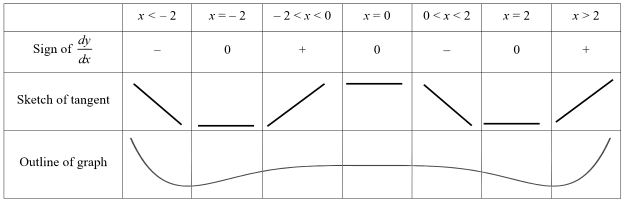

$ \displaystyle \begin{array}{l}\therefore \ \ \ \ (-2,-32)\ \operatorname{and}\ (2,-32)\ \text{are minimum turning} \\\ \ \ \ \ \ \text{ points and}\ (0,0)\ \text{is maximum turning point.}\end{array}$


14. (a) Show that the tangent to the curve $ \displaystyle y=e^{-2x}-3x$ at the point $ \displaystyle (a,0)$ meets the $ \displaystyle y$-axis at the point whose $ \displaystyle y$-coordinate is $ \displaystyle 2ae^{-2a} +3a.$
(5 marks)

Show/Hide Solution
$ \displaystyle \begin{array}{l}\ \ \ \ \ y={{e}^{{-2x}}}-3x\\\\\ \ \ \ \ \frac{{dy}}{{dx}}=-2{{e}^{{-2x}}}-3\\\\\ \ \ \ \ \text{At}\ (a,0),\ \frac{{dy}}{{dx}}=-2{{e}^{{-2a}}}-3\\\\\therefore \ \ \ \text{Equation of tangent at}\ (a,0)\ \text{is}\\\\\ \ \ \ \ y-0=\left( {-2{{e}^{{-2a}}}-3} \right)(x-a)\\\\\therefore \ \ \ y=\left( {-2{{e}^{{-2a}}}-3} \right)(x-a)\\\\\ \ \ \ \ \text{When the tangent meets the y-axis},\ x=0.\\\\\therefore \ \ \ y=\left( {-2{{e}^{{-2a}}}-3} \right)(0-a)=2a{{e}^{{-2a}}}+3a\\\\\therefore \ \ \ \text{The tangent to the curve}\ \text{meets the y-axis}\\\ \ \ \ \ \text{at the point whose}\ \text{y}\ \text{oordinate is}\ 2a{{e}^{{-2a}}}+3a.\\\end{array}$


     (b) Points $ \displaystyle A$ and $ \displaystyle B$ have position vectors $ \displaystyle {\vec{a}}$ and $ \displaystyle {\vec{b}}$ respectively, relative to an origin $ \displaystyle O.$ The point $ \displaystyle C$ lies on $ \displaystyle OA$ produced such that $ \displaystyle OC = 3OA,$ and $ \displaystyle D$ lies on $ \displaystyle OB$ such that $ \displaystyle OD = \frac {1}{4}OB.$ Express $ \displaystyle \overrightarrow{{AB}}$ and $ \displaystyle \overrightarrow{{CD}}$ in terms of $ \displaystyle {\vec{a}}$ and $ \displaystyle {\vec{b}}$. The line segments $ \displaystyle AB$ and $ \displaystyle CD$ intersect at $ \displaystyle P.$ If $ \displaystyle CP = hCD$ and $ \displaystyle AP = kAB,$ calculate the values of $ \displaystyle h$ and $ \displaystyle k.$
(5 marks)

Show/Hide Solution

$ \displaystyle \begin{array}{l}\ \ \ \ \ \overrightarrow{{OA}}=\vec{a},\ \ \overrightarrow{{OB}}=\vec{b}\\\\\ \ \ \ \ OC=\text{ }3OA\ \operatorname{and}\ O,A\ \operatorname{and}\ C\ \text{are collinear}.\\\\\therefore \ \ \ \overrightarrow{{OC}}=3\vec{a}\ \operatorname{and}\ \overrightarrow{{AC}}=2\vec{a}\\\\\ \ \ \ \ \text{Similarly,}\ OD=\text{ }\displaystyle \frac{1}{4}OB\operatorname{and}\ O,D,B\ \text{are collinear}.\\\\\therefore \ \ \ \overrightarrow{{OD}}=\displaystyle \frac{1}{4}\vec{b}\ \operatorname{and}\ \ \overrightarrow{{DB}}=\displaystyle \frac{3}{4}\vec{b}.\\\\\therefore \ \ \ \overrightarrow{{AB}}=\overrightarrow{{OB}}-\overrightarrow{{OA}}=\vec{b}-\vec{a}\\\\\therefore \ \ \ \overrightarrow{{CD}}=\overrightarrow{{OD}}-\overrightarrow{{OC}}=\displaystyle \frac{1}{4}\vec{b}-3\vec{a}\\\\\ \ \ \ \ \text{Since }CP\text{ = }hCD\ \text{and }C\text{, }P\text{ and }D\ \text{are collinear,}\\\\\ \ \ \ \ \overrightarrow{{CP}}=h\overrightarrow{{CD}}=\displaystyle \frac{h}{4}\vec{b}-3h\vec{a}\\\\\ \ \ \ \ \text{Similarly, }AP\text{ = }kAB\text{, }A\text{, }P\text{ and }P\text{ are collinear,}\\\\\therefore \ \ \ \overrightarrow{{AP}}=k\overrightarrow{{AB}}=k\vec{b}-k\vec{a}\\\\\ \ \ \ \ \text{Since}\ \overrightarrow{{AP}}=\overrightarrow{{AC}}+\overrightarrow{{CP}},\\\\\therefore \ \ \ \overrightarrow{{AC}}+\overrightarrow{{CP}}=k\vec{b}-k\vec{a}\\\\\therefore \ \ \ 2\vec{a}+\displaystyle \frac{h}{4}\vec{b}-3h\vec{a}\ =k\vec{b}-k\vec{a}\\\\\therefore \ \ \ \displaystyle \frac{h}{4}\vec{b}+(2-3h)\vec{a}\ =k\vec{b}-k\vec{a}\\\\\therefore \ \ \ \displaystyle \frac{h}{4}=k\Rightarrow h=4k\\\ \\\ \ \ \ \ 2-3h=-k\Rightarrow 2-12k=-k\\\\\therefore \ \ \ 11k=2\Rightarrow k=\displaystyle \frac{2}{{11}}\\\\\therefore \ \ \ h=\displaystyle \frac{8}{{11}}\end{array}$


الخميس، 24 يناير 2019

Sample Math Paper (2) - Section (B) Solution

ဒီေနရာမွာ တင္ေပးလိုက္တဲ့ ေမးခြန္းရဲ့ section (B) အေျဖျဖစ္ပါတယ္။


Section (B)

6.  (a) Given that $ \displaystyle f(x) =2x^2-1$ and $ \displaystyle g(x) = \cos x$ where $ \displaystyle x\in A=\{x|0\le x\le \frac{\pi}{2}\}.$ Solve the equation $ \displaystyle (f∘g)(x)=0,$ where $ \displaystyle x\in A.$
(5 marks)

Show/Hide Solution
$ \displaystyle \begin{array}{l}\ \ \ \ \ \ \ f(x)=2{{x}^{2}}-1,g(x)=\cos x\\\\\ \ \ \ \ \ \ (f\circ g)(x)=f\left( {g(x)} \right)\\\\\ \ \ \ \ \ \ \ \ \ \ \ \ \ \ \ \ \ \ \ \ \ \ \ =f(\cos x)\\\\\ \ \ \ \ \ \ \ \ \ \ \ \ \ \ \ \ \ \ \ \ \ \ \ =2{{\cos }^{2}}x-1\\\\\ \ \ \ \ \ \ \ (f\circ g)(x)=0\\\\\ \ \ \ \ \ \ \ 2{{\cos }^{2}}x-1=0\\\\\ \ \ \ \ \ \ \ \cos 2x=0\\\\\ \therefore \ \ \ \ \ 2x=\displaystyle \frac{\pi }{2}\ \ \text{(or)}\ 2x=\displaystyle \frac{{3\pi }}{2}\\\\\therefore \ \ \ \ \ \ x=\displaystyle \frac{\pi }{4}\ \text{(or)}\ x=\displaystyle \frac{{3\pi }}{4}>\displaystyle \frac{\pi }{2}\ \text{(reject)}\\\\\therefore \ \ \ \ \ \ x=\displaystyle \frac{\pi }{4}\ \end{array}$


     (b) The curve of the polynomial $ \displaystyle f(x)=-x^3+2x^2+ax-10$ cuts the $ \displaystyle x$-axis at $ \displaystyle x=p, x=2$ and $ \displaystyle x=q.$ Find the value of $ \displaystyle p$ and $ \displaystyle q.$ Hence show that $ \displaystyle a=5.$
(5 marks)

Show/Hide Solution
$ \displaystyle \begin{array}{l}\ \ \ \ \ \ f(x)=-{{x}^{3}}+2{{x}^{2}}+ax-10\\\\\ \ \ \ \ \ \text{Since the graph of }f(x)\text{ cuts the x-axis at }x=p\text{, }x=2\text{ and }x=q\text{,}\\\\\ \ \ \ \ \ x-p,x-2\ \operatorname{and}\ x-q\ \text{are factors of }f(x).\\\\\ \ \ \ \ \ \text{Since the coefficient of }{{x}^{3}}\ \text{is }-1,\\\\\ \ \ \ \ f(x)=-(x-p)(x-q)(x-2)\\\\\therefore \ \ \ \ f(x)=-\left( {{{x}^{2}}-(p+q)x+pq} \right)(x-2)\\\\\therefore \ \ \ \ f(x)=-\left( {{{x}^{3}}-(p+q){{x}^{2}}+pqx-2{{x}^{2}}+2(p+q)x-2pq} \right)\\\\\therefore \ \ \ \ f(x)=-{{x}^{3}}+(p+q){{x}^{2}}-pqx+2{{x}^{2}}-2(p+q)x+2pq\\\\\therefore \ \ \ \ f(x)=-{{x}^{3}}+(p+q+2){{x}^{2}}-(2p+2q+pq)x+2pq\\\\\therefore \ \ \ \ -{{x}^{3}}+2{{x}^{2}}+ax-10=-{{x}^{3}}+(p+q+2){{x}^{2}}-(2p+2q+pq)x+2pq\\\\\therefore \ \ \ \ 2pq=-10\Rightarrow pq=-5\Rightarrow q=-\displaystyle \frac{5}{p}\\\\\therefore \ \ \ \ p+q+2=2\Rightarrow p+q=0\\\\\therefore \ \ \ \ p-\displaystyle \frac{5}{p}=0\Rightarrow {{p}^{2}}=5\Rightarrow p=\sqrt{5}\\\\\therefore \ \ \ \ q=-\displaystyle \frac{5}{{\sqrt{5}}}=-\sqrt{5}\\\\\therefore \ \ \ \ a=-(2p+2q+pq)=-(2\sqrt{5}-2\sqrt{5}-5)=5\end{array}$


7.  (a) If $ \displaystyle f(x+y,x-y)=xy$ where $ \displaystyle x,y\in R$, show that $ \displaystyle f(x,y)+f(y,x) =0$.
(5 marks)

Show/Hide Solution
$ \displaystyle \begin{array}{*{20}{l}} \begin{array}{l}\ \ \ \ \ \ \ \ f(x+y,x-y)=xy\\\end{array} \\\\ \begin{array}{l}\ \ \ \ \ \ \ \ \text{Let }x+y=a\ \ \operatorname{and}x-y=b\\\end{array} \\\\ \begin{array}{l}\therefore \ \ \ \ \ \ \ 2x=a+b\Rightarrow x=\displaystyle \frac{{a+b}}{2}\\\end{array} \\\\ \begin{array}{l}\ \ \ \ \ \ \ \ \ 2y=a-b\Rightarrow y=\displaystyle \frac{{a-b}}{2}\\\end{array} \\\\ \begin{array}{l}\therefore \ \ \ \ \ \ f(a,b)=\displaystyle \frac{{a+b}}{2}\times \displaystyle \frac{{a-b}}{2}=\displaystyle \frac{{{{a}^{2}}-{{b}^{2}}}}{4}\\\end{array} \\\\ \begin{array}{l}\therefore \ \ \ \ \ \ f(x,y)=\displaystyle \frac{{{{x}^{2}}-{{y}^{2}}}}{4}\\\end{array} \\\\ \begin{array}{l}\therefore \ \ \ \ \ \ f(y,x)=\displaystyle \frac{{{{y}^{2}}-{{x}^{2}}}}{4}\\\end{array} \\\\ {\therefore \ \ \ \ \ \ f(x,y)+f(y,x)=\displaystyle \frac{{{{x}^{2}}-{{y}^{2}}}}{4}+\displaystyle \frac{{{{y}^{2}}-{{x}^{2}}}}{4}=0} \end{array}$


     (b) If the coefficients of $ \displaystyle (2p + 4)^{\text{th}}$ and $ \displaystyle (p - 2)^{\text{th}}$ terms in the expansion of $ \displaystyle (1 + x)^{18}$ are equal, find the value of $ \displaystyle p.$
(5 marks)

Show/Hide Solution
$ \displaystyle \begin{array}{l}\ \ \ \ \ \ \ {{(r+1)}^{{\text{th}}}}\text{ term in the expansion of}\ {{(1+x)}^{{18}}}\\\\\ \ \ \ \ \ ={}^{{18}}{{C}_{r}}{{x}^{r}}\\\\\therefore \ \ \ \ {{(2p+4)}^{{\text{th}}}}\ \text{term}={{(2p+3+1)}^{{\text{th}}}}\ \text{term}={}^{{18}}{{C}_{{2p+3}}}{{x}^{{2p+3}}}\\\\\ \ \ \ \ \ {{(p-2)}^{{\text{th}}}}\ \text{term}={{(p-3+1)}^{{\text{th}}}}\ \text{term}={}^{{18}}{{C}_{{p-3}}}{{x}^{{r-3}}}\\\\\ \ \ \ \ \ \text{By the problem, }\\\\\ \ \ \ \ \ \text{coefficient of}\ {{(2p+4)}^{{\text{th}}}}\ \text{term}=\text{coefficient of}\ {{(r-2)}^{{\text{th}}}}\ \text{term}\\\\\therefore \ \ \ \ {}^{{18}}{{C}_{{2p+3}}}={}^{{18}}{{C}_{{p-3}}}\ \text{(or)}{}^{{18}}{{C}_{{2p+3}}}={}^{{18}}{{C}_{{18-(p-3)}}}\ \left[ {\because {}^{n}{{C}_{r}}={}^{n}{{C}_{{n-r}}}} \right]\\\\\therefore \ \ \ \ 2p+3=p-3\ \text{(or)}\ 2p+3=18-(p-3)\\\\\therefore \ \ \ \ p=-6\ \ \text{(or)}\ p=6\\\\\ \ \ \ \ \ \text{Since}\ p>0,p=6\end{array}$


8.  (a) Find the solution set of the in equation $ \displaystyle 3(x-\frac{3}{2})^2>2x^2-4x+\frac{3}{4}$ and illustrate it on the number line.
(5 marks)

Show/Hide Solution
$ \displaystyle \begin{array}{l}\ \ \ \ \ \ \ 3{{\left( {x-\displaystyle \frac{3}{2}} \right)}^{2}}>2{{x}^{2}}-4x+\displaystyle \frac{3}{4}\\\\\ \ \ \ \ \ \ 3\left( {{{x}^{2}}-3x+\displaystyle \frac{9}{4}} \right)>2{{x}^{2}}-4x+\displaystyle \frac{3}{4}\\\\\ \ \ \ \ \ \ 3{{x}^{2}}-9x+\displaystyle \frac{{27}}{4}>2{{x}^{2}}-4x+\displaystyle \frac{3}{4}\\\\\ \ \ \ \ \ \ 3{{x}^{2}}-9x+\displaystyle \frac{{27}}{4}-2{{x}^{2}}+4x-\displaystyle \frac{3}{4}>0\\\\\ \ \ \ \ \ \ {{x}^{2}}-5x+6>0\\\\\ \ \ \ \ \ \ \text{Let}\ y={{x}^{2}}-5x+6.\\\\\ \ \ \ \ \ \ \text{When}\ y=0,{{x}^{2}}-5x+6=0\ \\\\\therefore \ \ \ \ \ (x-2)(x-3)=0\\\\\therefore \ \ \ \ \ x=2\ (\text{or})\ x=3\\\\\therefore \ \ \ \ \ \text{The graph cuts the x-axis at (2,0) and (3,0)}\text{.}\\\\\ \ \ \ \ \ \ \text{When}\ x=0,y=6\ \\\\\therefore \ \ \ \ \ \text{The graph cuts the y-axis at (0,6)}\text{.}\end{array}$


$ \displaystyle \begin{array}{*{20}{l}} {\therefore \ \ \ \ \ \text{Solution set}=\left\{ {x\ |\ x<2\ \text{(or)}\ x>3} \right\}} \\ \begin{array}{l}\\\ \ \ \ \ \ \text{Number line}\end{array} \end{array}$


     (b) Find three numbers in A.P. whose sum is $ \displaystyle 21$ and whose product is $ \displaystyle 315.$
(5 marks)

Show/Hide Solution
$ \displaystyle \begin{array}{l}\ \ \ \ \ \ \ \text{Let the three numbers in A}\text{.P}\text{. be}\\\ \ \ \ \ \ \ a,a+d\ \operatorname{and}\ a+2d.\\\\\ \ \ \ \ \ \ \text{By the problem,}\\\\\ \ \ \ \ \ \ a+a+d\ +\ a+2d=21\\\\\therefore \ \ \ \ \ a+d=7\ \ \ \ \ \ \ \ \ -------(1)\\\\\ \ \ \ \ \ \ a(a+d)(a+2d)=315\\\\\ \ \ \ \ \ \ 7a(7+d)=315\ \ \ \ \left[ {\because a+d=7} \right]\\\\\therefore \ \ \ \ \ a=\displaystyle \frac{{45}}{{7+d}}\ \ \ \ \ \ \ \ -------(2)\\\\\therefore \ \ \ \ \ \displaystyle \frac{{45}}{{7+d}}+d=7\\\ \\\therefore \ \ \ \ \ {{d}^{2}}=4\Rightarrow d=\pm 2\\\\\ \ \ \ \ \ \text{When}\ d=-2,a=9\\\\\ \ \ \ \ \ \text{When}\ d=2,a=5\\\\\therefore \ \ \ \ \text{The numbers are}\ 5,7\ \operatorname{and}\ 9.\end{array}$


9.  (a) If $ \displaystyle S_1, S_2,$ and $ \displaystyle S_3$ are the sums of $ \displaystyle n, 2n$ and $ \displaystyle 3n$ terms of a G.P., show that $ \displaystyle S_1(S_3- S_2) = (S_2-S_1)^2.$
(5 marks)

Show/Hide Solution
$ \displaystyle \begin{array}{l}\ \ \ \ \ \ \ \text{Let the first term and the common ratio }\\\ \ \ \ \ \ \ \text{of given G}\text{.P}\text{. be }a\text{ and }r\text{ respectively}\text{.}\\\\\ \ \ \ \ \ \ \text{By the problem,}\\\\\ \ \ \ \ \ {{S}_{1}}={{S}_{n}}=\displaystyle \frac{{a(1-{{r}^{n}})}}{{1-r}}\\\\\ \ \ \ \ \ {{S}_{2}}={{S}_{{2n}}}=\displaystyle \frac{{a(1-{{r}^{{2n}}})}}{{1-r}}\\\\\ \ \ \ \ \ {{S}_{3}}={{S}_{{3n}}}=\displaystyle \frac{{a(1-{{r}^{{3n}}})}}{{1-r}}\\\\\therefore \ \ \ \ {{S}_{3}}-{{S}_{2}}=\displaystyle \frac{a}{{1-r}}\left( {1-{{r}^{{3n}}}-1+{{r}^{{2n}}}} \right)\\\\\therefore \ \ \ \ {{S}_{3}}-{{S}_{2}}=\displaystyle \frac{a}{{1-r}}\left( {{{r}^{{2n}}}-{{r}^{{3n}}}} \right)\\\\\therefore \ \ \ \ {{S}_{1}}\left( {{{S}_{3}}-{{S}_{2}}} \right)=\displaystyle \frac{{a(1-{{r}^{n}})}}{{1-r}}\times \displaystyle \frac{a}{{1-r}}\left( {{{r}^{{2n}}}-{{r}^{{3n}}}} \right)\\\\\therefore \ \ \ \ {{S}_{1}}\left( {{{S}_{3}}-{{S}_{2}}} \right)=\displaystyle \frac{{{{a}^{2}}}}{{{{{\left( {1-r} \right)}}^{2}}}}\left( {{{r}^{{2n}}}-{{r}^{{3n}}}-{{r}^{{3n}}}+{{r}^{{4n}}}} \right)\\\\\therefore \ \ \ \ {{S}_{1}}\left( {{{S}_{3}}-{{S}_{2}}} \right)=\displaystyle \frac{{{{a}^{2}}}}{{{{{\left( {1-r} \right)}}^{2}}}}\left( {{{r}^{{2n}}}-2{{r}^{{3n}}}+{{r}^{{4n}}}} \right)---(1)\\\\\ \ \ \ \ \ {{S}_{2}}-{{S}_{1}}=\displaystyle \frac{a}{{1-r}}\left( {1-{{r}^{{2n}}}-1+{{r}^{n}}} \right)\\\\\therefore \ \ \ \ {{S}_{2}}-{{S}_{1}}=\displaystyle \frac{a}{{1-r}}\left( {{{r}^{n}}-{{r}^{{2n}}}} \right)\\\\\therefore \ \ \ \ {{\left( {{{S}_{2}}-{{S}_{1}}} \right)}^{2}}=\displaystyle \frac{{{{a}^{2}}}}{{{{{\left( {1-r} \right)}}^{2}}}}{{\left( {{{r}^{n}}-{{r}^{{2n}}}} \right)}^{2}}\\\\\therefore \ \ \ \ {{\left( {{{S}_{2}}-{{S}_{1}}} \right)}^{2}}=\displaystyle \frac{{{{a}^{2}}}}{{{{{\left( {1-r} \right)}}^{2}}}}\left( {{{r}^{{2n}}}-2{{r}^{{3n}}}+{{r}^{{4n}}}} \right)---(2)\\\\\therefore \ \ \ \ \text{By}\ (1)\ \operatorname{and}\ (2),\\\\\ \ \ \ \ \ {{S}_{1}}\left( {{{S}_{3}}-{{S}_{2}}} \right)={{\left( {{{S}_{2}}-{{S}_{1}}} \right)}^{2}}\end{array}$


     (b) Given that $ \displaystyle A=\left( {\begin{array}{*{20}{c}} {\cos \theta } & {-\sin \theta } \\ {\sin \theta } & {\cos \theta } \end{array}} \right).$ If $ \displaystyle A + A' = I$ where $ \displaystyle I$ is a unit matrix of order $ \displaystyle 2,$ find the value of $ \displaystyle \theta$ for $ \displaystyle 0°<\theta< 90°.$
(5 marks)

Show/Hide Solution
$ \displaystyle \begin{array}{l}\ \ \ \ \ A=\displaystyle \left( {\begin{array}{*{20}{c}} {\cos \theta } & {-\sin \theta } \\ {\sin \theta } & {\cos \theta } \end{array}} \right)\\\\\therefore \ \ \ {A}'=\displaystyle \left( {\begin{array}{*{20}{c}} {\cos \theta } & {\sin \theta } \\ {-\sin \theta } & {\cos \theta } \end{array}} \right)\\\\\ \ \ \ \ \text{By the problem,}\\\\\ \ \ \ \ A+{A}'=I\\\\\therefore \ \ \ \displaystyle \left( {\begin{array}{*{20}{c}} {\cos \theta } & {-\sin \theta } \\ {\sin \theta } & {\cos \theta } \end{array}} \right)+\displaystyle \left( {\begin{array}{*{20}{c}} {\cos \theta } & {\sin \theta } \\ {-\sin \theta } & {\cos \theta } \end{array}} \right)=\displaystyle \left( {\begin{array}{*{20}{c}} 1 & 0 \\ 0 & 1 \end{array}} \right)\\\\\therefore \ \ \ \displaystyle \left( {\begin{array}{*{20}{c}} {2\cos \theta } & 0 \\ 0 & {2\cos \theta } \end{array}} \right)=\displaystyle \left( {\begin{array}{*{20}{c}} 1 & 0 \\ 0 & 1 \end{array}} \right)\\\\\therefore \ \ \ 2\cos \theta =1\Rightarrow \cos \theta =\displaystyle \frac{1}{2}\\\\\therefore \ \ \ \theta =60{}^\circ \end{array}$


10. (a) Given that $ \displaystyle A=\left( {\begin{array}{*{20}{c}} {\cos \theta } & {-\sin \theta } \\ {\sin \theta } & {\cos \theta } \end{array}} \right).$ Determine whether $\displaystyle {{A}^{{-1}}}$ exists or not, if exists find $\displaystyle {{A}^{{-1}}}.$ Hence solve the system of equations $\displaystyle x\cos \theta -y\sin \theta =2$ and $\displaystyle x\sin \theta +y\cos \theta =2\sqrt{3}$ when $\displaystyle \theta=30°.$
(5 marks)

Show/Hide Solution
$ \displaystyle \begin{array}{l}\ \ \ \ \ A=\displaystyle \left( {\begin{array}{*{20}{c}} {\cos \theta } & {-\sin \theta } \\ {\sin \theta } & {\cos \theta } \end{array}} \right)\\\\\therefore \ \ \ \det A={{\cos }^{2}}\theta +{{\sin }^{2}}\theta =1\ne 0\\\\\therefore \ \ \ {{A}^{{-1}}}\ \text{exists}.\\\\\therefore \ \ \ {{A}^{{-1}}}=\displaystyle \left( {\begin{array}{*{20}{c}} {\cos \theta } & {\sin \theta } \\ {-\sin \theta } & {\cos \theta } \end{array}} \right)\\\\\ \ \ \ \ \displaystyle \left. \begin{array}{l}x\cos \theta -y\sin \theta =2\\x\sin \theta +y\cos \theta =2\sqrt{3}\end{array} \right\}-------(1)\\\\\ \ \ \ \ \text{Transforming into matrix form},\\\\\ \ \ \ \ \displaystyle \left( {\begin{array}{*{20}{c}} {\cos \theta } & {-\sin \theta } \\ {\sin \theta } & {\cos \theta } \end{array}} \right)\displaystyle \left( {\begin{array}{*{20}{c}} x \\ y \end{array}} \right)=\displaystyle \left( {\begin{array}{*{20}{c}} 2 \\ {2\sqrt{3}} \end{array}} \right)---(2)\\\\\ \ \ \ \ \text{Let}\ X=\displaystyle \left( {\begin{array}{*{20}{c}} x \\ y \end{array}} \right)\operatorname{and}\ B=\displaystyle \left( {\begin{array}{*{20}{c}} 2 \\ {2\sqrt{3}} \end{array}} \right).\\\\\ \ \ \ \ \text{Equation (2) becomes,}\ AX=B.\\\\\therefore \ \ \ {{A}^{{-1}}}AX={{A}^{{-1}}}B\\\\\therefore \ \ \ IX={{A}^{{-1}}}B\\\\\therefore \ \ \ X={{A}^{{-1}}}B\\\\\therefore \ \ \ X=\displaystyle \left( {\begin{array}{*{20}{c}} {\cos \theta } & {\sin \theta } \\ {-\sin \theta } & {\cos \theta } \end{array}} \right)\displaystyle \left( {\begin{array}{*{20}{c}} 2 \\ {2\sqrt{3}} \end{array}} \right)\\\\\ \ \ \ \ \text{When}\ \theta =30{}^\circ ,\\\\\ \ \ \ \ X=\displaystyle \left( {\begin{array}{*{20}{c}} {\cos 30{}^\circ } & {\sin 30{}^\circ } \\ {-\sin 30{}^\circ } & {\cos 30{}^\circ } \end{array}} \right)\displaystyle \left( {\begin{array}{*{20}{c}} 2 \\ {2\sqrt{3}} \end{array}} \right)\\\\\ \ \ \ \ X=\displaystyle \left( {\begin{array}{*{20}{c}} {\displaystyle \frac{{\sqrt{3}}}{2}} & {\displaystyle \frac{1}{2}} \\ {-\displaystyle \frac{1}{2}} & {\displaystyle \frac{{\sqrt{3}}}{2}} \end{array}} \right)\displaystyle \left( {\begin{array}{*{20}{c}} 2 \\ {2\sqrt{3}} \end{array}} \right)\\\\\therefore \ \ \ X=\displaystyle \left( {\begin{array}{*{20}{c}} {\displaystyle \frac{{2\sqrt{3}}}{2}+\displaystyle \frac{{2\sqrt{3}}}{2}} \\ {-1+3} \end{array}} \right)\\\\\therefore \ \ \ \displaystyle \left( {\begin{array}{*{20}{c}} x \\ y \end{array}} \right)=\displaystyle \left( {\begin{array}{*{20}{c}} {2\sqrt{3}} \\ 2 \end{array}} \right)\Rightarrow x=2\sqrt{3},y=2.\end{array}$


     (b) A set of cards bearing the number from $ \displaystyle 200$ to $ \displaystyle 299$ is used in a game. If a card is drawn at random, what is the probability that it is divisible by $ \displaystyle 3?$
(5 marks)

Show/Hide Solution
$ \displaystyle \begin{array}{l}\ \ \ \ \ \ \text{Set of possible outcomes}=\left\{ {200,201,202,...,299} \right\}\\\\\therefore \ \ \ \ \text{Number of possible outcomes}=100\\\\\ \ \ \ \ \ \text{The numbers between 200 and 299 }\\\ \ \ \ \ \ \text{which are divisible by 3 are}\ \\\\\ \ \ \ \ \ 201,204,205,...,297.\\\\\ \ \ \ \ \ \text{It is an A}\text{.P with }a=201\ \operatorname{and}\ d=3.\\\\\therefore \ \ \ \ {{u}_{n}}=99\\\\\therefore \ \ \ \ a+(n-1)d=297\\\\\therefore \ \ \ \ 201+(n-1)3=297\\\\\therefore \ \ \ \ n=33\\\\\therefore \ \ \ \ \text{Number of favourable outcomes}=33\\\\\therefore \ \ \ \ P(\text{a number divisible by3)}=\displaystyle \frac{{33}}{{100}}.\end{array}$


الأربعاء، 23 يناير 2019

Sample Math Paper (2) - Section (A) Solution

👉 ဒီေနရာမွာ တင္ေပးလိုက္တဲ့ ေမးခြန္းရဲ့ section (A) အေျဖျဖစ္ပါတယ္။ ဒီေမးခြန္းက ထူးခၽြန္ ေက်ာင္းသားမ်ား အတြက္ ရည္ရြယ္ပါတယ္။ ေအာင္မွတ္ အတြက္သာ လုပ္ေနရတဲ့ ေက်ာင္းသား မ်ားအတြက္ အဆင္မေျပႏိုင္ပါဘူး။ ဒါ့ေၾကာင့္ သာမန္အဆင့္ ေက်ာင္းသားမ်ားကို ေလ့က်င့္ေပးရန္ မသင့္ေလ်ာ္ေၾကာင္း အႀကံျပဳ အပ္ပါတယ္။ ရည္မွန္းထားသည့္ အတိုင္း ေပါက္ေျမာက္ ေအာင္ျမင္ ႏိုင္ၾကပါေစ။...


Section (A)

1.  (a) The function $ \displaystyle g : N \to N$ is defined as $ \displaystyle g : x\mapsto$ smallest prime factor of $ \displaystyle x.$ (i) Find values for $ \displaystyle g(10), g (20)$ and $ \displaystyle g (81).$ (ii) Does $ \displaystyle g$ have an inverse? Give reasons for your answer.
(3 marks)

Show/Hide Solution
$ \displaystyle \begin{array}{l}\ \ \ \ g:N\to N\\\\\ \ \ \ g(x)=\text{smallest prime factor of}\ x.\\\\\ \ \ \ 10=2\times 5\\\\\therefore \ \ g(10)=2\\\\\ \ \ \ 20=2\times 2\times 5\\\\\therefore \ \ g(20)=2\\\\\ \ \ \ 81=3\times 3\times 3\times 3\\\\\therefore \ \ g(81)=3\\\\\ \ \ \ \text{Since}\ g(10)=g(20),\\\\\ \ \ \ g\ \text{is not one to one correspondence}\text{.}\\\\\therefore \ \ {{g}^{{-1}}}\ \text{does not}\ \text{exists}\text{.}\end{array}$


(1)  (b) If $ \displaystyle 2x-1$ is a factor of $ \displaystyle 2x^3-x^2-8x+k,$ find $ \displaystyle k$ and the other factors.
(3 marks)

Show/Hide Solution
$ \displaystyle \begin{array}{l}\ \ \ \ \ \ \ \text{Let }f(x)=2{{x}^{3}}-{{x}^{2}}-8x+k\\\\\ \ \ \ \ \ \ 2x-1\ \text{is a factor of }f(x).\\\\\therefore \ \ \ \ \ f\left( {\displaystyle \frac{1}{2}} \right)=0\\\\\therefore \ \ \ \ \ 2{{\left( {\displaystyle \frac{1}{2}} \right)}^{3}}-{{\left( {\displaystyle \frac{1}{2}} \right)}^{2}}-8\left( {\displaystyle \frac{1}{2}} \right)+k=0\\\\\therefore \ \ \ \ \ \displaystyle \frac{1}{4}-\displaystyle \frac{1}{4}-4+k=0\\\\\therefore \ \ \ \ \ k=4\\\\\therefore \ \ \ \ \ f(x)=2{{x}^{3}}-{{x}^{2}}-8x+4\\\\\ \ \ \ \ \ \ \text{Let }f(x)=(2x-1)({{x}^{2}}+ax+b)\\\\\ \ \ \ \ \ \ \ \ \ \ \ \ \ \ \ \ \ \ \ =2{{x}^{3}}+2a{{x}^{2}}+2bx-{{x}^{2}}-ax-b\\\\\ \ \ \ \ \ \ \ \ \ \ \ \ \ \ \ \ \ \ \ =2{{x}^{3}}+(2a-1){{x}^{2}}+(2b-a)x-b\\\\\therefore \ \ \ \ \ 2a-1=-1\ \operatorname{and}\,b=-4\\\\\therefore \ \ \ \ \ a=0\ \operatorname{and}\ b=-4\\\\\therefore \ \ \ \ \ f(x)=(2x-1)({{x}^{2}}-4)=(2x-1)(x-2)(x+2)\\\\\therefore \ \ \ \ \text{The other factors are }x-2\ \text{and }x+2.\end{array}$


2.  (a) Find the term independent of $ \displaystyle x$ in the expansion of $ \displaystyle {{\left( {x-\frac{2}{{{{x}^{2}}}}} \right)}^{9}}.$
(3 marks)

Show/Hide Solution
$ \displaystyle \begin{array}{l}\ \ \ \ \ \ \ {{(r+1)}^{{\text{th}}}}\text{ term in the expansion of }\ {{\left( {x-\displaystyle \frac{2}{{{{x}^{2}}}}} \right)}^{9}}\\\\\ \ \ \ ={}^{9}{{C}_{r}}{{x}^{{9-r}}}{{\left( {-\displaystyle \frac{2}{{{{x}^{2}}}}} \right)}^{r}}\\\\\ \ \ \ ={}^{9}{{C}_{r}}{{(-2)}^{r}}{{x}^{{9-3r}}}\\\\\ \ \ \ \ \ \ \text{For the term independent of }x,\ 9-3r=0\\\\\therefore \ \ \ \ \ r=3\\\\\therefore \ \ \ \ \ \text{The term independent of }x={}^{9}{{C}_{3}}{{(-2)}^{3}}=\displaystyle \frac{{9\times 8\times 7}}{{1\times 2\times 3}}(-8)=-672\end{array}$


(2)  (b) If the sum of n terms of a certain sequence is $ \displaystyle 2n + 3n^2,$ find the $ \displaystyle {n}^{\text{th}}$ term.
(3 marks)

Show/Hide Solution
$ \displaystyle \begin{array}{l}\ \ \ \ \ \ {{S}_{n}}=2n+3{{n}^{2}}\\\\\ \ \ \ \ \ {{u}_{n}}={{S}_{n}}-{{S}_{{n-1}}}\\\\\therefore \ \ \ \ {{u}_{n}}=2n+3{{n}^{2}}-\left[ {2(n-1)+3{{{(n-1)}}^{2}}} \right]\\\\\therefore \ \ \ \ {{u}_{n}}=2n+3{{n}^{2}}-2n+2+3{{n}^{2}}+6n-3\\\\\therefore \ \ \ \ {{u}_{n}}=4n-1\end{array}$


3.  (a) If $ \displaystyle X=\left( {\begin{array}{*{20}{c}} 1 & 0 \\ 2 & 3 \end{array}} \right)$ and $ \displaystyle X-kI$ is singular, where $ \displaystyle I$ is a unit matrix of order $ \displaystyle 2,$ find $ \displaystyle k.$
(3 marks)

Show/Hide Solution
$ \displaystyle \begin{array}{l}\ \ \ \ \ X=\displaystyle \left( {\begin{array}{*{20}{c}} 1 & 0 \\ 2 & 3 \end{array}} \right)\\\\\ \ \ \ \ X-kI=\displaystyle \left( {\begin{array}{*{20}{c}} 1 & 0 \\ 2 & 3 \end{array}} \right)-k\displaystyle \left( {\begin{array}{*{20}{c}} 1 & 0 \\ 0 & 1 \end{array}} \right)=\displaystyle \left( {\begin{array}{*{20}{c}} {1-k} & 0 \\ 2 & {3-k} \end{array}} \right)\\\\\ \ \ \ \ X-kI\ \text{is singular}.\\\\\therefore \ \ \ \det (X-kI)=0\\\\\therefore \ \ \ (1-k)(3-k)=0\\\\\therefore \ \ \ k=1\ (\text{or})\ k=3\end{array}$


(3)  (b) A number $ \displaystyle x$ is chosen at random from the numbers $ \displaystyle -4, -3, -2, -1, 0, 1, 2, 3, 4.$ What is the probability that $ \displaystyle |x| \le 2?$
(3 marks)

Show/Hide Solution
$ \displaystyle \begin{array}{l}\ \ \ \ \ \ \text{Set of possible outcomes}=\left\{ {-4,-3,-2,-1,0,1,2,3,4} \right\}\\\\\therefore \ \ \ \ \text{Number of possible outcomes}=9\\\\\ \ \ \ \ \ |x|\le 2\Leftrightarrow -2\le x\le 2\\\\\therefore \ \ \ \ \text{Set of favourable outcomes}=\left\{ {-2,-1,0,1,2} \right\}\\\\\therefore \ \ \ \ \text{Number of favourable outcomes}=5\\\\\therefore \ \ \ \ P\left( {|x|\le 2} \right)=\displaystyle \frac{5}{9}\end{array}$


4.  (a) $ \displaystyle TA$ is the tangent to the circle at$ \displaystyle A, AB = BC, ∠BAC = 41°$ and $ \displaystyle ∠ACT = 46°.$ Find $ \displaystyle ∠ATC.$
(3 marks)

Show/Hide Solution
$ \displaystyle \begin{array}{l}\ \ \ \ \ \angle BAC=41{}^\circ ,\angle ACT=46{}^\circ (\text{given})\\\\\ \ \ \ \text{Since}\ AB=BC,\angle BCA=\angle BAC\\\\\therefore \ \ \angle BCA=41{}^\circ \\\\\therefore \ \ \angle ABC=180{}^\circ -(41{}^\circ +41{}^\circ )=98{}^\circ \\\\\ \ \ \ \text{Since}\ \angle CAT=\angle ABC,\angle CAT=98{}^\circ \\\\\ \ \ \ \text{In}\ \vartriangle CAT,\\\\\ \ \ \ \angle ATC=180{}^\circ -(\angle CAT+\angle ACT)\\\\\therefore \ \ \angle ATC=180{}^\circ -(98{}^\circ +46{}^\circ )=36{}^\circ \end{array}$


4.  (b) If $ \displaystyle 3\overrightarrow{{OA}}-2\overrightarrow{{OB}}-\overrightarrow{{OC}}=\vec{0},$ show that the points $ \displaystyle A, B$ and $ \displaystyle C$ are collinear.
(3 marks)

Show/Hide Solution
$ \displaystyle \begin{array}{l}\ \ \ \ \ 3\overrightarrow{{OA}}-2\overrightarrow{{OB}}-\overrightarrow{{OC}}=\vec{0}\\\\\therefore \ \ \ 2\overrightarrow{{OA}}-2\overrightarrow{{OB}}+\overrightarrow{{OA}}-\overrightarrow{{OC}}=\vec{0}\\\\\therefore \ \ \ 2\left( {\overrightarrow{{OA}}-\overrightarrow{{OB}}} \right)+\left( {\overrightarrow{{OA}}-\overrightarrow{{OC}}} \right)=\vec{0}\\\\\therefore \ \ \ 2\overrightarrow{{BA}}+\overrightarrow{{CA}}=\vec{0}\\\\\therefore \ \ \ 2\overrightarrow{{BA}}=-\overrightarrow{{CA}}\\\\\therefore \ \ \ 2\overrightarrow{{BA}}=\overrightarrow{{AC}}\\\\\therefore \ \ \ A,B\ \operatorname{and}\ C\ \text{are collinear}\text{.}\end{array}$


5.  (a) If $\displaystyle \tan \alpha =x+1$ and $ \displaystyle \tan \beta =x-1$, find $ \displaystyle \cot (\alpha -\beta )$ in terms of $ \displaystyle x.$
(3 marks)

Show/Hide Solution
$ \displaystyle \begin{array}{l}\ \ \ \ \ \ \tan \ \alpha =x+1,\ \tan \beta =x-1\\\\\therefore \ \ \ \ \tan (\alpha -\beta )=\displaystyle \frac{{\tan \ \alpha -\tan \beta }}{{1+\tan \ \alpha \tan \beta }}\\\\\therefore \ \ \ \ \tan (\alpha -\beta )=\displaystyle \frac{{x+1-x+1}}{{1+(x+1)(x-1)}}\\\\\therefore \ \ \ \ \tan (\alpha -\beta )=\displaystyle \frac{2}{{1+({{x}^{2}}-1)}}=\displaystyle \frac{2}{{{{x}^{2}}}}\\\\\therefore \ \ \ \ \cot (\alpha -\beta )=\displaystyle \frac{1}{{\tan (\alpha -\beta )}}=\displaystyle \frac{{{{x}^{2}}}}{2}\end{array}$


5.  (b) Evaluate $ \displaystyle \underset{{x\to 1}}{\mathop{{\lim }}}\,\frac{{(2x-3)(\sqrt{x}-1)}}{{2{{x}^{2}}+x-3}}$ and $ \displaystyle \underset{{x\to 0}}{\mathop{{\lim }}}\,\frac{{3{{{\sin }}^{2}}x-2\sin {{x}^{2}}}}{{3{{x}^{2}}}}.$
(3 marks)

Show/Hide Solution
$ \displaystyle \begin{array}{l}\ \ \ \ \ \ \ \underset{{x\to 1}}{\mathop{{\lim }}}\,\displaystyle \frac{{(2x-3)(\sqrt{x}-1)}}{{2{{x}^{2}}+x-3}}\\\\\ \ \ \ =\underset{{x\to 1}}{\mathop{{\lim }}}\,\displaystyle \frac{{(2x-3)(\sqrt{x}-1)}}{{(2x+3)(x-1)}}\\\\\ \ \ \ =\underset{{x\to 1}}{\mathop{{\lim }}}\,\displaystyle \frac{{(2x-3)(\sqrt{x}-1)}}{{(2x+3)(\sqrt{x}-1)(\sqrt{x}+1)}}\\\\\ \ \ \ =\underset{{x\to 1}}{\mathop{{\lim }}}\,\displaystyle \frac{{(2x-3)}}{{(2x+3)(\sqrt{x}+1)}}\\\\\ \ \ \ =\displaystyle \frac{{2-3}}{{(2+3)(1+1)}}\\\\\ \ \ \ =-\displaystyle \frac{1}{{10}}\\\\\\\ \ \ \ \ \ \ \underset{{x\to 0}}{\mathop{{\lim }}}\,\displaystyle \frac{{3{{{\sin }}^{2}}x-2\sin {{x}^{2}}}}{{3{{x}^{2}}}}\\\\\ \ \ \ =\underset{{x\to 0}}{\mathop{{\lim }}}\,\left[ {\displaystyle \frac{{{{{\sin }}^{2}}x}}{{{{x}^{2}}}}-\displaystyle \frac{2}{3}\cdot \displaystyle \frac{{\sin {{x}^{2}}}}{{{{x}^{2}}}}} \right]\\\\\ \ \ \ =\underset{{x\to 0}}{\mathop{{\lim }}}\,\left[ {{{{\left( {\displaystyle \frac{{\sin x}}{x}} \right)}}^{2}}-\displaystyle \frac{2}{3}\cdot \displaystyle \frac{{\sin {{x}^{2}}}}{{{{x}^{2}}}}} \right]\\\\\ \ \ \ =1-\displaystyle \frac{2}{3}\\\\\ \ \ \ =\displaystyle \frac{1}{3}\end{array}$


က်န္ေသာ အေျဖမ်ားကို ဆက္လက္ တင္ေပးသြားပါ့မယ္။


Sample Math Paper - Set (2) - for 2019 Matriculation Examination


2019 Matriculation Examination
Sample Paper (2)
Mathematics                              Time allowed : 3 hours
WRITE YOUR ANSWER IN THE ANSWER BOOKLET.
Section (A)
Answer ALL Questions.

1.  (a) The function $ \displaystyle g : N \to N$ is defined as $ \displaystyle g : x\mapsto$ smallest prime factor of $ \displaystyle x.$ (i) Find values for $ \displaystyle g(10), g (20)$ and $ \displaystyle g (81).$ (ii) Does $ \displaystyle g$ have an inverse? Give reasons for your answer.
(3 marks)

     (b) If $ \displaystyle 2x-1$ is a factor of $ \displaystyle 2x^3-x^2-8x+k,$ find $ \displaystyle k$ and the other factors.
(3 marks)

2.  (a) Find the term independent of $ \displaystyle x$ in the expansion of $ \displaystyle {{\left( {x-\frac{2}{{{{x}^{2}}}}} \right)}^{9}}.$
(3 marks)

     (b) If the sum of n terms of a certain sequence is $ \displaystyle 2n + 3n^2,$ find the $ \displaystyle {n}^{\text{th}}$ term.
(3 marks)

3.  (a) If $ \displaystyle X=\left( {\begin{array}{*{20}{c}} 1 & 0 \\ 2 & 3 \end{array}} \right)$ and $ \displaystyle X-kI$ is singular, where $ \displaystyle I$ is a unit matrix of order $ \displaystyle 2,$ find $ \displaystyle k.$
(3 marks)

     (b) A number $ \displaystyle x$ is chosen at random from the numbers $ \displaystyle -4, -3, -2, -1, 0, 1, 2, 3, 4.$ What is the probability that $ \displaystyle |x| \le 2?$
(3 marks)

4.  (a) $ \displaystyle TA$ is the tangent to the circle at$ \displaystyle A, AB = BC, ∠BAC = 41°$ and $ \displaystyle ∠ACT = 46°.$ Find $ \displaystyle ∠ATC.$
(3 marks)

     (b) If $ \displaystyle 3\overrightarrow{{OA}}-2\overrightarrow{{OB}}-\overrightarrow{{OC}}=\vec{0},$ show that the points $ \displaystyle A, B$ and $ \displaystyle C$ are collinear.
(3 marks)

5.  (a) If $\displaystyle \tan \alpha =x+1$ and $ \displaystyle \tan \beta =x-1$, find $ \displaystyle \cot (\alpha -\beta )$ in terms of $ \displaystyle x.$
(3 marks)

     (b) Evaluate $ \displaystyle \underset{{x\to 1}}{\mathop{{\lim }}}\,\frac{{(2x-3)(\sqrt{x}-1)}}{{2{{x}^{2}}+x-3}}$ and $ \displaystyle \underset{{x\to 0}}{\mathop{{\lim }}}\,\frac{{3{{{\sin }}^{2}}x-2\sin {{x}^{2}}}}{{3{{x}^{2}}}}.$
(3 marks)

Section (B)
Answer any FOUR Questions.

6.  (a) Given that $ \displaystyle f(x) =2x^2-1$ and $ \displaystyle g(x) = \cos x$ where $ \displaystyle x\in A=\{x|0\le x\le \frac{\pi}{2}\}.$ Solve the equation $ \displaystyle (f∘g)(x)=0,$ where $ \displaystyle x\in A.$
(5 marks)

     (b) The curve of the polynomial $ \displaystyle f(x)=-x^3+2x^2+ax-10$ cuts the $ \displaystyle x$-axis at $ \displaystyle x=p, x=2$ and $ \displaystyle x=q$. Find the value of $ \displaystyle p$ and $ \displaystyle q.$ Hence show that $ \displaystyle a=5.$
(5 marks)

7.  (a) If $ \displaystyle f(x+y,x-y)=xy$ where $ \displaystyle x,y\in R$, show that $ \displaystyle f(x,y)+f(y,x) =0$.
(5 marks)

     (b) If the coefficients of $ \displaystyle (2p + 4)^{\text{th}}$ and $ \displaystyle (p - 2)^{\text{th}}$ terms in the expansion of $ \displaystyle (1 + x)^{18}$ are equal, find the value of $ \displaystyle p.$
(5 marks)

8.  (a) Find the solution set of the inequation $ \displaystyle 3(x-\frac{3}{2})^2>2x^2-4x+\frac{3}{4}$ and illustrate it on the number line.
(5 marks)

     (b) Find three numbers in A.P. whose sum is $ \displaystyle 21$ and whose product is $ \displaystyle 315.$
(5 marks)

9.  (a) If $ \displaystyle S_1, S_2,$ and $ \displaystyle S_3$ are the sums of $ \displaystyle n, 2n$ and $ \displaystyle 3n$ terms of a G.P., show that $ \displaystyle S_1(S_3- S_2) = (S_2-S_1)^2.$
(5 marks)

     (b) Given that $ \displaystyle A=\left( {\begin{array}{*{20}{c}} {\cos \theta } & {-\sin \theta } \\ {\sin \theta } & {\cos \theta } \end{array}} \right).$ If $ \displaystyle A + A' = I$ where $ \displaystyle I$ is a unit matrix of order $ \displaystyle 2,$ find the value of $ \displaystyle \theta$ for $ \displaystyle 0°<\theta< 90°.$
(5 marks)

10. (a) Given that $ \displaystyle A=\left( {\begin{array}{*{20}{c}} {\cos \theta } & {-\sin \theta } \\ {\sin \theta } & {\cos \theta } \end{array}} \right).$ Determine whether $\displaystyle {{A}^{{-1}}}$ exists or not, if exists find $\displaystyle {{A}^{{-1}}}.$ Hence solve the system of equations $\displaystyle x\cos \theta -y\sin \theta =2$ and $\displaystyle x\sin \theta +y\cos \theta =2\sqrt{3}$ when $\displaystyle \theta=30°.$
(5 marks)

     (b) A set of cards bearing the number from $ \displaystyle 200$ to $ \displaystyle 299$ is used in a game. If a card is drawn at random, what is the probability that it is divisible by $ \displaystyle 3?$
(5 marks)

Section (C)
Answer any THREE Questions.

11. (a) In the diagram, two circles are tangent at $ \displaystyle A$ and have a common tangent touching them $ \displaystyle B$ and $ \displaystyle C$ respectively. If $ \displaystyle BA$ is produced to meet the second circle at $ \displaystyle D,$ show that $ \displaystyle CD$ is a diameter.
(5 marks)

     (b) $ \displaystyle ABC$ is a right triangle with $ \displaystyle A$ the right angle. $ \displaystyle E$ and $ \displaystyle D$ are points on opposite side of $ \displaystyle AC,$ with $ \displaystyle E$ on the same side of $ \displaystyle AC$ as $ \displaystyle B,$ such that $ \displaystyle ΔACD$ and $ \displaystyle ΔBCE$ are both equilateral. If $ \displaystyle α (ΔBCE) = 2 α (ΔACD),$ prove that $ \displaystyle ABC$ is an isosceles right triangle.
(5 marks)

12. (a) Two circles are drawn intersecting at $ \displaystyle A, B$ and so that the circumference of each passes through the centre of the another. Through $ \displaystyle A,$ a line is drawn meeting the circumference at $ \displaystyle C, D$ respectively. Prove that $ \displaystyle \vartriangle BCD$ is equilateral.
(5 marks)

     (b) Given that $ \displaystyle \sin \alpha =\frac{3}{5}$ and $ \displaystyle \cos \beta =\frac{{12}}{{13}}$, where $ \displaystyle α$ is obtuse and $ \displaystyle β$ is acute, find the exact values of $ \displaystyle \cos (α+β)$ and $ \displaystyle \cot (α- β).$
(5 marks)

13. (a) Solve $ \displaystyle ΔABC$ with $ \displaystyle b=12.5, c=23$ and $ \displaystyle α=38°20′.$
(5 marks)

     (b) Find the stationary points on the curve $ \displaystyle y=x^4(x^2-6)$ and determine their natures.
(5 marks)

14. (a) Show that the tangent to the curve $ \displaystyle y=e^{-2x}-3x$ at the point $ \displaystyle (a,0)$ meets the $ \displaystyle y$-axis at the point whose $ \displaystyle y$-coordinate is $ \displaystyle 2ae^{-2a} +3a.$
(5 marks)

     (b) Points $ \displaystyle A$ and $ \displaystyle B$ have position vectors $ \displaystyle {\vec{a}}$ and $ \displaystyle {\vec{b}}$ respectively, relative to an origin $ \displaystyle O.$ The point $ \displaystyle C$ lies on $ \displaystyle OA$ produced such that $ \displaystyle OC = 3OA,$ and $ \displaystyle D$ lies on $ \displaystyle OB$ such that $ \displaystyle OD = \frac {1}{4}OB.$ Express $ \displaystyle \overrightarrow{{AB}}$ and $ \displaystyle \overrightarrow{{CD}}$ in terms of $ \displaystyle {\vec{a}}$ and $ \displaystyle {\vec{b}}$. The line segments $ \displaystyle AB$ and $ \displaystyle CD$ intersect at $ \displaystyle P.$ If $ \displaystyle CP = hCD$ and $ \displaystyle AP = kAB,$ calculate the values of $ \displaystyle h$ and $ \displaystyle k.$
(5 marks)

الخميس، 29 نوفمبر 2018

Sample Math Paper for 2019 Matriculation Examination


2019 Matriculation Examination
Sample Paper
Mathematics                              Time allowed : 3 hours
WRITE YOUR ANSWER IN THE ANSWER BOOKLET.
Section (A)
Answer ALL Questions.

1. (a) Let the function $ \displaystyle f(x)=\frac{{1-2x}}{{1+x}},x\ne 1$. If $\displaystyle {{g}^{{-1}}}(x)={{f}^{{-1}}}(x+1)$, evaluate $ \displaystyle g(2)$.
(3 marks)
    (b) The expression $ \displaystyle (x + 4)^3 + ax + b$ has a factor $ \displaystyle x + 1$ but leaves a remainder of $ \displaystyle 8$ when divided by $ \displaystyle x + 5$. Find the values of $ \displaystyle a$ and $ \displaystyle b$.
(3 marks)
2.  (a) If the first four terms in the expansion of $ \displaystyle (x^2−2)^5$ in descending powers of $ \displaystyle x$ are $ \displaystyle x^{10}−10x^8+40x^6+Ax^4+...$, find the value of $ \displaystyle A$.
(3 marks)
     (b) In a geometric progression, $ \displaystyle {{u}_{1}}=\frac{1}{{81}}$ and $ \displaystyle {{u}_{4}}=\frac{1}{{3}}$. Find the common ratio.
(3 marks)
3  (a) Find the two matrices of the form $ \displaystyle P=\left( {\begin{array}{*{20}{c}} 4 \\ {x-2} \end{array}\ \ \ \begin{array}{*{20}{c}} {{{x}^{2}}-2x} \\ {-1} \end{array}} \right)$ such that $ \displaystyle P=P'$.
(3 marks)
    (b) A fair coin is tossed 5 times. What is the probability of getting at least one head?
(3 marks)
4.  (a) In the figure, $ \displaystyle ∠ABC=30°$, $ \displaystyle AB=BC$ and $ \displaystyle AD$ is a tangent. Find $ \displaystyle ∠BDA$.
    (3 marks)
    (b)  $ \displaystyle A,B$, and $ \displaystyle C$ are with position vectors $ \displaystyle \hat{\text{i}}+3\hat{\text{j}}$, $ \displaystyle 2\hat{\text{i}}+5\hat{\text{j}}$ and $ \displaystyle k\hat{\text{i}}-4\hat{\text{j}}$  respectively. Find the value of $ \displaystyle k$ if $ \displaystyle A,B$, and $ \displaystyle C$ are collinear.
 (3 marks)
5.  (a) Prove that $ \displaystyle {{(1-\tan x)}^{2}}+{{(1-\cot x)}^{2}}={{(\sec x-\operatorname{cosec}x)}^{2}}$.
(3 marks)
     (b) Evaluate (i) $ \displaystyle \underset{{x\to 1}}{\mathop{{\lim }}}\,\frac{{\sqrt[3]{x}-1}}{{x-1}}$   (ii) $ \displaystyle \underset{{x\to \pi }}{\mathop{{\lim }}}\,\frac{{\cos \frac{x}{2}}}{{\pi -x}}$.
(3 marks)
Section (B)
Answer any FOUR Questions.

6.    (a) A function $ \displaystyle f$ is defined by $ \displaystyle f:x\mapsto \frac{x}{p}+q,p\ne 0$. If $ \displaystyle f(8)=1$ and$ \displaystyle {{f}^{{-1}}}(-2)=2$, show that $ \displaystyle \frac{p}{2}+{{q}^{2}}=10$.
(5 marks)
       (b)  Given that the $ \displaystyle (p + 1)^{\text{th}}$ term of an A.P. is twice the $ \displaystyle (q + 1)^{\text{th}}$ term. Prove that$ \displaystyle (3p + 1)^{\text{th}}$ term is twice the $ \displaystyle (p +q+ 1)^{\text{th}}$ term.
(5 marks)
7.    (a) Find the term in $ \displaystyle x^2$ and $ \displaystyle x^3$ in the expansion of  $ \displaystyle(2x+1)^5$. Hence find the term in $ \displaystyle x^3$ in the expansion of  $ \displaystyle (x+3)(2x+1)^5$.
(5 marks)
       (b) Let $ \displaystyle {{\text{J}}^{+}}$ be the set of all positive integers. Is the operation $ \displaystyle \odot $ defined by $ \displaystyle x\odot y=x^2+3y$ a binary operation on  $ \displaystyle {{\text{J}}^{+}}$? If it is a binary operation, solve the equation $ \displaystyle \left( {k\odot 5} \right)-\left( {3\odot k} \right)=3k+1$.
(5 marks)
8.    (a) If $ \displaystyle k+4, k$ and $ \displaystyle 2k-15$ where $ \displaystyle k>0$ are the first three terms of a geometric progression, find the value of $ \displaystyle k$. Hence find the first term and the common ratio and determine whether the sum to infinity exists or not. Find the sum to infinity of the progression if exists.
(5 marks)
       (b) Find the solution set in $\displaystyle \text{R}$ of the in equations $\displaystyle (x+2)^2>2x+7$ and illustrate it on the number line.
(5 marks)
9.   (a) Given that when $ \displaystyle f(x)=6x^3+3x^2+ax+b$, where $ \displaystyle a$ and $ \displaystyle b$ are constants, is divided by $ \displaystyle (x+1)$ the remainder is $  \displaystyle 45$, show that $ \displaystyle b – a=48$. Given also that $ \displaystyle (2x+1)$ is a factor of $ \displaystyle f(x)$, find the value of $ \displaystyle a$ and of $ \displaystyle b$. Hence factorise $ \displaystyle f(x)$ completely.
(5 marks)
       (b) If $ \displaystyle A=\left( {\begin{array}{*{20}{c}} {-2} & 3 \\ {-3} & 4 \end{array}} \right)$ show that $ \displaystyle A+{{A}^{{-1}}}-2I=O$ where $\displaystyle I$ is a unit matrix of order 2.
(5 marks)
10.  (a) The matrices $ \displaystyle P,Q$ and $ \displaystyle R$ such that$ \displaystyle P=\left( {\begin{array}{*{20}{c}} 2 & 1 \\ 3 & 2 \end{array}} \right)$, $ \displaystyle Q=\left( {\begin{array}{*{20}{c}} {-1} & 0 \\ 2 & 1 \end{array}} \right)$ and $ \displaystyle R=PQ$. Verify that $ \displaystyle {{Q}^{{-1}}}{{P}^{{-1}}}={{R}^{{-1}}}$.
(5 marks)
        (b) The probability that a student will receive an $ \displaystyle A, B, C$ or $ \displaystyle D$ grade are 0.3, 0.38, 0.22 and 0.1 respectively. What is the probability that student will receive
     (i) at least $ \displaystyle B$ grade?
     (ii) at most $ \displaystyle C$ grade?
     (iii) not an $ \displaystyle A$ grade?
     (iv) $ \displaystyle B$ or $ \displaystyle C$ grade?
(5 marks)
Section (C)
Answer any THREE Questions.

11.   (a) Two unequal circles are tangent externally at $ \displaystyle O$. $ \displaystyle AB$ the chord of the first circle is tangent to the second circle at $ \displaystyle C$, and $ \displaystyle AO$ meets this circle at $ \displaystyle E$. Prove that $ \displaystyle ∠BOC=∠COE$.
(5 marks)
         (b) In $ \displaystyle ΔABC$, $ \displaystyle D$ is a point of $ \displaystyle AC$ such that $ \displaystyle AD=2CD$. $ \displaystyle E$ is on $ \displaystyle BC$ such that $ \displaystyle DE \parallel AB$. Compare the areas of $ \displaystyle ΔCDE$ and $ \displaystyle ΔABC$. If $ \displaystyle α (ABED)=40$, what is $ \displaystyle α (ΔABC)$?
(5 marks)
12.    (a) The position vectors, relative to an origin $ \displaystyle O$, of three nonlinear points $ \displaystyle A, B$ and $ \displaystyle C$ are $ -2\hat{\text{i}}+3\hat{\text{j}}$, $ 3\hat{\text{i}}+2\hat{\text{j}}$ and $ -\hat{\text{i}}-5\hat{\text{j}}$. Show that $ \displaystyle ΔABC$ is isosceles.
(5 marks)
           (b) The tangent at the point $ \displaystyle C$ on the circle meets the diameter $ \displaystyle AB$ produced at $ \displaystyle T$. If $ \displaystyle ∠BCT=27°$, calculate $ \displaystyle ∠CTA$. If $ \displaystyle CT=t$ and $ \displaystyle BT=x$, prove that the radius of the circle is $ \displaystyle {\frac{{{{t}^{2}}-{{x}^{2}}}}{{2x}}}$.
(5 marks)
13.   (a) Find the angles of a triangle, given that $ \displaystyle \angle A$ is obtuse and $ \sec (B+C)=\operatorname{cosec}(B-C)=2$.
(5 marks)
         (b) Differentiate $ \displaystyle \frac{1}{\sqrt{x}}$ with respect to $ \displaystyle x$ from the first principles.
(5 marks)
14.   (a) A cruise ship travels at a bearing of $ \displaystyle 45°$ at $ \displaystyle 15$ mph for $ \displaystyle 3$ hours, and changes course to a bearing of $ \displaystyle 120°$. It then travels $ \displaystyle 10$ mph for $ \displaystyle 2$ hours. Find the distance of the ship from its original position and also its bearing from the original position.
(5 marks)
         (b) Find the two positive numbers $ \displaystyle x$ and $ \displaystyle y$ such that their sum is $ \displaystyle 60$ and $ \displaystyle xy^3$ is maximum.
(5 marks)
================================
ထူးချွန်စွာ အောင်မြင်ကြပါစေ